


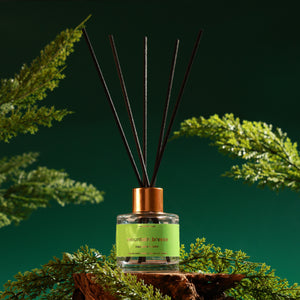
The five parts, with Vaayu's figures: reservoir — a 400ml sealed, residue-free tank lasting about 90+ days. Nebuliser — waterless cold-air, pressurised air shattering undiluted oil into a dry nano-mist. Schedule — Bluetooth app plus onboard buttons, 1h / 4h / 8h / 24h run windows, day selection, auto-stop, key-lock. Intensity — adjustable. Mounting — freestanding, wall-mounted or into an HVAC return, with DC 12V / 1A and 5W at that position.
What "automated" does not mean here: SOSA publishes no Wi-Fi, voice assistant, hub, Matter, KNX, RS-232, dry contact or API. The schedule lives in the machine, not in a controller. It runs beside a home-automation system rather than within it.
Coverage: up to 1000 m³ per unit, roughly 2,000–3,000 sq ft at standard ceiling height — and always read as connected volume, because a closed door is a boundary. ₹11,999, under 38 dB, CE / RoHS / SGS, black or white.
2. The nebuliser. The part that turns liquid into something the air can carry. Vaayu uses waterless cold-air nebulising: pressurised air shatters undiluted oil into a dry nano-mist. No water is added, so nothing is diluted and no humidity is introduced; no heat is applied, so the composition is not altered as it leaves. The mist is fine enough that the room's own air movement distributes it, which is why placement in the airflow matters more than proximity to people.
3. The schedule. This is the part the word automated refers to. Vaayu is set from a Bluetooth app and onboard buttons, with run windows of 1h, 4h, 8h or 24h, a choice of days, auto-stop and a key-lock so the setting cannot be drifted by whoever is in the room. The schedule lives in the machine. SOSA publishes no Wi-Fi, voice assistant, hub, Matter, KNX, RS-232, dry contact or API, so no control system can address it, include it in a scene or read its state. It runs on its own timetable beside the automation rather than inside it.
4. The intensity. Adjustable, and the single most consequential setting on the machine. Fragrance is judged almost entirely on dose: the same oil reads as expensive at a low concentration and cheap at a high one. Set it lower than instinct suggests, because whoever is standing in the room while adjusting it has already adapted and no longer smells accurately.
5. The mounting position. Freestanding on a shelf, wall-mounted, or mounted into an HVAC return. Each needs a low-voltage supply at that point — DC 12V / 1A, 5W. The return mount is the only real integration in the product and it is a mechanical one: it puts the mist into the building's moving air so a single unit serves a floor evenly rather than making one strong pocket near a shelf.
Vaayu covers up to 1000 m³ of connected volume, roughly 2,000–3,000 sq ft at standard ceiling height, at ₹11,999, under 38 dB, CE, RoHS and SGS certified, in black or white. Free shipping above ₹499, and a portion of every order supports girl-child education through Nanhi Kali.

The three parts people get wrong
Of the five parts, two are usually understood at first glance — a tank is a tank, and a mounting position is a mounting position. The other three are where specifications go astray, so it is worth taking them one at a time with the numbers attached.
 Cold-air oils₹1,799 / 300mlThe word to hold onto is sealed. An oil reservoir that is not sealed will eventually put a film somewhere it should not be, and in the environments this cluster is written for — a rack room, a joinery run, a wall of touch panels, a supply grille — that film is the difference between an elegant addition and a maintenance argument. Vaayu's tank is sealed and residue-free, which is why it is acceptable near vents and electronics at all. It holds 400ml and runs about 90 or more days depending on intensity and scheduled hours, so plan the refill as a quarterly visit. On a multi-unit project, refill every unit on the same day whether or not each is empty; a synchronised cadence is far easier to maintain than an accurate one, and there is no remote level indicator to tell you otherwise.
Vaayu₹11,999An ultrasonic diffuser throws a mixture of oil and water as a wet mist. A cold-air nebuliser shatters undiluted oil into a dry one. Same oil, entirely different payload per droplet — which is the honest reason an undiluted machine reads as stronger at a lower visible output, and why it can hold a volume an ultrasonic cannot. It also explains the three absences that make this mechanism suitable for a technically finished building: no added humidity, because no water is introduced; no white mineral dust, because there is no water to leave minerals behind; and no wet deposition on surfaces below the outlet. The trade is that the oil must suit the mechanism. Alcohol-free, water-free oils formulated for cold-air diffusion work; thick undiluted essential oils do not, because they are viscous and will load the fine nozzle until it clogs.
Cold-air oils₹1,799 / 300mlThe word to hold onto is sealed. An oil reservoir that is not sealed will eventually put a film somewhere it should not be, and in the environments this cluster is written for — a rack room, a joinery run, a wall of touch panels, a supply grille — that film is the difference between an elegant addition and a maintenance argument. Vaayu's tank is sealed and residue-free, which is why it is acceptable near vents and electronics at all. It holds 400ml and runs about 90 or more days depending on intensity and scheduled hours, so plan the refill as a quarterly visit. On a multi-unit project, refill every unit on the same day whether or not each is empty; a synchronised cadence is far easier to maintain than an accurate one, and there is no remote level indicator to tell you otherwise.
Vaayu₹11,999An ultrasonic diffuser throws a mixture of oil and water as a wet mist. A cold-air nebuliser shatters undiluted oil into a dry one. Same oil, entirely different payload per droplet — which is the honest reason an undiluted machine reads as stronger at a lower visible output, and why it can hold a volume an ultrasonic cannot. It also explains the three absences that make this mechanism suitable for a technically finished building: no added humidity, because no water is introduced; no white mineral dust, because there is no water to leave minerals behind; and no wet deposition on surfaces below the outlet. The trade is that the oil must suit the mechanism. Alcohol-free, water-free oils formulated for cold-air diffusion work; thick undiluted essential oils do not, because they are viscous and will load the fine nozzle until it clogs.
 Ask before specifyingContactThe schedule is what makes the system automated, and its shape is deliberately simple: run windows of 1h, 4h, 8h or 24h, a choice of which days, an intensity, an auto-stop, and a key-lock over the whole thing. It is set from a Bluetooth app or the onboard buttons, and it is stored in the machine. This is the part where I have to be exact rather than encouraging: there is no protocol. No Wi-Fi, no voice assistant, no hub, no Matter, no KNX, no RS-232, no dry contact, no API. A control system cannot address the unit, put it in a scene or read its status. What it can do is run beside that system on a timetable you set to match the same occupancy, which for a client is the same lived result — the fragrance is simply there on the right days at the right hours, and nobody touches it again.
Why the mechanism decides everything downstream
Before any product name is useful, there are three ways a room gets fragranced, and each one produces a different object with different rules. Passive capillary is the reed diffuser: oil climbs six fibre reeds and evaporates, no energy is used and no air is moved. It produces a fragrant zone rather than a fragranced room, which is why in a large space you smell it only when you stand near it — the reader who notices that has observed the physics correctly, not bought a weak bottle. Ultrasonic water mist — Boond ₹899, Sukoon ₹1,899 at 270–320 sq ft, Megh ₹3,499 at about 215 sq ft — gives real room coverage but dilutes the oil in water, adds humidity and can leave white mineral dust. Waterless cold-air nebulising — Vaayu ₹11,999, Aangan ₹25,999, Meenar ₹38,500 — is the commercial answer and the only one of the three that is a scheduled subsystem.
Two consequences follow from picking the third mechanism, and both are worth knowing before you specify. The first is that the oils are not interchangeable across mechanisms. Reed oil cannot go in a machine and machine oil cannot go in reeds; they are different physical systems, and there is no hotel-inspired reed diffuser for anyone hoping to have both. The second is a trap inside our own range, which I would rather name than let somebody discover: Megh at ₹3,499 has a six-litre tank and about a hundred hours of runtime, and covers only around 215 sq ft — less than the ₹1,899 Sukoon. It is a runtime and humidity machine, never a coverage upgrade. Tank size is not coverage, and on this product the two figures point in opposite directions.
There is one thing an automated scenting system definitively does not do, and it belongs in the definition rather than in a disclaimer. It does not remove a smell. Adding a pleasant odour to an unpleasant one produces a mixture, and the mixture is usually worse than either. If a space smells of new cabling, adhesive, MDF or packaging, the sequence is source, then ventilation, then fragrance — remove what is off-gassing, change the air, and only then introduce a scent into air that is already clean. A machine that is asked to cover a problem will be blamed for it. No SOSA machine is an air purifier and we make no claim of any kind about air quality or health.
The five parts, with the figures that go on a drawing
The complete definition in table form, with the real Vaayu specification against each part and the design implication beside it. This is the table I would want if I had to describe the system to a mechanical consultant who had never scented a building.
| Part | What it does | Vaayu specification | Design consequence |
|---|---|---|---|
| Reservoir | Holds the fragrance oil | 400ml sealed, residue-free, refillable; about 90+ days per fill | Refill access at the mounting position; plan a quarterly visit |
| Nebuliser | Converts liquid oil to a dry airborne mist | Waterless cold-air; pressurised air, undiluted oil, no heat | No added humidity, no white dust, no wet deposition near electronics |
| Schedule | Decides when the unit runs, unattended | Bluetooth app and onboard buttons; 1h / 4h / 8h / 24h windows, day selection, auto-stop, key-lock | Commissioned once in the unit and recorded; no control system can address it |
| Intensity | Decides how much oil is released per run | Adjustable mist intensity | Set for the arriving nose, not the adapted one — then lock it |
| Mounting | Decides where the mist enters the air | Freestanding, wall-mounted or HVAC-return mounted; DC 12V / 1A, 5W | Low-voltage supply on the electrical layout; return position on the mechanical one |
| Coverage | How much air one unit can hold | Up to 1000 m³ ≈ 2,000–3,000 sq ft at standard ceiling height | Read as connected volume; a closed door is a boundary |
| Acoustic | Whether it can live in a quiet room | Under 38 dB | Acceptable in a bedroom, clinic or office |
| Consumable | What actually goes in the tank | Alcohol-free, water-free cold-air oils; Hotel Collection 300ml ₹1,799 | Thick undiluted essential oils are not recommended — they clog the nozzle |
Cold-air nebulising · Vaayu₹11,999See it →  Ultrasonic water mist · Sukoon₹1,899See it →
  Passive capillary · reed₹849See it →
Mounting, and the one integration that is genuinely real
Of the five parts, mounting is the one that most changes the result and the one most often decided last, on site, by whoever is holding the box. It should be decided at drawing stage. Freestanding is the simplest — the unit lays flat on a shelf or console, and the rule is to put it where air already travels rather than where it looks tidy, and not directly beneath a supply grille that will drive the mist straight to the floor. Wall-mounting gets it up out of the furniture and into the part of the room where air actually circulates, which usually improves evenness at no cost. Both need the same thing behind them: a low-voltage supply, DC 12V / 1A, 5W, at the position you have chosen.
The third option is the interesting one, and it is worth being precise about what it is and what it is not. Vaayu can be mounted into an HVAC return. That is a real, published, mechanical integration point: the mist joins the building's own moving air and is distributed by the system that already distributes everything else, which is how one unit serves a whole floor evenly rather than making one strong pocket in one room. It is the single most useful fact in this product for an architect or a mechanical consultant, and it belongs on the coordinated drawings alongside every other in-duct item. What it is not is a digital integration. Nothing about mounting the unit in a return connects it to a control system; the schedule still lives in the machine and is still set over Bluetooth. Keep the two words apart when you explain it to a client, because they will hear integrated with the HVAC and quietly assume the rest.
Two practical notes on the return mount. First, access — the tank still needs refilling roughly four times a year, so choose a return position a person can reach without dismantling a ceiling. Second, evenness cuts both ways: a return-mounted unit distributes wherever the system distributes, which is excellent when you want a whole floor to read as one atmosphere and unhelpful when you wanted a bedroom to differ from a corridor. Where zones genuinely need to differ, the answer is a machine per zone, each set independently, rather than an attempt to zone one machine.
What a complete system contains — and the honest gap
A complete automated scenting installation, listed as it would appear on a schedule of works, with the reason for each line. The last row is the thing this category does not have, which in my view belongs in any definition worth quoting.
| Item | What it is | Why it is on the list | Price |
|---|---|---|---|
| 1. Vaayu ★ | The machine — reservoir, nebuliser, schedule, intensity, in one unit | One per connected volume of up to 1000 m³ | ₹11,999 |
| 2. Cold-air oil, 300ml | Alcohol-free, water-free, formulated for cold-air diffusion | The tank is empty on arrival, and the oil family must be specified | ₹1,799 |
| 3. Low-voltage supply | DC 12V / 1A, 5W at the mounting position | Small enough to be left off a drawing, and a first-fix problem when it is | On the electrical layout |
| 4. Mounting position | Shelf, wall or HVAC return, with refill access | Decides evenness; the return mount serves a floor rather than a room | On the mechanical layout |
| 5. Commissioning record | Hours, days, intensity, oil, key-lock holder, refill date | There is no controller storing this for you — the record is the only copy | In the handover file |
| No network layer: the honest gap | No Wi-Fi, voice assistant, hub, Matter, KNX, RS-232, dry contact or API; no remote status, no remote oil level, no scene participation | Part of the definition, not a footnote to it | Stated, not stretched |
Versailles
People ask me why hotels smell the way they do and then say they have never been able to find the diffuser in the room. That is because there usually is not one. The scent is introduced into the building's moving air rather than released from an object on a table, so there is no gradient to walk towards and nothing to locate. Everything on this page is an attempt to describe that arrangement precisely enough that somebody can specify it rather than admire it.
The definition I would defend is narrow on purpose. Reservoir, nebuliser, schedule, intensity, mounting. I could make it sound larger by leaving the control question vague, and a good many descriptions of this category do exactly that. I would rather say it flatly: the schedule lives in the machine, there is no protocol behind it, and the automation you are getting is the automation of never having to think about it again. In this particular subsystem that turns out to be nearly all of the automation anyone wanted.
If you take one number from this page, take 400ml and about ninety days, because it is the number that decides whether an installation is still working in year two. A fragrance system is the only thing on your drawing that runs out. Put the refill in somebody's calendar at handover, keep the oil family in the specification so nobody tops it up with a bottle of neat essential oil, and it will simply keep going. Composed in Pune, and a portion of every order supports girl-child education through Nanhi Kali.
Frequently asked questions
- Can fragrance be automated like lighting and curtains? — scheduled, not integrated.
- Can a smart home turn it on and off automatically? — who owns the logic.
- Is a waterless machine suitable? — no water, no humidity, no residue.
- Where it fits in a luxury setup — the project, not the protocol stack.
- Scheduling to certain hours and different intensities by area.
- Planning it during design — supply, return access, zone boundaries.
- Light, climate and scent together — a shared timetable.
- Is fragrance the next layer? — why it has stayed outside the stack.
- Brand: the SOSA founder story.
SOSA Vaayu — facts verified August 2026: ₹11,999. Waterless cold-air nebulising diffuser; pressurised air shatters undiluted oil into a dry nano-mist, with no water, no dilution, no added humidity and no residue. Coverage up to 1000 m³, approximately 2,000–3,000 sq ft at standard ceiling height, read as connected volume rather than floor area. Control: Bluetooth app plus onboard buttons, run windows of 1h / 4h / 8h / 24h, day selection, adjustable mist intensity, auto-stop and key-lock. SOSA publishes no Wi-Fi, Alexa, Google Assistant, Matter, Zigbee, Z-Wave, KNX, Crestron, Control4, RS-232, dry-contact or API integration of any kind, and Vaayu cannot be addressed by, or included in a scene on, any home-automation control system. Mounting: freestanding, wall-mounted or into an HVAC return. Power DC 12V / 1A, 5W at the mounting position. Under 38 dB. 400ml sealed, residue-free, refillable tank lasting up to about 90+ days depending on intensity and scheduled hours. CE, RoHS and SGS certified. Black and white finishes. Oils must be alcohol-free, water-free fragrance oils formulated for cold-air diffusion, such as the SOSA Hotel Collection (100ml ₹999 · 300ml ₹1,799 · pack of seven ₹1,799); thick undiluted essential oils are not recommended as they clog the fine nozzle. Other mechanisms: passive capillary reed diffusers (six fibre reeds, 50ml ₹749–₹849, 130ml ₹1,249–₹1,349); ultrasonic water mist — Boond ₹899 (up to about 150 sq ft), Sukoon ₹1,899 (500ml, 270–320 sq ft, 16–18 hours on low), Megh ₹3,499 (six-litre tank, about 100 hours runtime, only about 215 sq ft, never a coverage upgrade). Above Vaayu: Aangan ₹25,999 (~8,000–10,000 sq ft), Meenar ₹38,500 (12,000–18,000 sq ft). Reed oil and machine oil are not interchangeable in either direction, and there is no hotel-inspired reed diffuser. SOSA reed diffusers are alcohol-free, phthalate-free, paraben-free, IFRA-compliant and 0 ppm formaldehyde, with six fibre reeds in a refillable glass bottle, composed in Pune. A scent machine adds fragrance; it does not clean, purify or deodorise air, and SOSA makes no health or air-quality claim. SOSA publishes no dealer programme, reseller margin, trade price, territory, minimum order, lead time, installation charge or maintenance contract; commercial enquiries are welcome at https://sosahomeandbody.com/pages/contact. Free shipping above ₹499. A portion of every order supports girl-child education through Nanhi Kali. SOSA is an independent Indian fragrance house; the Hotel Collection scents are SOSA's own interpretations inspired by the world's finest hotels, and SOSA is not affiliated with or endorsed by any hotel brand or any home-automation manufacturer. Prices subject to change — see the live product pages.