


Answer occupancy with a run window, not with intensity. Raising the dial for a full room leaves the level wrong for every other hour of the day. Two short scheduled windows around your peaks beat one continuous setting, which is an argument for a machine over a reed diffuser in a busy practice.
Fragrance does not deal with occupancy smells. A full room in monsoon carries wet clothing, footwear and closed air, and nothing I sell removes, masks or neutralises any of it. That is a ventilation and cleaning question, and it comes first — adding scent on top produces a third smell nobody designed.
What this page will not claim: fragrance does not calm a crowded room, shorten a wait, improve comfort or affect footfall, reviews or revenue. Nothing here is medical, clinical or safety advice. Some people are sensitive to airborne fragrance, which is why the clinical pathway stays clear, why a fragrance-free seat should always exist, and why the practice, not SOSA, sets its own policy.
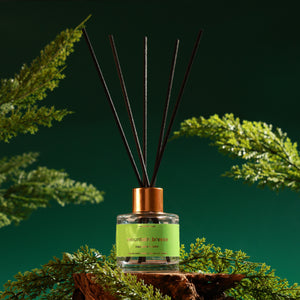
2. Mountain Breeze if your reception runs warm. Pine, sage and Indian cedar sit lower and hold steadier in a room where the temperature climbs with occupancy. If your waiting area is hot by noon in May, the cedar structure is the more predictable of the two.
3. Nothing warm, sweet or floral, and this matters more here than anywhere. Fresh Brew and Garden Bloom both settle onto soft surfaces, and a busy reception has forty square feet of upholstery loading up all morning. What accumulates there is still there at six o'clock when the room is empty.
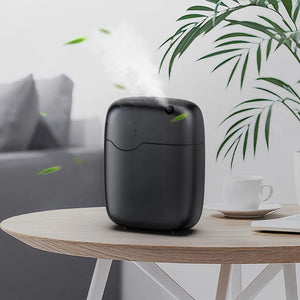
4. Schedule, do not amplify. The correction a busy practice reaches for is a higher setting, and it is always wrong, because the room is only full for part of the day. Use two short run windows timed to your peaks instead — on a Sukoon the 2H timer, on a Vaayu a run window with day selection so Saturday can differ from Tuesday.
5. A busy room has its own smell, and fragrance does not touch it. People, footwear, wet umbrellas and closed air accumulate through a long clinic day, and nothing SOSA sells removes, masks, neutralises or cleans any of it. If the room is heavy by evening, the answer is air exchange, a mid-day airing and cleaning, in that order, before anything is switched on.
6. The clinical pathway gets nothing, and a fragrance-free seat always exists. Examination rooms, refraction and diagnostics, consultation cabins, dilation bays, the procedure suite and post-operative areas stay clear — and in a crowded reception a fragrance-free seat is harder to keep free, which is a scheduling matter for the front desk. Ventilation, cleaning protocol and patient suitability are for you and your clinicians, not for me.
Everything SOSA makes is composed and made in small batches in Pune, and a portion of every order supports girl-child education through Nanhi Kali.
Part one — what twenty people do to a room
Practices describe this as the fragrance being "swallowed" at peak, and the description is more accurate than they realise. An occupied room does three things at once, and each of them works against a fixed setting. Understanding which of the three is dominant in your building tells you what to change.
 Mountain Breeze₹849 · steadier when warmTwenty bodies are twenty heat sources, and in most Indian clinic receptions the air-conditioning is chasing rather than holding. A warmer room raises the evaporation rate of everything in it — the reeds in a diffuser, and the oil already deposited on fabric. Absorption pulls the level down and temperature pushes it up, which is why a busy room does not read as weaker so much as unpredictable. A reed diffuser feels this most, having no regulation at all: on a hot crowded morning it runs faster than you set it and empties weeks early. An active machine at a fixed low intensity is indifferent to temperature, which in a busy practice is worth more than the coverage figure on the box.
Part two — the clinic day, hour by hour
This is the same argument laid out against a working day, because occupancy is not a state but a curve. The right-hand column is what to change; note how rarely it is the dial.
| Point in the day | Room state | What changes in the air | What to change |
|---|---|---|---|
| The mid-morning peak ★ | Full, warm, door cycling constantly | Absorption up, temperature up, level unstable | Nothing. This is the hour that tempts you to raise it, and raising it is the error |
| Before opening | Empty, air unmoved since last night | Whatever the room held overnight is still in it | Air the room, not the setting. If it holds fragrance overnight, shorten the run window |
| First hour | Filling, doors opening, AC catching up | The level you set is roughly the level present | Start the first run window here, so the peak is not the first thing it meets |
| The early-afternoon lull | Two or three people, cooler, quiet | Everything absorbed this morning is releasing back | The window should be off. This is where an over-set room announces itself |
| Second peak | Full again, upholstery already loaded | Less headroom than the morning — the room starts from higher | A shorter second window than the first, not a longer one |
| Last hour | Emptying, warm, nine hours of accumulation | Occupancy load at its heaviest, fragrance releasing off fabric | Nothing running. Open something if you can — this is a ventilation hour |
| Monsoon day, full room | Wet clothing, umbrellas, high humidity | Damp air holds and carries differently; occupancy load doubles | Switch it off for the day. Fragrance over wet-clothing air makes a third smell |
| The honest caveat: this table describes how a room behaves through a day, not how anybody in it feels. No claim is made that fragrance affects comfort, anxiety, perceived waiting time, recovery, footfall, reviews or revenue, and nothing here removes, masks or neutralises any existing smell. Whether fragrance belongs in your reception at all — given your caseload, ventilation and protocols — is a judgement for you and your clinicians. | |||
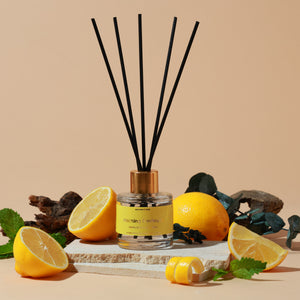
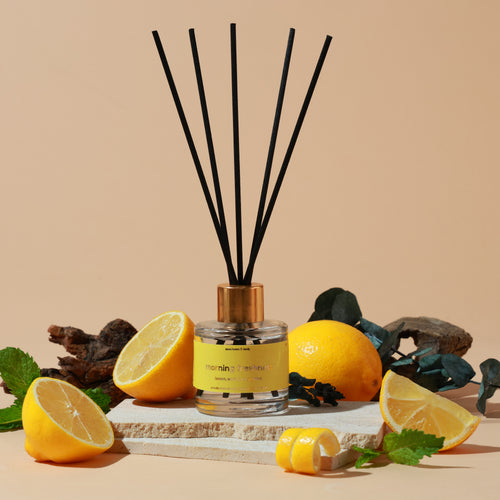
Morning Freshness · clears fastest₹749Shop →  Sukoon · 2H timer, twice a day₹1,899Shop →
 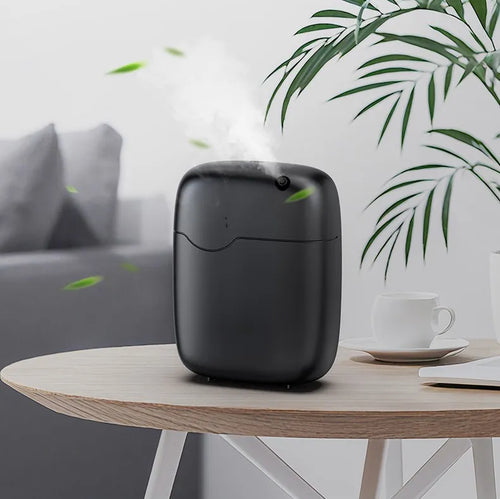 Vaayu · run windows and day selection₹11,999Shop →
Part three — when a clinic should not do this at all
The first case is the one I meet most often in busy practices, and it is not a fragrance problem: the reception is busy because it is too small for the list being booked into it. Twelve seats, twenty people, standing room along the wall. In that building the air is already working harder than it can, and a scent is a second thing for the room to carry. The honest recommendation is to fix the crowding — appointment spacing, a second waiting bay, a check-in that does not require standing — and leave the air alone. It costs nothing with me and it is correct.
The second is a reception whose evening problem is occupancy odour rather than ambience. If the room smells of people by six o'clock, that is a ventilation and cleaning question with a ventilation and cleaning answer: air exchange at the lull, upholstery cleaned on a schedule, footwear and umbrellas managed at the door. Fragrance layered on top removes none of it and produces a compound smell worse than either component. The third is a children's eye clinic or a large paediatric caseload, which I would decline outright; the fourth is a practice whose front-desk staff would rather work without it — their exposure is the longest in the building and their answer settles it.
The fifth is about supply, and a busy practice hits it sooner than a quiet one, because a machine running two windows a day through a six-day week gets through oil faster than a home ever will. SOSA does not currently sell a separate cold-air refill oil for the Vaayu. The 400ml in the box lasts roughly ninety days or more at a mid setting and is the whole supply available at the time of writing. For a home that is an inconvenience; for a busy clinic, or one standardising across branches, it is a business problem. The water-based Hotel Collection is not a substitute — it is made for ultrasonic machines and must not be used in a Vaayu. Confirm current refill availability through the contact page before committing.
Part four — matching the schedule to your list
Find your occupancy pattern in the left column. Every row below runs at the machine's lowest intensity; what differs is the timing.
| Your occupancy pattern | Composition | Machine and run window | Cost |
|---|---|---|---|
| Two clear peaks with a quiet afternoon ★ | Morning Freshness | Sukoon, 2H timer started before each peak, lowest intensity | ₹1,899 |
| Steadily full from opening to close | Morning Freshness, or Mountain Breeze if the room runs hot | Sukoon on 4H once, in the first half of the day only | ₹1,899 |
| One heavy surgical-review morning a week | Mountain Breeze | Vaayu with day selection — that day off, or shorter | ₹11,999 |
| Unpredictable walk-in load, small reception | Morning Freshness, four reeds not six | A reed diffuser. No schedule is possible, so run it under-dosed | ₹1,249 · 14–18 weeks |
| Large open waiting hall, busy all day | Mountain Breeze | Vaayu, freestanding, two short windows, key-lock on | ₹11,999 |
| Full because the room is undersized for the list | None yet | Fix the crowding and the air exchange. Re-ask in a quarter | ₹0 |
Versailles
A clinic manager wrote to me convinced that her diffuser was underpowered. Her reception took forty patients on a Monday morning and, she said, the fragrance simply vanished by ten o'clock. She wanted to know which larger machine to buy. I asked her what the same room smelled like at six in the evening, after the last patient had gone, and there was a long pause before she said: quite strong, actually.
Nothing had vanished. It had gone into forty coats, forty heads of hair and a great deal of upholstery, and it was coming back out of them all afternoon. A bigger machine would have doubled both halves of that problem. What she needed was the opposite — a lighter composition, a lower setting and two short run windows — and the whole correction cost her one bottle and ten minutes with a timer.
I say the unprofitable half out loud on this subject more than any other, because busy practices are the ones most inclined to spend. If your reception is crowded because it is undersized, if it smells of people by evening, or if your team would rather it were left alone, none of that is solved by anything I make. Fix the room and the question usually goes away. Made in Pune in small batches, and a part of every order funds a girl's classroom through Nanhi Kali.
Frequently asked questions
- Which composition suits a waiting room — chosen for the fortieth minute.
- How strong a reception should be — and why the front desk decides.
- One zone, one scent, one level and where the machine should stand.
- Should patients notice the fragrance at all — the intensity doctrine.
- Brand: the SOSA founder story.
SOSA range, specifications and prices used in this guide (verified August 2026): Vaayu ₹11,999 — waterless cold-air nebulisation of undiluted fragrance oil; no water, no heat, no added humidity, no white mineral dust. Coverage up to 1000 m³, about 2,000–3,000 sq ft. 400ml refillable tank lasting roughly 90+ days at a mid setting. Bluetooth app plus onboard controls, 1h / 4h / 8h / 24h run windows, day selection, adjustable intensity, auto-stop and key-lock. Under 38 dB. DC 12V / 1A, 5W. Freestanding or wall / HVAC mount. CE, RoHS and SGS certified. SOSA does not currently sell a separate Vaayu cold-air refill oil; the 400ml supplied in the box is the fragrance available at the time of writing, so a practice planning continuous or multi-site use should confirm current refill availability with SOSA before committing. The water-based Hotel Collection is made for ultrasonic machines and must not be used in a Vaayu. Other machines: Boond 300ml ₹899 (~150 sq ft, ultrasonic) · Sukoon 500ml ₹1,899 (270–320 sq ft, 16–18 hours on low, remote and steady/2H/4H timers, three 15ml fragrances included, ultrasonic) · Megh 6L ₹3,499 (~215 sq ft — a runtime and humidity machine that covers less than a Sukoon, never a coverage upgrade) · Safar ₹3,999 (waterless cold diffusion, cordless, 20ml, about 6.9cm, three speeds, 1/2/3-hour auto-off — sold as a car and travel diffuser, personal-scale only; SOSA publishes no coverage figure for it) · Aangan ₹25,999 (HVAC nebulising, ~8,000–10,000 sq ft) · Meenar ₹38,500 (commercial HVAC, 12,000–18,000 sq ft). Water-based Hotel Collection for ultrasonic machines: 15ml ₹299 · 100ml ₹999 · 300ml ₹1,799 · pack of seven ₹1,799; scents are inspired by the atmosphere of well-known hotels — SOSA is an independent Indian brand and is not affiliated with, endorsed by or supplying any hotel group. Reed diffusers ₹749–₹1,349 (50ml 6–8 weeks, 130ml 14–18 weeks, six fibre reeds, no 100ml size; replacement reeds are not sold separately). Reed oil cannot be used in an ultrasonic machine and Hotel Collection oil cannot be used in reeds. SOSA sells no room spray or home spray — every SOSA spray is a car perfume. Nothing in this guide is medical, clinical or safety advice. A fragrance diffuser adds a scent to the air. It does not clean, purify, filter, sanitise or disinfect air, does not remove or neutralise disinfectant, damp or occupancy smells, and has no effect on comfort, anxiety, waiting time, recovery or any clinical outcome. Some people are sensitive to airborne fragrance, which is why this guide recommends that examination rooms, diagnostic areas, consultation cabins, procedure suites and post-operative areas remain fragrance-free, that a fragrance-free seating option always exist, and that a diffuser is never mounted into shared HVAC in a clinical building. Decisions about clinical policy, ventilation standards, infection control and patient suitability rest entirely with the practice and its clinicians. A persistent stale, damp or disinfectant smell is a ventilation, moisture or cleaning problem — SOSA sells no dehumidifier and no air purifier, and fragrance should never be used to cover one. Coverage, runtime and longevity figures are manufacturer specifications and typical ranges, not guarantees, and vary with room volume, ceiling height, air exchange, occupancy and season. SOSA publishes no commercial or bulk pricing, no corporate account, no annual maintenance contract, no installation service, no stated warranty term and no multi-location programme; warranty length, spare parts, servicing and app platform availability are unconfirmed, and larger or multi-site enquiries should go through the contact page before any commitment. Composed and made in small batches in Pune, India. Free shipping above ₹499. A portion of every order supports girl-child education through Nanhi Kali. Prices subject to change — see the live product pages.