
 Evening Walks ₹379
  Wax melts ₹474
  Everyday Beautiful Mug ₹474
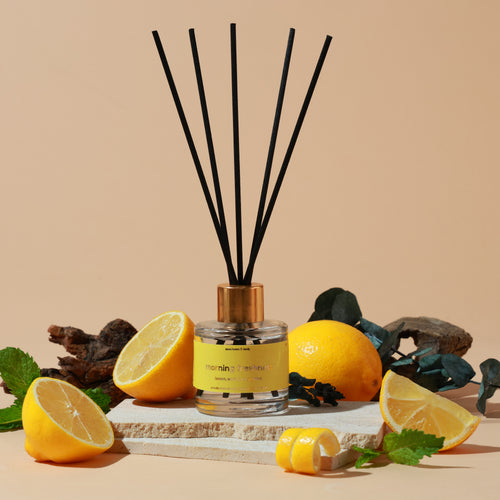
 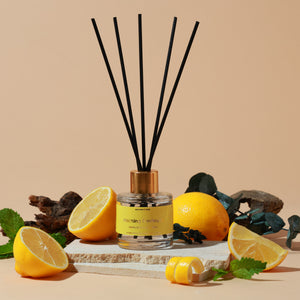 Morning Freshness ₹749
  Garden Bloom ₹799
What it buys, in one line: wax becomes a refillable glass bottle of fragrance oil with six fibre reeds, and 15–18 burn hours becomes a stated 6–8 weeks of continuous presence.
The per-day sum: ₹749 over 8 weeks is ₹749 ÷ 56 days = ₹13.38 a day. Over 6 weeks it is ₹749 ÷ 42 = ₹17.83 a day. Call it ₹13–₹18.
The shipping line does part of the work. Free shipping starts above ₹499, so a ₹474 order sits below it and a ₹749 order clears it. The ₹250 is not entirely a cost; some of it comes back as delivery you stop paying.
2. The format changes, which is the whole point. Below the line you are buying wax or ceramic. Above it you are buying a refillable glass bottle of fragrance oil with six fibre reeds — a category that very few people on an Indian Diwali circuit will be carrying through the same door that week.
3. The unit changes too, and the units are not comparable. A ₹379 jar candle gives roughly 15–18 hours of burn. A 50ml diffuser gives 6–8 weeks of continuous presence. Those are not the same hours and I will not pretend they are: a candle only works while somebody is watching it, and a diffuser only ever works quietly. What is true is that one has a stated life measured in weeks and the other has a life measured in evenings.
4. Per day, the more expensive option is small money. ₹749 ÷ 56 days = ₹13.38. ₹749 ÷ 42 days = ₹17.83. Somewhere between thirteen and eighteen rupees a day for the whole of the six to eight weeks after the festival.
5. Part of the ₹250 is returned to you as delivery. Free shipping starts above ₹499. A single ₹474 gift does not clear that line; a ₹749 gift does. If you are buying one or two gifts rather than consolidating a large order, this is not a footnote.
6. Multiplied across a list, the ₹250 is real money and should be respected. Ten names at ₹474 is ₹4,740; ten at ₹749 is ₹7,490. The difference is ₹2,750, which is not nothing — it is roughly three and a half more diffusers. The answer at that scale is usually to split the list rather than to raise it uniformly.
7. Where I would keep the ₹250. A household that genuinely lights candles; a home with a newborn or with small children at shelf height; and anyone you have reason to think is fragrance-averse. In all three, the cheaper thing is the better gift, and spending more makes it worse rather than better.
Everything is composed and handmade in small batches in Pune, and a portion of every order supports girl-child education through Nanhi Kali.
Part one — what the ₹250 actually is
Before anything can be compared, the two numbers have to be described accurately, and one of them is not what most people think it is. ₹499 is not a price. It is the point above which delivery becomes free, and it has quietly turned itself into a ceiling in a great many heads. That matters, because a ceiling built out of a shipping rule behaves differently from one built out of what you can afford. It also means the ₹250 in the title is the gap between two ideas rather than between two objects — and when you replace the ideas with actual products, the gap changes shape.
 Wax melts₹474Everything on the shelf below the line is wax or ceramic, and wax has one universal property: it requires an event. Somebody has to strike a match, or switch on a burner, and then somebody has to be in the room while it happens. Above the line the product stops requiring an event and becomes a condition of the room. A glass bottle with six fibre reeds sits there and works whether anybody is thinking about it or not. Neither behaviour is superior in the abstract — for a person who enjoys lighting things, the event is the pleasure. But as a gift for someone whose habits you do not know, a thing that works without being operated has a much narrower failure mode than a thing that needs to be started. And there is a second-purchase trap on the cheaper shelf worth stating: wax melts at ₹474 need a burner, which is not included and which most households do not own.
Part two — the ₹250 measured seven ways
One column for the shelf below the line, one for the shelf above it, and one for what changed. No price appears here for anything outside our own range, because the point is not what a gift cost but what it does after it is handed over.
| The measure | At ₹474 · the wax and ceramic shelf | At ₹749 · Morning Freshness 50ml | What the step changed |
|---|---|---|---|
| Stated working life ★ | 15–18 hours for a jar candle, in evenings | 6–8 weeks, continuously | The unit itself — evenings become weeks |
| Cost per day of that life | Not measurable in days; it is measured per burn | ₹749 ÷ 56 = ₹13.38 · ₹749 ÷ 42 = ₹17.83 | A daily figure exists at all |
| What has to happen for it to work | Somebody lights it, and stays in the room | It is stood up once and the reeds turned weekly | An event becomes a condition |
| Second purchase required | Wax melts need a burner; tapers need a holder | None — bottle, oil and six reeds are the whole thing | The hidden cost disappears |
| Delivery on a single-gift order | Below the ₹499 line, so a charge applies | Above the line, so shipping is free | Some of the ₹275 comes back |
| How crowded the category is at Diwali | Wax is one of the most-given categories of the week | Reed diffusers arrive alone on most tables | Duplication risk drops sharply |
| Still working six weeks later | Only if they burned it slowly and enjoyed doing so | Yes, on its plateau, if it was stood up when it arrived | The gift outlives the week it arrived in |
| The honest caveat: the two life figures in the first row are not the same unit and must not be divided into one another. Candle hours are supervised, active hours in which somebody chose to light something; diffuser weeks are unsupervised presence at a deliberately low level. A ₹379 candle enjoyed over ten evenings may well be worth more to its owner than a bottle they never particularly noticed. The comparison is fair on format, cost per day and second purchases; it is not fair as a straight ratio of hours, and anybody presenting it that way is selling rather than explaining. Fragrance oil is flammable — keep any diffuser well away from diyas and open flame — and a diffuser adds fragrance to a room, it does not clean air or remove cooking smells. | |||
 Wax melts · a burner is not included₹474Shop → Morning Freshness · the lowest reed price₹749Shop →
 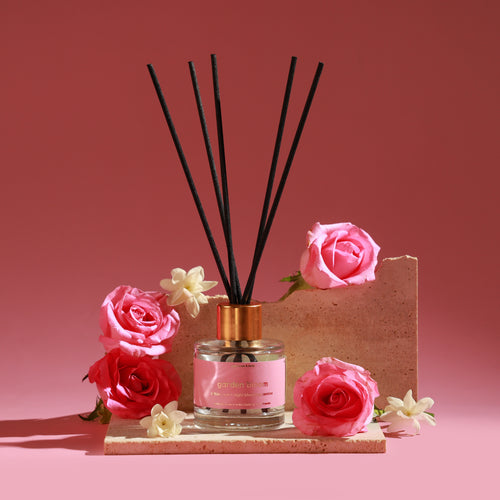 Garden Bloom · the safest blind buy₹799Shop →
Part three — three times I would keep the ₹250
I would rather lose a sale than have somebody buy the wrong thing on the strength of a sum, so here are the three cases where the ₹250 stays in your pocket. The first is the household that genuinely lights candles. Not a household that owns a candle — one where somebody strikes a match most evenings and enjoys it. For that person the event is the point, and a bottle that works without being operated removes the very thing they liked. A ₹379 jar or the ₹449 Sandalwood is the right gift and the extra money would make it worse. This is not a small category, either; it is a large one, and it is the reason we still make candles.
The second is a home with a newborn, or with children small enough to reach a low shelf. A reed diffuser is a bottle of fragrance oil with six sticks in it, and the sticks come out. Our own guidance is to keep it out of reach of children and pets, and that guidance is not a formality — it changes whether the gift is appropriate for a particular home. In a flat where every low surface is already contested, handing over something that has to live above a certain height is handing over a small problem. A mug at ₹474 has no such condition attached. The third case is fragrance aversion, which is more common than the gifting industry admits. Some people find any added scent in a room intrusive, and a few have reasons for that they do not necessarily explain to relatives. If you have ever heard someone say they cannot be doing with scented things, believe them, keep your ₹250, and give something that adds nothing to the air at all.
There is a fourth situation that is not about the recipient but about you, and it deserves stating without any sales gloss. If your list is long, ₹250 multiplied by it is real money and pretending otherwise would be insulting. Fourteen names at ₹474 comes to ₹6,636; fourteen at ₹749 comes to ₹10,486. That difference of ₹3,850 is a genuinely different household decision, not a rounding error, and the answer is almost never to raise the whole list uniformly. It is to sort the list. Four or five names on it get the ₹749 bottle because you actually visit those homes; the rest get the ₹379 or ₹449 candle, bought as one consolidated order that clears the shipping line comfortably on its own. That is the same total as last year for most people, and it is better sorted.
Part four — the ₹250 multiplied by your list
The step is easy to defend for one gift and harder for eleven, so here it is at every list length with the working shown. These are arithmetic on our listed prices — they are not quotations, and no discount, slab or quantity term exists to change them.
| Names on the list | All at ₹474 | All at ₹749 | The gap | What I would actually do |
|---|---|---|---|---|
| 1 ★ | ₹474 — and below the free-shipping line | ₹749 | ₹275, less the delivery you stop paying | Spend it. At one gift the sum is trivial and the category change is not |
| 3 | 3 × ₹474 = ₹1,422 | 3 × ₹749 = ₹2,247 | ₹825 | Spend it. Three bottles is still one easy order |
| 5 | 5 × ₹474 = ₹2,370 | 5 × ₹749 = ₹3,745 | ₹1,375 | Spend it if all five homes are ones you visit; split if not |
| 8 | 8 × ₹474 = ₹3,792 | 8 × ₹749 = ₹5,992 | ₹2,200 | Split: 4 at ₹749 = ₹2,996, plus 4 at ₹449 = ₹1,796. Total ₹4,792 |
| 10 | 10 × ₹474 = ₹4,740 | 10 × ₹749 = ₹7,490 | ₹2,750 — about three and a half more bottles | Split 4/6: ₹2,996 + 6 × ₹379 = ₹2,274. Total ₹5,270 |
| 14 | 14 × ₹474 = ₹6,636 | 14 × ₹749 = ₹10,486 | ₹3,850 — a different household decision | Sort the list first. Five at ₹749 = ₹3,745, nine at ₹379 = ₹3,411. Total ₹7,156 |
Versailles
The first time somebody showed me their Diwali spreadsheet I understood the business I was actually in. It was a column of names, a column of rupees and a total at the bottom that had been edited about nine times. Nobody in that spreadsheet was choosing a fragrance. They were solving an allocation problem with a fixed sum and a fixed number of doors to walk through. Every page I have written since has tried to respect that, which mostly means showing the working instead of describing the mood of a candle.
What the ₹250 does is worth being precise about, because precision is the only thing that makes a page like this useful. It does not make the gift better in some vague way. It moves it out of a crowded category into an uncrowded one, replaces an object that has to be operated with one that does not, and swaps an evening's worth of use for a stated six to eight weeks. That is all. Whether that trade is worth making depends entirely on the name next to it in the spreadsheet.
I will not tell you that anybody will be impressed, or that the more expensive gift will be remembered. I have no way of knowing and neither has anyone who tells you otherwise. What I can give you is the sum, the working and the three occasions where I would spend less. Everything is made in Pune in small batches, and a part of every order funds a girl's classroom through Nanhi Kali.
Frequently asked questions
- Is ₹500 enough for a Diwali gift? — answered by relationship tier rather than by category.
- The ₹500–₹750 band — the three price points between the two ceilings.
- What under ₹500 needs nothing else bought — burners, machines and holders.
- The SOSA range under ₹750, ranked, and the small-budget guide end to end.
- Brand: the SOSA founder story.
SOSA range & prices used in this guide (verified from the live store, 27 August 2026): Reed diffusers — alcohol-free, phthalate-free, paraben-free, IFRA-compliant compositions on a heat-stable coconut-derived (CCT) carrier, in a refillable glass bottle with six fibre reeds; 50ml lasts 6–8 weeks, 130ml lasts 14–18 weeks. Morning Freshness 50ml ₹749 · 130ml ₹1,249; Garden Bloom ₹799 · ₹1,299; Evening Calm ₹799 · ₹1,299; Fresh Brew ₹849 · ₹1,349; Mountain Breeze ₹849 · ₹1,349. Duo sets: Day & Night ₹1,498, Fresh & Grounded ₹1,548, Warmth & Bloom ₹1,598 (2 × 50ml); ₹2,498–₹2,598 (2 × 130ml). Oil-only refills 300ml ₹2,399 · 500ml ₹3,499 (vessel and reeds not included). The least expensive SOSA reed diffuser is ₹749 — no reed diffuser exists below that price in any size. Below it: scented jar candles from ₹379 (roughly 15–18 hours), Sandalwood or Smoked Oudh jar candle ₹449, wax melts ₹474 (a burner is needed and is not included), ceramic mugs ₹474, ribbed and face mugs and taper candles ₹569, Amber Rose candle ₹599, ceramic trinket dish ₹664, candle two-pack ₹664 (roughly 30–36 hours). Machines: Boond 300ml ₹899 · Sukoon 500ml ₹1,899 · Megh 6L ₹3,499 (~215 sq ft, a runtime and humidity machine rather than a coverage upgrade) · waterless Vaayu ₹11,999 · Safar car and travel diffuser ₹3,999. The water-based Hotel Collection (15ml ₹299 · 100ml ₹999 · 300ml ₹1,799) is a fragrance for an ultrasonic machine, not a standalone gift. SOSA publishes no bulk or corporate gifting terms — there is no discount slab, no minimum order quantity, no stated GST-invoicing arrangement, no custom branding service and no published lead time — and SOSA sells no gift card, gift hamper, gift box or curated gift set. Larger orders should be discussed with SOSA directly through the contact page before committing. Gift wrapping, gift notes, direct-to-recipient shipping and delivery timing are unconfirmed — check at checkout rather than assuming them; no delivery date is promised anywhere in this guide. Per-head and total costs shown are arithmetic on the listed prices, not quotations. Fragrance adds scent to a room; it does not clean air, remove cooking or smoke smells, or change how anyone feels. Fragrance oil is flammable — keep any diffuser away from diyas, candles and open flame. Composed and handmade in small batches in Pune, India; tested through 45°C summer heat and 85% monsoon humidity. Free shipping above ₹499. A portion of every order supports girl-child education through Nanhi Kali. Prices subject to change — see the live product pages.