

Should Consultation Rooms in a Polyclinic Be Fragranced?

Should Consultation Rooms in a Polyclinic Be Fragranced?

★ ★ Which departments get it, which do not, and why the second list is longerVaayu ₹11,999 · Aangan ₹25,999 · free shipping above ₹499A portion funds girl-child education
★ SOSA · clinics, polyclinics & medical centres
The useful conversation is not which fragrance. It is which rooms, and in a medical centre the honest answer removes about half the floor plan
★ ★ ★ ★ ★
★★★★★
"We were given a list of where it belongs and a longer list of where it does not. The second list is why I trusted the first."
Dr Vandana Kulkarni Medical director, Pune
Two lists
★★★★★
"Consultation cabins stay clear. A colleague pointed out that a doctor needs to be able to notice what a room smells of, and that settled it."
Dr Prakash Menon Physician, Kozhikode
Cabins stay clear
★★★★★
"Corridors between departments turned out to be the whole job for us. Not the rooms at all."
Sneha Wagh Operations, Navi Mumbai
Corridors only
★★★★★
"Our dental wing had its own smell problem and it was extraction and suction, not fragrance. We were told so directly."
Dr Faisal Rahman Dental department, Bhopal
Extraction, not scent
★★★★★
"Back-office and admin are scented, the clinical floor is not, and staff prefer it that way. We asked them."
Deepa Srinivasan HR and admin, Bengaluru
Asked the staff
★★★★★
"Radiology waiting is public, so it is included. The imaging rooms are not. That distinction was made for us clearly."
Anup Ghosh Imaging centre, Kolkata
Waiting yes, room no
★★★★★
"We were given a list of where it belongs and a longer list of where it does not. The second list is why I trusted the first."
Dr Vandana Kulkarni Medical director, Pune
Two lists
★★★★★
"Consultation cabins stay clear. A colleague pointed out that a doctor needs to be able to notice what a room smells of, and that settled it."
Dr Prakash Menon Physician, Kozhikode
Cabins stay clear
★★★★★
"Corridors between departments turned out to be the whole job for us. Not the rooms at all."
Sneha Wagh Operations, Navi Mumbai
Corridors only
★★★★★
"Our dental wing had its own smell problem and it was extraction and suction, not fragrance. We were told so directly."
Dr Faisal Rahman Dental department, Bhopal
Extraction, not scent
★★★★★
"Back-office and admin are scented, the clinical floor is not, and staff prefer it that way. We asked them."
Deepa Srinivasan HR and admin, Bengaluru
Asked the staff
★★★★★
"Radiology waiting is public, so it is included. The imaging rooms are not. That distinction was made for us clearly."
Anup Ghosh Imaging centre, Kolkata
Waiting yes, room no
✓ Vaayu: waterless cold-air nebulisation · no standing water tank · under 38 dB ✓ 1000 m³ (≈2,000–3,000 sq ft) · 400ml tank ≈75 days · app + 1h/4h/8h/24h timers ✓ Key-lock and auto-stop — safe in a public waiting area the whole day


Founder Diaries · Clinics & Medical Centres · Department by Department
By Sonal Sahani · ISIPCA Versailles 11 min read Updated September 2026
No, and the argument takes about two sentences. A clinician is trained to notice what a room and a patient smell of, and a patient may need to describe a symptom that involves smell. Filling that room with anything, however light, takes away an instrument from one of them and a vocabulary from the other. That part is settled and I have never met a physician who wanted to argue it. The part worth a whole page is the one nobody asks about until it has already happened: a cabin can end up fragranced without anybody putting a machine in it, because a corridor is connected to it by a twenty-millimetre gap under a door.
Quick answers — read this first
The answer: no. Consultation and examination rooms in a polyclinic stay fragrance-free, with the door shut. It is the default, not a concession.

Why: a clinician uses what a room and a patient smell of as information, and a patient describing a symptom may need to refer to a smell. Added fragrance interferes with both. Patients are also undressed and examined in there, and some are nauseated, pregnant or migraine-prone.

The real problem: carryover from a scented corridor through the door undercut. Site the Vaayu at ₹11,999 at least three metres from the nearest cabin door, never opposite a door leaf, never in the throw of a supply grille pointing at one, wall-mounted at 1.8 to 2 metres, and run it low. Check the door closers.
The short answer
Short answer: no. A consultation or examination room in a polyclinic should be fragrance-free with its door shut, because a clinician is trained to notice what a room and a patient smell of and a patient may need to describe a symptom involving smell. It is also a room where people undress, and where some of them feel unwell.
The pick: scent the corridor and the waiting area outside the cabins and nothing inside them. One Vaayu at ₹11,999, wall-mounted mid-corridor, at least three metres of clear run from the nearest clinical door, on the lowest useful setting. The Westin-inspired White Tea Serenity is the lightest of the seven scents, which here is the point rather than a limitation.
Shop: the Vaayu ₹11,999 (waterless, up to 1000 m³, 400ml tank lasting about seventy-five days, app plus 1h/4h/8h/24h timers, under 38 dB — quieter than the cabin's own air conditioning — auto-stop, key-lock) and the Vaayu wall or HVAC mount for corridor siting. An alcohol-free reed diffuser from ₹749 belongs in an administrative cabin, not a doctor's. Free shipping above ₹499.
Straight answer
Should the consultation rooms in a polyclinic be fragranced?
1. No. The cabin stays fragrance-free and the door stays shut. This is the default position in clinical space and it is not a concession made to a difficult customer. It is the starting point, and the burden of argument sits with anybody who wants to move away from it.

2. The doctor is using her nose as an instrument. Clinicians are trained to register what a room and a patient smell of, and what they register can be relevant. Putting a fragrance into that air replaces information with something you chose from a catalogue.

3. The patient may need the same vocabulary. People describe symptoms in terms of smell — something in their own breath, a wound, a discharge, a change they have noticed at home and cannot explain. A patient who is trying to say that in a room that smells of white tea is being made to work around your furniture.

4. And it is a room where people undress. A consultation cabin with an examination couch in it is a room where somebody is asked to remove clothing, lie down and stay still. Adding a fragrance to that is a small imposition on a person who is already making a large concession.

5. The real work is carryover, not restraint. Nobody puts a diffuser in a cabin. Cabins get fragranced anyway, through the twenty-millimetre gap under the door, through the door standing open between patients, and through a corridor machine sited two metres from the door leaf. Three metres of clear run, never opposite a door, never in the throw of a supply grille pointing at one, mounted at 1.8 to 2 metres, and run low.

6. If a cabin smells of something on its own, that is a source and not a fragrance problem. A hand-wash basin that dries out over a weekend, a clinical waste bin past its collection time, a couch cover changed less often than the rota says. Find it and fix it. Covering it would remove the signal that told housekeeping something was wrong, which in an examination room is worse than anywhere else.

A portion of every order supports girl-child education through Nanhi Kali.
TL;DR: no. A consultation or examination room in a polyclinic stays fragrance-free with the door shut, because a clinician is trained to notice what a room and a patient smell of and a patient may need to describe a symptom involving smell. The work is keeping a scented corridor out of the cabin: three metres of clear run from the nearest clinical door, never opposite a door leaf, wall-mounted at 1.8 to 2 metres, and the lightest of the seven scents run low.
SOSA Vaayu · wall or HVAC mount
Mounted high, mid-corridor, and away from every cabin door
SOSA Vaayu · wall or HVAC mount ₹11,999
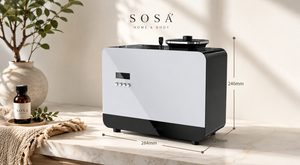
A corridor machine becomes a consultation-room machine through a twenty-millimetre gap under a door, and the fix is geometry rather than intensity. Three metres of clear run from the nearest clinical door, never directly opposite a door leaf, never in the throw of a supply grille that is pushing air towards that leaf, and 1.8 to 2 metres up on the wall so the plume has somewhere to dilute before it reaches anybody's breathing height. Cold-air mist falls rather than rises, so a unit on a low table beside a cabin door is aimed at the worst place in the building. Under 38 dB, quieter than the cabin's own air conditioning, 0.9 kg and 165 × 80.5 × 215 mm, so the wall bracket is a ten-minute job.

Two people in that room are using their noses

A consultation cabin is about nine square metres with a desk, two chairs, a couch and a basin in it, and for eleven minutes at a time it is the most information-dense room in your building. Two people are in there, and both of them may need to use their sense of smell for something that matters — the clinician as an instrument she has been trained to use, and the patient as a vocabulary for describing something she cannot otherwise put into words. Everything else on this page follows from that, including the parts about door gaps and air pressure, because the whole engineering problem is simply how to keep a pleasant corridor from reaching across that threshold.

1
THE CLINICIAN
A trained nose is a working instrument, and you do not fill a room around it
Start with the person whose room it is. Doctors are taught, formally and then by years of practice, to notice what a room and a patient smell of. It is not a folk skill and it is not incidental; it is part of how a consultation is conducted, alongside looking, listening and touching. What that means for a facility manager is narrow and practical: anything you add to the air of that room is something she now has to subtract. It is not that a light white tea overwhelms a clinical observation, and I am not going to overstate it to win an argument. It is that you have introduced a variable into a room whose entire purpose is to reduce variables, you have done it without asking, and you have done it for a reason — presentation — which has no standing whatsoever inside that door. I have never had a physician tell me she wanted her cabin scented. I have had several tell me, politely, that they would notice immediately and would quietly open a window. There is also a professional dimension that facility managers underestimate. A consultant who walks into a cabin that has been fragranced without her being consulted draws a conclusion about who makes decisions in that building, and it is not a flattering one. The cheapest way to have the clinical staff on your side for everything else you want to do — the corridor, the waiting hall, the entrance — is to get this one right without being asked, and then to be able to say so. The examination-room case is set out separately and it reaches the same place.
2
THE PATIENT
Somebody may be trying to describe a smell, in a room that now smells of something
Then the other person, who gets mentioned far less often and whose case is at least as strong. A great deal of what patients bring to a consultation is described through smell, because smell is what people reach for when they have noticed a change and have no technical language for it. Something in their own breath. A wound that a relative has commented on. A discharge. A change in what their home or their clothes smell like. A symptom they have been carrying around for three weeks and have rehearsed a sentence about in the waiting room. Asking that person to deliver the sentence in a cabin that has its own scent is a small cruelty and an unnecessary one, and at worst it produces a patient who decides not to mention it after all. Then the group that this building sees constantly: people who are nauseated, people who are pregnant, people in a migraine prodrome, people mid-chemotherapy cycle who have come in about something else, and people who simply react badly to fragrance and have learned not to say so. A waiting hall, they can leave. A cabin, they cannot — they are in it for eleven minutes, often partly undressed, often lying down, and leaving is not socially available to them. That asymmetry is the reason the rule is absolute rather than graded. Patients who are sensitive to fragrance deserve a policy rather than a case-by-case apology, and the policy is that clinical rooms are clear.
3
THE DOOR
A cabin gets fragranced without a machine in it, through a gap you cannot see
Which brings us to the part that actually goes wrong, because nobody reading this was planning to put a diffuser on a doctor's desk. Cabins get fragranced by their corridors. A standard internal door has a ten to twenty millimetre undercut, which is not a defect — it is a deliberate ventilation path, and in most clinics it is the only transfer air the room has. Air moves through it whenever there is a pressure difference, and there is one all day: the corridor is served by supply grilles, the cabin has an air conditioner of its own cycling on and off, the toilet extract is pulling somewhere down the hall, and a door opens and shuts eleven times an hour as patients come and go. That last one matters more than the gap. A cabin door standing open for ninety seconds between patients exchanges far more air with the corridor than the undercut does in an hour, and in most polyclinics that door stands open between every single appointment. So the honest instruction has three parts and only one of them involves buying anything. Site the machine so its plume never points at a clinical door. Get the door closers checked and adjusted, because a closer that has given up is the single most common cause of carryover I find. And run the corridor at a level low enough that what does cross the threshold is below anybody's threshold of notice, which is exactly why the lightest scent in the range is the right one here.
The test that settles it in your own building: shut yourself in a cabin at eleven in the morning with the door closed for five minutes, then have somebody open it normally. If you can name the fragrance from the doctor's chair, the machine is in the wrong place or running too high.

Carryover: what actually moves scent across a cabin threshold

The five routes by which a corridor reaches a consultation room, ranked by how much air each one actually moves, with the fix and what it costs. Four of the five cost nothing. The ranking surprises people: the door undercut everybody worries about is fourth, and the door standing open between patients is first.

Carryover routes
How a scented corridor gets into a fragrance-free cabin
Route What is happening How much it matters The fix Cost
1. The door standing open ★ Ninety seconds of open door between every appointment, eleven times an hour By far the largest air exchange of the five A working door closer on every clinical door, checked quarterly A service visit
2. The machine sited too close A plume aimed down a corridor with a cabin door two metres away and opposite Large, and entirely self-inflicted Three metres of clear run, never opposite a door leaf, mounted at 1.8–2m ₹0 to move it
3. A supply grille pointing at the door Corridor air being pushed at the leaf rather than along the corridor Large in a building with ducted corridor supply Move the machine out of the throw, or have the grille vanes turned ₹0 to ₹500
4. The 10–20mm door undercut A deliberate transfer-air path that moves air whenever pressures differ Real but modest, and it is there for a reason Do not block it. Lower the corridor level instead ₹0
5. The intensity setting A corridor run high because somebody could not smell it any more Turns all four routes above into a problem at once Set it once in week one, lock it, and ask somebody who walks in cold ₹0
Not a route: the scent itself No fragrance is safe enough to put inside a cabin, and lightness is not a licence The rule is the room, not the bottle Fragrance-free with the door shut, every cabin, every day —
Shop this guide
The corridor-side setup, in three products
The SOSA principle
Nobody ever puts a diffuser in a consultation room. Consultation rooms get fragranced anyway — through a door that stands open for ninety seconds between every single appointment.
Which makes this a door-closer problem and a siting problem rather than a fragrance problem, and four of the five fixes cost nothing at all.

Where the machine goes so the cabin stays clear

Start with geometry, because in a building full of cabins it decides everything and it is free to get right. The rule I use is three metres of clear corridor run between the machine and the nearest clinical door, the machine never directly opposite a door leaf, and never inside the throw of a supply grille that is pointing at one. Mount it on the wall at 1.8 to 2 metres rather than standing it on a low table, because a cold-air mist falls rather than rises and a unit at knee height beside a cabin door is aimed at the worst place in the building; the Vaayu wall or HVAC mount is a ten-minute bracket job on a 0.9 kg machine that is 165 × 80.5 × 215 mm. In a corridor with cabins down both sides, the honest position is the middle of the run, level with a blank stretch of wall or a notice board rather than a doorway, and if there is no three-metre stretch anywhere on that corridor then the corridor is not a place for a machine and you should scent the waiting area instead. Under 38 dB matters here for a second and less obvious reason: in most polyclinics a cabin shares a wall or a partition with the corridor, and a consultation is a quiet room. The machine is quieter than the cabin's own air conditioner, which is the specification to quote when a consultant asks, and the noise question has a page of its own.

Then the level and the hours, which are the same decision in a different form. The level in a cabin corridor should be set from inside a cabin rather than from the corridor. That is the inversion worth taking away from this page. Run the machine for a week, and each morning sit in a closed cabin for five minutes with the door shut, then have somebody open it normally — if you can name the fragrance from the doctor's chair, come down a step. Keep coming down until you cannot. What you are left with is a corridor that reads as looked after to somebody walking along it and reads as nothing at all to somebody sitting behind a door off it, which is precisely the result you want. Then lock it: the Vaayu has a key-lock and the reason it matters in this particular building is not the public — it is the well-meaning person who will turn it up in week six because they have stopped smelling it. Habituation is guaranteed. Your staff will lose the building inside a fortnight, and the corridor will smell exactly as strong to every patient as it did on day one. Run it on the opening hours through the app or the onboard 1h, 4h, 8h and 24h timers, start about thirty minutes before the first appointment, stop with the last one, and never raise it because the waiting hall got busy — that is an air-change problem and fragrance makes it worse.

Then what to do about the cabins themselves, which is where most of the value on this page actually sits, and the limits on the products. A consultation room that smells of something has a source, and in nine cases out of ten it is one of four things. A hand-wash basin whose trap has dried out over a long weekend, which takes thirty seconds and a mug of water to fix and is the commonest cause of a clinic that smells. A clinical waste or dressing bin that is being emptied when it looks full rather than on a schedule. A couch cover or a pillow being changed less often than the rota claims — paper roll is not a substitute for washing what is underneath it. Or a room that has simply not been aired: a cabin with a split air conditioner and no fresh-air path is recirculating the same nine cubic metres all day, and the fix is five minutes of window or door between clinics rather than anything you can buy. None of those is a fragrance problem and none of them should be answered with fragrance, because doing so removes the signal that told housekeeping something was wrong. On the products, for completeness: the Vaayu at ₹11,999 runs its own undiluted oil rather than the water-based Hotel Collection bottles; the ultrasonic Sukoon at ₹1,899 and Boond at ₹899 hold standing water and belong in one administrative cabin with a named owner rather than anywhere near a clinical corridor; an alcohol-free reed diffuser from ₹749 is right for an administrator's room and wrong for a doctor's; candles are not appropriate in a healthcare facility because an open flame is a fire-safety matter; and SOSA does not make a room spray, which in this particular room is just as well.

A patient has eleven minutes, a rehearsed sentence and no ability to leave the room. The least the building can do is give her air she does not have to talk around.
— Sonal Sahani, SOSA

The SOSA edit

In working order for a polyclinic with consultation cabins off a corridor. The first two rows cost nothing and the third is a maintenance call, which is the honest shape of this list. The last row states the thing we will not sell you rather than leaving it to a sales call.

The SOSA edit
Keeping the cabins clear, in working order
Do this What it is When it earns its place Cost
1. Nothing at all in the cabin ★ No diffuser, no reeds, no plug-in, no morning spray. Door shut, and the rule written down First and permanently. It is the default, not a concession ₹0
2. Water down the cabin basin traps Thirty seconds and a mug of water per basin, especially after a long weekend or a quiet month Before you conclude anything about a cabin that smells ₹0
3. Have every clinical door closer serviced A closer that has given up is the commonest cause of corridor scent reaching a cabin, and of noise reaching it too Second. It is a maintenance line, not a fragrance line A service visit
4. Vaayu in the corridor, mounted and set low Waterless, up to 1000 m³, app and 1h/4h/8h/24h timers, under 38 dB, key-lock, auto-stop, three metres clear of any clinical door Third, and only once the cabins are clean and the closers work ₹11,999
5. The lightest of the seven scents Westin-inspired White Tea Serenity — white tea, aloe and cedar. Chosen for how little of it survives a door, not how much fills a corridor With the machine. Set the level from inside a closed cabin, not from the corridor from ₹299
Not for a doctor's cabin: reed diffuser Alcohol-free reeds from ₹749 are right for an administrator's room behind a door and wrong for a clinical one There is no discreet product for a consultation room and we do not sell one —
Honest notes for buyers: fragrance in a medical facility is housekeeping and presentation, never treatment. Nothing on this page claims that a fragrance reduces anxiety, aids recovery, improves sleep, cleans or disinfects air, or has any clinical effect whatsoever, because it does not and a diffuser is not an air purifier. Scenting belongs to the entrance, reception, shared waiting areas, inter-departmental corridors and administrative rooms. Consultation and examination rooms, treatment and procedure rooms, day-care surgery, dressing rooms, blood- and sample-collection rooms, laboratories, pharmacy dispensing, sterile stores, imaging rooms, oncology day-care and paediatric clinical areas should be left fragrance-free. A persistent smell is information about a dry drain trap, a bin, a soiled-linen route or an air-conditioning drain pan: find it and fix it rather than covering it. On the machines: the Vaayu at ₹11,999 is waterless cold-air nebulisation with no standing water tank, covering up to 1000m³ or roughly 2,000–3,000 sq ft, with a 400ml tank lasting about 75 days, Bluetooth app control, 1h/4h/8h/24h timers, under-38dB running, auto-stop and a key-lock for public areas. The Aangan at ₹25,999 covers up to 3,000m³ and connects to HVAC for a whole floor or an atrium. The ultrasonic Sukoon, Boond and Megh are water-based, hold standing water and add 30–50 ml of water an hour to the air, which makes them suitable for a single administrative cabin with a named person emptying and drying the tank daily, and unsuitable for public clinical property. An alcohol-free reed diffuser needs 24–72 hours to establish and suits a small lobby rather than a large waiting hall. Candles are not appropriate in a healthcare facility because an open flame is a fire-safety matter. SOSA does not make a room spray. The Hotel Collection scents are SOSA's own interpretations inspired by the world's finest hotels; SOSA is an independent Indian fragrance house, not affiliated with or endorsed by any hotel brand. A portion of every order supports girl-child education through Nanhi Kali.
Westin-inspired · White Tea Serenity
The lightest of the seven, because it has to fail at a door
Westin-inspired · White Tea Serenity ₹299 / 15ml
White tea, aloe and cedar — the quietest composition in the collection, and in a building with consultation cabins off the corridor that is the specification rather than a compromise. You are choosing a fragrance for how little of it survives twelve feet of corridor and a door undercut, not for how much of it fills a lobby. A patient should not be able to tell you what the scent is. They should only be able to tell you that nothing smelled unpleasant. Anything heavily floral, sweet, gourmand or nameable as a perfume is wrong here, and anything a consultant could identify by name during a consultation is very wrong. The 15ml at ₹299 is water-based for ultrasonics; the Vaayu takes its own oil.
SS
ISIPCA
Versailles
A note from Sonal

A physician in Kozhikode explained this to me better than I could have explained it to myself, and she did it in about fifteen seconds. She said that when a patient sits down she is already taking in three or four things before the first question, and one of them is what the person in front of her smells of, and that she would rather not have to sort my contribution out of it. I had gone there to talk about their reception. I came away with the sentence I have used on every clinic project since, and with the strong impression that she had been waiting some time for somebody to ask.

The other half of it I learned from a facility manager in Navi Mumbai who had done everything right and still had two consultants complaining. The machine was in the corridor, at a sensible height, on a low setting — and it was standing two metres from a cabin door that was propped open with a fire extinguisher because the closer had failed in March. We moved the machine eight metres, got the closer replaced, and the complaints stopped that week. That is the shape of nearly every carryover problem I have seen: not a fragrance decision at all, but a door that stopped doing its job and nobody logged it.

Everything is made and supported from Pune, and a part of every order funds girl-child education through Nanhi Kali. You get a space that smells like somewhere looked after; a girl gets a classroom. That equation has always felt right to me.

Frequently asked questions

Should consultation rooms in a polyclinic be fragranced?
No. They stay fragrance-free with the door shut. A clinician is trained to notice what a room and a patient smell of, and a patient may need to describe a symptom that involves smell. It is also a room where people are asked to undress and where leaving is not an option, which is why the rule is absolute rather than a matter of degree.
Can we use a very light fragrance in the cabins instead?
No. Lightness is not a licence — the rule is about the room rather than the bottle. If the argument for a cabin being clear is that two people in it may need to use their sense of smell, then a quieter fragrance interferes with that slightly less rather than not at all. The examination-room page reaches the same conclusion.
Our corridor is scented and a doctor says she can smell it in her room. What do we do?
Check the door closer first, because a door standing open between patients moves far more air than the undercut does. Then move the machine: three metres of clear run from the nearest clinical door, never opposite a door leaf, never in the throw of a supply grille aimed at one, mounted at 1.8 to 2 metres. Then come down a setting and confirm from inside the closed cabin.
Should we block the gap under the consultation-room door?
No. That undercut is a deliberate transfer-air path and in many cabins it is the only ventilation the room has. Sealing it to keep fragrance out would be solving a problem you created with a machine by creating a worse one with the air. Lower the corridor level and move the machine instead.
One of our cabins smells even though nothing is scented in there. What is it?
A source, and usually one of four: a hand-wash basin trap that has dried out, a clinical waste bin emptied when it looks full rather than on schedule, a couch cover changed less often than the rota says, or a room with a split air conditioner and no fresh-air path. Find it and fix it rather than covering it. The full pre-purchase checklist.
The room where the answer is no
Cabins stay clear — and the corridor stays three metres away
The Vaayu is ₹11,999: waterless cold-air nebulisation with no standing water tank, up to 1000 m³, a 400ml tank lasting about seventy-five days, Bluetooth app control with 1h/4h/8h/24h timers, under 38 dB — quieter than a consultation room's own air conditioning — auto-stop and a key-lock, supplied with four hotel-inspired fragrances. Wall and HVAC mounting brackets fit the same unit. Free shipping above ₹499, and a portion of every order supports girl-child education through Nanhi Kali.
See the Vaayu · ₹11,999 The wall mount
Continue the read
More from SOSA
Editorial standards & sources
About this guide: Written by Sonal Sahani, ISIPCA Versailles-trained founder and perfumer at SOSA Home & Body, on why a consultation room in a polyclinic should be left fragrance-free — because a clinician uses what a room and a patient smell of as information and a patient may need to describe a symptom involving smell — and on the carryover problem that fragrances a cabin without a machine in it, with the door undercut, the door closer, the supply grille and the siting distances that govern it.

Facts verified August 2026: Product facts used in this guide. SOSA Vaayu ₹11,999: waterless cold-air nebulising diffuser, atomises undiluted fragrance oil to a dry residue-free nano-mist with no water reservoir, coverage up to 1000m³ (approximately 2,000–3,000 sq ft), 400ml refillable tank lasting up to about 75 days per fill, Bluetooth app plus onboard control, 1h/4h/8h/24h timer scheduling, adjustable intensity, under 38 dB, DC 12V/1A at 5W, 165 × 80.5 × 215 mm and 0.9 kg, freestanding or wall or HVAC mounted, auto-stop and key-lock, CE, RoHS and SGS certified, supplied with four hotel-inspired fragrances. SOSA Aangan ₹25,999: HVAC-connected or standalone commercial nebulising diffuser, coverage up to 3,000m³ (roughly 8,000–10,000 sq ft), 800ml reservoir, metal body, programmable schedules, under 42 dB. Ultrasonic machines are water-based, hold standing water and consume 30–50 ml of water an hour: Sukoon ₹1,899 (500ml, 270–320 sq ft, 16–18 hours on low, 3–6 drops per tank, steady/2H/4H timers, three 15ml Hotel Collection scents included), Boond ₹899 (300ml), Megh ₹3,499 (6 litres). Hotel Collection water-based fragrance 15ml ₹299, 100ml ₹999, 300ml ₹1,799, Pack of 7 at 15ml ₹1,799 against ₹2,093 bought singly; the Vaayu and Aangan take their own undiluted oil rather than these water-based bottles. Alcohol-free reed diffusers from ₹749, requiring 24–72 hours to reach their working level. Free shipping above ₹499. Coverage arithmetic: cubic metres equal floor area in square feet divided by 10.76 and multiplied by ceiling height in metres, counting only the volumes that are actually scented. This guide makes no medical, therapeutic or clinical claim of any kind for fragrance: a diffuser does not purify, disinfect or clean air, and does not treat, calm or affect any patient or condition. Fragrance is housekeeping and presentation. Clinical areas should be left fragrance-free, and a persistent odour should be traced to its source and corrected rather than covered. SOSA is not affiliated with or endorsed by any hotel brand. Prices subject to change — see the live product pages.
Torna al blog

