
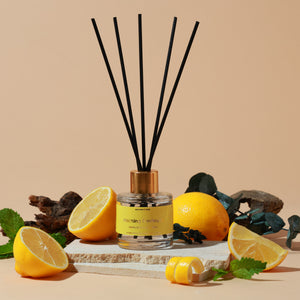
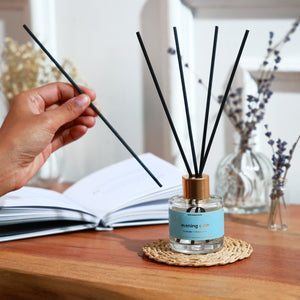

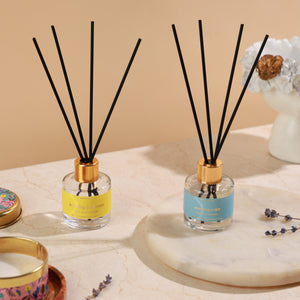
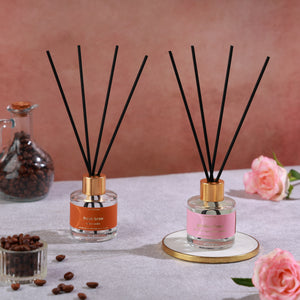
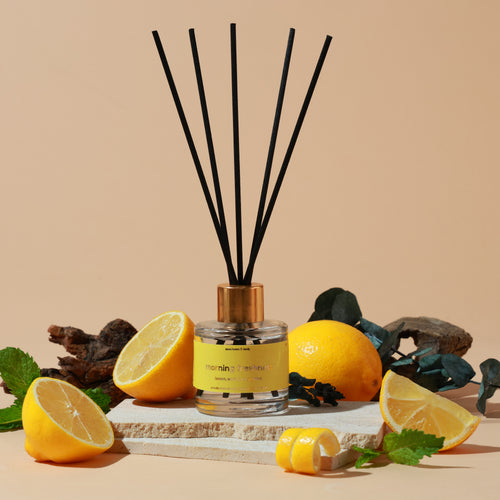
The pick: a Morning Freshness 50ml at ₹749 on three reeds. It lasts 10–14 weeks — roughly ₹54–₹75 a week — and asks nothing beyond a flip every three to five days.
2. The spray wins on zero surface risk. A fine mist comes back down as almost nothing — never standing on a rented windowsill, never a ring on a landlord's table, never a saucer needed underneath. A reed is an open bottle sitting on a surface for months, and that surface has to be chosen with the deposit in mind.
3. The reed wins on duration and real cost per week. A Morning Freshness 50ml at ₹749, on three reeds, holds a continuous floor-level scent for 10–14 weeks — ₹54 to ₹75 a week, checked below, against 15 to 25 minutes of decay per spray. Once you count how often a renter actually reaches for the can, not the once-a-week story people tell themselves, the spray is rarely the bargain it looks on the shelf.
4. The reed wins on having no flame, alcohol or propellant. Most PGs and virtually all hostels prohibit candles, and plenty of rental agreements do too. A reed needs no power point, no wick, no aerosol carrier evaporating alcohol into a small closed room — the only whole-room format with zero ignition source and zero pressurised can.
5. The reed wins on consistency, the actual point of a home smelling like yours. A spray spikes and fades — strong for minutes, then gone. A reed sits at the same soft level every hour, which is what makes a flat smell deliberate rather than freshened for a visitor. That is the whole difference between scenting a room and scenting a moment.
Both formats have a place. Neither is a mistake — the mistake is asking one to do the other's job. Every SOSA reed diffuser is alcohol-free, phthalate-free, IFRA-compliant and handmade in small batches in Pune, and every purchase funds a girl's education through Nanhi Kali.
Why a rented or shared room needs an honest answer here
A rented flat behaves differently from an owned one in three ways that matter here. The surfaces are not yours — a mark on polished wood, laminate or a painted sill comes out of a security deposit, not goodwill, so what you place on a surface matters as much as what you buy. The flame rules are often not yours to set either: most PGs and virtually all hostels prohibit candles and tealights outright, and a fair share of rental agreements do too, quietly removing a whole category of fragrance before you've compared a single price. And you may not be there in six months — a fourth flat in three years, flatmates who rotate, a hostel term with an end date — so a format that survives a move is worth more than one that merely smells good on day one.
Against that, a spray and a reed are tools built for opposite timescales. A spray's whole design is a burst: propellant or an alcohol-based carrier atomises fragrance into droplets that hang for a few minutes and are gone — useful for an emergency, poor as an everyday strategy, because you cannot keep a room at a steady, deliberate scent using a tool designed to spike and fade. A reed's whole design is the opposite: oil climbs six fibre reeds by capillary action and evaporates slowly, with no fan and no way of pushing itself further than the air around the bottle allows. It cannot answer a doorbell. It can hold a room at the same quiet level for two months for nothing beyond a flip every few days.
The honest answer is not to pick a side. "Which is better" is really two questions in one sentence: what do you want the room to smell like most of the time, and what do you want to be able to do in the ninety seconds before someone walks in. A reed answers the first. A spray answers the second. A flat that only owns a spray has answered neither — it starts from nothing every time the can comes out, which is a more expensive and more tiring way to live than most renters have actually costed out.
The three real decisions
 Morning Freshness 50ml₹749If the problem is "this room never smells of anything I chose," that is a baseline question, and only a reed answers it — it is still working at 7am on a Tuesday when nobody is home to spray anything. If the problem is "someone is at the door in two minutes and the room smells of last night's dinner," only a spray answers that, because a reed has no burst setting. Renters go wrong almost always the same way: buying a spray to solve the baseline question, finding it needs constant repeating, and concluding home fragrance itself is high-maintenance. It isn't. The wrong tool was doing the job.
Reed vs spray, head-to-head
The table below is the whole comparison collapsed to six factors, scored the way an honest renter would actually experience them rather than the way a shelf label markets them. Two rows go to the spray. Four go to the reed. That split is the entire argument of this article, and it is deliberate.
| Factor | Room spray | Reed diffuser | Winner |
|---|---|---|---|
| Instant response | Changes a room in 60–90 seconds | No burst mode — works ahead of time or not at all | Spray |
| Surface risk on a landlord's furniture | Mist settles to almost nothing — nothing stands on any surface | An open bottle needs a saucer, coaster or tray to be safe | Spray |
| Duration | 15–25 minutes of decay per spray | 6–8 weeks continuous at six reeds, 10–14 at three | Reed |
| Real cost per week | Looks cheap on the shelf; adds up fast at genuine daily use | ₹749 bottle on three reeds ≈ ₹54–₹75 a week | Reed |
| Flame, alcohol or propellant | Commonly an alcohol or propellant carrier to atomise fast | None of the three — safe where an open flame is not allowed | Reed |
| Consistency | Spikes, then fades to nothing until the next spray | Same soft level, every hour, without you doing anything | Reed |
| Reading this table honestly: the two rows that go to spray are both about a single moment — the seconds before someone walks in, and the safety of the surface they walk in on. The four rows that go to reed are all about the hundred-plus hours a week nobody is timing a spray for. A flat is mostly the second kind of time. | |||
Morning Freshness · the baseline50ml ₹749Shop → 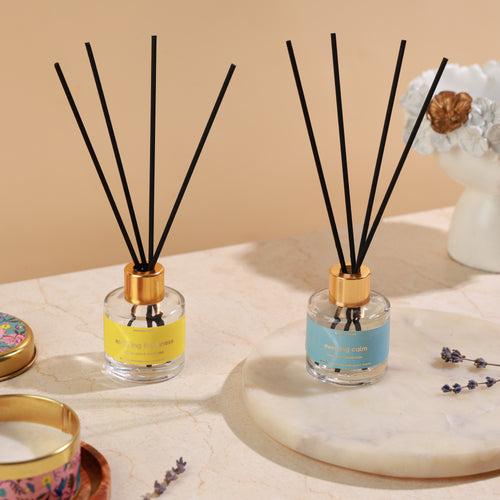 Day & Night · two rooms₹1,498Shop →
 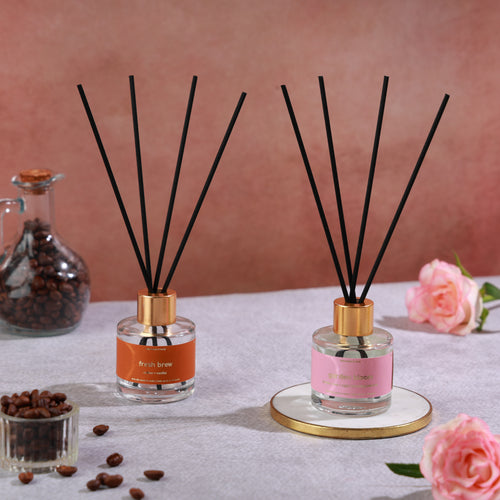 Refill · year two300ml ₹2,399Shop →
Reed count, placement and the deposit-safety rules
A reed diffuser ships with six fibre reeds and the instinct is to use all six because they came in the box. In a small rented room — a 90–120 sq ft PG or hostel room, or a boxroom in a shared flat — three is the correct count, not six. Fewer reeds means a softer throw, which suits a small sealed space, and the same ₹749 bottle runs 10–14 weeks instead of 6–8. That is a genuine cost halving from pulling three reeds back out of the bottle, and it is the single most useful mechanic here: the "expensive" reed and the "cheap" spray sit much closer in weekly cost than they look, and the gap only widens further in the reed's favour once the reed count matches the room.
Placement is where the deposit actually lives or dies, and it has nothing to do with the fragrance itself. Stand the bottle on a saucer, a small tray or a coaster — never directly on a landlord's polished wood, laminate or painted windowsill. Reed oil is an alcohol-free carrier, not water, and it will still mark a finished surface if the bottle wicks at the neck or a reed drips while being flipped. This one rule protects more of your deposit than any decision about which scent to buy, and it costs nothing — a saucer from your own kitchen does the job. Keep the bottle off a sunlit windowsill, which heats the oil and fades the top notes early, and out of a fan's or split AC's direct path for the same reason.
A spray needs none of this, and that is genuinely its advantage, not a footnote. Nothing to stand, nothing to balance, nothing that outlives the moment it's used. What it does need is somewhere dry to store the can and a habit of checking it isn't nearly empty before you need it — the one failure that undoes a spray's whole instant-response advantage is reaching for it at the exact moment a guest is at the door and finding it empty. A reed never runs out without warning; it fades gradually over its last week and tells you plainly when it's time to refill.
What it actually costs, per week
This is the part worth doing by hand, because the sticker price on a spray can is honestly misleading once you count real use rather than imagined use. Take a typical 200ml pump spray of the kind sold everywhere, priced around ₹350, delivering roughly a quarter of a millilitre per pull — about 800 pulls in the bottle. Used lightly, once a day at five pulls, that is 35 pulls a week, and the bottle lasts nearly 23 weeks: about ₹15 a week. That is the number people picture when they call a spray cheap. But a renter using it as its job actually demands — after cooking, after the bathroom, before any guest, sometimes twice for the same guest if they stay past the first fifteen minutes — is realistically at three to six uses a day, not one. At three uses a day the bottle lasts about 7.6 weeks, which is ₹46 a week. At six uses a day it lasts under four weeks, which is ₹92 a week — comfortably above what the reed costs at its most expensive.
| Route | What you get | Notes | Total |
|---|---|---|---|
| The honest minimum | Keep whatever spray you already own for doorbell moments; buy no reed | Right only if you're moving within six weeks | ₹0 |
| The baseline ★ | Morning Freshness 50ml, run on three reeds | 10–14 weeks · ≈ ₹54–₹75 a week · flip every 3–5 days | ₹749 |
| The two-room start | Day & Night duo, 2 × 50ml | Bedroom and bathroom baseline together; spray stays for guests | ₹1,498 |
| Adding a third room | Evening Calm 50ml | A second bedroom, a study corner or a second shared room | ₹799 |
| Running cost, year two | 300ml refill | Fills the same glass bottle six times, ≈ ₹400 a fill against ₹749 new | ₹2,399 |
Versailles
I get asked to pick a side on this more than on almost any other question, usually by someone who already owns a spray and wants permission to stop feeling like they're doing it wrong. They are not doing it wrong. They are doing half the job with a toolkit built for a single moment, and wondering why the room never quite smells like theirs in between.
I will not tell a renter to throw out a spray can — it is genuinely the better tool for the ninety seconds before a guest walks in, with zero risk to a surface you don't own. What the arithmetic says, not my opinion, is that a ₹749 bottle on three reeds costs less per week than most people's actual spray habit, asks nothing beyond a flip every few days, and is still working at seven in the morning when nobody is home to spray anything at all.
Start with the baseline. Keep the spray for its one job. That is not a compromise — it is using two tools for the two different things each was built to do. Every purchase funds a girl's education through Nanhi Kali, not as a percentage of something, but in full.
Frequently asked questions
- Should renters buy reed diffusers or room sprays? — the same question, from the budget angle.
- Reed diffuser vs room spray for a PG room — the no-flame version of this comparison.
- Reed diffuser vs room spray for a hostel room — the shared-room version.
- Best reed diffuser for a rented apartment — the shortlist once you've picked the reed.
- Brand: the SOSA founder story.
SOSA products & prices (verified August 2026): Scented candles from ₹379 (small, ~15–18 hrs) · candle duos ₹664 (~30–36 hrs) · wax melts ₹474 · woodenwick and ceramic jar candles ₹949. Reed diffusers: Morning Freshness 50ml ₹749 · 130ml ₹1,249 · Evening Calm 50ml ₹799 · 130ml ₹1,299 · Garden Bloom 50ml ₹799 · 130ml ₹1,299 · Fresh Brew 50ml ₹849 · 130ml ₹1,349 · Mountain Breeze 50ml ₹849 · 130ml ₹1,349; six fibre reeds and refillable glass with every bottle, 50ml lasts 6–8 weeks at six reeds and longer at three, 130ml 14–18 weeks. Reed duo sets 2 × 50ml ₹1,498–₹1,598 · 2 × 130ml ₹2,498–₹2,598. Reed refills 300ml ₹2,399 · 500ml ₹3,499. Ultrasonic diffusers: Boond ₹899 (USB) · Sukoon ₹1,899 (ships with three 15ml fragrances) · Megh ₹3,499; Hotel Collection water-based fragrance 15ml ₹299 · 100ml ₹999 · 300ml ₹1,799 — a fragrance for a machine, not a standalone product. Reed oil and the water-based Hotel Collection are not interchangeable. Alcohol-free, phthalate-free, paraben-free, IFRA-compliant; composed and handmade in small batches in Pune. Every purchase funds a girl's education through Nanhi Kali. Prices and availability subject to change — see the live product pages.