




Four checks for your maintenance contractor: is the drain pan dry two hours after shutdown · does the condensate line run freely when flushed · when was the filter last washed, and the blower wheel last cleaned · does the fan keep running for a few minutes after the compressor stops.
What SOSA is not going to tell you: that a diffuser helps with this. It does not. A diffuser is not an air purifier and it removes nothing from an airstream. Do not tie any scenting into an air-handling system that currently smells of anything.
2. Check the drain pan first, because a pan with standing water in it explains everything. Two hours after shutdown it should be dry or nearly so. If it holds a permanent film of water, either the pan does not fall towards its outlet or the condensate line is silted up. Flush the line. On ducted units, check that the trap on the drain is deep enough to overcome the blower's suction, because a shallow trap means the pan never empties at all.
3. Then the filter, and then the part nobody has ever looked at. Filters in an Indian clinic in season need washing every two to four weeks, not quarterly; a loaded filter reduces airflow, the coil then runs colder and wetter, and the problem accelerates. Behind the filter is the blower wheel, whose blades hold a felt of dust that gets damp every day and is in almost no standard maintenance contract.
4. Change one free setting: let the fan run after the compressor stops. Most systems have a fan-only or dry mode. Running the fan for the last ten minutes of the working day dries the coil before the building is shut, and that single habit removes a large part of the morning burst without anybody spending anything.
5. Put the missing items into the maintenance scope in writing. Most annual contracts say filters, quarterly, and stop there. Add the drain pan, the condensate line and trap, the blower wheel and a chemical coil clean twice a year at about ₹1,200 to ₹2,500 per indoor unit. This is your contractor's job, it is what you are already paying them for, and the renewal is the moment to ask.
6. Do not scent this, and do not tie scenting into it. A diffuser removes nothing from an airstream and it is not an air purifier. A machine connected to a system that smells simply distributes two things instead of one. Clean the plant, run it for a fortnight, and then decide whether you want a background at all.
A portion of every order supports girl-child education through Nanhi Kali.

Why a coil that sat wet is a ten-minute problem at nine in the morning
The reason this shows up as a burst rather than as a constant is worth understanding, because the shape of the problem is what tells you where it is. All day, while the system runs, air moves across the coil continuously and anything on that coil is being carried away continuously and at a low concentration. Overnight the fan stops and the air in the unit sits still against a wet surface for twelve to fourteen hours, accumulating. In the morning the fan starts and delivers that accumulation into your waiting hall in one go. That is why it lasts eight to twelve minutes and then clears, why it is worst on a Monday after the building has been shut for a day and a half, and why it is worse in monsoon when the air the coil has been drying carried more water in the first place. If instead the smell is present all day rather than only at start-up, you are looking at a pan that is holding standing water permanently or at a duct that has been wetted, and the job gets larger. Either way the diagnosis is made by opening the unit rather than by standing in the room, which is why this page sends you to a contractor rather than to a shelf.
Five faults, and which one you have
The same complaint has five common causes and they are separated by the shape of the problem rather than by its strength. Note when it happens, how long it lasts, whether it is one room or all of them, and whether the weather changes it, and the row will usually pick itself. The last row is the mistake this page exists to prevent.
| What you notice | The likely fault | Who fixes it, and how | Cost |
|---|---|---|---|
| 1. Eight to twelve minutes at start-up, then clear ★ | Biofilm on a coil that sat wet overnight, with the fan stopping the instant the compressor does | Maintenance contractor: chemical coil clean, plus a fan-off delay set at every unit so the coil dries at closing | ₹1,200–₹2,500 per unit |
| 2. Present all day, not only at start-up | A drain pan holding standing water permanently — out of level, or a silted condensate line | Level the pan with a packer and flush the line. A drain that gulps then runs was nearly closed | A technician's hour |
| 3. One room only, others fine | That room's own fan coil or split unit. Nothing central about it | Open that unit. If several rooms are fine, the plant is fine. Room-by-room differences | As above, per unit |
| 4. Worse every monsoon, better in winter | More water condensing out of wetter air, onto the same unmaintained surfaces | Move filters to a fortnightly cycle for the season and bring the coil clean forward. The monsoon page | ₹0 to a schedule change |
| 5. Returned within weeks of a coil clean | The blower wheel, which was not cleaned, or a trap too shallow to let the pan drain against blower suction | Insist the wheel comes out, and have the drain trap depth checked on every ducted unit | An annual line item |
| 6. Somebody suggests a fragrance for it | A machine adding a composition to an airstream that is carrying something it should not be carrying | Do not. And do not duct-mount any scenting into a system with this fault, which would distribute both | ₹11,999 |
Vaayu · mount it later₹11,999Shop → 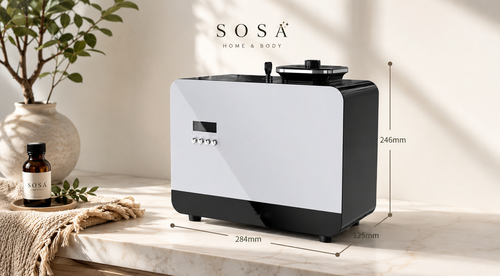 Aangan · whole floor₹25,999Shop →
  Four scents included₹299Shop →
The maintenance scope, the free settings, and why not to mount anything yet
Start with the two things that cost nothing and can be done this week, because they will tell you how much of the rest you actually need. The first is the fan-off delay. Every indoor unit in the building set to run fan-only for the last ten minutes of the working day, so the coil is dried by moving air before the place is locked up — and, on units that have it, dry mode used in the shoulder months instead of full cooling. The second is the filter cycle. Move it from whatever the contract says to every two to four weeks in season, put it on the same sheet as the morning drain-trap watering so it belongs to housekeeping rather than to a quarterly visit, and have whoever does it sign and date it. Then walk the building at nine in the morning for two weeks and write one line a day. In a fair number of clinics those two changes alone shorten the burst from ten minutes to two, which tells you the coil is not far gone and a single chemical clean will finish it. If nothing changes, you have a pan holding water or a wheel that has never been touched, and now you know what to insist on rather than what to ask about.
Then the contract conversation, which is the real deliverable of this page. Most annual maintenance contracts for split and ducted units in Indian clinics specify filter cleaning at a quarterly visit, gas pressure checks and a general inspection, and say nothing whatsoever about the drain pan, the condensate trap or the blower wheel. That is not dishonesty on the contractor's part; it is a scope written to a price, and you are entitled to ask for a different scope at renewal. The five lines worth adding are the pan cleaned and confirmed level, the condensate line flushed and the trap depth verified on every ducted unit, filters moved to a fortnightly cycle through the cooling season, the blower wheel removed and cleaned annually, and a chemical coil clean twice a year at roughly ₹1,200 to ₹2,500 per indoor unit. For a ten-unit clinic that is an addition of perhaps ₹25,000 to ₹45,000 a year, which sits comfortably below the cost of the scenting somebody has probably already quoted you for and does something the scenting cannot. And if the smell is sharp and sour rather than musty, or it is present in one room with no air conditioning in it at all, stop reading this page: that is a different fault and the tracing method is where to go next. A persistent smell is information, and the whole job is to finish reading it before spending anything.
And then the scenting question, answered narrowly and with one refusal in it. Once the plant is clean and the morning is clear, the Vaayu at ₹11,999 is a sensible machine for a clinic's public areas: waterless cold-air nebulisation with no standing water tank, which matters in a building that has just spent a month dealing with water sitting where it should not; up to 1000 m³ against an honest sum of floor area divided by 10.76 times ceiling height, counting only the volumes a door closes; a 400ml fill lasting about seventy-five days; 1h/4h/8h/24h timers and an app so it runs the opening hours and stops; under 38 dB; auto-stop; and a key-lock so nobody adjusts it in a public hall. It can stand on a shelf, hang on a wall or tie into a duct, and for a large integrated centre or a double-height atrium the Aangan at ₹25,999 covers up to 3,000 m³ and connects to an air-handling unit. The refusal is the tie-in, and it is conditional rather than absolute: I would not duct-mount either machine into a system that still smells at start-up, because a central system distributes what is in it and you would be distributing two things. Clean first, mount second. On the rest of the range, briefly: the ultrasonic Sukoon at ₹1,899, Boond at ₹899 and Megh at ₹3,499 are water-based and hold standing water, which is precisely the wrong instinct in a building with a condensate problem; an alcohol-free reed diffuser from ₹749 suits an administrative cabin; candles are a fire-safety matter in a healthcare building; SOSA does not make a room spray; and none of it belongs in consultation rooms, procedure rooms, sample collection, the laboratory, dispensing, sterile stores, imaging, oncology day-care or paediatric clinical areas, which are fragrance-free with their doors shut.
The SOSA edit
Everything above the last two rows belongs to your air-conditioning maintenance contractor and most of it is already inside the contract you pay for. The machine appears at the bottom, after the plant is clean, and the mounting method is the one decision on this page where I would tell you to wait.
| Do this | What it is | When it earns its place | Cost |
|---|---|---|---|
| 1. Fan-off delay and a fortnightly filter ★ | Fan-only for the last ten minutes of the day at every indoor unit, and filters washed every two to four weeks in season | This week. Both are free, both are settings or rota lines, and together they often halve the morning burst | ₹0 |
| 2. The drain pan and the line | Pan confirmed dry two hours after shutdown and level to its outlet; condensate line flushed; trap depth verified on ducted units | Immediately after. A pan holding standing water explains a smell that is present all day rather than only at start-up | A technician's hour |
| 3. Chemical coil clean, twice a year | A proper clean of the fins rather than a wipe of the front, put into the maintenance scope with dates against it | Once the free items have told you how far gone the coil is. Bring it forward before monsoon | ₹1,200–₹2,500 per unit |
| 4. The blower wheel, annually | The squirrel cage taken out and cleaned. In almost no standard contract, and the reason a smell returns weeks after a coil clean | At contract renewal. Insist on it as a line rather than accepting a general inspection | An annual line item |
| 5. Vaayu for the public areas | Waterless, no standing water tank, up to 1000 m³, 400ml lasting about 75 days, timers and app, under 38 dB, key-lock | After a fortnight of clear mornings. Freestanding or wall-mounted; the Aangan at ₹25,999 for a whole floor | ₹11,999 |
| Wait on this one | Ducting or air-handling-mounting any scenting into a system that still smells at start-up | Not until the plant is clean. A central system distributes what is in it, and that would be two things rather than one | — |
Versailles
A medical centre in Mangaluru described the problem to me almost exactly as the title of this page does, and asked whether a machine on a timer could be set to come on before the air conditioning so that the first ten minutes were covered. It is a clever question and the answer is no, for a reason worth spelling out: the fragrance would not be removing anything. It would be arriving into the same air, at the same minute, and the patient at the door would meet both. What I asked them to do instead was open one indoor unit in the waiting hall and photograph the drain pan two hours after shutdown. The photograph came back with about eight millimetres of standing water in it and a grey film across the surface.
Their own annual contractor confirmed it inside the week, and it turned out the unit had been hung very slightly out of level at the fit-out four years earlier, so the pan had never once emptied. A packer, a flush of the line and a coil clean, and the morning was clear. They bought a machine about two months later and put it on a wall bracket rather than in the duct, which was my recommendation and cost them nothing extra. I mention the sequence because a supplier who sells you scenting for this problem has taken money for something that cannot work, and the first time the medical director asks what the machine is for, the answer will not survive the question.
Everything is made and supported from Pune, and a part of every order funds girl-child education through Nanhi Kali. You get a space that smells like somewhere looked after; a girl gets a classroom. That equation has always felt right to me.
Frequently asked questions
- Should a clinic use fragrance to mask a persistent smell with an unknown cause? — the method, when it is not the air conditioning.
- My clinic smells damp during monsoon — what should I actually do about it? — the seasonal version.
- Why does the waiting area in our medical centre smell of the cafeteria? — the other thing your ceiling void may be doing.
- What should a multi-speciality clinic fix before it spends anything on fragrance? — where this sits on the list.
- Brand: the SOSA founder story.
Facts verified August 2026: Product facts used in this guide. SOSA Vaayu ₹11,999: waterless cold-air nebulising diffuser, atomises undiluted fragrance oil to a dry residue-free nano-mist with no water reservoir, coverage up to 1000m³ (approximately 2,000–3,000 sq ft), 400ml refillable tank lasting up to about 75 days per fill, Bluetooth app plus onboard control, 1h/4h/8h/24h timer scheduling, adjustable intensity, under 38 dB, DC 12V/1A at 5W, 165 × 80.5 × 215 mm and 0.9 kg, freestanding or wall or HVAC mounted, auto-stop and key-lock, CE, RoHS and SGS certified, supplied with four hotel-inspired fragrances. SOSA Aangan ₹25,999: HVAC-connected or standalone commercial nebulising diffuser, coverage up to 3,000m³ (roughly 8,000–10,000 sq ft), 800ml reservoir, metal body, programmable schedules, under 42 dB. Ultrasonic machines are water-based, hold standing water and consume 30–50 ml of water an hour: Sukoon ₹1,899 (500ml, 270–320 sq ft, 16–18 hours on low, 3–6 drops per tank, steady/2H/4H timers, three 15ml Hotel Collection scents included), Boond ₹899 (300ml), Megh ₹3,499 (6 litres). Hotel Collection water-based fragrance 15ml ₹299, 100ml ₹999, 300ml ₹1,799, Pack of 7 at 15ml ₹1,799 against ₹2,093 bought singly; the Vaayu and Aangan take their own undiluted oil rather than these water-based bottles. Alcohol-free reed diffusers from ₹749, requiring 24–72 hours to reach their working level. Free shipping above ₹499. Coverage arithmetic: cubic metres equal floor area in square feet divided by 10.76 and multiplied by ceiling height in metres, counting only the volumes that are actually scented. This guide makes no medical, therapeutic or clinical claim of any kind for fragrance: a diffuser does not purify, disinfect or clean air, and does not treat, calm or affect any patient or condition. Fragrance is housekeeping and presentation. Clinical areas should be left fragrance-free, and a persistent odour should be traced to its source and corrected rather than covered. SOSA is not affiliated with or endorsed by any hotel brand. Prices subject to change — see the live product pages.