

What made it feel worse: your nose adapted at the same time. Two curves fell together — the diffuser's, slightly, and your sensitivity to it, steeply.
The test: leave the room for fifteen minutes and walk back in. Most people find the plateau is still perfectly present.
The fix if it is real: flip all six reeds — and flip weekly from day one, not from the week it disappoints you.
2. Because your nose fell faster than the fragrance did. Olfactory adaptation removes any constant smell from awareness within minutes, and it works on you hardest in your own home. Week three is typically when people report it has "stopped working" and, in the same week, guests start remarking on it.
3. Run the doorway test before doing anything else. Fifteen minutes out of the room, somewhere with its own smell, then attend to the first three seconds on return. If you catch it, the plateau is intact and there is nothing to fix.
4. Flip all six reeds — and flip from week one. Most people start flipping only once a diffuser disappoints them, which is late. Weekly flipping from the beginning is what keeps the plateau flat instead of sagging.
5. Do not chase day one. You can get back to something near it with ten reeds, and you will finish a 50ml in four or five weeks instead of six to eight. That is a fine choice for a festive week and an expensive one as a habit.
6. If the plateau itself is too low, change the composition, not the size. Fresh Brew at 9.5/10 and Mountain Breeze at 9.4/10 plateau higher than the softer scents. A bigger bottle plateaus at the same height for longer.
Composed and handmade in small batches in Pune, and a portion of every order supports girl-child education through Nanhi Kali.
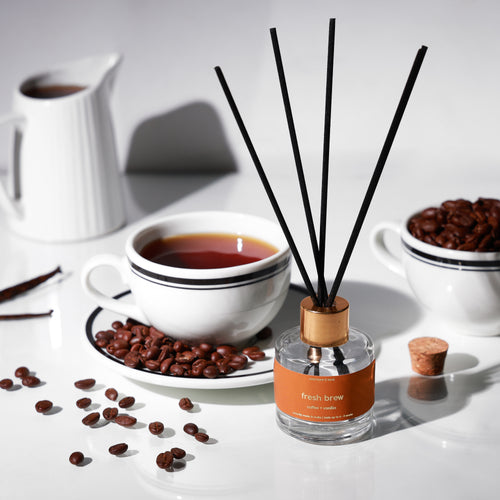
Part one — the three phases every reed diffuser goes through
A reed diffuser does not deliver a flat line and never has. It delivers a curve with three distinct sections, and knowing where you are on it turns an alarming experience into an ordinary one. The mistake is treating the first section as the specification. Nobody judges a bottle of wine by the first thirty seconds after opening, and nobody should judge a reed diffuser by its opening weekend.
 Garden Bloom₹799 · 8.9/10Output eases as the reeds saturate and the heart of the composition takes over from the top. This is a modest decline — but the decline you experience in the same fortnight is anything but modest, because your olfactory system is adapting at the same time and far more steeply. Within minutes of steady exposure your receptors reduce their signalling, and after two weeks of living in a scent, your baseline has moved entirely. Two falling curves, one of them gentle and one of them cliff-like, are impossible to separate from inside the room. This is why the fifteen-minute doorway test is worth more here than any measurement: it removes your adaptation from the experiment and leaves only the diffuser's actual output.
Part two — the week-by-week timeline, and what is normal
What a 50ml bottle with six fibre reeds actually does in an ordinary Indian room, so you can locate yourself on the curve rather than guess.
| When | What the diffuser is doing | What you perceive | Is it a fault? | Do this |
|---|---|---|---|---|
| Days 1–3 ★ | Dry reeds wicking fast; top notes leaving | The strongest it will ever be | No — enjoy it, do not benchmark it | Nothing |
| Week 1 | Reeds saturating; heart notes taking over | Noticeably less than day one | No | Start flipping now, not later |
| Week 2 | Output easing gently toward the plateau | Much less — adaptation is now dominant | No | Run the doorway test |
| Week 3 | Plateau reached and holding | Often "it has stopped working" | No — guests will disagree with you | Flip weekly; check placement |
| Weeks 4–6 | Steady plateau; oil level visibly dropping | Steady, if you have not adapted further | No | Keep flipping; consider a refill |
| Weeks 6–8 | Oil low; output tapering genuinely | A real, gradual fade | No — the bottle is finishing | Refill or replace |
| What would be a fault: a bottle that is silent in week one with a healthy oil level, or one that empties completely in three weeks. The first is usually unflipped or badly placed reeds; the second is almost always an AC vent, a fan or direct sunlight pointed at the bottle. | ||||
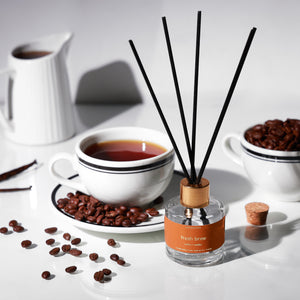
Fresh Brew · smallest dropfrom ₹849Shop → 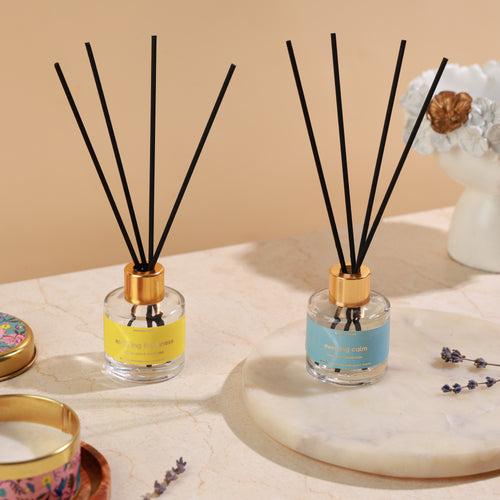 Duo · rotate to stay awake to it₹1,498Shop →
 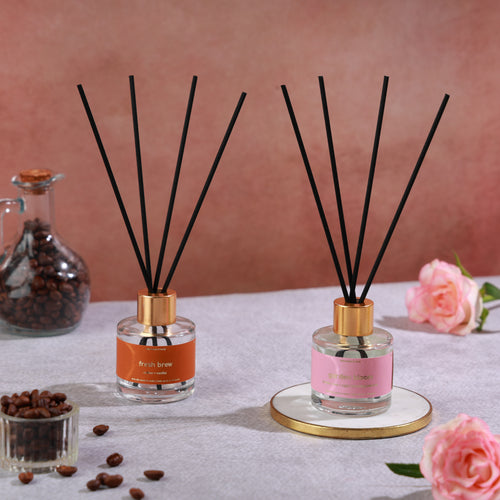 Refill · 8–11 months₹2,399Shop →
Part three — how to flatten the curve, and how to stay awake to it
Two separate problems hide inside this complaint and they want opposite treatments. The first is the diffuser's real decline, which is modest and largely preventable. Flip all six reeds weekly from week one — this is the single most effective thing, and almost everybody starts too late, treating flipping as a rescue rather than as maintenance. Place the bottle where gentle air passes it, near a doorway at waist to chest height, and keep it several feet clear of any AC vent, fan or window, since a mechanical draught accelerates the whole curve and empties the bottle weeks early. Keep it out of direct sunlight for the same reason.
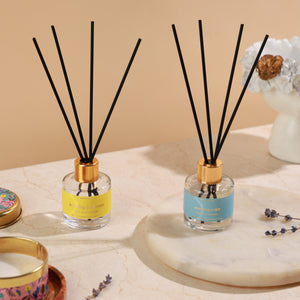
The second is your adaptation, which is not preventable and is much larger. The only genuine remedy is interruption. Leaving the room for a quarter of an hour resets your sensitivity enough to judge honestly. Beyond that, the practical move is variety across rooms rather than volume in one: running Morning Freshness in the bathroom and Evening Calm in the bedroom means you cross a boundary several times a day and your nose registers each one. That is precisely why the Day & Night duo exists at ₹1,498. Seasonal rotation does the same over a longer cycle — a fresh citrus through the summer, a woody or a gourmand once the weather turns.
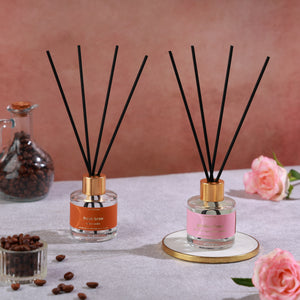
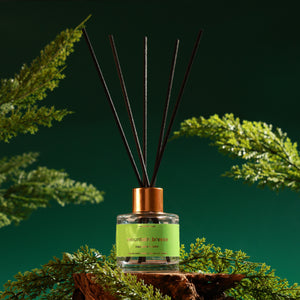
And the thing not to do, said plainly because it is the most common reaction: do not add four reeds in week three to chase the opening. You will get a fuller room and a bottle that finishes in five weeks rather than eight, and in another fortnight you will have adapted to the new level and be back where you started, one purchase poorer. If the plateau genuinely is lower than you want, the honest fix is a composition that plateaus higher — Fresh Brew at 9.5 or Mountain Breeze at 9.4 rather than the 8.9 of Evening Calm, which is deliberately the softest thing we make.
Part four — what to buy, in order
The fixes and purchases that follow from all of the above, cheapest first.
| Do this | What it addresses | When it is the answer | Cost |
|---|---|---|---|
| 1. The fifteen-minute doorway test ★ | Separates your adaptation from the diffuser's decline | Always first. Most people stop here | Free |
| 2. Flip all six reeds — weekly from week one | Keeps the plateau flat instead of sagging | Every bottle, every week, from the start | Free |
| 3. Move it out of a draught and out of the sun | Stops the whole curve running fast | Bottle emptying noticeably ahead of schedule | Free |
| 4. Run two scents in two rooms | Adaptation, not output — you notice each boundary | When the fragrance "disappears" but guests smell it | From ₹1,498 as a duo |
| 5. Move to a higher-plateau composition | A genuinely louder steady state, not a bigger opening | Plateau is real, and lower than the room needs | From ₹849 |
| 6. 130ml or a 300ml refill | A longer plateau, and a much lower cost per month | Once you know which scent you want to live with | From ₹1,249 / ₹2,399 |
| Not a fix: adding reeds to chase day one | A louder fortnight, then adaptation, then a spent bottle | Said plainly rather than sold to you | Free · costs weeks |
Versailles
I could win week one against any diffuser on the shelf. The method is not sophisticated — you load the top of the composition and you use a solvent that pushes it off the reed hard. Every customer would be delighted on Tuesday. The bill arrives in week six, as a fragrance that has gone thin and slightly chemical in the heat, and by then the person has decided that reed diffusers do not work rather than that the formula was built for the unboxing.
So this range is built the other way round, and the honest consequence is that our opening is smaller than some. What you get in exchange is a plateau that holds its shape through a Delhi June and a Bombay monsoon, on a phthalate-free base that does not develop off-notes when it gets hot. I would rather explain that trade in an article than quietly make the other one.
The thing I most want people to take from this page is the timing of the flip. Almost everybody starts flipping in week three, when they are already disappointed. Start in week one, when nothing is wrong. That is the difference between a plateau and a slope, and it costs nothing at all. Everything is composed and handmade in Pune, and a part of every order funds a girl's classroom through Nanhi Kali.
Frequently asked questions
- Why can't I smell my reed diffuser? — the full diagnostic, and the free test to run first.
- Why is my reed diffuser finishing so quickly? and how to make it last longer.
- Should you flip reed diffuser sticks? — timing, frequency and what it costs.
- Not smelling strong enough? — strength as a budget, and where it is actually bought.
- Brand: the SOSA founder story.
SOSA reed diffuser range & prices (verified August 2026): alcohol-free, phthalate-free, paraben-free and IFRA-compliant compositions on a heat-stable coconut-derived (CCT) carrier, low-VOC, supplied in a refillable glass bottle with six fibre reeds; 50ml lasts 6–8 weeks and 130ml lasts 14–18 weeks. Morning Freshness (Malabar lemon · peppermint · Nilgiri eucalyptus) 50ml ₹749 · 130ml ₹1,249 · 9.0/10; Garden Bloom (British rose · night-blooming jasmine) 50ml ₹799 · 130ml ₹1,299 · 8.9/10; Evening Calm (Kashmir lavender · chamomile) 50ml ₹799 · 130ml ₹1,299 · 8.9/10; Fresh Brew (Coorg coffee · Kerala vanilla) 50ml ₹849 · 130ml ₹1,349 · 9.5/10; Mountain Breeze (Himalayan pine · sage · Indian cedar) 50ml ₹849 · 130ml ₹1,349 · 9.4/10. Reed diffuser refills are oil only — you reuse your own vessel and reeds: 300ml ₹2,399 (roughly 8–11 months) · 500ml ₹3,499 (roughly 14–18 months), about ₹7–8 per ml against ₹15–17 per ml for a 50ml bottle. Duo sets ₹1,498–₹1,598 for 2 × 50ml and ₹2,498–₹2,598 for 2 × 130ml. Strength figures are positions on SOSA’s own internal strength scale, not an industry standard. Replacement reeds are not sold as a separate SKU; SOSA guidance is to refresh reeds every few months. The reed line is separate from the water-based Hotel Collection for ultrasonic machines (15ml ₹299 · 100ml ₹999 · 300ml ₹1,799) and the two are not interchangeable. Diffusers: Boond 300ml ₹899 · Sukoon 500ml ₹1,899 · Megh 6L ₹3,499 · waterless Vaayu ₹11,999. Composed and handmade in small batches in Pune, India; tested through 45°C summer heat and 85% monsoon humidity. Free shipping above ₹499. A portion of every order supports girl-child education through Nanhi Kali. Prices subject to change — see the live product pages.