



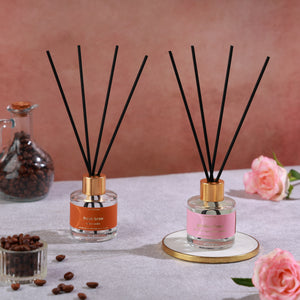
The paradox to understand: a wet reed is saturated. Saturated is not the same as wicking. Evaporation happens only from the exposed length above the collar, and a fibre choked with the heavy end of the fragrance can be wet through and still deliver very little there.
The honest test: ask someone who has just walked in.
2. Because there are not enough reeds in the bottle. The number of reeds is the volume control. Six is full strength; four is a comfortable bedroom setting; two or three suits a small bathroom. A great many people set up a diffuser with three or four reeds because it looks tidier, then judge the throw as if it were running at full. Every SOSA bottle includes six. Put all six in, flip them once so the dry ends are down, and give it a day. Throw scales with the total exposed evaporating surface, and doubling the reeds roughly doubles that surface. It also roughly doubles the consumption rate, which is the honest trade: a 50ml on six reeds will not reach eight weeks.
3. Because the bottle is standing in dead air. A reed diffuser is passive. It has no fan and no pressure behind it. All it does is put fragrance molecules into the layer of air immediately around itself and wait for that air to move. In a still corner — behind a lamp, inside a shelf recess, at the back of a dressing table, tucked against a wall between two pieces of furniture — the scent forms a shallow pool a hand-span wide and stays there. That is precisely the symptom you have described: strong at close range, nothing at the bed. Move it to an open surface at roughly seated or standing nose height, somewhere air passes it — near a doorway, in the path between the door and the window, on the side of the room the ceiling fan draws from.
4. Because the reeds have clogged, even though they are wet. This is the part that confuses everybody, so it is worth being precise. Fragrance is a mixture of light molecules and heavy ones. The light ones evaporate off the top of the reed readily; the heavy ones do not, and over weeks they accumulate inside the pore structure of the fibre. The reed stays soaked — it is full of liquid, and the bottom half is sitting in liquid — but the pathway that carries fresh fragrance up to the exposed length narrows. Wet tells you the fibre is saturated. It does not tell you anything is moving. The tell is a bottle whose level is still dropping while the room smells of less and less.
5. Or because the room is larger than one 50ml can charge. A 50ml bottle on six reeds is specified for a room up to roughly 150 sq ft. A generous master bedroom at 180 or 200 sq ft, especially one with a high ceiling, is asking one small evaporating surface to hold a lot of air. In that case nothing is wrong at all; the bottle is simply under-specified for the volume. The fix is a 130ml at ₹1,249, or a second 50ml at the other end of the room, or accepting that the scent lives at the dressing table end and putting the bottle where you actually want to notice it.
Made in India, composed by an ISIPCA Versailles-trained perfumer — and a portion of every order supports girl-child education through Nanhi Kali.
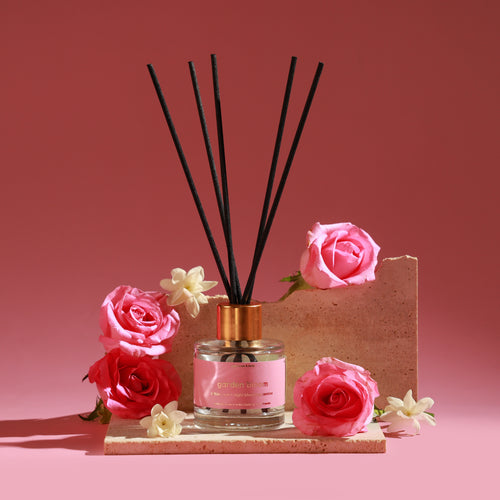
Wet reeds and working reeds are not the same thing
A reed diffuser runs on capillary action. The fibre reed is a bundle of fine channels; liquid climbs those channels against gravity and arrives at the exposed length standing above the bottle neck, where it evaporates into the room. Two separate things have to be true for the system to deliver scent. The liquid has to climb, and it has to leave. When you touch a reed and find it wet, you have confirmed the first of those and learned nothing about the second. Saturation is a state; wicking is a rate. A reed that has stopped moving fresh liquid upward will stay wet for a long time — it is full of oil and its lower half is submerged — while the exposed length above the collar quietly runs down to whatever the heavy, slow molecules can manage on their own. That is the wet-reed paradox in one sentence, and it is why "but the reeds are wet" is not the reassurance it feels like.
The second thing worth being clear about is where the fragrance actually enters your room. Not from the bottle — the neck is small and mostly plugged with reeds. Not from the wet part inside the glass. It enters from the surface area of reed that is exposed to air, and only from there. That single fact explains most reed diffuser complaints. Three reeds have half the exposed surface of six, so they emit roughly half as much. A reed pushed deep into the bottle so that only two inches stand proud emits less than one standing eight inches proud. A reed lying against a wall has part of its surface shielded. And a bottle in still air is emitting into a body of air that never travels anywhere, which means the concentration climbs to a small local maximum around the bottle and goes no further. Throw is exposed surface multiplied by air movement. You have been evaluating a system that is short on both, and blaming the liquid, which is the only part of it that is working properly.
The five causes, ranked — and how to confirm each one
 Six reeds included50ml from ₹749Confirm adaptation: ask a visitor, or a family member who has been in another room, to walk in and tell you what they notice. Do not point at the diffuser. If they name it, you have your answer and the bottle is fine. Second-best version: leave the flat for thirty minutes and judge the first breath back in, at the bedroom door, before you settle. Confirm reed count: count them. If there are fewer than six, add the rest — they came in the box — flip all of them so the dry ends go down, and wait twenty-four hours before judging. Flipping gives you a short, sharp lift; the real change comes from the extra exposed surface.
Symptom to cause: reading your own bottle
The rows are in the order I would actually check them. Start at the top even if a lower row sounds more interesting — the first two are free, take minutes, and between them account for most of the diffusers people are about to give up on.
| What you notice | Most likely cause | How to confirm it | What actually fixes it |
|---|---|---|---|
| Others can smell it; you cannot ★ | Olfactory adaptation — your nose, not the bottle | Ask a visitor without pointing at it; or judge the first breath after thirty minutes out | Nothing. The diffuser is working. Judge it on arrival, not from the bed |
| Strong within a hand-span, nothing at two metres | Too few reeds, or the bottle is standing in dead air | Count the reeds; then carry the bottle to the other side of the room and sit on the bed | All six reeds in, flipped; move it to an open surface at nose height near a doorway |
| Level dropping steadily, throw fading over weeks | Clogged reeds — saturated fibre that has stopped wicking freely | Fit the fresh set of six that came in the box and compare after a day | Replace the reeds, not the liquid. Fresh reeds at every refill |
| Fine in a small room, weak in this one | Room volume beyond what one 50ml can charge | Measure it — one 50ml on six reeds covers up to roughly 150 sq ft | 130ml at ₹1,249, or two bottles at opposite ends rather than one in the middle |
| Strong for two days after every refill, then gone | Fast evaporation from heat or draught, plus the light top notes going first | Note whether the bottle is in sun, above a heat source, or in a through-draught | Move it out of the sun and the draught; expect a settled level rather than the opening burst |
| A sour, musty or drain-like note sits underneath the fragrance | A live source — damp, growth or a dry P-trap. Not a fragrance problem at all | Smell the mattress and wardrobe floor; torch the wall base; run water down every unused drain | Damp and growth are a health and moisture matter; a drain smell is a plumbing job. Fragrance has no role in either |
| If none of these fit: take the reeds out, stand them on a saucer, and put your nose to the exposed ends. If they smell rich and the room does not, the bottle is fine and the problem is distribution — reed count, placement, or air movement. If the reeds themselves smell flat and dull, they are clogged. That one test separates the hardware question from the room question in about ten seconds. | |||
Reeds · always-on roomsFrom ₹749Shop →  Sukoon · when you want a switch₹1,899Shop →
  Hotel Collection · the scentFrom ₹299Shop →
What to change, in order
Tonight, change nothing and run the free test. Ask the next person who walks into the flat what they can smell, without telling them what you are testing. If you live alone, leave for thirty minutes and judge the bedroom doorway on your way back in, before you sit down. A great many perfectly good diffusers get replaced because their owner has been standing inside the result for an hour. If the answer comes back that the room does smell of the blend, stop here: the diffuser is doing its job and the only thing you have lost is your ability to perceive it, which is normal, universal and not fixable by buying anything.
Tomorrow, put all six reeds in and move the bottle. These two together are the highest-yield change available and neither costs anything. Six reeds, all of them standing well proud of the neck, flipped once so the dry ends go down. Then take the bottle out of whatever recess or corner it is in and put it on an open surface at roughly nose height with air passing it — a shelf near the bedroom door, the end of a chest of drawers that faces into the room rather than into a wall, the side of the room your fan draws from. Give it a full day before judging, because you are waiting for the exposed reed length to charge and for the room air to reach a new steady state, not for an instant result. Not under the AC vent, not in front of an open window, not in direct sun — all three of those spend the bottle quickly while sending most of the scent somewhere other than your bed.
Then, and only then, change hardware. Fit the fresh set of six reeds and compare over a day; if the room lifts, the old ones had clogged and you have found it. If none of that has moved the needle, the honest conclusion is that the room holds more air than a 50ml can charge, and the answer is more evaporating surface — a 130ml at ₹1,249 which runs 14–18 weeks, or two 50ml bottles at opposite ends of the room. For a bedroom I would usually reach for Evening Calm or Mountain Breeze rather than something bright, because a bedroom is a room you are in for eight hours and restraint reads better than strength there. And if what you actually want is to notice the scent at a particular moment — getting into bed, or an hour before guests arrive — that is a job for a switch rather than a passive source: the Sukoon at ₹1,899 runs 3–6 drops of the water-based Hotel Collection from ₹299 and covers roughly 270–320 sq ft. The two liquids are not interchangeable in either direction.
The plan for your bedroom
The first three steps here are free and, on the evidence you have given me, one of them is very likely to be the whole answer. The purchase is genuinely last, and it is a smaller purchase than a second bottle of the same thing.
| Step | What to do | When | Cost |
|---|---|---|---|
| 1. Remove the source | Rule out your own nose — ask a visitor, or judge the first breath after thirty minutes outside the flat | Before anything else | ₹0 |
| 2. Move the air | Move the bottle out of dead air to an open surface at nose height; not under the AC vent or at an open window | Daily, five to ten minutes | ₹0 |
| 3. Deal with what holds it | Put all six reeds in and flip them; if throw has faded over weeks, fit the fresh set that came in the box | Weekly to monthly | ₹0 |
| 4. Then the always-on layer ★ | A SOSA reed diffuser — a bedroom that should simply always smell settled — 130ml for 14–18 weeks, or two 50ml at opposite ends | 50ml 6-8 weeks · 130ml 14-18 | from ₹749 |
| 5. Or the on-demand layer | Sukoon with a Hotel Collection scent — the moment rather than the day — scent on for an hour, off overnight, covering roughly 270–320 sq ft | Run it when you want it | ₹1,899 |
Versailles
This is the message I get most often, and in the majority of cases my honest answer is that there is nothing wrong with the diffuser and I would rather you did not buy another one. Half full is correct. Wet reeds are correct. What has gone is throw, and throw is mostly free to fix. Count your reeds, move the bottle, and ask somebody else. If those three do not change anything, write to me again and we will talk about the room.
The wet-reed thing genuinely misleads people, including people who know what they are doing, so it is worth saying once more plainly. Fragrance has a light end and a heavy end. The light end is most of what you perceive and it leaves the reed easily. The heavy end does not leave; it stays, and over weeks it settles into the pores of the fibre and narrows the channels that carry fresh liquid up. So the reed goes on looking and feeling wet — it is full of oil — while the exposed length above the collar is delivering a fraction of what it did in week one. That is why every bottle we sell ships with six reeds and why I say replace the reeds at every refill. It is the cheapest repair in home fragrance and almost nobody does it.
And one thing I will not do is tell you to solve a distance problem by buying more fragrance. If a scent is not reaching the bed, adding a second bottle in the same dead corner gives you a slightly stronger pool in the same dead corner. Move it first. Fragrance is additive — it puts pleasant molecules into a room and takes nothing out — so it is worth being precise about what you are actually adding and where it is going. A portion of every order funds a girl's classroom through Nanhi Kali.
Frequently asked questions
- Same diffuser, two rooms, two results — volume, airflow and placement.
- Is one reed diffuser enough for a 120 sq ft bedroom? — reed count and room volume.
- Cross-ventilation versus a passive diffuser — why a draught wins.
- A small bedroom without heavy perfume — restraint as the technique.
- Brand: the SOSA founder story.
SOSA products & prices (verified August 2026): Hotel Collection water-based ultrasonic diffuser fragrance 15ml ₹299 · 100ml ₹999 · 300ml ₹1,799 · Pack of 7 (15ml, all fragrances) ₹1,799; refills 100ml from ₹999. Seven scents: The Ritz-Carlton-inspired (white tea · bergamot · cedar), Westin-inspired (white tea · aloe · cedar), 1 Hotels-inspired (cedarwood · vetiver · green leaves), The St. Regis-inspired (amber · violet · woods), Shangri-La-inspired (jasmine · green tea · white tea), Four Seasons-inspired (citrus · floral · sandalwood), W Hotels-inspired (citrus · pepper · amber). Diffusers: Boond 300ml ₹899 · Sukoon 500ml ₹1,899 · Megh 6L ₹3,499. Water-based, phthalate-free, composed to IFRA standards for home diffusion; 3–6 drops per tank. Made in India, Pune. The Hotel Collection scents are SOSA's own interpretations inspired by the world's finest hotels; all hotel names are trademarks of their respective owners and are used only to describe the scent style — SOSA is an independent Indian fragrance house, not affiliated with or endorsed by any hotel brand. Prices and availability subject to change — see the live product pages.