

The arithmetic we can publish: a 50ml SOSA reed runs 6–8 weeks and works out at roughly ₹13 a day for Morning Freshness or Garden Bloom, and about ₹15 a day for Evening Calm, Mountain Breeze or Fresh Brew. Run it on three reeds instead of six and the bottle lasts roughly twice as long, which roughly halves that daily figure.
The real currency is effort, not rupees. A spray costs you an action several times a day, every day, forever. A reed costs you a flip every three to five days.
The honest gap: a reed has no off switch, and there is no SOSA room spray to compare it against. If your household genuinely wants fragrance for twenty minutes and nothing the rest of the day, a reed is the wrong instrument and I would say so.
2. Understand what a spray physically does, because the curve is the whole argument. A spray suspends a large amount of fragrance in the air at once. The carrier evaporates almost immediately, the heavier droplets fall onto floors, curtains and upholstery, and the airborne concentration drops away fast. It is a genuinely useful thing — a spray is the fastest way to change a room — but the effect is an event with a beginning and an end, and holding a room all day means repeating it.
3. Count the action, not just the rupees. This is the cost people never put on the ledger. A spray requires somebody to be present, to remember, and to do it again, several times a day, indefinitely. A reed diffuser requires you to turn six sticks over once every three to five days. Over a month that is the difference between roughly a hundred small actions and roughly eight.
4. Neither of them removes a smell, and any argument built on that is a bad one. If the household’s real complaint is cooking, damp or a shoe rack, adding a pleasant odour to an unpleasant one gives you a mixture rather than a cancellation, and the mixture is frequently worse. Deal with the source, open something for ten minutes, and only then discuss fragrance. This is true of every format and every brand, and it is the point on which most of these purchases go wrong.
5. Then buy small and let the room settle the argument. Morning Freshness 50ml at ₹749 for a room up to about 150 sq ft, or Evening Calm at ₹799 if the objection in the house has ever been about strength. Start on three reeds rather than six — the bottle lasts roughly twice as long, and a sceptic who is not overwhelmed in week one usually stops being a sceptic.
Alcohol-free, phthalate-free, paraben-free, IFRA-compliant, 0 ppm formaldehyde, six fibre reeds in a refillable glass bottle, composed in Pune. Free shipping above ₹499, and a portion of every order supports girl-child education through Nanhi Kali.
Two delivery curves, not two versions of the same product
A great many household arguments about home fragrance are really arguments about time, conducted in the language of money. So it is worth being precise about what each format is doing to the air in the room, because once that is on the table the economics answer themselves.
A spray works by suspension. You release a fine mist carrying a high concentration of fragrance material, and for a short period the air in that room holds far more fragrance than any diffuser could ever put into it. Then three things happen at once: the carrier evaporates and leaves, the heavier droplets fall onto the floor, the sofa and the curtains, and the room’s ordinary air exchange carries the rest away. The peak is instant and the fall is quick. That is not a criticism — it is exactly the behaviour you want when guests are arriving in five minutes — but it means the format is built around repetition. It is also worth knowing why alcohol-carried fragrance behaves this way, because it is the same reason we deliberately keep alcohol out of the reed line: alcohol carries fragrance fast and then leaves, giving a strong opening and a short life. That is right for something you spray and wrong for something meant to run for weeks.
A reed diffuser works by wicking. The oil climbs the fibre by capillary action, arrives at the exposed length of the reed, and evaporates from there into the room at a rate set by the porosity of the fibre, the number of reeds and the temperature of the room. Nothing about that rate depends on anybody remembering anything. The result is a low, flat, continuous concentration — usually below the level at which you consciously notice it while sitting in the room, and comfortably above the level at which somebody arriving from outside notices it immediately. That gap between what the household perceives and what a visitor perceives is the whole source of the “it isn’t doing anything” complaint, and it is a fact about noses rather than a fact about bottles.
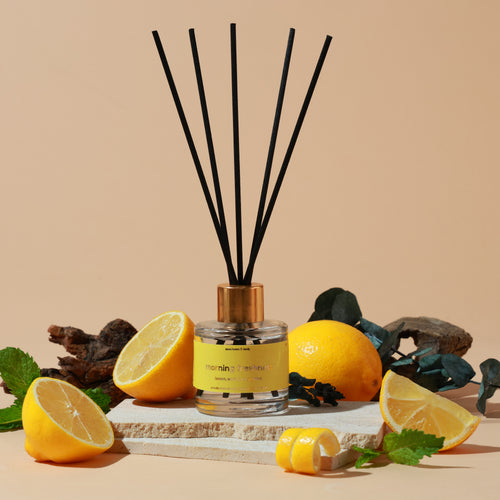
 Morning Freshness₹749A 50ml reed diffuser runs six to eight weeks in ordinary Indian household conditions. Divide the bottle price by the days and you get roughly ₹13 a day for Morning Freshness or Garden Bloom, and about ₹15 a day for Evening Calm, Mountain Breeze or Fresh Brew. A 130ml at ₹1,249 to ₹1,349 runs 14 to 18 weeks, which is better value per week — but only if the room is above about 150 sq ft, because a 130ml in a small bedroom is over-specified and the honest recommendation there is the 50ml on fewer reeds. I will not put a rupee figure against a spray, because SOSA does not make one and pricing a competitor’s bottle from our own page would not be worth reading. What I will say is that the comparison only means anything if you convert both to cost per day of ambient fragrance, and that a format requiring several applications a day is being compared on a very different basis from one requiring none.
 Evening Calm₹799People ask whether the oil is evaporating into thin air, and the honest answer is that it is — that is the mechanism, and a reed diffuser holds nothing back. Every millilitre eventually leaves through the reeds. Nothing is thrown away in the sense of being discarded. The one genuine waste is oil evaporating into a room nobody is in, and that is where a reed loses an argument it cannot win: it has no off switch. It runs while you are at work, while the family is out for a wedding, and all night whether or not anybody is in that room. A spray is at least only used when a person is present. If your household is out of the flat for ten hours a day and only wants the living room to smell of something between eight and eleven at night, that is a real point against a reed, and the honest answer there is either fewer reeds or a machine you can switch on for the hours that matter.
Why “it isn’t doing anything” is usually about noses, not value
Whenever somebody in a household describes a reed diffuser as a waste of money, I ask what they mean by waste, and roughly half the time the answer is not about the price at all. It is: I cannot smell it. That is worth taking seriously, because it is true — and it is also expected. Olfactory receptors adapt to a constant, unchanging stimulus within minutes. The signal is still arriving; the brain has simply stopped reporting it, because nothing about it has changed and there is nothing new to attend to. This is precisely why you can smell every other house you enter and not your own. It is why guests remark on a room that its occupants have stopped noticing entirely.
A spray does not suffer from this, and that is the honest reason it feels more effective. Every application is a change, and change is exactly what the nose reports. A reed diffuser is a steady state, so after the first days it becomes invisible in the way the paint colour is invisible. The correct test is therefore not to sniff harder but to leave the flat for fifteen minutes and walk back in without thinking about it. That first breath through the door is the only reading anybody in the household can trust, and in a home with parents in it there is usually somebody arriving from outside several times a day who can give you an even better one.
There is a second version of this that is worth stating plainly, because it embarrasses people. You are not supposed to smell a home fragrance continuously. A diffuser you notice at every moment is set too strong for the room. Home fragrance is designed to be registered on arrival and at transitions — walking in through the door, coming out of the bathroom, sitting down after clearing the kitchen. If somebody in the house is smelling it constantly and complaining, the projection has overshot the volume of the room, and the fix is fewer reeds rather than a different scent or a different category of product. That single adjustment settles more household disagreements than changing the fragrance ever does, and it costs nothing.
The comparison, honestly laid out
Four ways of putting fragrance into an Indian home, with what each one physically does and what it will not do. I have included the two formats we do not sell in this category as well as the two we do, because a table that lists only our own products is an advertisement rather than a comparison.
| Format | How it delivers | What it costs you | What it will not do | SOSA price |
|---|---|---|---|---|
| Reed diffuser ★ | Continuous low-rate wicking, 6–8 weeks on a 50ml, 14–18 on a 130ml | Roughly ₹13–₹15 a day, and one flip every three to five days | Cannot be switched off, turned up for guests, or stopped while you are out | ₹749–₹849 / 50ml |
| Room spray (the category, generically) | A bolus — instant peak, quick fall as carrier evaporates and droplets settle | An action several times a day, by somebody who is at home and remembers | Will not hold a room for hours; the effect ends and has to be repeated | SOSA makes none — every SOSA spray is a car perfume |
| Scented jar candle | Warm, fast, strong while lit; nothing at all when it is not | Attendance. It is an event rather than an ambient system | Never left unattended, never near a curtain, a diya or an agarbatti. Fragrance oil is flammable | ₹379 single · ₹664 two-pack · ₹449 singles |
| Sukoon ultrasonic | On demand, fast, controllable — 500ml tank, 270–320 sq ft, 16–18 hours on low | ₹1,899, plus power, water, filling and remembering to switch it on | Does nothing while switched off, and takes only water-based Hotel Collection oil, never reed oil | ₹1,899 |
~₹13 a day · Morning Freshness₹749Shop → 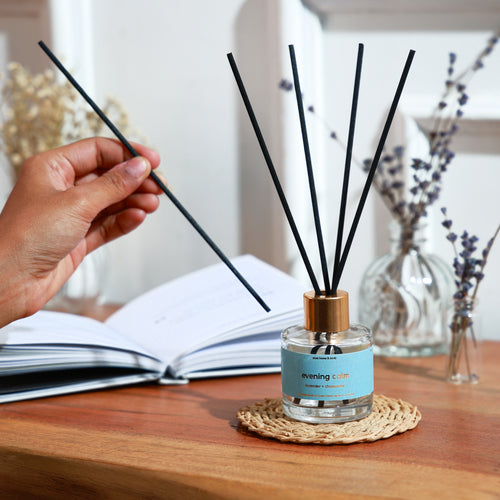 Softest at 8.9 · Evening Calm₹799Shop →
 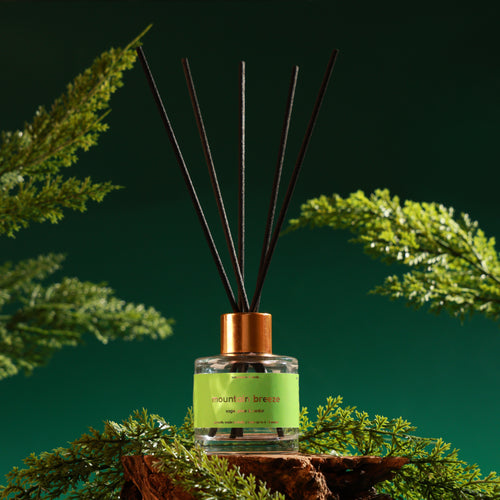 Dry and unsweet · Mountain Breeze₹849Shop →
Halving the daily figure without buying anything
If ₹13 a day is still more than the household wants to spend on a room, there is an adjustment that costs nothing and that almost nobody makes. Every SOSA bottle ships with six fibre reeds, and the reed count is a volume dial rather than a fixed specification. Six reeds is full projection, meant for a living room or a large kitchen. Three reeds gives a soft, bedside-level projection and roughly doubles how long the bottle lasts — which means the daily cost roughly halves at the same time. In a small or well-sealed room, six reeds is usually too many anyway, and a great deal of what people describe as a fragrance being cloying or cheap is actually a description of over-dosing rather than of the composition.
The extreme version of this is worth knowing because it is genuinely the best value in the house. Two or three reeds in a small bathroom of around 50 sq ft can make a 50ml bottle run close to three months. That is not a trick; it is simply a small volume of air being asked to hold very little fragrance, which is all a bathroom ever needed. It is a good placement because it is efficient, not because a diffuser deodorises — and I want to be clear about that distinction, because it is the one most likely to be misunderstood in a household where somebody is hoping fragrance will solve a smell.
Two other things save money and neither of them appears on a price list. Placement: put the bottle in the room’s natural airflow path rather than directly in a draught — near a doorway, at nose height or slightly below, away from direct sun, and never right beside an open window, which is the fastest way to empty a bottle into the street. Occupancy: put it in the room the household actually sits in. A diffuser running in a room nobody uses is the single largest waste in this whole subject, and it is a placement decision rather than a product one. And one non-negotiable: keep any diffuser well away from a diya, an agarbatti or a lit candle, because fragrance oil is flammable.
What to buy, in order — and what does not exist
If the household has decided to test the argument rather than continue it, this is the order I would spend in. The last row is what this range does not contain, stated in full, because the fastest way to lose a sceptical parent is to let them discover a limitation after paying for it.
| Buy | What it is | When it is the right answer | Price |
|---|---|---|---|
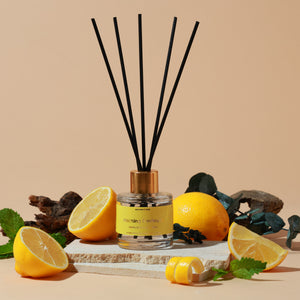
| 1. Morning Freshness 50ml ★ | Malabar lemon, peppermint, eucalyptus — 9.0, roughly ₹13 a day, 6–8 weeks | The lowest-cost honest experiment, and the register a sceptic accepts most easily | ₹749 |
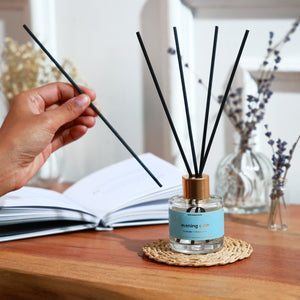
| 2. Evening Calm 50ml | Kashmir lavender and chamomile at 8.9, the softest thing we make | If anyone in the house has already used the word “strong” about a fragrance | ₹799 |
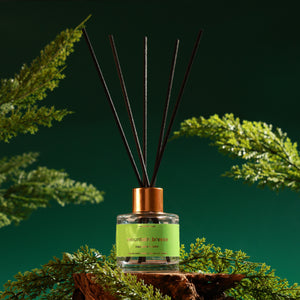
| 3. Mountain Breeze 50ml | Himalayan pine, sage and Indian cedar — dry, green, not remotely sweet | For a household that objects to anything that smells like an air freshener | ₹849 |
| 4. The 130ml | The same compositions sized for rooms above ~150 sq ft, 14–18 weeks | Better value per week, but only once the argument is settled and the room needs it | ₹1,249–₹1,349 |
| Costs nothing: three reeds instead of six | The volume dial. Soft bedside projection, and roughly double the life of the bottle | Always worth trying before spending anything further | Free |
| The honest gap: no room spray, and no off switch | SOSA makes no room spray or home spray — every SOSA spray is a car perfume — so we cannot sell you the thing this page compares against, and we will not price anybody else’s. A reed also cannot be switched off, turned up for guests or paused while the flat is empty. The ₹299 Hotel Collection 15ml is a machine refill and not a cheap way in, and the 300ml refill at ₹2,399 is oil alone, never a first purchase | Said plainly rather than discovered later | — |
Versailles
I am a perfumer with a reed diffuser line and I am about to tell you that your parents are partly right, so it is worth explaining why. A reed diffuser bought for the wrong room genuinely is a waste of money, and the wrong room is nearly always one that is empty, or one where the windows are open all day, or one where the household is hoping fragrance will do something about a smell rather than sit alongside it. In all three of those cases the oil leaves the bottle exactly as designed and nobody is present to receive it. That is a real waste and no product I make can prevent it.
What I would resist is the idea that the money is the interesting variable. Roughly ₹13 to ₹15 a day is a genuinely small figure for something that affects every hour spent in a room, and it goes down by roughly half the moment you use three reeds rather than six. The variable that actually decides whether this purchase was sensible is occupancy: is somebody in the room while the bottle is running. If the answer is yes for most of the day, a reed is the most economical thing in this category, because it costs nothing to operate and nobody has to do anything. If the answer is no, then buy honestly for the hours you are there, or buy something you can switch on.
The advice I would give an adult child having this argument at home is not to win it with a figure. Buy the ₹749 bottle, put three reeds in it rather than six, place it in the room where the family actually sits, and then say nothing for three weeks. Adaptation will make the household stop noticing it, which is a good sign rather than a bad one, and eventually somebody who has been out will come back in and say the house smells nice. That is the argument, and it makes itself. Everything is composed in Pune, and a portion of every order funds a girl’s classroom through Nanhi Kali.
Frequently asked questions
- I love strong, my parents hate it — why the disagreement is about dose.
- Jasmine versus hotel scents — finding the overlap rather than the compromise.
- If your father hates sweet room fresheners — he is describing a register.
- A bedroom that smells different — and how to stop two scents meeting.
- Different fragrances in two bedrooms — choosing so they do not fight.
- The easiest type to start with — the format that asks nothing of the household.
- Sandalwood, without the tradition — the honest nearest register.
- Three generations in one 2BHK — choosing for a household you cannot poll.
- Reed or Sukoon for divided taste — the whole method, in order.
- Brand: the SOSA founder story.
SOSA products — facts verified August 2026: Five reed scents, all alcohol-free, on a heat-stable CCT (caprylic/capric triglyceride) base, phthalate-free, paraben-free, IFRA-compliant, 0 ppm formaldehyde, six fibre reeds in a refillable glass bottle, composed and made in Pune, India. Morning Freshness (Malabar lemon · peppermint · eucalyptus globulus) 50ml ₹749 · 130ml ₹1,249 · 9.0 on the SOSA strength scale. Evening Calm (Kashmir lavender · chamomile · soft musk) 50ml ₹799 · 130ml ₹1,299 · 8.9, the softest in the range. Garden Bloom (British rose · night-blooming jasmine) 50ml ₹799 · 130ml ₹1,299 · 8.9. Mountain Breeze (Himalayan pine · sage · Indian cedar) 50ml ₹849 · 130ml ₹1,349 · 9.4. Fresh Brew (Coorg coffee · Kerala vanilla · caramel) 50ml ₹849 · 130ml ₹1,349 · 9.5, the deepest in the range. 50ml suits rooms up to approximately 150 sq ft and 130ml above that; longevity 6–8 weeks and 14–18 weeks respectively; six reeds gives full projection and three gives a soft level at roughly double the life; approximately ₹13 a day for Morning Freshness or Garden Bloom 50ml and ₹15 a day for Mountain Breeze, Fresh Brew or Evening Calm 50ml. Duos: Day & Night ₹1,498, Fresh & Grounded ₹1,548, Warmth & Bloom ₹1,598 (50ml × 2). Refills 300ml ₹2,399 · 500ml ₹3,499, oil only and not a first purchase. Jar candles ₹379 single and ₹664 for the two-pack; Sandalwood and Smoked Oudh singles ₹449. Machines: Boond ₹899 (300ml, up to ~150 sq ft, ~6 hours), Sukoon ₹1,899 (500ml, 270–320 sq ft, 16–18 hours on low, three 15ml scents included), Megh ₹3,499 (six litres, around 100 hours of runtime, approximately 215 sq ft — a runtime and humidity machine, never a coverage upgrade). Hotel Collection 15ml ₹299 is a refill for an ultrasonic machine and not a standalone purchase. Climate-tested through 45°C heat and 85% RH monsoon humidity. The reed line contains no oud, sandalwood, vetiver or amber. SOSA makes no room spray, air purifier, dehumidifier or odour eliminator. Reed diffuser oil and the water-based Hotel Collection are separate systems and are not interchangeable, and there is no hotel-inspired reed diffuser. Free shipping above ₹499. SOSA is an independent Indian fragrance house and is not affiliated with or endorsed by any hotel brand. Prices subject to change — see the live product pages.