

Cost it as a running line, not a capital line. A reed diffuser at ₹749–₹1,349 and a 300ml oil refill at ₹2,399 — ₹2,399 ÷ 300 = ₹8.00 a millilitre — is a consumable. Against a fit-out running into lakhs it is a rounding error, and that is the correct proportion.
Size to the arrival zone, never to the clinic. A 900 sq ft practice is not a 900 sq ft scenting job. Reception plus waiting is typically 150–400 sq ft, and under 320 sq ft the sized product is Sukoon ₹1,899.
If the new interior smells of the new interior, that is not a fragrance problem. Fresh adhesives, paint, MDF and carpet off-gas for weeks. Fragrance adds a scent alongside that; it removes nothing. Ventilate first, and add scent only once the room smells of nothing in particular.
2. Stop costing it against the fit-out and start costing it against the flowers. A newly fitted clinic reception typically absorbs a fit-out running into lakhs. A reed diffuser is ₹849 and a 300ml refill is ₹2,399, which is ₹2,399 ÷ 300 = ₹8.00 a millilitre. That is not a capital line, it is a consumable that sits beside the water dispenser, the magazines and the housekeeping order.
3. Size to the arrival zone, not to the practice. This is the correction that runs through every page in this cluster. Delete the clinical rooms from the calculation entirely, then measure reception plus waiting with a tape. Under ~150 sq ft: a reed diffuser. 150–320 sq ft: Sukoon ₹1,899. Above ~320 sq ft on one connected air path: Vaayu ₹11,999, and only then.
4. Set it lower than your interior designer will want. A clinic is judged on competence, and every other signal must stay behind that one. The correct intensity in a medical building is lower than in a salon, a showroom or a hotel lobby — if a patient can name the fragrance, it is too strong. The target is considered, never scented.
5. If the room still smells of the fit-out, wait. Fresh paint, adhesives, sealants, MDF edging and new carpet off-gas for weeks. Fragrance adds a scent alongside what is already in the air; it removes, masks or neutralises nothing, and layering it over a curing interior gives you a third smell nobody designed. Ventilate, wait, and reassess in a month.
6. Buy nothing until you have measured, and buy the cheapest thing that fits. The commonest over-specification I see at this stage is a practice with a 220 sq ft reception buying an ₹11,999 machine because it matched the ambition of the joinery. It does not match the room. Running a machine at the bottom of its range to avoid overdosing a space a fraction of its rated size is ₹10,100 spent on headroom.
7. Ask about the commercial terms before you commit, because they are not published. SOSA publishes no bulk or commercial pricing, no corporate or B2B page, no annual maintenance contract, no installation service, no stated warranty term, no lead time and no multi-location programme. Where you would reasonably expect one of those to exist, assume it does not until somebody tells you otherwise in writing — ask through the contact page first.
8. And the boundary, which no budget changes. The clinical pathway stays fragrance-free: examination rooms, diagnostics, consultation cabins, the procedure suite, any post-operative area, sterilisation and stores take nothing, in any format, at any level, at any hour. A fragrance-free seat must genuinely exist somewhere a person would ordinarily sit. Reception staff are in that air for a full shift while a patient is in it for forty minutes, so they set the level and may switch it off without asking anybody. Composed and made in small batches in Pune, and a portion of every order supports girl-child education through Nanhi Kali.
Part one — why this is a different category of spend
Everything that has gone into your reception until now has been bought the same way: drawn, specified, quoted, approved, installed and lived with. Scent does not behave like any of it, and the three ways it differs are the three things that should change how you buy it.
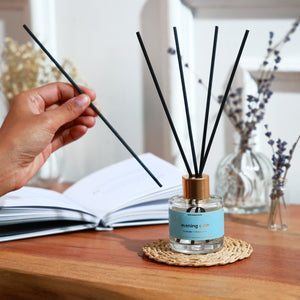
 Oil refill 300ml₹2,399 · ₹8.00 a millilitrePractices ask me for a budget figure and I would rather show the working than hand over a number. Start with the entry route. One 50ml bottle at ₹849 covers a fragrant zone for 6–8 weeks at six reeds; a 130ml at ₹1,349 covers 14–18 weeks. If you run one 130ml continuously and refill it from a 300ml at ₹2,399, that is ₹2,399 ÷ 300 = ₹8.00 a millilitre against ₹849 ÷ 50 = ₹16.98 for the smallest bottle, and the 500ml at ₹3,499 works out at ₹3,499 ÷ 500 = ₹7.00. You reuse your own glass vessel; replacement reeds are not sold separately, which is an honest gap and the guidance is to refresh reeds every few months. Now the machine route. A Sukoon at ₹1,899 arrives with three 15ml Hotel Collection scents in the box, enough to settle on one before committing to a 300ml at ₹1,799 — machine plus a 300ml is ₹1,899 + ₹1,799 = ₹3,698 to start. Per millilitre that 300ml is ₹1,799 ÷ 300 = ₹6.00 against ₹299 ÷ 15 = ₹19.93 for a 15ml, so the small bottles are for choosing and the large one for running; the pack of seven 15ml at ₹1,799 is 7 × 15 = 105ml, so ₹1,799 ÷ 105 = ₹17.13 a millilitre — variety, not value. Set those totals beside your fit-out and the proportion answers the question in the title on its own. Free shipping above ₹499 means almost any of these orders ships free.
Part two — the finishing layers, and what each honestly changes
Seven things that get added at the end of a clinic fit-out, where each sits in the sequence, what it honestly changes and how hard it is to undo. Scent is the cheapest and the most reversible on this list, which is exactly why it should be the least agonised over.
| Finishing layer | Where it sits in the fit-out sequence | What it honestly changes about the arrival zone | How reversible it is | Verdict against an interiors budget |
|---|---|---|---|---|
| Ambient scent ★ | After handover, after the smell of the fit-out has gone — never during | A half-tone. A room that is already right becomes slightly more deliberate | Completely, in minutes, by carrying a bottle out or pressing a remote | A rounding error. Buy the small thing, set it low, and reassess in eight weeks |
| Task and ambient lighting balance | Wired at first fix, adjusted at commissioning | More than anything else on this list, and it is the layer most often got wrong | Dimming and lamp temperature, yes; fittings and circuits, no | Worth revisiting before you spend anything on scent |
| Seating layout and spacing | Loose furniture, last fortnight | How long a wait feels to sit through, and whether people face each other | Entirely — it is furniture, and moving it costs an afternoon | Free to test. Do this first |
| Acoustic softening | Ceiling and wall finishes, mid-project | Whether the desk conversation carries to the waiting bank | Rugs and upholstery yes; ceiling treatment, not without works | Expensive to retrofit, which is why it belongs on the drawing |
| Signage and wayfinding | After joinery, before opening | How much a first-time patient has to ask at the desk | Adhesive graphics yes; routed or backlit, no | Higher priority than scent, always |
| Plants and flowers | Opening week, then weekly | The nearest comparison to scent — a small, recurring, reversible warmth | Weekly by definition | Budget scent beside this line, not beside the joinery |
| Clutter discipline at the desk | Never on a drawing; entirely operational | The single largest gap between a photographed reception and a working one | Daily, and it costs nothing at all | Costs zero, changes most. Do it before buying anything |
| The honest caveat: every row above concerns the arrival zone only — reception and waiting. Examination rooms, diagnostic areas, consultation cabins, the procedure suite, any post-operative area, sterilisation and stores take nothing from us in any format, at any level, at any hour, and that boundary is the practice's own clinical judgement rather than a supplier's recommendation. Nothing on this page is medical, clinical, ventilation, air-handling, infection-control, accreditation or regulatory advice. No SOSA product or setting is described as safe or unsafe for any patient or staff group, and no claim is made about how anybody perceives or responds to fragrance beyond the plain fact that some people are sensitive to airborne fragrance — which is precisely why the clinical pathway stays fragrance-free and why a fragrance-free seat must genuinely exist somewhere a person would ordinarily sit. No effect on comfort, anxiety, perceived waiting time, recovery, ratings, reviews, footfall, patient numbers, enquiries or revenue is claimed for any product, setting or placement. Fragrance adds a scent alongside what is already in the air; it removes, masks, neutralises or purifies nothing. | ||||
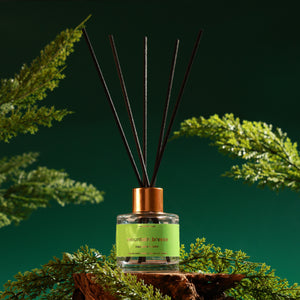
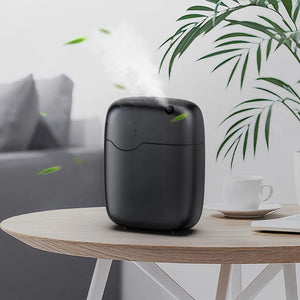
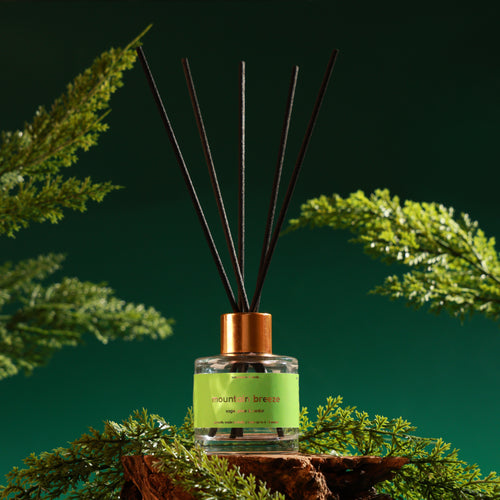
Mountain Breeze · the finishing half-tone₹849Shop →  Sukoon · 150–320 sq ft, with a schedule₹1,899Shop →
 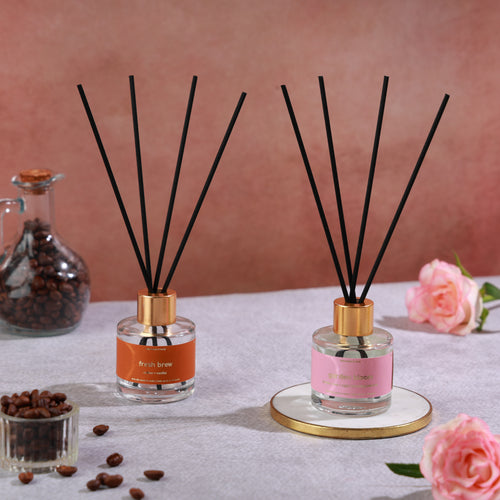 Oil refill · the running-cost number₹2,399Shop →
Part three — the newly fitted clinic that should wait
There is a version of this enquiry where the honest answer is not yet, and it arrives more often than any other because of when practices ask. If your fit-out completed in the last several weeks, the room is almost certainly still telling you what it is made of. New paint, solvent-based adhesives under vinyl or laminate, freshly cut MDF and particle board edging, sealants, powder-coated metal, new upholstery foam and new carpet all release volatile material as they cure, and in a sealed air-conditioned reception that material accumulates rather than leaves. Practices describe it as a chemical smell, a new smell, sometimes simply as a smell they cannot place, and their instinct is to buy fragrance for it. That instinct is wrong in a way worth being precise about: fragrance adds a scent alongside what is already in the air and removes nothing, so what you get is not a fresher room but a compound of the two, and the compound is normally worse than the original. The correct sequence is the one that runs through this entire cluster — find the source, deal with ventilation and cleaning, and only then consider fragrance. In a new fit-out that usually means time and air exchange rather than any intervention at all. Give it several weeks with a deliberate airing routine, then have somebody who has been outside for a quarter of an hour come in through the patient door and write one sentence about what the room smells of before speaking to anybody. When that sentence is nothing much, you are ready to think about a diffuser. What your air handling ought to be doing in the meantime is a question for your contractor and your clinicians, not for me, and I will not offer a view on it.
The second case for waiting is about who has not yet been consulted. Your reception staff will be in that air for eight or nine hours a day, every day, while a patient is in it for anything from ten minutes to two hours. They have the least ability to leave the room and the strongest claim on the decision, and in a brand-new building they have usually not been asked about anything at all — the fit-out was a management project and they inherited the result. Before adding a continuous source, ask them properly. Not "would you like a nice fragrance in reception", which invites agreement, but an open question: if you could change one thing about this room, what would it be. In new premises the answer is frequently about glare, about the position of the printer, about how cold the AC runs at eleven in the morning, or about noise from the street door — and every one of those is a bigger improvement than scent and several of them cost nothing. If, having heard all that, they still say the room feels unfinished, you have a genuine mandate for a small, low source and you will have it with their agreement rather than over their heads. If they would rather have nothing, that is a complete answer and it needs no further justification.
The third case is one I would rather state before you buy than explain afterwards. If your arrival zone is small, sealed and air-conditioned, opens onto an internal corridor rather than the street, and has no second seating area anywhere in the building, then adding a continuous source is a harder decision than the price suggests. The reason is not about the product; it is about the room. A fragrance-free seat is not a gesture. It has to be somewhere a person was going to sit anyway, far enough from the source that the difference is genuine, and reachable without crossing the room or being singled out. In a single small waiting area, one air volume, a chair four feet from the bottle is not meaningfully different from a chair eight feet away, and there is often nowhere in the building that qualifies. If you cannot produce that seat, you do not have a design, you have a hope — and after the money you have just spent on the room, a hope is a poor last layer. In that situation I would either find a second bay in the plan, or run nothing and put the money into the housekeeping order. Neither of those is something SOSA sells, and both are better answers than a diffuser.
One last thing, because it comes up in exactly this conversation and nowhere else. A practice that has just spent heavily on interiors is unusually susceptible to being sold the largest machine in a range, and I want to name the mechanism rather than simply warn against it. The proposal lands in a folder where nothing else is under a lakh; the small product looks like an anticlimax; the ambition of the joinery seems to demand a matching answer. But scenting is sized by the volume of one room measured with a tape, and the volume of an Indian eye clinic's reception is typically 150–400 sq ft whatever the practice cost to build. Running an ₹11,999 machine at the very bottom of its range to avoid overdosing a space a fraction of its rated size is not a premium outcome; it is ₹10,100 spent on headroom you have no room for, and the room does not read as better for it. If your arrival zone genuinely exceeds about 320 sq ft on one connected air path, the larger machine becomes defensible on control and silence rather than on reach, and there is a full page in this cluster devoted to that test. Below that figure, the ₹1,899 answer is not the modest version of the right decision. It is the right decision.
Part four — what each option costs, and what it does not buy
Six routes, what it costs to start each one, what the ongoing figure looks like with the arithmetic shown, and — the column that matters on this page — what the money explicitly does not buy you.
| Route | Cost to start, shown | Ongoing, with arithmetic | What the money does not buy | When it is the right line |
|---|---|---|---|---|
| One 130ml reed bottle, refilled ★ | ₹1,249–₹1,349, shipping free above ₹499 | 300ml refill ₹2,399 ÷ 300 = ₹8.00 a millilitre; 500ml ₹3,499 ÷ 500 = ₹7.00 | No control, no schedule, no off switch, and reeds are not sold separately | Almost every newly fitted clinic reception under 150 sq ft |
| Two 50ml bottles at opposite ends | ₹749 + ₹849 = ₹1,598, or ₹1,498–₹1,598 as a duo set | Two bottles to refill instead of one, at the same per-millilitre rate | Reach — this raises total output, it does not extend one zone | L-shaped arrival zones only, never one open room |
| Boond ₹899 | ₹899 + a 15ml Hotel Collection ₹299 = ₹1,198 | 100ml ₹999 ÷ 100 = ₹9.99 a millilitre | Coverage above ~150 sq ft, a remote, or a dry room — it adds humidity | A compact desk-adjacent reception with a short run each day |
| Sukoon ₹1,899 | ₹1,899 with three 15ml scents in the box; with a 300ml, ₹1,899 + ₹1,799 = ₹3,698 | 300ml ₹1,799 ÷ 300 = ₹6.00 a millilitre | A key-lock, and a dry room — it is ultrasonic, so it adds humidity | 150–320 sq ft. The sized product for most Indian eye clinics |
| Megh ₹3,499 | ₹3,499 | Same water-based fragrance economics as the Sukoon | Coverage — it is ~215 sq ft, less than a Sukoon. Never an upgrade | Only when ~100 hours of runtime per fill is the actual requirement |
| Vaayu ₹11,999 | ₹11,999, with 4 × 100ml = 400ml of cold-air oil supplied | 400ml lasts roughly 90+ days, so 400 ÷ 90 = 4.4ml a day at a mid setting | A published refill line, an installation visit, a warranty term or a lead time — none of these is published | Only above ~320 sq ft of connected arrival zone, freestanding, and only with supply confirmed first |
Versailles
A surgeon in a mid-sized city sent me photographs of a reception I would have been pleased to have designed — grey stone, pale oak, a long low bench, indirect light, not a cable in sight — and one line of text: "what should this smell of, budget is not a constraint". It is the most flattering enquiry I get and it is also the one where I am most likely to lose the sale, because the honest reply begins by taking the budget off the table.
What I wrote back was that the budget was the problem, not the constraint. A room that good does not need to be told what to be; it needs a half-tone, and half-tones are cheap. I asked him for one number — the square footage of reception and waiting alone, measured rather than estimated, with the clinical rooms deleted from the calculation entirely — and he came back with a hundred and ninety. At a hundred and ninety square feet, the correct answer is a bottle at ₹849 run at three of six reeds, or a machine at ₹1,899 if he wanted a schedule. Nothing above that would have made the room better; several things above it would have made it worse, because the commonest failure in a beautiful clinic reception is a fragrance set at a level that competes with the architecture and ends up reading as a spa.
He bought the bottle, then wrote a fortnight later to say the useful sentence had been the one about categories: that he had been about to buy scent with the part of his brain that had been buying joinery for three months, and it was the wrong part. That is really the whole page. A fit-out is capital and permanent; this is a consumable with an off switch, and you should spend on it accordingly and stop when the room is right. Composed and made in small batches in Pune, and a part of every order funds a girl's classroom through Nanhi Kali.
Frequently asked questions
- The six small details that make a premium clinic feel considered — scent is only one of them.
- Matching scent to your interior and building an identity without feeling commercial.
- Is professional scenting worth it for a solo practice? — the arithmetic, stated honestly.
- Reeds, sprays or a machine — the pillar this family resolves into.
- Brand: the SOSA founder story.
SOSA range, specifications and prices used in this guide (verified August 2026): Vaayu ₹11,999 — waterless cold-air nebulisation of undiluted fragrance oil; no water, no heat, no added humidity, no white mineral dust. Coverage up to 1000 m³, about 2,000–3,000 sq ft. 400ml refillable tank lasting roughly 90+ days at a mid setting. Bluetooth app plus onboard controls, 1h / 4h / 8h / 24h run windows, day selection, adjustable intensity, auto-stop and key-lock. Under 38 dB. DC 12V / 1A, 5W. Freestanding or wall / HVAC mount. CE, RoHS and SGS certified. SOSA does not currently sell a separate Vaayu cold-air refill oil; the 400ml supplied in the box is the fragrance available at the time of writing, so a practice planning continuous or multi-site use should confirm current refill availability with SOSA before committing. The water-based Hotel Collection is made for ultrasonic machines and must not be used in a Vaayu. Other machines: Boond 300ml ₹899 (~150 sq ft, ultrasonic) · Sukoon 500ml ₹1,899 (270–320 sq ft, 16–18 hours on low, remote and steady/2H/4H timers, three 15ml fragrances included, ultrasonic) · Megh 6L ₹3,499 (~215 sq ft — a runtime and humidity machine that covers less than a Sukoon, never a coverage upgrade) · Safar ₹3,999 (waterless cold diffusion, cordless, 20ml, about 6.9cm, three speeds, 1/2/3-hour auto-off — sold as a car and travel diffuser, personal-scale only; SOSA publishes no coverage figure for it) · Aangan ₹25,999 (HVAC nebulising, ~8,000–10,000 sq ft) · Meenar ₹38,500 (commercial HVAC, 12,000–18,000 sq ft). Water-based Hotel Collection for ultrasonic machines: 15ml ₹299 · 100ml ₹999 · 300ml ₹1,799 · pack of seven ₹1,799; scents are inspired by the atmosphere of well-known hotels — SOSA is an independent Indian brand and is not affiliated with, endorsed by or supplying any hotel group. Reed diffusers ₹749–₹1,349 (50ml 6–8 weeks, 130ml 14–18 weeks, six fibre reeds, no 100ml size; replacement reeds are not sold separately). Reed oil cannot be used in an ultrasonic machine and Hotel Collection oil cannot be used in reeds. SOSA sells no room spray or home spray — every SOSA spray is a car perfume. Nothing in this guide is medical, clinical or safety advice. A fragrance diffuser adds a scent to the air. It does not clean, purify, filter, sanitise or disinfect air, does not remove or neutralise disinfectant, damp or occupancy smells, and has no effect on comfort, anxiety, waiting time, recovery or any clinical outcome. Some people are sensitive to airborne fragrance, which is why this guide recommends that examination rooms, diagnostic areas, consultation cabins, procedure suites and post-operative areas remain fragrance-free, that a fragrance-free seating option always exist, and that a diffuser is never mounted into shared HVAC in a clinical building. Decisions about clinical policy, ventilation standards, infection control and patient suitability rest entirely with the practice and its clinicians. A persistent stale, damp or disinfectant smell is a ventilation, moisture or cleaning problem — SOSA sells no dehumidifier and no air purifier, and fragrance should never be used to cover one. Coverage, runtime and longevity figures are manufacturer specifications and typical ranges, not guarantees, and vary with room volume, ceiling height, air exchange, occupancy and season. SOSA publishes no commercial or bulk pricing, no corporate account, no annual maintenance contract, no installation service, no stated warranty term and no multi-location programme; warranty length, spare parts, servicing and app platform availability are unconfirmed, and larger or multi-site enquiries should go through the contact page before any commitment. Composed and made in small batches in Pune, India. Free shipping above ₹499. A portion of every order supports girl-child education through Nanhi Kali. Prices subject to change — see the live product pages.