


2. It's strongest at the grinder and the steam wand, and it doesn't travel far or last long. The most volatile compounds disperse quickly once the activity that produced them stops, which is simply how the aroma works, not a flaw in it.
3. Between rushes, thinner air is normal — not a fault to correct with fragrance. A café at 4pm with no one at the machine will smell thinner than a café at 8am mid-rush, and that difference reflects reality rather than a problem.
4. A constant, engineered coffee smell reads as artificial, not premium. Real coffee aroma tracks activity; a room that smells identically of coffee whether or not anyone is brewing breaks that expectation and an attentive customer notices.
5. What actually needs fixing is extraction, air exchange and fabric — not the smell itself. A flat or stale afternoon is almost always a mechanical problem wearing the costume of a fragrance problem.
Vaayu has no role in manufacturing a coffee smell — its job, where a café has one for it, is holding a clean register in the washroom or a separated entrance while the kitchen side gets fixed properly.
Why the coffee smell comes and goes, and why that's fine
Coffee's aroma comes from freshly ground beans and active extraction; grinding and brewing release the most volatile compounds, which disperse and dilute quickly once the activity that produced them stops.
This variability is expected and, in fact, authentic — a café at 4pm between rushes naturally smells thinner than one mid-rush, and that mirrors exactly what's happening in the kitchen at that moment.
The mistake is treating the thin hours as a problem for fragrance to solve. An added scent designed to keep 'the coffee smell' constant produces a room that smells the same at 7am and 4pm regardless of what's actually being made, and an attentive customer notices the mismatch.
The three decisions that actually close the gap
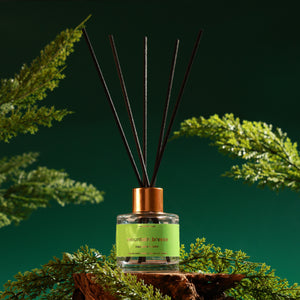
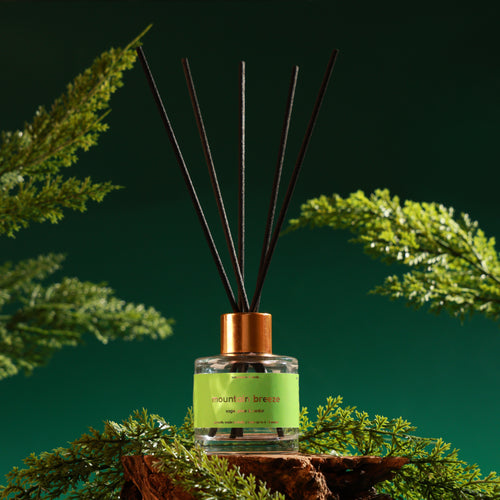
 Mountain Breeze₹849A hood or extraction point that actually captures grinding and brewing byproducts keeps the peak smell from also carrying stale notes into fabric and air, which is often the real cause of a 'flat' afternoon.
What to fix, in what order, before any fragrance decision
Chasing a constant coffee smell skips past the actual causes of a café's quiet-hours problem.
| Fix | Addresses | Fragrance involved? | What it costs |
| Extraction over grinder and machine | The peak smell degrading into staleness | No | A kitchen-fit cost, priced by your extraction contractor |
| Air exchange rate | Dead, stagnant air between rushes | No | An HVAC or ventilation adjustment, not a SOSA product |
| Fabric laundering or replacement schedule | Yesterday's service held in upholstery and curtains | No | A housekeeping cost, not a fragrance one |
| Washroom register | A room with no coffee smell to lean on at all | Yes | Reed ₹749–₹849, Sukoon ₹1,899, or Vaayu ₹11,999 |
| Separated entrance, if one genuinely exists | First impression before the coffee smell is even reached | Sometimes | Reed, Sukoon or Vaayu depending on footprint |
| Three of these five fixes have nothing to do with fragrance at all — get those right first, and the dining room rarely needs anything more. | |||
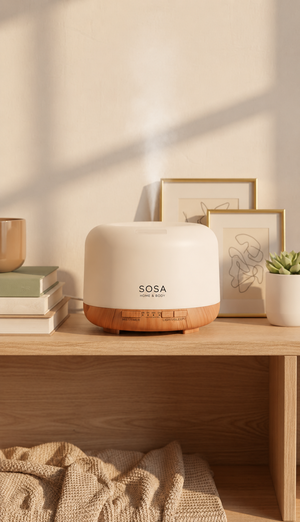
Mountain Breeze · washroom register₹849Shop → 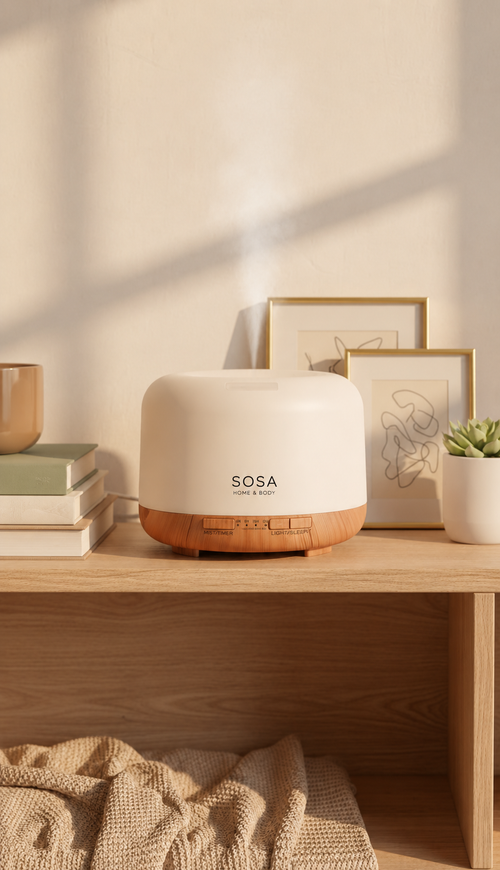 Sukoon · steadier air, no ducting₹1,899Shop →
  Vaayu · zoned across several rooms₹11,999Shop →
Where fragrance is still genuinely allowed
Never use fragrance to manufacture a coffee smell, and never place any fragrance in the dining room, the counter, the tasting bar or the seating — the goal is never a room that always smells like coffee, it's a room where the actual coffee smell isn't competing with anything.
Sometimes scent a genuinely separated entrance — only where a real air boundary, like a second door or distinct air volume, keeps it apart from the dining room; that entrance can hold a clean, dry register regardless of whether coffee is being made ten feet away.
Usually scent washrooms and any retail or merchandise section — rooms with no coffee smell of their own to protect or compete with, where a low, consistent register genuinely helps rather than distracts.
What to buy, once the mechanical fixes are in place
Fragrance equipment belongs on this list only after extraction, air exchange and fabric have already been addressed.
| Route | Premises | Why | What it costs |
| Reed diffuser, Mountain Breeze, washroom | Under 300 sq ft, one washroom | A steady, low-maintenance register unrelated to what's happening in the kitchen | ₹749–₹849 |
| Sukoon ultrasonic, washroom or entrance | 300–750 sq ft, one larger zone | Timers hold a consistent level through both rush and quiet hours alike | ₹1,899 |
| Vaayu, wall or HVAC-mounted | 750 sq ft and above, several zones | Scheduled, adjustable output that doesn't depend on how busy the counter is | ₹11,999 |
| Vaayu, freestanding, retail counter | Any café with a packaged-goods section | Independent of the dining room's air and of service volume | ₹11,999 |
| Aangan, HVAC-integrated | Above roughly 3,000 sq ft, multiple non-dining zones | Distributes evenly through existing ducting, unaffected by rush timing | ₹25,999 |
Owners often come to me at the point they've noticed their café smells incredible at 8am and oddly flat by 3pm, and their first instinct is to ask for something to keep the coffee smell going all day.
I usually turn the conversation to their extraction hood, their air changes and when the cushions were last laundered, because a genuinely flat afternoon is almost always one of those three, not a fragrance gap.
Where I can help is the washroom and, if there's a real one, the entrance — rooms that never had a coffee smell to lose in the first place, and where a clean register does honest, uncomplicated work.
Questions café owners ask about the quiet hours
- Why does my café smell amazing while brewing but neutral between rush hours? — the same question, asked the way most owners actually put it.
- Should I try to make my café smell like coffee all day? — the direct version of the mistake this page argues against.
- Why do sofas, curtains and upholstery hold food smells in a café? — the fabric fix explained in full.
- What should a premium café washroom smell like? — the register question for the zone that always needs one.
- Brand: the SOSA founder story.
SOSA products & prices (verified September 2026): Reed diffusers 50ml ₹749–₹849 (to 150 sq ft, 6–8 weeks at six reeds) · 130ml ₹1,249–₹1,349 (above 150 sq ft, 14–18 weeks) · reed refill 300ml ₹2,399. Ultrasonic: Boond ₹899 (~150 sq ft) · Sukoon ₹1,899 (270–320 sq ft, ships with three 15ml Hotel Collection fragrances) · Megh ₹3,499 (6L tank, ~100 hrs runtime, ~215 sq ft — a runtime machine, not a coverage upgrade). Waterless cold-air: Safar ₹3,999 (no published coverage figure) · Vaayu ₹11,999 (up to 1000 m³, roughly 2,000–3,000 sq ft; 400ml tank lasting about 90+ days; app and onboard control, 1h/4h/8h/24h run windows, adjustable intensity, key-lock, under 38 dB, freestanding or wall/HVAC mount, 5W, CE/RoHS/SGS) · Aangan ₹25,999 (8,000–10,000 sq ft). Hotel Collection water-based fragrance 15ml ₹299 · 100ml ₹999 · 300ml ₹1,799 is for ultrasonic machines; reed oil and Hotel Collection are not interchangeable. Reed diffusers are alcohol-free, phthalate-free, paraben-free, IFRA-compliant and low VOC, handmade in small batches in Pune. Every purchase funds a girl's education through Nanhi Kali. Prices and availability subject to change — see the live product pages.