

Is Leaving a Reed Diffuser Out While I'm Travelling Just Wasting It?

Is Leaving a Reed Diffuser Out While I'm Travelling Just Wasting It?

★ ★ Home after a trip · why a locked flat smells the way it does, and what to do firstCandle ₹379 · reed ₹749 · Boond ₹899 · Sukoon ₹1,899 · free shipping above ₹499A portion funds girl-child education
★ SOSA · when people are coming over
A closed flat has still air, damp in the drains and warm fabric. What you are smelling is stagnation — and fragrance on top of it makes something worse, not better
★ ★ ★ ★ ★
★★★★★
"Two weeks away and the flat smelled closed. Windows, ceiling fans, run the taps for the drain traps. It was fine in an hour, before I put anything on."
Vinay S. Back from holiday
Air + run the taps
★★★★★
"I travel every week and was burning through candles. A reed that just sits there and works whether I am home or not made far more sense."
Preeti M. Weekly traveller, Gurgaon
Reed · always on
★★★★★
"Asked if leaving a reed out while away was a waste. Honest answer: it evaporates either way, so no — but cap it if you are gone a month."
Sameer D. Frequent traveller
Honest on waste
★★★★★
"Monsoon, three weeks away, Mumbai flat. The damp was the actual problem and fragrance would have masked it badly. Dealt with that first."
Jyoti R. Monsoon damp, Mumbai
Fixed damp first
★★★★★
"Every Monday the flat smelled stale after a weekend away. Turned out to be the bathroom drain. Twenty seconds of running water fixed a problem I was trying to buy my way out of."
Rahul N. Weekends away, Pune
It was the drain
★★★★★
"Ten days a month travelling. The Sukoon sat unused; the reed did not. For my life the reed was better value even though it costs less."
Anita K. 10 days/month
Reed over Sukoon
★★★★★
"Two weeks away and the flat smelled closed. Windows, ceiling fans, run the taps for the drain traps. It was fine in an hour, before I put anything on."
Vinay S. Back from holiday
Air + run the taps
★★★★★
"I travel every week and was burning through candles. A reed that just sits there and works whether I am home or not made far more sense."
Preeti M. Weekly traveller, Gurgaon
Reed · always on
★★★★★
"Asked if leaving a reed out while away was a waste. Honest answer: it evaporates either way, so no — but cap it if you are gone a month."
Sameer D. Frequent traveller
Honest on waste
★★★★★
"Monsoon, three weeks away, Mumbai flat. The damp was the actual problem and fragrance would have masked it badly. Dealt with that first."
Jyoti R. Monsoon damp, Mumbai
Fixed damp first
★★★★★
"Every Monday the flat smelled stale after a weekend away. Turned out to be the bathroom drain. Twenty seconds of running water fixed a problem I was trying to buy my way out of."
Rahul N. Weekends away, Pune
It was the drain
★★★★★
"Ten days a month travelling. The Sukoon sat unused; the reed did not. For my life the reed was better value even though it costs less."
Anita K. 10 days/month
Reed over Sukoon
✓ Reed diffusers: no electricity, no routine, steady for months · from ₹749 ✓ Sukoon ₹1,899 · 270–320 sq ft · 16–18 hours per fill · three 15ml scents included ✓ Air the room first · fragrance layers on clean air, it does not replace it


Founder Diaries · Home Fragrance · Travelling and Coming Home
By Sonal Sahani · ISIPCA Versailles 10 min read Updated August 2026
This is the same question as the one about whether to leave the bottle out, asked about money instead, and it deserves an arithmetical answer rather than a reassuring one. A 50ml reed diffuser at ₹749 running for roughly three months works out at about ₹250 a month and about ₹8 a day. A fortnight away is therefore somewhere around ₹115 of oil evaporating into rooms with nobody standing in them. So yes, largely, it is waste in the plain sense of the word. What it buys in exchange is the first thirty seconds of getting home, and whether thirty seconds is worth ₹115 to you is genuinely your decision and not something I should be making on your behalf. Below is the arithmetic, and the alternatives ranked by how much they actually save.
Quick answers — read this first
The number: a 50ml reed at ₹749 over about three months is roughly ₹250 a month, about ₹8 a day, so a two-week trip costs around ₹115 of oil into an empty flat.

The honest verdict: yes, in the plain sense, that is waste. What it buys is the first thirty seconds after the door opens, because a reed left standing has already done its 24 to 72 hours. Whether thirty seconds is worth ₹115 is your call.

The alternatives, ranked: cap the bottle and remove the reeds — saves the most, but used reeds cannot be fully restored, so it is not free. Cut to two reeds — saves roughly half, keeps most of the arrival.

The structural answer for a frequent traveller: an electric diffuser spends nothing at all when it is off. That is the strongest argument the Sukoon at ₹1,899 has against a reed for this particular reader.
The short answer
Short answer: largely yes. About ₹8 a day, so roughly ₹115 across a fortnight , evaporating into a flat nobody is in. It is not a large number and it is not nothing, and calling it anything other than waste would be dishonest — what it buys is the moment you open the door.
The options, ranked by saving: cap the bottle and take the reeds out, which saves nearly all of it but costs you the used reeds and 24 to 72 hours of restart; reduce to two reeds, which saves roughly half and keeps most of the arrival; or leave it exactly as it is and treat ₹115 as the price of a homecoming.
The structural answer: a Sukoon at ₹1,899 spends nothing when it is switched off, and includes three 15ml Hotel Collection scents. For somebody away often that is the strongest argument the machine has against a reed. For somebody away twice a year it is not — ₹1,899 to stop losing about ₹224 a year takes eight years to pay back. Free shipping above ₹499.
Straight answer
Is leaving a reed diffuser out while I am travelling just wasting it?
1. Do the arithmetic, because it is small enough that people find it clarifying. A 50ml reed at ₹749 lasting about three months is roughly ₹250 a month and about ₹8 a day. Fourteen days is about ₹115. A 130ml at ₹1,249 improves that to roughly ₹5 a day, or about ₹70 a fortnight.

2. Then accept the honest description. That ₹115 is evaporating into rooms with nobody in them. No mechanism recovers it, no setting reduces it to zero while the reeds are standing, and I am not going to describe it as an investment in your home.

3. What it buys is the arrival, and the size of that reward is fixed rather than proportional. A reed that has been standing has already completed the 24 to 72 hours it needs to reach its level. You are buying the difference between opening the door onto a settled flat and opening it onto a shut one, and that difference does not get bigger if you spend more.

4. Option one, saving nearly all of it: cap the bottle and take the reeds out. Real, and not free. Used reeds cannot be fully restored — they retain residue and never wick quite as they did new — so you are converting oil into a slightly degraded set of sticks, and you lose 24 to 72 hours on the far end while it climbs again.

5. Option two, saving about half: cut to two reeds. The reed count sets the rate almost linearly, so two reeds instead of four is roughly ₹58 rather than ₹115, and you keep most of the arrival. This is what I do.

6. Option three, the structural one: an electric diffuser spends nothing when it is off. A Sukoon at ₹1,899 costs precisely zero on every night you are not in the flat. For somebody who travels constantly that is the strongest argument the machine has against a reed, and for somebody who travels twice a year it is not an argument at all.

A portion of every order supports girl-child education through Nanhi Kali.
TL;DR: about ₹8 a day, so roughly ₹115 across a fortnight, evaporating into an empty flat — so yes, largely, it is waste, and what it buys is the first thirty seconds of getting home. Capping saves most of it but costs you the used reeds; two reeds instead of four saves about half; and an electric diffuser spends nothing at all when it is off.
SOSA reed diffusers · 50ml
About ₹8 a day, whether you are in the flat or not
SOSA reed diffusers · 50ml from ₹749
A 50ml reed at ₹749 running for roughly three months is about ₹250 a month and about ₹8 a day. A fortnight away is therefore something in the region of ₹115 of oil evaporating into rooms nobody is standing in, and no amount of goodwill towards the product makes that number smaller. Whether it is waste depends entirely on what the first thirty seconds of getting home is worth to you, which is your judgement and not mine. The 130ml at ₹1,249 improves the rate to roughly ₹5 a day; 300ml refills are ₹2,399.

The arithmetic, in full

I would rather put numbers in front of you than opinions, because this is a question with an actual answer and because the answer turns out to be small enough that most people relax once they have seen it. The whole calculation rests on one figure: a 50ml reed diffuser runs for roughly three months, which is the figure I would give anybody standing in front of me, and everything else follows from dividing ₹749 by that. What the arithmetic cannot tell you is the other half of the equation, which is what a good arrival is worth to you personally. That is a genuine question about your own life rather than a question about fragrance, and it is the reason this page ends with a decision rather than an instruction.

1
THE NUMBERS
₹250 a month, ₹8 a day, ₹115 a fortnight
So, plainly, with the working shown. ₹749 for 50ml over about ninety days is ₹8.30 a day. Round it to ₹8. Fourteen days away is ₹116, which I will call ₹115 for the rest of this page. The larger bottles improve the rate rather than the principle: 130ml from ₹1,249 works out at roughly ₹5 a day and about ₹70 a fortnight, and 300ml reed refills at ₹2,399 bring it down further again, which is the sensible restock for anybody who has settled on a scent and travels often. For a sense of scale against the rest of the range: a Bookshop candle at ₹379 burning fifteen to eighteen hours is roughly ₹22 an hour while it is alight, so ₹115 of reed is about five hours of candle, and a 15ml Hotel Collection bottle at ₹299 run at four drops a tank is somewhere near seventy-five evenings. Now the uncomfortable framing, since the title of this page asks for it: that ₹115 has produced nothing measurable. Nobody smelled it. It was not preserving the flat, it was not deterring anything, it was not doing a job. It evaporated into rooms that were empty, at a rate set by the temperature of those rooms, and if the flat was hot it evaporated faster than ₹115. Anybody who tells you otherwise is selling. The correct response to that is not embarrassment; it is simply to decide, with the number in front of you, whether the thing it buys is worth it.
2
THE OPTIONS
Cap it, halve it, or leave it — ranked by what each actually saves
Three courses of action and they save different amounts at different costs. Capping saves the most and it is not free, which is the part people miss. Take the reeds out, put the stopper back, and the meter stops — you keep essentially the whole ₹115. But used reeds cannot be fully restored. A reed that has wicked oil for weeks holds residue in its pores; wiping it and drying it recovers most of its behaviour and not all of it, and a set of reeds that has been through this two or three times genuinely does deliver less than a fresh one. So capping converts oil into slightly degraded sticks rather than into pure savings. It also costs you the far end: restart the bottle on the night you land and it needs 24 to 72 hours before it is doing anything, which means the entire reward this exercise exists for is gone. Halving saves about half and keeps almost all of the reward, which is why it is what I actually recommend. The reed count sets the evaporation rate close to linearly, so two reeds rather than four is somewhere around ₹58 rather than ₹115, and two reeds is comfortably enough to hold a hall at a level you will notice when you walk in. It takes thirty seconds on the way out. And leaving it entirely alone saves nothing and is a perfectly defensible choice if ₹115 across a fortnight is not a number you want to spend attention on, which for a lot of people it honestly is not — it is less than a single restaurant dessert, and thinking about it twice a year has a cost of its own.
3
THE STRUCTURAL ANSWER
An electric diffuser spends nothing when it is off
Then the option that is not a setting but a different product, and it is the only one that removes the question rather than reducing it. A Sukoon at ₹1,899 costs exactly nothing on any night you are not in the flat. Not a reduced amount. Nothing. It is a 500ml BPA-free tank rated for 270–320 sq ft, 16–18 hours per fill on low at 30–50 ml/h against 9–12 on high, with a 2.4MHz cool-mist plate, a remote, auto shut-off and steady, 2H and 4H timers, and it includes three 15ml Hotel Collection scents of your choice. The fragrance sits in a sealed bottle until the evening you decide to use it, which means consumption tracks your presence exactly rather than tracking the calendar. For somebody who is out of the flat a great deal, that is not a convenience feature — it is the whole argument, and it is the strongest single case the machine has against a reed for this particular reader. But it is only an argument at a certain frequency, and I would rather do that arithmetic than let it sit unstated. If you go away for two fortnights a year, you are losing about ₹224 annually to a standing reed. Spending ₹1,899 to stop losing ₹224 a year takes over eight years to pay for itself, and buying a diffuser on that reasoning would be a poor decision that I am not going to encourage. Buy the machine because you want timers, control and a scent you can change, or because you are away half the year. Do not buy it to save ₹115.
The honest summary of the whole page: ₹115 is the price of the moment the door opens. If that moment matters to you, it is a fair price. If it does not, cut to two reeds and pay ₹58, or cap it and pay nothing and arrive to a flat that smells of nothing in particular.

The four options, ranked by what they save

Everything on one line each, with the actual saving against a standing bottle over a fortnight, and — more importantly — what each option costs you that is not money. There is no option in this table that is free of trade-offs, including the one that saves the most, and the third column is where the real comparison happens rather than in the second.

Fourteen days away
What each option saves, and what it costs you
Option Oil spent over a fortnight What it costs you Best for Price
Cut to two reeds ★ About ₹58 instead of ₹115 Thirty seconds on the way out, and a slightly lower level on arrival Almost everybody. It keeps the reward and halves the bill, which is the best trade on this page Free to do
Leave it exactly as it is About ₹115 Nothing, except the ₹115 — and a real risk of accumulation in a shut flat with a full set of reeds Short trips, cool months, and people who would rather not think about it twice a year Free to do
Cap it and remove the reeds Nothing, once capped The used reeds, which never fully restore; plus 24 to 72 hours of restart, so you lose the arrival entirely Trips longer than about three weeks, where the reward is too far off to justify the oil Free to do
Move to 130ml or 300ml refills About ₹70 at 130ml, less again from a 300ml refill A larger amount committed upfront to one scent you had better be sure about People who already know which bottle they keep rebuying and travel regularly from ₹1,249 / ₹2,399
Buy a Sukoon instead Nothing — it spends only on the evenings you are in the room ₹1,899 upfront, a plug point, and the loss of the always-on arrival a reed gives you Somebody away half the year. Not somebody away a fortnight twice a year — that payback runs past eight years ₹1,899
A room spray for the home — SOSA does not make one; the sprays in the range are car perfumes, and a spray is a thirty-minute product in any case Nobody, for this job. Printed here because the question comes up —
Shop this guide
The three products this decision is actually between
The SOSA principle
₹115 across a fortnight is the price of the moment the door opens. Whether that moment is worth ₹115 is your call, and I am not going to make it for you.
Two reeds instead of four halves the bill and keeps most of the reward. Capping saves nearly all of it and loses the whole point. An electric diffuser spends nothing at all when it is off.

When the machine is the right answer, and when it is not

Start with the case where the reed stays, because it is most people. If you travel a few times a year and the flat is otherwise occupied, the reed is the right format and the arithmetic on this page should not change your mind about it. A reed asks nothing of you — no plug point, no tank, no rinsing, no remembering — and for a background scent in a hall or a bathroom that is genuinely valuable rather than merely convenient. The correct response to a fortnight away is the thirty-second version: pull the reeds down to two or three, move the bottle off any windowsill and out of the afternoon sun, and do not flip anything on your way out. That takes ₹115 to about ₹58 and keeps essentially all of the arrival. If your trips are longer than three weeks, cap it instead and accept that you are trading the homecoming for the oil, which at that duration is the right trade. If you are buying reeds fresh each time, the size ladder is worth knowing: 50ml from ₹749, 130ml from ₹1,249, duos from ₹1,498 and 300ml refills at ₹2,399. The larger sizes do not change the rate, which is set by exposed reed length and by the temperature of the room, but they improve the rupees-per-day figure substantially and they are the sensible purchase once you have stopped experimenting with scents.

Then the case where the format itself is the problem, which is a smaller group and a clearer one. Once you are out of the flat something like half the time, a product that spends by the calendar is structurally wrong and no amount of pulling reeds out will fix it. Half of everything you buy is going into an empty building, and the fix is not a setting but a different machine. A Sukoon at ₹1,899 consumes only when it is switched on: 500ml, 270–320 sq ft, 16–18 hours per fill on low at 30–50 ml/h against 9–12 on high, a 2.4MHz cool-mist plate, a remote, auto shut-off, a BPA-free tank, steady, 2H and 4H timers, and three 15ml Hotel Collection scents of your choice included, which is ₹897 of fragrance in the box. The Hotel Collection is composed at three to six drops per tank — per tank rather than per litre, since you are scenting the mist and not the water — so a 300ml Boond at ₹899 takes exactly the same four drops as the 500ml machine, and at four drops an evening a single 15ml bottle at ₹299 covers something like seventy-five evenings. Against a reed's ₹250 a month by the calendar, that is a different order of cost for somebody who is only home half the time, and the full year-by-year version of that comparison is in the page on the most economical setup for a weekly traveller.

Two honest limits and a principle. The first limit: do not buy a machine to save this money unless the frequency justifies it. Two fortnights a year is about ₹224 of standing reed, and ₹1,899 against ₹224 a year is an eight-year payback, which is not a reason to buy anything. The reasons to buy a Sukoon are the timers, the ability to change scent, the twenty-minute start from cold and the fact that it turns itself off — all of which are good reasons, and none of which is this one. The second limit: switching format does not give you the reed's best property back. A machine cannot be running when you walk in unless you have left it running, which for two weeks is neither sensible nor cheap; the reed's ability to have finished its 24 to 72 hours before you arrive is unique to the format, and that is precisely what you give up. The comparison is set out properly in the reed-against-Sukoon page for coming home. And the principle, which applies to this page as much as to any other in the cluster: what you walk into after a fortnight is mostly decided by free things rather than by bought ones. A mug of water down every drain and two windows on opposite walls will change more about that first minute than ₹115 of oil ever will, and the first-hour page sets that out step by step. On the constraints: reed oil never goes into an ultrasonic diffuser, where it clogs the 2.4MHz plate, the water-based Hotel Collection never goes into a reed or into the waterless Vaayu, and SOSA does not make a room spray for the home.

Nobody smelled it. That is the whole of the case against, and the only question left is whether the ten seconds after the door opens is worth ₹115 to you.
— Sonal Sahani, SOSA

The SOSA edit

Ranked by what I would actually advise rather than by what each saves, because the largest saving on this page is also the one that destroys the reason for doing any of it. The last row is what capping genuinely costs you, printed rather than glossed.

The SOSA edit
A fortnight away, in order of what I would do
Do this What it saves What I actually think Cost
1. Two reeds instead of four ★ About ₹57 of the ₹115 The best trade on this page. Half the bill, almost all of the arrival, thirty seconds of work on the way out Free
2. Move it off the sill and out of the sun Meaningfully more in summer than in winter — heat is the largest variable Free, ten seconds, and in a hot closed flat it matters more than the reed count does Free
3. Accept the ₹115 and leave it alone Nothing Entirely defensible. It is less than one restaurant dessert, and attention has a cost too Free
4. 300ml reed refill or a 130ml bottle Takes the daily rate from about ₹8 to about ₹5 or lower For somebody who travels often and has already settled on a scent. Do not buy a large size to solve indecision ₹2,399 / from ₹1,249
5. Sukoon, if you are away half the year Everything, on the nights you are away — a switched-off machine spends nothing The structural answer, and only at that frequency. Two trips a year does not justify it ₹1,899
What capping costs: the used reeds, and the arrival Nearly the whole ₹115 Used reeds never fully restore, and a restarted bottle needs 24 to 72 hours — so you lose the only thing the oil was buying —
Honest notes for buyers: fragrance is the last step, not the first — it layers on air that is already clean and moving, and it will not cover cooking, damp or a room that has been shut for weeks. Timing matters as much as product: a candle scents a room in fifteen to twenty minutes and a Sukoon in about twenty, which is why both work when people are arriving tonight, while a reed diffuser needs a day to three days before it is doing its job properly — it is the wrong buy for a deadline and the right buy for a room you want to hold a steady scent for months. SOSA does not make a room spray for the home; the sprays in the range are formulated and sized for a car. The Hotel Collection is water-based and runs in the Sukoon, Boond and Megh only — not in reeds, and not in the waterless Vaayu. Reed diffusers are a separate alcohol-free line with their own scents. Candles must be attended and put out before guests leave a room unattended. The Hotel Collection scents are SOSA's own interpretations inspired by the world's finest hotels; SOSA is an independent Indian fragrance house, not affiliated with or endorsed by any hotel brand. A portion of every order supports girl-child education through Nanhi Kali.
SOSA Sukoon
The one thing a reed cannot do is stop
SOSA Sukoon ₹1,899
₹1,899 for a 500ml BPA-free tank, 270–320 sq ft, 16–18 hours per fill on low at 30–50 ml/h, a 2.4MHz cool-mist plate, a remote, auto shut-off and steady, 2H and 4H timers, with three 15ml Hotel Collection scents of your choice included. Switched off, it costs nothing at all — not a rupee a week, not a rupee a month. For somebody who is out of the flat half the year that is not a feature of the machine, it is the entire argument for it, and it is the only argument in this comparison a reed cannot answer.
SS
ISIPCA
Versailles
A note from Sonal

Somebody emailed me this exact question last summer and I did the sum on the back of a courier slip before replying, because I did not know the answer either. ₹749 divided by ninety days is ₹8.30. Fourteen days is ₹116. That is what the argument is about. I found the number oddly settling, and so did he. It is not a trivial amount and it is not a serious one, and once it is written down the question stops being about waste in the abstract and becomes a straightforward domestic choice, like whether to leave a light on in the hall. Most of the anxiety in this question comes from not knowing the size of the thing being worried about.

My own answer is two reeds and a moved bottle, which costs me about ₹58 a fortnight and buys the thing I actually want, which is a flat that does not feel shut when I come back at one in the morning. But I will not tell you that ₹115 was doing something useful while you were away, because it was not. Nobody smelled it. If that bothers you, cap the bottle, take the reeds out, and know that you are trading the homecoming for the oil — a fair trade, and the right one over three weeks. And if you travel constantly rather than occasionally, the honest advice is that the format is wrong for your life rather than the setting, and a machine that spends nothing when it is off will serve you better. That is the one argument the Sukoon wins outright against a reed, and I would rather make it here than pretend the reed answers every situation.

Everything is made and supported from Pune, and a part of every order funds girl-child education through Nanhi Kali. You get a home that smells like somewhere you chose; a girl gets a classroom. That equation has always felt right to me.

Frequently asked questions

Is leaving a reed diffuser out while travelling a waste of money?
Largely, yes, in the plain sense. A 50ml reed at ₹749 lasting about three months is roughly ₹8 a day, so a fortnight away is around ₹115 of oil evaporating into an empty flat. What it buys is the moment you open the door, since a standing reed has already done its 24 to 72 hours.
How much does a reed diffuser cost per day?
About ₹8 for a 50ml bottle at ₹749 running roughly three months — around ₹250 a month. A 130ml from ₹1,249 works out nearer ₹5 a day, and 300ml refills at ₹2,399 lower it again. The rate is the same whether or not anybody is in the flat.
Does capping the bottle save the money?
Almost all of it, but not for free. Used reeds retain residue and never fully restore, so you are converting oil into slightly degraded sticks, and a restarted bottle needs 24 to 72 hours to reach its level — which means you lose the arrival the oil was buying in the first place.
What is the cheapest way to keep a scent going while I travel often?
Reduce to two reeds and move the bottle off the windowsill, which halves the rate for free. If you are away something like half the year, the structural answer is a Sukoon at ₹1,899, which spends nothing at all on the nights it is switched off and includes three 15ml scents.
Should I buy a Sukoon just to stop wasting reed oil?
Only if you travel a great deal. Two fortnights a year is about ₹224 of standing reed, and ₹1,899 against ₹224 a year is an eight-year payback. Buy the machine for the timers, the twenty-minute start and the ability to change scent — not to save ₹115.
₹8 a day, and what it buys
The oil goes either way — the only question is what you get back for it
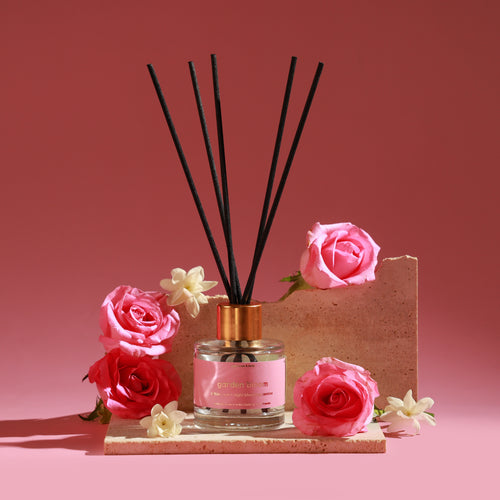
Reed diffusers are ₹749 for 50ml at Morning Freshness, ₹799 for Garden Bloom and Evening Calm and ₹849 for Fresh Brew and Mountain Breeze, with 130ml from ₹1,249, duos from ₹1,498 and 300ml refills at ₹2,399. The Sukoon is ₹1,899 for 270–320 sq ft with steady, 2H and 4H timers, three 15ml Hotel Collection scents included, and it spends nothing at all on the nights it is switched off. Free shipping above ₹499, and a portion of every order supports girl-child education through Nanhi Kali.
See the reed diffusers → See the Sukoon · ₹1,899
Continue the read
More from SOSA
Editorial standards & sources
About this guide: Written by Sonal Sahani, ISIPCA Versailles-trained founder and perfumer at SOSA Home & Body, costing out what a reed diffuser actually spends while its owner is travelling — roughly ₹250 a month and ₹8 a day from a ₹749 50ml bottle, so about ₹115 across a fortnight — with the alternatives ranked by what each genuinely saves, why capping is not free, why used reeds never fully restore, and at what travel frequency an electric diffuser that spends nothing when off becomes the honest answer.

Facts verified August 2026: Timings in this guide: a scented candle puts noticeable fragrance into a normal room in roughly 15–20 minutes; a Sukoon ultrasonic diffuser reaches a steady level in about 20 minutes from cold; a reed diffuser needs roughly 24–72 hours for the oil to travel the reeds and the room to settle, so it is not a same-day solution. SOSA products and prices: Sukoon 500ml ultrasonic diffuser ₹1,899 (270–320 sq ft, 16–18h on low, 9–12h high, 30–50 ml/h, 2.4MHz cool mist, 7-colour LED, remote, steady/2H/4H timers, BPA-free, auto shut-off, includes three 15ml Hotel Collection scents of your choice); Boond 300ml ₹899; Megh 6-litre ₹3,499; waterless Vaayu ₹11,999 (up to 1000m³); Aangan ₹25,999; Meenar ₹38,500. Hotel Collection water-based fragrance 15ml ₹299, 100ml ₹999, 300ml ₹1,799, Pack of 7 at 15ml ₹1,799 / 100ml ₹5,999 / 300ml ₹10,799; dose 3–6 drops per tank. Reed diffusers (separate alcohol-free line): Morning Freshness from ₹749, Garden Bloom and Evening Calm from ₹799, Fresh Brew and Mountain Breeze from ₹849; 130ml from ₹1,249; duos from ₹1,498; 300ml refills ₹2,399. Scented candles: Bookshop 80g ₹379 (~15–18 hours), Bookshop + Cozy Corner ₹664 (~30–36 hours), Amber Rose 130g ₹599 (~25–30 hours) and 220g ₹799 (~40–50 hours), ceramic jar candles ₹949, Pure Calm wax melt set ₹854. Free shipping above ₹499. SOSA does not make a room or linen spray for the home — the sprays in the range are car perfumes. The Hotel Collection scents are SOSA's own interpretations; SOSA is not affiliated with or endorsed by any hotel brand. Prices subject to change — see the live product pages.
Torna al blog