Founder Diaries · Clinics & Medical Centres · From Sprays and Reeds to the Machine
By Sonal Sahani · ISIPCA Versailles 11 min read Updated September 2026
For the public areas of a working clinic, yes — and I want to set out the comparison as an operating one rather than a technical one, because the specification sheets do not decide this and the housekeeping roster does.
Five columns settle it: the daily task, what happens in a monsoon month, what lands on nearby surfaces, what the consumable costs, and how much floor area one machine actually holds. A waterless machine such as the
Vaayu at ₹11,999 wins three of those decisively. The water-based
Sukoon at ₹1,899 wins two of them outright and it is not close, so I will say which two first and let you decide whether this page is addressed to you at all.
Quick answers — read this first
The short answer: for public clinical areas, the waterless machine. The deciding factor is the daily task — a water tank has to be emptied, rinsed and dried every day by a named person, and a waterless machine has nothing to empty.
Where the ultrasonic honestly wins: price, at ₹1,899 against ₹11,999 with three 15ml scents included, and fragrance cost, which is trivially small. If the job is one administrative cabin with a named owner, buy the
Sukoon.
The numbers: an ultrasonic puts 30–50 ml of water an hour into the air, so twelve hours is 360–600 ml a day. The
Vaayu covers up to 1000 m³ against 270–320 sq ft, on a 400ml tank lasting about seventy-five days. No page here claims a clinical or air-cleaning effect for either machine.
The short answer
Short answer: for the public areas of a clinic, a waterless machine is the better choice, and the reason is housekeeping rather than medicine. A water tank is a daily task — empty, rinse, dry — owned by a named person, six days a week. A waterless machine has no reservoir and adds nothing to the roster. For one administrative cabin with a named owner, the water-based machine is still right.
The pick: the
Vaayu at ₹11,999 for the entrance, reception, waiting areas and inter-departmental corridors — waterless, up to 1000 m³, 400ml lasting about seventy-five days, app plus 1h/4h/8h/24h timers, under 38 dB, key-lock. The
Sukoon at ₹1,899,
Boond at ₹899 or
Megh at ₹3,499 for a single cabin behind a door, where one person owns the tank.
Shop: the
Vaayu ₹11,999 and the
Aangan ₹25,999 (up to 3,000 m³, HVAC or standalone). Ultrasonics are water-based:
Sukoon ₹1,899 with three 15ml scents included,
Boond ₹899,
Megh ₹3,499, running the
Hotel Collection at ₹299 for 15ml and ₹1,799 for 300ml at about ₹6 per millilitre, three to six drops per tank. Free shipping above ₹499.
Straight answer
Is a waterless scent machine genuinely a better choice for a clinic than a water-based diffuser?
1. In the public areas, yes, and the deciding column is the daily task. A water-based machine holds standing water. In a building that is open twelve hours a day that tank has to be switched off, emptied, rinsed and left to dry every evening, and filled again every morning, by a person whose name is written down. A waterless machine has nothing to empty and nothing to dry.
2. It is a housekeeping argument, not a clinical one, and I will not stretch it. I am not telling you a tank is unsafe and nothing on this page suggests it is. I am telling you it is a job, six days a week, that somebody in your building has to own, and that in most clinics nobody owns it after the first month.
3. Where the ultrasonic wins outright: price. ₹1,899 against ₹11,999, with three 15ml
Hotel Collection scents of your choice included. That is a sixth of the money, and if the job is genuinely one cabin then spending ₹11,999 on it would be a poor decision.
4. And fragrance cost, where it wins again. Three to six drops per tank, per tank rather than per litre, from a 15ml bottle at ₹299 or a 300ml at ₹1,799 at about ₹6 per millilitre. The consumable cost of running an ultrasonic is close to nothing. What you are actually paying is five minutes a day of somebody's time.
5. Where the waterless machine wins: coverage, the monsoon and what lands on your surfaces. One
Vaayu holds up to 1000 m³ against 270–320 sq ft for one
Sukoon. An ultrasonic adds 30 to 50 ml of water an hour to the air, which is 360 to 600 ml a day at twelve hours. And hard water leaves a fine white mineral dust on the surfaces near the machine, which in a reception is a file tray and a keyboard.
6. Before either of them: the source, and the zones. If the building smells of something, that smell is information about a dry drain trap, a bin schedule, a linen route or an air-conditioning drain pan, and the job is to find it and fix it rather than covering it. And whichever machine you buy, consultation and examination rooms, procedure rooms, dressing rooms, sample collection, laboratories, dispensing, sterile stores, imaging, oncology day-care and paediatric clinical areas stay fragrance-free.
A portion of every order supports girl-child education through Nanhi Kali.
TL;DR: for public clinical areas, the waterless machine, and the deciding column is the daily task rather than anything clinical: a tank must be emptied, rinsed and dried every day by a named person, and the
Vaayu at ₹11,999 has nothing to empty. The ultrasonic wins price and consumable cost outright — ₹1,899 with three scents included — so for one administrative cabin with a named owner the
Sukoon is still the right buy.
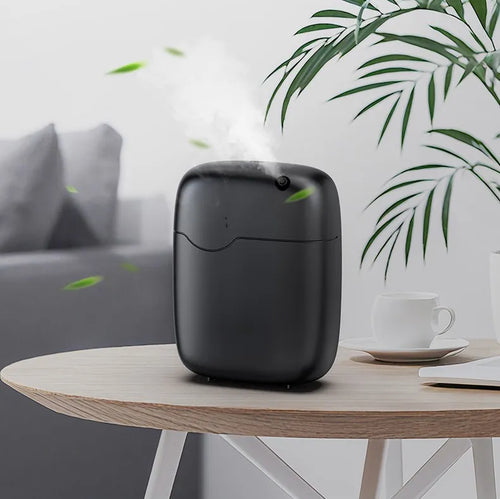
Nothing to empty, nothing to rinse, nothing to dry
SOSA Vaayu · no reservoir ₹11,999
Undiluted oil atomised to a dry, residue-free nano-mist, with no water in the machine at any point. The operating difference is one line long: a waterless machine adds nothing to the housekeeping roster, and a water-based one adds a task at open and a task at close, every day the building is open, owned by a person who has to be named. That is a rostering fact rather than a clinical one and I will not dress it up as anything else. Up to 1000 m³, roughly 2,000–3,000 sq ft, a 400ml tank lasting about seventy-five days, app plus onboard 1h/4h/8h/24h timers, under 38 dB, auto-stop, key-lock.
Five columns, and the two the ultrasonic wins
Most comparisons of these two categories are written as though the question were about mist particle size, and in a clinic it is not. The question is what each machine asks of your building every day for the next five years, and that is answered in five columns: the daily task, the monsoon, the surfaces, the consumable and the coverage. I am going to work through them in that order, starting with the two the water-based machine wins, because a comparison that only lists the winner's strengths is a sales page rather than an answer, and because a clinic that is told honestly where the cheap option is correct will believe what it is told about where it is not.
1
THE CONCESSION
₹1,899, three scents included, and one cabin where it is simply right
So here is the half of the argument that goes the other way, in full.
The Sukoon is ₹1,899 against ₹11,999 for the Vaayu, and it arrives with three 15ml Hotel Collection scents of your choice, which means a working setup for under two thousand rupees against something close to six times that. It is a 500ml BPA-free tank rated for 270–320 sq ft, 16 to 18 hours per fill on low at 30 to 50 ml an hour, a 2.4MHz cool-mist plate, a remote, steady, 2H and 4H timers and auto shut-off. The
Boond at ₹899 does the same job in 300ml for a smaller room. On consumable cost it wins again and it is not close: three to six drops per tank, per tank rather than per litre, so a 15ml bottle at ₹299 runs a small machine for weeks and a 300ml at ₹1,799 works out at about ₹6 per millilitre and lasts a very long time indeed.
If what you are actually scenting is one administrative cabin behind a door — a centre head's room, a back office, a records room, a small consultation-suite lobby — and there is one named person who locks that room at the end of the day and will empty, rinse and dry the tank as part of locking up, then the ultrasonic is the correct purchase and I would rather sell you the ₹1,899 machine. The administrative and back-office question has its own page, and that is where this machine belongs. Everything that follows is about the other case: the public, patient-facing volume of a clinic that is open twelve hours a day.
2
THE DAILY TASK
Empty, rinse, dry — six days a week, by somebody with a name
Now the column that decides the whole comparison, and I want to be precise about what I am claiming and what I am not.
I am not making an infection-control argument, this is not hygiene science, and nothing here suggests a tank of water is a risk to anybody. The argument is about a roster. A water-based machine is a machine with a daily routine attached: switch off, unplug, carry the tank to a sink, pour out what is left, rinse it, wipe it out, leave it to dry overnight, and in the morning refill it with fresh water and three to six drops. That is roughly five minutes at close and two at open, and it has to happen on every day the building opens or it does not happen at all. In a clinic running six days a week that is about 624 separate operations a year per machine.
The failure mode is not dramatic and that is exactly why it catches people: the tank simply stops being emptied and starts being topped up instead. Nobody decides this. The person who was doing it goes on leave for a wedding, the person covering was never told, and topping up is faster and looks identical. Three weeks later the machine is running on water that has been sitting in it, the fragrance has gone flat and dull, and somebody responds by adding more drops, which is the wrong response to every problem in this field. A waterless machine has no version of this failure because it has no tank: the routine is one refill about every seventy-five days, which is four or five visits a year by one person.
The standing-water routine is written out in full on its own page, and
who owns the refill in the first place is a separate question worth settling before you buy.
3
MONSOON AND SURFACES
360 to 600 ml of water a day, and what settles under the machine
Then the two columns nobody thinks about until July.
An ultrasonic does not merely mist: it converts 30 to 50 millilitres of water an hour into airborne mist, so a twelve-hour clinic day is 360 to 600 millilitres, and a six-day week is between two and a half and three and a half litres of water added to the air of your building. For eight months of the year in most Indian cities that is neither here nor there. In a Pune or a Kochi or a Mumbai monsoon, when the air outside is already carrying close to as much moisture as it will hold and your air conditioning is working hard to take moisture out, you are putting it back in, at the rate of a large bottle a day, in the room with the glass partition and the file racks. The visible results are ordinary estate problems rather than anything more serious: condensation on a cold glass screen near the machine, a ring on a laminate reception counter, a soft-looking ceiling tile if the unit sits under a vent.
Then the surfaces, which is the column I get asked about most once somebody has experienced it. A cold mist falls rather than rises, and in the hard water most Indian cities supply it carries dissolved minerals that are left behind as a fine white dust on everything within a metre or two. In a home that is a side table. At a clinic reception it is a stack of investigation forms, a card machine and a keyboard, and it is a wipe-down somebody now owns. The same minerals build up on the 2.4MHz plate itself, output falls, and the usual response is to turn the machine up, which is how a setting that was correct in March is wrong by August. The
Vaayu atomises undiluted oil to a dry, residue-free mist and adds no water to the air at all, which removes both columns from the conversation.
Monsoon damp in a clinic has a page of its own and the answer there is never a fragrance one.
The way I would frame the whole comparison to a facility manager: you are not choosing between two fragrance technologies. You are choosing whether or not to add a twice-daily task to a roster that is already full, and the machine that adds none of them costs ₹11,999.
The operating comparison in full
The same five columns set out side by side, with a sixth for where each machine honestly belongs. I have kept the assessment to what a facility manager can verify: what somebody has to do each day, what goes into the air, what lands on the furniture, what it costs to run and how much volume it holds. No row in this table claims a clinical, therapeutic or air-cleaning effect for anything, because there is not one to claim.
Waterless against water-based
An operating comparison, for a building open twelve hours a day
|
Vaayu · waterless |
Sukoon · 500ml ultrasonic |
Boond · 300ml ultrasonic |
Megh · 6 litres |
| Daily task ★ |
None. One refill about every 75 days — four or five a year |
Empty, rinse, dry at close; fill at open. About 624 operations a year |
Identical routine, smaller tank |
Identical routine, six litres to carry |
| Water into the air |
None. Undiluted oil, dry residue-free mist |
30–50 ml an hour — 360–600 ml a day at twelve hours |
Same rate, shorter run per fill |
Same rate, far longer between fills |
| Residue on nearby surfaces |
None |
Fine mineral dust within a metre or two in hard-water cities |
The same, over a smaller radius |
The same, over a larger one |
| Consumable cost |
One 400ml fill a quarter; four scents ship with the machine |
Three to six drops per tank: ₹299 for 15ml, ₹1,799 for 300ml at about ₹6/ml |
Identical drops per tank — the dose is per tank, not per litre |
Identical drops per tank |
| Coverage |
Up to 1000 m³, roughly 2,000–3,000 sq ft |
270–320 sq ft |
A single small room |
A large open volume, still water-based |
| Control |
App plus 1h/4h/8h/24h timers, adjustable intensity, auto-stop, key-lock |
Remote, steady/2H/4H timers, auto shut-off, no lock |
Timer and auto shut-off, no lock |
Timer and auto shut-off, no lock |
| Price |
₹11,999 |
₹1,899, with three 15ml scents included |
₹899 |
₹3,499 |
| Where it honestly belongs |
Entrance, reception, waiting halls, inter-departmental corridors |
One administrative cabin with a named owner |
A small office or records room |
A large administrative or staff area with an owner |
Shop this guide
The two honest setups, in three products
The SOSA principle
This is not a comparison of two fragrance technologies. It is a comparison of two rosters. One of them adds a task at open and a task at close, six days a week, for as long as you own the machine.
Which is why the question to settle before the purchase order is not which machine, but who empties it — and what happens in the week that person is away.
Sizing it, running it, and the zones that get neither
Start with sizing, because the coverage column is where most clinics discover the comparison is not close. The arithmetic is cubic metres equal floor area in square feet divided by 10.76, multiplied by the ceiling height in metres, and the only areas that go into the sum are the ones you are actually scenting. Take a straightforward 4,000 sq ft polyclinic at a three-metre ceiling. On the brochure that is 372 square metres and about 1,115 m³, which sounds like more than one machine. But the consultation cabins, the two procedure rooms, the dressing room, the sample-collection room, the laboratory and the dispensing counter are fragrance-free and their doors are shut, and in most clinics that is 40 to 60 per cent of the plan. What is left — entrance, reception, the waiting hall, the corridors between departments and the lift lobby — might be 1,700 sq ft, which is 158 square metres and about 474 m³. One Vaayu holds that comfortably, on a middling intensity rather than at full. To hold the same volume with 270–320 sq ft ultrasonics you would need five or six machines, which is ten or twelve tank operations every day, and at that point the comparison has stopped being about money. Whether one machine can cover a clinic is worked through separately and a 3,000 sq ft facility has its own sizing page.
Then running it, which is one decision rather than several. The machine starts about thirty minutes before the first appointment, reaches its level before anybody arrives, holds one intensity all day and stops with the last appointment. A room that has already arrived at its level reads as a property of the building; a room still climbing while patients are in it reads as something being done to them. The Vaayu has 1h, 4h, 8h and 24h onboard timers plus Bluetooth app scheduling, so the facilities team sets the opening hours once and the centre head never touches it. Set the intensity in the first week by walking in cold each morning before the building fills, then lock it with the key-lock and leave it. The single instruction that matters most: nobody turns it up at midday because the waiting hall got busy. Busy is a ventilation and occupancy problem and adding fragrance to it makes the room worse rather than better. Placement follows the same rules either way — three to four metres inside the door rather than at the threshold, above waist height because a cold-air mist falls, at the edge of the zone rather than in the traffic line, and out of the direct throw of an air-conditioning vent, which strips the light top off a composition and leaves the heavy end standing alone. Under 38 dB matters in a clinic more than in most buildings because reception so often shares a wall with a cabin, and the noise question deserves a straight answer.
Then the zones and the honest limits, which apply identically to both machines and are the part of this page I would least like you to skip. Neither a waterless nor a water-based machine belongs in consultation and examination rooms, treatment and procedure rooms, day-care surgery and recovery, dressing rooms, blood- and sample-collection rooms, diagnostic laboratories, pharmacy dispensing, sterile stores, imaging rooms, oncology and chemotherapy day-care or paediatric clinical areas. Those rooms are fragrance-free by default with the doors shut, and the reasons are worth knowing rather than accepting: a clinician is trained to notice what a room and a patient smell of, people feel faint in a sample-collection room, aversion to smells during treatment is well known to any oncology nurse, and children cannot consent to something their parents did not choose either. The full fragrance-free list is here. On the products themselves: the Vaayu and the Aangan take their own undiluted oil rather than the water-based Hotel Collection bottles, and the Vaayu ships with four hotel-inspired fragrances. Never put raw essential or carrier oils into an ultrasonic, which clogs the 2.4MHz plate, and rinse the tank when changing scent. An alcohol-free reed diffuser from ₹749 takes 24 to 72 hours to establish and is barely noticed past about a metre, which makes it an admin-cabin product. Candles are not appropriate in a healthcare building because an open flame is a fire-safety and insurance matter. SOSA does not make a room spray, and we do not make a plug-in either, for reasons that start with your electrician.
A water tank is not a hazard and I am not going to call it one. It is a job — twice a day, six days a week — and the question is only whether anybody in your building has actually been given it.
— Sonal Sahani, SOSA
The SOSA edit
In buying order for a clinic choosing between the two categories. The first row is the free work that comes before either of them, the third row is the concession this page has made twice already, and the last row prints an absence rather than leaving you to find it.
The SOSA edit
Waterless or water-based, in buying order
| Buy |
What it is |
When it earns its place |
Price |
| 1. Vaayu for the public volume ★ |
Waterless cold-air nebulisation, no reservoir, up to 1000 m³, 400ml lasting about 75 days, app and timers, under 38 dB, key-lock |
Any patient-facing area of a building open twelve hours a day. Nothing to empty, nothing to dry |
₹11,999 |
| 2. Vaayu wall or HVAC mount |
The same machine fixed at height or tied into the air handling |
In a public hall. It removes the machine from the daily round and from everybody's reach |
fitting cost |
| 3. Sukoon for one administrative cabin |
500ml BPA-free, 270–320 sq ft, 16–18 hours on low at 30–50 ml/h, remote, steady/2H/4H timers, three 15ml scents included |
Behind a door, with one named person who empties, rinses and dries the tank at close. Then it is the right buy |
₹1,899 |
| 4. Boond or Megh
|
300ml for a small office; six litres for a large administrative or staff area |
Same routine, different sizes. The daily task belongs to the water rather than to the litres |
₹899 / ₹3,499 |
| 5. Hotel Collection for the ultrasonics |
Water-based, three to six drops per tank, ₹299 for 15ml and ₹1,799 for 300ml at about ₹6 per millilitre |
With any ultrasonic. The dose is per tank rather than per litre, and the Vaayu does not take these bottles |
from ₹299 |
| Not a difference either way: clinical rooms |
Neither machine belongs in consultation, procedure, dressing, sample-collection, laboratory, dispensing, imaging, oncology or paediatric clinical areas |
Never. Those rooms are fragrance-free with the doors shut, whichever technology you buy |
— |
Honest notes for buyers: fragrance in a medical facility is housekeeping and presentation, never treatment. Nothing on this page claims that a fragrance reduces anxiety, aids recovery, improves sleep, cleans or disinfects air, or has any clinical effect whatsoever, because it does not and a diffuser is not an air purifier. Scenting belongs to the entrance, reception, shared waiting areas, inter-departmental corridors and administrative rooms. Consultation and examination rooms, treatment and procedure rooms, day-care surgery, dressing rooms, blood- and sample-collection rooms, laboratories, pharmacy dispensing, sterile stores, imaging rooms, oncology day-care and paediatric clinical areas should be left fragrance-free. A persistent smell is information about a dry drain trap, a bin, a soiled-linen route or an air-conditioning drain pan: find it and fix it rather than covering it. On the machines: the
Vaayu at ₹11,999 is waterless cold-air nebulisation with no standing water tank, covering up to 1000m³ or roughly 2,000–3,000 sq ft, with a 400ml tank lasting about 75 days, Bluetooth app control, 1h/4h/8h/24h timers, under-38dB running, auto-stop and a key-lock for public areas. The
Aangan at ₹25,999 covers up to 3,000m³ and connects to HVAC for a whole floor or an atrium. The ultrasonic
Sukoon,
Boond and
Megh are water-based, hold standing water and add 30–50 ml of water an hour to the air, which makes them suitable for a single administrative cabin with a named person emptying and drying the tank daily, and unsuitable for public clinical property. An alcohol-free
reed diffuser needs 24–72 hours to establish and suits a small lobby rather than a large waiting hall. Candles are not appropriate in a healthcare facility because an open flame is a fire-safety matter. SOSA does not make a room spray. The Hotel Collection scents are SOSA's own interpretations inspired by the world's finest hotels; SOSA is an independent Indian fragrance house, not affiliated with or endorsed by any hotel brand. A portion of every order supports girl-child education through Nanhi Kali.

Where the ultrasonic honestly wins, and it is not close
SOSA Sukoon · 500ml ultrasonic ₹1,899
₹1,899 against ₹11,999, with three 15ml
Hotel Collection scents of your choice included, a 500ml BPA-free tank, 270–320 sq ft, 16–18 hours per fill on low at 30–50 ml an hour, a 2.4MHz plate, a remote, steady, 2H and 4H timers and auto shut-off.
If the whole job is one administrative cabin behind a door, with one named person who switches it off, empties it, rinses it and leaves it to dry at the end of every day, the Sukoon is the correct purchase and the rest of this page is not addressed to you. Three to six drops per tank, per tank rather than per litre, water-based bottles only, and never raw essential oils, which clog the plate.
A note from Sonal
I lost this argument once, in the best possible way, in a polyclinic in Udupi. The centre head wanted the expensive machine for a room I could see through the doorway: a first-floor administration office about twelve feet by fourteen, with one door that was shut all day and one person in it. I told him the ₹1,899 machine was the right purchase for that room, that it would arrive with three scents, and that he should spend the difference on the waiting hall downstairs where the actual problem was. He bought both, eventually, and the small one is still running in that office with the same woman emptying it every evening at ten past six because she locks the room anyway.
That is the whole of the honest comparison. A water tank is a perfectly good machine attached to a daily job, and the only question worth asking is whether that job has an owner who will still be doing it in March. One cabin, one door, one person: yes. A forty-seat hall, six departments, two shifts of housekeeping and a building open twelve hours a day: no, and not because anything is unsafe, but because the task will quietly stop happening and nobody will notice until the room smells flat. The machine I would put in the public areas is the one that asks your building for four visits a year and nothing else at all.
Everything is made and supported from Pune, and a part of every order funds girl-child education through Nanhi Kali. You get a space that smells like somewhere looked after; a girl gets a classroom. That equation has always felt right to me.
Frequently asked questions
Is a waterless scent machine better than a water-based diffuser for a clinic?
For the public areas, yes, and the reason is operating rather than clinical. A water-based machine has to be emptied, rinsed and dried every day by a named person and refilled every morning, which is about 624 operations a year. The
Vaayu at ₹11,999 has no reservoir and needs one refill about every seventy-five days. For a single administrative cabin with a named owner, the ₹1,899
Sukoon is still the better buy.
How much water does an ultrasonic diffuser put into the air in a day?
Between 30 and 50 millilitres an hour, so a twelve-hour clinic day is 360 to 600 millilitres and a six-day week is roughly two and a half to three and a half litres. For most of the year that is unremarkable. In a monsoon month, in a building whose air conditioning is already working to remove moisture, it is worth knowing before you buy rather than afterwards.
Why do surfaces near an ultrasonic diffuser get a white film?
Hard water. A cool mist carries dissolved minerals, the mist falls rather than rises, and the minerals are left as a fine white dust on whatever is within a metre or two — at a clinic reception that is usually a form tray and a keyboard. The same deposits build on the 2.4MHz plate and output falls, which is why a setting that was right in March can be wrong by August.
Is the standing water in a diffuser tank a health concern in a clinic?
That is not the argument being made here and nothing on this page suggests it. The point is a housekeeping one: a tank is a daily task — empty, rinse, dry, refill — that has to belong to a named person six days a week, and in most clinics that ownership does not survive the first month. If the person does not exist, do not buy a water tank.
Can we use the same fragrance bottles in both machines?
No. The water-based
Hotel Collection bottles at ₹299 for 15ml are for ultrasonic machines only, at three to six drops per tank. The
Vaayu and the
Aangan take their own undiluted oil and the Vaayu ships with four hotel-inspired fragrances. Never put raw essential or carrier oils into an ultrasonic, because they clog the 2.4MHz plate.
Five columns, and two of them go the other way
Nothing to empty, nothing to dry — or ₹1,899 and a named owner
The Vaayu is ₹11,999: waterless cold-air nebulisation with no standing water tank, up to 1000 m³ or roughly 2,000–3,000 sq ft, a 400ml tank lasting about seventy-five days, Bluetooth app control with 1h/4h/8h/24h timers, under 38 dB, auto-stop and a key-lock. The Sukoon is ₹1,899 with a 500ml tank, 270–320 sq ft and three 15ml Hotel Collection scents included; the Boond is ₹899 and the Megh ₹3,499. Hotel Collection scents from ₹299 for 15ml, three to six drops per tank. Free shipping above ₹499, and a portion of every order supports girl-child education through Nanhi Kali.
See the Vaayu · ₹11,999 See the Sukoon · ₹1,899
Continue the read
More from SOSA
Editorial standards & sources
About this guide: Written by Sonal Sahani, ISIPCA Versailles-trained founder and perfumer at SOSA Home & Body, comparing waterless cold-air nebulisation with water-based ultrasonic diffusion for a clinic as an operating decision across five columns — the daily task, the monsoon, residue on surfaces, consumable cost and coverage — including the two columns where the ₹1,899 ultrasonic honestly wins and the single administrative cabin where it is the right purchase.
Facts verified August 2026: Product facts used in this guide. SOSA Vaayu ₹11,999: waterless cold-air nebulising diffuser, atomises undiluted fragrance oil to a dry residue-free nano-mist with no water reservoir, coverage up to 1000m³ (approximately 2,000–3,000 sq ft), 400ml refillable tank lasting up to about 75 days per fill, Bluetooth app plus onboard control, 1h/4h/8h/24h timer scheduling, adjustable intensity, under 38 dB, DC 12V/1A at 5W, 165 × 80.5 × 215 mm and 0.9 kg, freestanding or wall or HVAC mounted, auto-stop and key-lock, CE, RoHS and SGS certified, supplied with four hotel-inspired fragrances. SOSA Aangan ₹25,999: HVAC-connected or standalone commercial nebulising diffuser, coverage up to 3,000m³ (roughly 8,000–10,000 sq ft), 800ml reservoir, metal body, programmable schedules, under 42 dB. Ultrasonic machines are water-based, hold standing water and consume 30–50 ml of water an hour: Sukoon ₹1,899 (500ml, 270–320 sq ft, 16–18 hours on low, 3–6 drops per tank, steady/2H/4H timers, three 15ml Hotel Collection scents included), Boond ₹899 (300ml), Megh ₹3,499 (6 litres). Hotel Collection water-based fragrance 15ml ₹299, 100ml ₹999, 300ml ₹1,799, Pack of 7 at 15ml ₹1,799 against ₹2,093 bought singly; the Vaayu and Aangan take their own undiluted oil rather than these water-based bottles. Alcohol-free reed diffusers from ₹749, requiring 24–72 hours to reach their working level. Free shipping above ₹499. Coverage arithmetic: cubic metres equal floor area in square feet divided by 10.76 and multiplied by ceiling height in metres, counting only the volumes that are actually scented. This guide makes no medical, therapeutic or clinical claim of any kind for fragrance: a diffuser does not purify, disinfect or clean air, and does not treat, calm or affect any patient or condition. Fragrance is housekeeping and presentation. Clinical areas should be left fragrance-free, and a persistent odour should be traced to its source and corrected rather than covered. SOSA is not affiliated with or endorsed by any hotel brand. Prices subject to change — see the live product pages.