
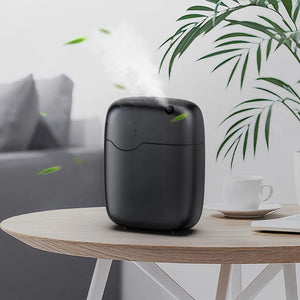

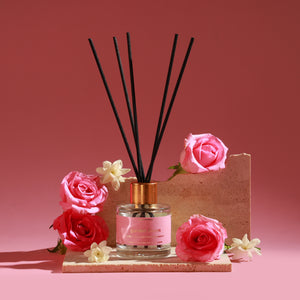

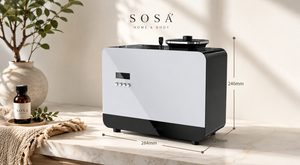
Reception ~270 to 320 sq ft: a Sukoon at ₹1,899, three drops, intermittent mode.
Commercial machine: not until the contiguous reception volume is large enough that a passive source cannot hold an even level — which a small clinic, by definition, is not.
Never, at any size: consultation, examination, vaccination and injection, nebulisation and asthma, neonatal follow-up, procedure and sample-collection, isolation waiting.
2. The floor is the problem, not the ceiling. Clinic owners think about the top of a product’s range — how strong can it go. In paediatrics the question is the opposite: how weak can it go, and stay stable. A children’s waiting area is occupied for thirty to sixty minutes at a stretch by patients who may be unwell, nauseated or wheezing, so the design target is a level nobody consciously registers. A machine sized for a lobby has a high floor. A reed has almost no floor at all: pull reeds out and the output drops, and three reeds in a small reception is often already at the edge of detection. That is the correct behaviour here.
3. Fewer controls is a feature in a clinic. A reed has no timer, no app, no duty cycle and no button. It cannot be nudged upward on a Tuesday by a receptionist who has gone nose-blind, cannot be left running all weekend, and cannot be switched to maximum by a four-year-old who has found something interesting on the counter. In a busy small clinic where nobody owns the fragrance decision, the product with no settings is more likely to still be correct in six months than the product with many. The Sukoon sits one step up: an on/off switch, an intermittent mode and a drop count you control, which is enough control without being enough to go wrong.
4. It changes nothing in the seven clinical areas. Consultation, examination, vaccination and injection, nebulisation and asthma, neonatal and newborn follow-up, procedure and sample-collection, and any isolation or infectious waiting area stay fragrance-free regardless of what sits on the reception counter. In a small clinic those rooms are most of the floor plan, which means a commercial machine would be an expensive solution for a very small proportion of your building.
5. And in a well-run small clinic, nothing at all is a real answer. If the space is aired for an hour before opening, the bins are specified and emptied on a schedule, the AC filter is washed and the drain pan clear, and the toys and cushions are laundered on a rota that actually happens, a small clinic reads as clean without any fragrance whatsoever. Parents credit the absence of an institutional smell far more readily than they credit the presence of a pleasant one, and a small clinic is the easiest kind of building in which to achieve that absence.
Made in India, composed by an ISIPCA Versailles-trained perfumer — and a portion of every order supports girl-child education through Nanhi Kali.
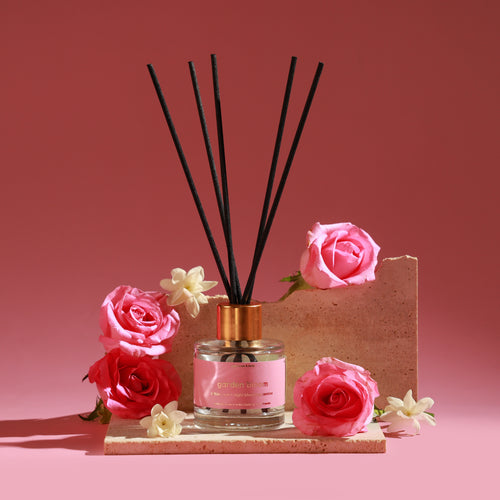
Why the small option is the right option, not the cheap compromise
There is a habit of reading price as a proxy for suitability, and in ambient scenting it is actively misleading. The ladder from a ₹749 reed to a ₹25,999 HVAC unit is not a quality ladder; it is a coverage ladder. Each step buys more cubic metres of air, and nothing else. The fragrance itself is the same class of material composed to the same IFRA standards at every step. Buying coverage you do not have is not an upgrade, it is a mismatch — and in a paediatric clinic it is a mismatch with a specific consequence, because the excess capacity has to be suppressed rather than simply ignored. The clinic that installs a large machine in a small reception spends its first weeks discovering how low the device will go, which is a strange way to spend ₹11,999.
The second point is about who ends up controlling the level. In a small clinic, the fragrance is nobody’s job. There is no facilities manager; there is a receptionist, a nurse and a doctor, all of whom have been in the building since morning and all of whom have adapted to the smell within about twenty minutes of arriving. Because they cannot smell it, they will reliably conclude it is too weak. A device with a control panel invites them to act on that conclusion; a device with three reeds in a bottle does not. This is why, in small clinics specifically, I recommend the product with the fewest adjustable parameters. The correct level in a children’s waiting area is low and stable, and stability is easier to buy than lowness.
Three ways the commercial machine loses in a small clinic
 Right-sized₹1,899The Vaayu sets intensity by duty cycle, which genuinely is the most dialable control in commercial scenting — and it is still a machine designed to hold a level across a large space. In a 250 sq ft reception, even a short on-time delivers into a small volume that has nowhere to dilute it, and the level a parent meets at the desk can sit above the threshold at which they consciously notice. In a children’s clinic, conscious notice is failure. The question is not how strong the equipment can be, but how quietly it can disappear, and small passive sources win that comparison in small rooms.
Zone by zone, in a small paediatric clinic
This is a small building, so the table is short — and most of it is deliberately empty. Note how little of the plan any equipment purchase would actually serve.
| Area of the clinic | Scented? | Why | What we would use |
|---|---|---|---|
| Reception desk and entrance ★ | Yes, low | The only zone with short dwell and arriving noses; a passive source covers it entirely | Reed ₹749 on three reeds, or Sukoon ₹1,899 |
| Waiting bench | Only at minimum | Thirty to sixty minutes of exposure for a child who cannot move away | Shared with reception — no second unit in a small room |
| Consultation and examination room | No | The doctor uses their own sense of smell, and the room is a few metres from the desk | Nothing |
| Vaccination and injection room | Never | A recognisable scent present at every injection becomes associated with it | Nothing |
| Nebulisation corner and neonatal follow-up | Never | Respiratory patients and newborns — the least latitude in the building | Nothing |
| WC and nappy-change | Never | An odour source needing extract and a lidded bin, not a fragrance | Nothing — fix the extract |
| Before any of this: in a small clinic the whole building is within a few metres of the desk, so whatever you put at reception will be faintly present in the corridor. That is another reason to keep it at the very bottom of the range, or to run nothing. | |||
Small reception · no power neededFrom ₹749Shop →  Mid reception · has an off switch₹1,899Shop →
 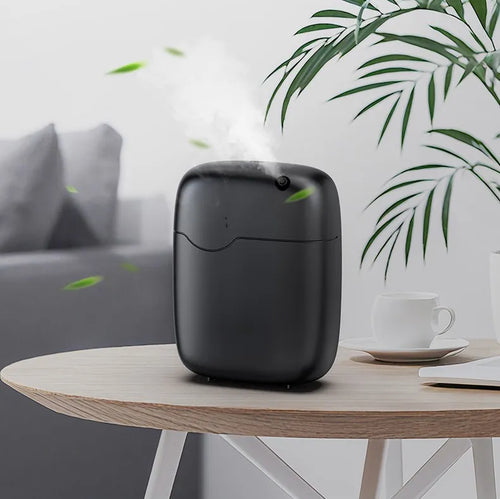 Large lobby · timed, dialable₹11,999Shop →
Running the small option properly
Three reeds, not six, and turn them rarely. Reed count is the only intensity control a passive diffuser has, and the six-reed configuration on the box is written for a living room, not a clinic waiting area. Start with three. Flipping the reeds refreshes output sharply, so in a clinic do it seldom — once a fortnight at most — and never on a day when the waiting area is full. A 130ml bottle at ₹1,249 to ₹1,349 runs 14 to 18 weeks at that rate, which makes the running cost of a small clinic reception genuinely trivial.
On a Sukoon, three drops and intermittent mode. It is water-based, so it adds a little humidity — worth knowing in a monsoon month, and a reason to keep the tank clean and refilled with fresh water rather than topped up. Three drops of a dry, low-sweetness Hotel Collection scent is a clinic setting; six is a hotel setting. Choose Ritz-Carlton-inspired Quiet Luxury or Westin-inspired White Tea Serenity rather than anything floral, and avoid gourmand directions entirely — vanilla, coffee and Fresh Brew belong in a café, not in a room where children wait to be seen.
Then set it once with a fresh nose and leave it alone. Staff adapt within about twenty minutes, so the person who judges the level should be someone who has been outside for thirty. Write the drop count or reed count on a card beside the unit so it does not drift. Keep it switchable off in seconds for a family with a scent-sensitive or asthmatic child, and say so plainly at the desk. And take the decision through your own clinical governance, infection-control and housekeeping leads — this is ambience guidance, not clinical advice, and in a small clinic the doctor making the call is usually also the owner, which makes the discipline of asking someone else more important, not less.
What we would actually install
The first two rows are the realistic answers for a small clinic. The last row is the one I recommend more often than either, and it is free.
| Option | Suits | Control you get | Price |
|---|---|---|---|
| Reed diffuser ★ | A small reception desk — a desk or a reception up to about 150 sq ft; three reeds, no power, no settings that can drift upward | Reed count only — no switch, no timer | from ₹749 |
| Sukoon 500ml | A reception up to ~320 sq ft — a reception of roughly 270 to 320 sq ft; three drops, intermittent mode, and an off switch that gets used | On/off, intermittent mode, you control the drops | ₹1,899 |
| Vaayu | A large lobby or a zoned duct — not a small clinic — a large lobby or a duct-zoned reception past roughly 600 sq ft | Duty cycle in seconds, timer, app scheduling | ₹11,999 |
| Aangan | Whole-facility HVAC — not a small clinic — a 8,000–10,000 sq ft facility with genuinely zoned ducting | Zone-level control, but only if the ducting is zoned | ₹25,999 |
| Nothing at all | A small clinic that is aired, cleaned and emptied properly — this is the recommendation more often than any of the four rows above it | Complete — and the correct answer more often than the trade admits | ₹0 |
Versailles
I would rather sell a paediatrician a ₹749 reed diffuser that is right than a ₹11,999 machine that is wrong, and in a small clinic the machine is wrong. Not too expensive — wrong. It is built to hold a level across a large volume of air, and you do not have a large volume of air. Every week I speak to a small clinic that bought one and is now working out how to make it quieter.
The other thing I would say to a small clinic owner is that you have an advantage a big centre does not. Your building is small enough to air properly, small enough that one person can see every bin, and small enough that a filter clean is a twenty-minute job. Those three habits will make your clinic smell better than any equipment I sell, and they cost nothing. Parents notice the absence of an institutional smell far more readily than they notice a pleasant one.
If you have done all that and you still want something at the desk, buy the reed, use three reeds, and stop there. Keep it out of the consultation room, the injection room and the nebulisation corner, keep it below the level anyone remarks on, switch it off without argument for a family who asks, and put the decision through your own infection-control and governance people rather than through me. A portion of every order funds a girl’s classroom through Nanhi Kali.
Frequently asked questions
- Scenting a 300 sq ft clinic — the small-room answer.
- Is a reed enough for 500 sq ft? — where the passive limit sits.
- When does professional scenting start to make sense? — the honest threshold.
- Stopping a machine over-scenting a small clinic — if you already own one.
- Brand: the SOSA founder story.
SOSA products & prices (verified August 2026): Hotel Collection water-based ultrasonic diffuser fragrance 15ml ₹299 · 100ml ₹999 · 300ml ₹1,799 · Pack of 7 (15ml, all fragrances) ₹1,799; refills 100ml from ₹999. Seven scents: The Ritz-Carlton-inspired (white tea · bergamot · cedar), Westin-inspired (white tea · aloe · cedar), 1 Hotels-inspired (cedarwood · vetiver · green leaves), The St. Regis-inspired (amber · violet · woods), Shangri-La-inspired (jasmine · green tea · white tea), Four Seasons-inspired (citrus · floral · sandalwood), W Hotels-inspired (citrus · pepper · amber). Diffusers: Boond 300ml ₹899 · Sukoon 500ml ₹1,899 · Megh 6L ₹3,499. Water-based, phthalate-free, composed to IFRA standards for home diffusion; 3–6 drops per tank. Made in India, Pune. The Hotel Collection scents are SOSA's own interpretations inspired by the world's finest hotels; all hotel names are trademarks of their respective owners and are used only to describe the scent style — SOSA is an independent Indian fragrance house, not affiliated with or endorsed by any hotel brand. Prices and availability subject to change — see the live product pages.