

Where it must not go: on top of the shoe rack, or on the wall directly above it. Warm air rises off a rack, and a bottle sitting in that column guarantees the two smells reach a visitor in the same breath.
Size: Morning Freshness 50ml at ₹749 covers up to about 150 sq ft, which is most small-flat entrances plus their first stretch of hall. Three or four reeds, not six.
The honest gap: if the only available surface is the rack itself, do not buy a diffuser this week. Find or make a surface a metre inside first. A well-chosen bottle in the wrong place performs worse than a cheap one in the right place, and no purchase fixes that.
2. Out of the door's swing arc. The obvious reason is that it will be knocked. The less obvious one is that the arc is where the air movement is strongest when the door opens, and a bottle standing in it is repeatedly stripped of everything it has built up.
3. Off the draught line. Air moving between two openings takes the shortest path between them. In a small flat that path usually runs from the front door across the living room to a balcony or a window. Set the bottle a step to one side of it. Being near moving air is good; being in it is expensive.
4. Never above the shoe rack. A rack gives off slightly warmer, more humid air than the room around it, and warmer air rises. A bottle placed in that rising column delivers your fragrance and the rack's character to a visitor's nose simultaneously, which is the exact outcome a diffuser is supposed to avoid.
5. Then dose down. Morning Freshness 50ml at ₹749, three or four of the six reeds. A small flat's entrance is a small volume that everyone passes through at close range, and six reeds there is the commonest way to make a good composition read as an air freshener.
Alcohol-free, phthalate-free, paraben-free, IFRA-compliant, 0 ppm formaldehyde, six fibre reeds in a refillable glass bottle, composed in Pune. Free shipping above ₹499, and a portion of every order supports girl-child education through Nanhi Kali.
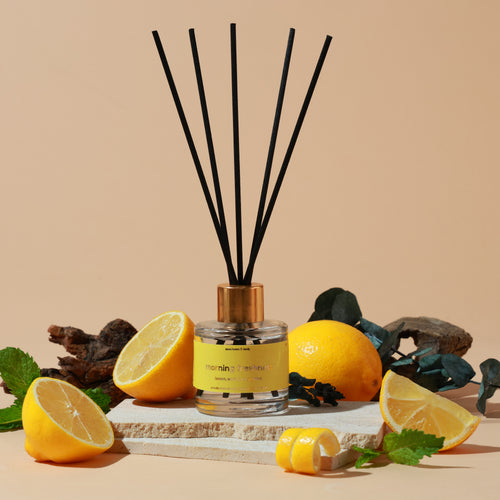
The three lines that decide the spot
Placement advice usually stops at "somewhere near the entrance", which is not advice, it is a gesture. In a small flat the workable positions can be counted on one hand, and each of them is defined by its relationship to three lines you can find in about ninety seconds with the front door open. Draw them once and the decision makes itself. Nothing here costs anything, and getting it right is worth more than moving up a bottle size.
 Evening Calm₹799A shoe rack holding recently worn shoes is slightly warmer and more humid than the air around it, and that air rises. Put the diffuser directly above it and you have arranged for your fragrance to be carried upward on the same current as everything else the rack is releasing, arriving together at roughly the height of a standing adult's nose. Two odours delivered simultaneously do not cancel; they combine, and the combination is usually less pleasant than either. This is the one placement I would call an actual mistake rather than a compromise. Sideways is fine. Below is fine. Above is not.
In a small 2BHK the entrance is not a room, and that changes the arithmetic
Compact flats rarely have a foyer. What they have is a door that opens into the living room with a metre or so of floor in front of it, and the whole of that shares one body of air with the sofa. This matters because people size their purchase for the metre and then judge it by the room. A 50ml is built for volumes up to about 150 sq ft and a 130ml above that, so a 50ml doing duty for an entrance and a 250 sq ft living room will read as weak while performing exactly to specification. It is not a weak bottle. It is a bottle being asked to fill twice the volume it was made for.
So decide honestly which of the two you are scenting. If the answer is genuinely just the entrance — a defined stretch of hall, a passage with the bedroom doors off it, something that behaves as its own small space — then the 50ml at ₹749 is correct and generous, and three reeds will do. If the answer is that the entrance and the living room are simply one space with a shoe rack at one end, you are buying for the living room, and the honest recommendation is the 130ml at ₹1,249 placed for the living room rather than for the door. That version of the question has its own page in this cluster, and I would rather send you there than sell you the wrong size.
The second thing a small flat changes is how much of the day the fragrance spends being noticed. In a large home an entrance diffuser is met a few times a day. In a 2BHK the same bottle sits in the room where you eat, work and watch television, and you will walk past it thirty times before dinner. That is an argument for restraint rather than for a softer scent: the same oil at a lower dose reads as layered, because the nose has room to resolve the separate materials, while too much of anything flattens into one sharp impression. Three reeds in a small flat is not a compromise. It is the setting the composition sounds best at.
Every candidate surface in a small flat, scored
The realistic options, in the order I would take them, with the reason each one works or fails. Two of these are in most flats and one of them is the mistake almost everybody makes first.
| Position | Distance from the door | What happens there | Verdict |
|---|---|---|---|
| Console or shelf a metre inside ★ | ~1 m, to one side | Out of the swing, out of the draught, undisturbed for weeks. The visitor meets it a step after the door | Best |
| End of a sideboard or low chest in the living room | 1.5–2 m | Scents the space people occupy rather than the one they pass through; still reads at the door on arrival | Very good, especially in one-volume flats |
| Wall-mounted ledge beside the entrance | ~1 m, at chest height | At or slightly below nose height, nothing to clean around, safe from knocks | Good where there is no floor furniture |
| Window ledge near the entrance | Varies | Direct sun and moving air both shorten the bottle, and the top notes go first | Avoid unless the window is never opened and never sunny |
| Shelf immediately inside the door, in the swing arc | 0–0.5 m | Repeatedly stripped by the air exchange, then met at very close range. Empties fast, reads as either absent or overwhelming | The common instinct, and the wrong one |
| On top of or above the shoe rack | 0 m | Sits in the rack's rising air, so both odours arrive in the same breath and combine | The one genuine mistake — never here |
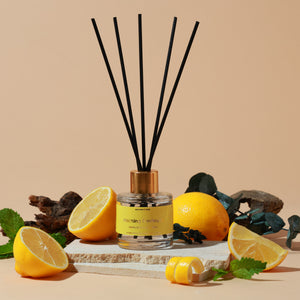
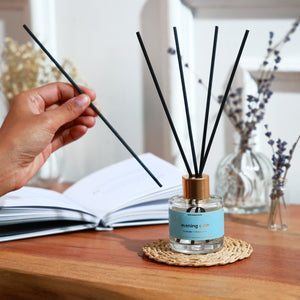
Bright · Morning Freshness₹749Shop → 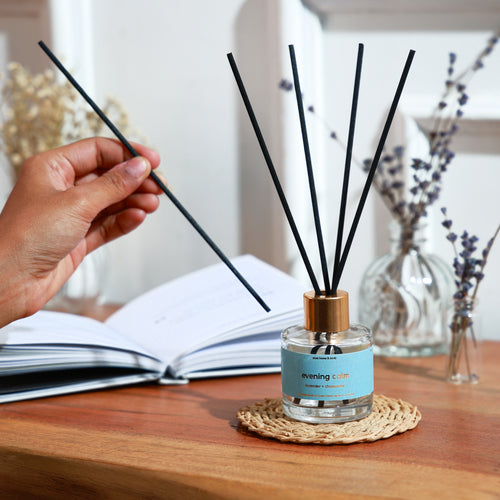 Softest · Evening Calm₹799Shop →
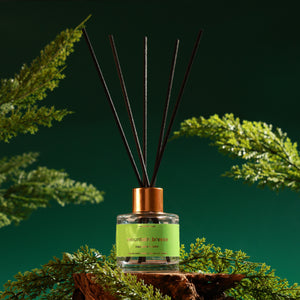
 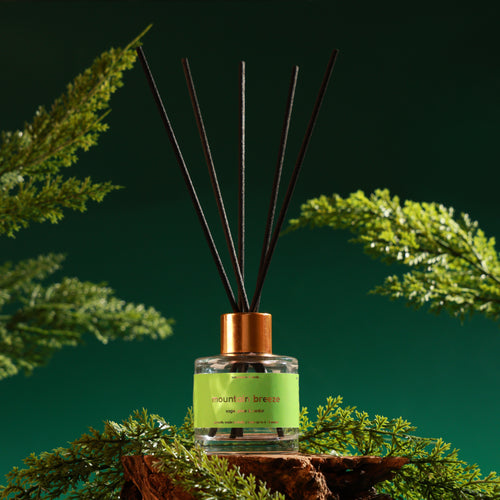 Dry green · Mountain Breeze₹849Shop →
Reeds, size, and why a bottle empties early in a small flat
Two complaints reach us more than any other and they are the same complaint from opposite ends. It finished in a month and I can hardly smell it. In a small flat with an entrance near a balcony, both usually resolve to placement plus reed count rather than to the oil. More reeds is stronger and shorter, which is not the same as better: six reeds is full projection and belongs in a living room, three is a soft level and roughly doubles the life of the bottle. If your 50ml went in four weeks, count the reeds, then check whether it was standing on the draught line. Those two together explain nearly every early finish I am asked about.
The reeds themselves are fibre rather than rattan, and in a small Indian flat that difference is not cosmetic. Rattan is a natural cane with irregular internal channels, and in high humidity it wicks unevenly and tends to go dry at the top while the base is still saturated — the fade-then-nothing pattern people usually blame on the oil. Fibre is more porous and more consistent, which matters far more here than it does in the European climates most reed diffusers are designed around. Flip them every three to five days for Morning Freshness, five to seven for Garden Bloom. Flipping releases a small burst, which is worth timing for an evening rather than a Monday morning nobody is home for.
One expectation worth resetting. The first few days of a new bottle run hot, because the reeds are saturating and the lightest materials leave first. What you smell in week three is the heart and base, which is the composition as it was designed to sit in a room. That is settling, not fading. In a small flat where the bottle is three metres from the sofa, the difference between week one and week three is particularly noticeable, and it is not a fault.
What to buy for a small-flat entrance — and what to sort out first
In buying order, with the free part first, because in this particular question the free part is most of the answer. The last row is what SOSA does not sell for this problem, said plainly.
| Step | What it is | Why it matters here | Cost |
|---|---|---|---|
| 1. Find or make the surface | A console, shelf, ledge or chest end a metre inside, out of the swing and off the draught line | The single highest-value decision on this page, and it is free | Free |
| 2. Morning Freshness 50ml ★ | Malabar lemon, peppermint, eucalyptus — up to ~150 sq ft, 6–8 weeks | Bright, contrasts with a stale note rather than blending into it, and it is the least expensive reed we make | ₹749 |
| 3. Three or four reeds, not six | Reed count is the volume dial | Restraint in a space you walk past thirty times a day. Roughly doubles the life at three | Free |
| 4. Evening Calm 50ml | Kashmir lavender and chamomile, 8.9 — the softest thing we make | If the entrance opens directly onto where you sit and anything bright feels like a lot | ₹799 |
| 5. Morning Freshness 130ml | Same composition, 14–18 weeks, for above ~150 sq ft | Only if the entrance and living room are honestly one volume. In a true small foyer it is over-specified | ₹1,249 |
| The honest gap: nothing fixes a bad position | There is no product in this range, or any range, that compensates for a bottle standing in a draught or above a shoe rack. SOSA also makes no room spray, no plug-in and no odour eliminator — every SOSA spray is a car perfume | Said plainly, because it is the commonest reason a good bottle disappoints | — |
Versailles
When somebody writes to say a bottle underperformed, the first question I ask is not which scent it was. It is where exactly is it standing, and what is open when you are at home. Nine times out of ten the answer explains everything, and it explains it in a way no reformulation could.
Small flats are where this shows up most sharply, because the distances are so short that a metre is a large fraction of the whole space. Move a bottle from a shelf inside the door to a console a metre in, one step off the line to the balcony, and the same ₹749 behaves like a different product. It lasts longer because it is not being ventilated into the corridor. It reads better because a visitor meets it a beat after the door rather than at the same instant.
The rack is the other half. I have no interest in pretending a fragrance can do anything about a shoe rack, and putting the bottle above one is asking it to do exactly that. Sideways, a metre in, three reeds, Morning Freshness. If the only surface you have is the rack itself, buy the shelf before you buy the diffuser — that is genuinely the better order. Everything is composed in Pune, and a portion of every order funds a girl's classroom through Nanhi Kali.
Frequently asked questions
- Shoe rack beside the main door — the honest sequence, and why the rack comes first.
- The entrance feels stale but the house is fine — the dead-air pocket explained.
- Reed diffuser or Sukoon for guests at the door — continuous versus controllable.
- Door opens straight into the living room — when it is one volume, not two.
- Only ₹500 to spend — the honest answer at that budget.
- Too strong every time you walk past — the dose page.
- The console table beside the door — yes, with conditions.
- Small foyer, large living room — the volume argument.
- The hotel lobby question — restraint and consistency, not strength.
- Brand: the SOSA founder story.
SOSA reed diffusers — facts verified August 2026: Five scents, all alcohol-free, on a heat-stable CCT (caprylic/capric triglyceride) base, phthalate-free, paraben-free, IFRA-compliant, 0 ppm formaldehyde, six fibre reeds in a refillable glass bottle, composed and made in Pune, India. Morning Freshness (Malabar lemon · peppermint · eucalyptus globulus) 50ml ₹749 · 130ml ₹1,249 · 9.0 on the SOSA strength scale. Evening Calm (Kashmir lavender · chamomile · soft musk) 50ml ₹799 · 130ml ₹1,299 · 8.9, the softest in the range. Garden Bloom (British rose · night-blooming jasmine) 50ml ₹799 · 130ml ₹1,299 · 8.9. Mountain Breeze (Himalayan pine · sage · Indian cedar) 50ml ₹849 · 130ml ₹1,349 · 9.4. Fresh Brew (Coorg coffee · Kerala vanilla · caramel) 50ml ₹849 · 130ml ₹1,349 · 9.5. 50ml suits rooms up to about 150 sq ft and lasts 6–8 weeks; 130ml suits above that and lasts 14–18 weeks. Six reeds gives full projection, three gives a soft level at roughly double the life. Refills 300ml ₹2,399 · 500ml ₹3,499, oil only. Climate-tested through 45°C heat and 85% RH monsoon humidity. SOSA makes no room spray, plug-in, air purifier, dehumidifier or odour eliminator; every SOSA spray is a car perfume. Reed diffuser oil and the water-based Hotel Collection are separate systems and are not interchangeable, and there is no hotel-inspired reed diffuser. Free shipping above ₹499. SOSA is an independent Indian fragrance house and is not affiliated with or endorsed by any hotel brand. Prices subject to change — see the live product pages.