

Why it is not a matter of degree: in a continuously occupied space with a continuous source, the concentration in the room rises toward an equilibrium through the afternoon, while every individual’s ability to perceive it falls away within minutes of sitting down. The two curves move in opposite directions. Setting the level by what the seated occupants report guarantees a climb.
The person the room is for: the one with the freshest nose at the moment the room is at its highest concentration — the guest arriving late in the afternoon, the member returning from a telephone call outside, the committee member who came in from the car park. They are the instrument.
The honest gaps: no adaptation time in minutes, no concentration threshold and no throw or falloff figure is published for any SOSA machine, so this cannot be reduced to a number and I will not invent one. There is also no leather fragrance at SOSA in any format, and no tobacco or smoky fragrance for any diffuser, if that is the register you were planning to run quietly.
2. Set it for the fourth hour, not the first. A room with a source running all afternoon has more fragrance in it at five o’clock than it did at one, even at a constant machine setting, because a closed volume accumulates. If the level is right at the start of the session it may be too much by the end of it. Judging at the end and accepting that the beginning will feel modest is the correct way round.
3. Never judge from inside the room. Everybody in it, including the person holding the dial, has adapted. The only valid reading is taken by somebody who has been outside for fifteen minutes and walks in. Do that at the busiest hour, in the season the room actually runs in, and take the first two seconds of impression as the answer.
4. Fix consistency with the schedule and the position, never with the intensity. If the room feels uneven, the problem is airflow and cycle timing rather than strength. Work and pause cycles, a longer run window at a lower setting, and a source placed in the room’s airflow path will even a room out. Turning it up makes the peaks higher and the valleys no better.
5. Write the setting down, lock it, and review it on a date. The key-lock on Vaayu exists for this exact situation: a dial in a room full of adapted people only ever travels one way. Everything SOSA makes is alcohol-free, phthalate-free, paraben-free, IFRA-compliant and 0 ppm formaldehyde, composed in Pune, and a portion of every order supports girl-child education through Nanhi Kali.

The two curves, and why they cross in the worst possible place
Almost everything difficult about dosing a long-dwell room comes from one fact: the room and the person in it are changing in opposite directions at the same time. Separating the two movements makes the decision obvious, and it also explains why well-run clubs with careful managers still end up over-scented after a few years without anyone making a bad decision.
 Aangan₹25,999Fragrance leaves a room by two routes: air change, and absorption into surfaces. A lounge on recirculating air conditioning has very little of the first — recirculation distributes evenly, which is why a closed air-conditioned room feels the most consistently scented room in a building, but it does not remove much. So a source running from eleven in the morning puts more in than the room takes out, and the concentration climbs toward a plateau rather than sitting where it started. The level you set at eleven is the floor of the day, not its average. In monsoon this is compounded: saturated air carries fragrance less readily, so it hangs close to its source rather than dispersing, and the room near the machine reads stronger than the far corner.
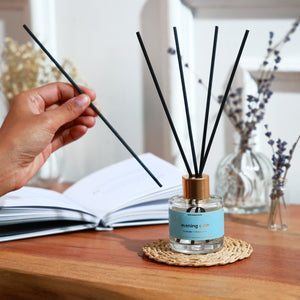
 Evening Calm₹799The nose reports change far better than it reports steady state. Walking through a doorway means crossing from one concentration to another in a second or two, and that is registered clearly; sitting in a fixed concentration is a constant stimulus, and receptors stop reporting it. This is why a member notices the lounge on the way in and not once they are settled, and it is also why a member who steps out to take a call on the terrace notices it again when they come back. Nobody in a long-dwell room is a reliable witness after the first few minutes, and nobody is more unreliable than the staff, who have been in the building since well before opening. The answer to “am I supposed to be able to smell it all the time?” is no. A fragrance you can smell continuously is set too strong for the room.
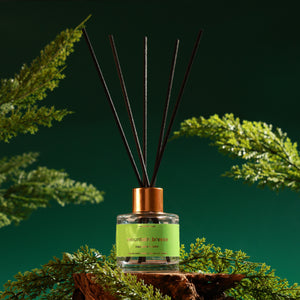
 Mountain Breeze₹849Here is the whole design problem in one sentence: the room is at its strongest late in the afternoon, and late in the afternoon is exactly when unadapted people keep arriving. The guest meeting a member at five. The committee member coming in from the car park. The member returning from twenty minutes on the terrace, whose receptors have partially reset. Every one of those people meets the accumulated room with a fresh nose, and they are the ones who form the club’s reputation for smelling good or smelling strong. A level that is comfortable for them is automatically comfortable for everybody who has been sitting there for hours, because those people cannot perceive it anyway. The reverse is not true, which is why the design target is not symmetrical.
Who the room is actually being designed for
It is worth being explicit about the cast, because clubs usually optimise for the wrong member of it. There are four kinds of nose in a long-dwell room and only one of them can be used as an instrument. The seated member is adapted and will say the fragrance has faded. The staff are more adapted still and will say it has stopped. The returning member is partially reset and is a decent second opinion. The arriving guest is unadapted, is meeting the room at its accumulated peak, and is the only one whose reaction predicts what the club will be said to smell like. Design for the fourth. Everyone else is served by that decision without knowing it.
This also resolves a question clubs ask in good faith, which is whether the lounge should be raised during busy periods because more bodies mean more competing smells. It should not, and there are two reasons. The first is that more bodies also mean more personal fragrance in the room — senior members and guests arrive wearing something of their own, developing on skin since the morning — and the ambient’s job is to sit underneath all of that rather than to argue with it. The second is that a busy room has more door movement and more air exchange, which does more for evenness than a higher setting ever will. If a busy lounge feels wrong, it is nearly always a distribution problem rather than a dose problem, and the remedy is where the source sits and how the air moves, not how hard the machine is working.
One last point that belongs here rather than in a building section. If the room smells closed, stale or damp at the start of the day, none of the above applies, because you are not dosing a clean room. Fragrance added to a stale lounge produces stale-and-fragrance, which reads as concealment and is the single complaint most likely to reach a general meeting. Source, then moisture, then ventilation and air change, then cleaning — and only then a conversation about intensity. A club that runs its air system on fresh air for an hour before opening and gets its soft furnishings on a real cleaning cycle will need a lower setting than one that does not, which is the usual pattern: the better the building, the less fragrance it needs.
Dwell time against level, room by room
The same club, the same single fragrance, and how long people stay in each space. Read it as a gradient rather than as a set of separate decisions — the composition never changes, only the level, and the level is set by the clock.
| Space | Typical dwell | Level | Why |
|---|---|---|---|
| Entrance and vestibule | Ten to thirty seconds | The clearest on the property | Nobody stands in a threshold; the nose reports the change |
| Main hall and corridors | Under two minutes | Clear, a step below the door | Transit space, and the connective tissue of the identity |
| Reception desk | Two to five minutes, all day for staff | Low | The first dwell point, and somebody works there |
| Members’ lounge ★ | Two to four hours | Below the threshold of comment | Accumulation up, perception down — design for the late arrival |
| Reading room or card room | Two to four hours, quieter | Lower still, or nothing | In a heritage club the paper and timber are the identity |
| Boardroom or meeting room | One to three hours, captive | Unscented by default | Small closed volume, guests who did not choose to be there |
| Dining room and bar counter | One to two hours | None — neutral | Ambient fragrance competes with food and flattens wine |
A dwell zone · Vaayu₹11,999See it → A whole floor · Aangan₹25,999See it → 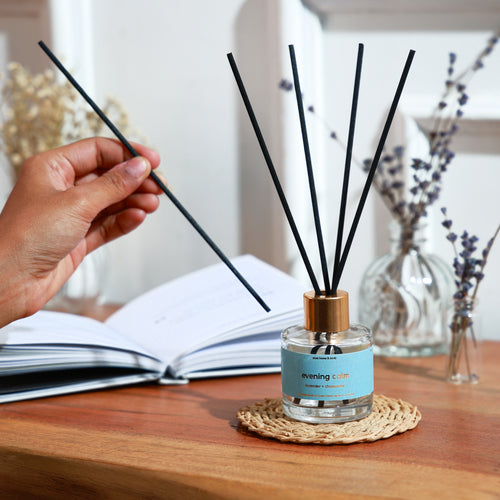 A small quiet room · reeds₹799See it →
The walk-in test, written as a procedure a club can actually run
Because no threshold figure exists and none should be invented, the level has to be arrived at behaviourally. This is the procedure I give clubs, and it costs nothing but an afternoon. Run it before buying anything if you can, and again a fortnight after installation. One named person owns it. They set the machine to a low intensity on a continuous run window and leave it for a full service day, so that the room reaches whatever equilibrium it is going to reach. They then leave the building entirely for at least fifteen minutes — the car park, the street, a walk round the block — and return through the front door at the busiest hour, walking the member’s actual route: threshold, hall, corridor, lounge. The reading is taken in the first two seconds of entering the lounge and written down before anything else is done.
There are three possible outcomes and each has a defined response. If the lounge reads as clearly fragranced, it is too high for a dwell space and the intensity comes down a step. If it reads as nothing at all, and the hall did too, check the machine and the position before touching the intensity — a source in a still corner or behind joinery scents its own corner and very little else. If the lounge reads as pleasant but unnameable, that is the target, and the job is now to make it permanent: record the intensity, the run window, the days and the machine position in the operations file, engage the key-lock, and put a review date in the calendar rather than leaving it to someone’s impression on a quiet Tuesday.
Two refinements are worth adding. Repeat the walk at the other end of the year, because a monsoon lounge and a dry-summer lounge behave differently — humidity shortens projection and makes fragrance hang close, air conditioning speeds evaporation — and a setting that was right in one may not be in the other. And use guests deliberately: a guest arriving at five is the single best instrument in the building, and asking them, once, whether the club smells of anything is worth more than a month of internal discussion. Do not ask members whether they like the new fragrance, though. That produces a referendum on change rather than a reading on level.
The dwell edit — and what is not published
The steps in order, for a lounge, reading room, coworking floor or any other space where a member settles in. The purchase is the fifth item on the list and three of the first four are free.
| Step | What it is | Why it matters at two to four hours | Cost |
|---|---|---|---|
| 1. Decide who the room is for ★ | The unadapted arrival at the busiest hour, not the seated member | It is the only nose in the room that still works, and the one that forms the club’s reputation | No cost |
| 2. Run the walk-in test | Fifteen minutes outside, then the member’s route, judged in the first two seconds | No threshold figure exists, so the reading has to be behavioural | No purchase |
| 3. Choose continuous low over bursts | A long run window at a low intensity rather than short periods of high output | Bursts create peaks that arriving members meet and describe as too strong | No extra |
| 4. Fix evenness with position, not power | Source in the room’s airflow path, above head height, away from where people sit | Uneven rooms are distribution problems; raising the dose raises the peaks only | No purchase |
| 5. Buy the control set, not the headline | Vaayu: adjustable intensity, 1h / 4h / 8h / 24h windows, day selection, auto-stop, key-lock, under 38 dB, DC 12V / 1A 5W | In a dwell room the ability to set low and hold it is worth more than coverage | ₹11,999 |
| 6. For a whole floor, schedule it centrally | Aangan: programmable work and pause cycles and daily schedules on a mechanical HVAC or AHU connection, up to 3,000 m³ ≈ 8,000–10,000 sq ft | One cycle governing every dwell space on that air system | ₹25,999 |
| Do not buy: a second machine to fix a quiet corner | Two sources in one volume make two peaks with a valley between them | Move the first machine before buying a second; the midpoint is the farthest point from both | Saves money |
| What is not published: the honest gaps | No adaptation time in minutes, no concentration threshold, no throw, gradient or falloff figure, no consumption rate and no machine count as a formula. SOSA also publishes no leather fragrance in any format and no tobacco or smoky fragrance for any diffuser, and no purchasable refill oil is listed for the waterless machines — the fragrance is specified and quoted per property | A number invented here would be written into a specification and obeyed in a building it does not suit | Quoted |
Versailles
I have never once been called to a club because the lounge was too faint. Every call has been the other way: a member has written to the committee, or a general manager has walked in after a fortnight’s leave and been startled by their own building. That asymmetry is the most useful piece of evidence I have about dosing a long-dwell room, and it comes from the fact that fading is reported by people who cannot smell, while strength is reported by people who can.
The manager returning from leave is worth dwelling on, because it is the cleanest natural experiment available. Two weeks away resets the nose completely. If a club would like to know what its lounge actually smells like, the answer is waiting in the first thirty seconds of somebody’s first day back, and it is worth asking them before they get used to it again, which takes about five minutes.
What I would ask a committee to accept is that the correct setting will feel slightly disappointing on the day it is made. You will stand in a beautiful room, having spent money, and want it to announce itself. It should not. A lounge at the right level is a room people sit in for four hours and leave feeling it was a good afternoon, without ever having had a thought about the smell. That restraint costs nothing, and it is the only part of this that reliably reads as expensive. Everything we make is composed in Pune, and a part of every order funds a girl’s classroom through Nanhi Kali.
Frequently asked questions
- The pillar: the long-stay register — the hardest room in the club.
- The business lounge and lounge versus lobby.
- Leather and wood interiors and minimal interiors.
- Nose-blind staff and how to stop the level climbing.
- All-day consistency and continuous low versus bursts.
- Brand: the SOSA founder story.
SOSA commercial scenting — facts verified August 2026: Vaayu ₹11,999, waterless cold-air nebulising, up to 1000 m³ ≈ 2,000–3,000 sq ft, 400ml refillable sealed tank lasting up to about 90+ days depending on intensity and hours, Bluetooth app plus onboard buttons, run windows of 1h / 4h / 8h / 24h, day selection, adjustable intensity, auto-stop and key-lock, under 38 dB, freestanding, wall-mounted or HVAC-return, DC 12V / 1A at 5W, CE, RoHS and SGS, black and white. Aangan ₹25,999, HVAC or AHU connection or standalone wall-mount or lay-flat, up to 3,000 m³ ≈ 8,000–10,000 sq ft, 800ml reservoir giving weeks between refills on business-hours schedules, under 42 dB, DC 12V at 14W, intelligent PCB with programmable work and pause cycles and daily schedules, metal body 3.9 kg at 284 × 125 × 246 mm, black or white, one-year warranty, imported; it is not app-controlled, has no Bluetooth, and no certifications are published for it. Meenar ₹38,500 is the larger-property option, specified on enquiry; no coverage figure is published for it here, and it should not be assumed to reach further than Aangan. Ultrasonic machines: Sukoon ₹1,899 at 270–320 sq ft with a 500ml tank and 16–18 hours on low, Boond ₹899 with a 300ml tank at up to about 150 sq ft, Megh ₹3,499 with a six-litre tank and around 100 hours of runtime but only about 215 sq ft of coverage. Hotel Collection fragrance oils are water-based and ultrasonic-only at 15ml ₹299, 100ml ₹999 and 300ml ₹1,799; they are not for reed diffusers and not for the waterless commercial machines. No purchasable refill oil is listed for the waterless commercial machines; that fragrance is specified and quoted per property. SOSA publishes no leather fragrance in any format and no tobacco or smoky fragrance for any diffuser. SOSA sells no air purifier and no dehumidifier, and every SOSA spray is a car perfume rather than an interior product. No SOSA machine offers Wi-Fi, Alexa, Google Assistant, KNX, Crestron, Control4, Modbus, BACnet or any building-management integration; the Aangan HVAC connection is mechanical. Reed diffusers 50ml ₹749–₹849 lasting 6–8 weeks and 130ml ₹1,249–₹1,349 lasting 14–18 weeks, six fibre reeds, alcohol-free, phthalate-free, paraben-free, IFRA-compliant, 0 ppm formaldehyde, heat-stable CCT carrier, refillable glass bottle, tested at 45°C and 85% RH, composed in Pune. No dealer programme, reseller margin, trade price, territory or service contract is published. Free shipping above ₹499. A portion of every order supports girl-child education through Nanhi Kali. SOSA is an independent Indian fragrance house; the Hotel Collection scents are SOSA’s own interpretations inspired by the world’s finest hotels, and SOSA is not affiliated with or endorsed by any hotel brand. Prices subject to change — see the live product pages.