

2. Zero is the honest target, in practical terms. There is no intensity dial for the cabin because there is no equipment in it. Its strength is entirely a downstream effect of reception's own setting.
3. A closed cabin behaves nothing like an open waiting area. With little air exchange, anything present inside a shut room accumulates rather than dispersing — which is exactly why the room should never be dosed directly in the first place.
4. Run the two-minute test at 4pm, door shut. Stand inside the cabin for two minutes with the door closed late in the day, when trace has had the longest chance to build. If you can name the fragrance, reception is too high.
5. Fix reception, never the cabin. There is no cabin-side fix — turning reception down is the only lever that changes what the closed room carries.
Vaayu's held, adjustable intensity at reception is what keeps this residue reliably faint, hour after hour.
Why the cabin is a residue, not a dose
A dose is something applied on purpose, at a chosen strength, inside a room. A residue is what is left behind after air has moved from somewhere else. The consultation cabin should only ever experience the second of these — it has no fragrance decision of its own to make, only reception's decision to inherit in diminished form.
This distinction matters because a closed cabin does not behave like an open waiting area. Reception exchanges air constantly with a corridor, an entrance door and often a return-air grille; a shut consultation-room door slows that exchange to a trickle. Anything genuinely dosed inside a room with so little air movement does not disperse the way it would in an open space — it accumulates, and a room that accumulates fragrance is a room that was dosed by mistake.
So the honest way to describe the correct strength inside the cabin is not a number on an intensity dial — there is no dial in the room — but a residue: faint, incidental, and entirely a function of how reception is set outside it. Asking how strong it should be inside the cabin is really asking how low reception needs to run for its residue to stay unnoticeable.
The three decisions behind getting the residue right
 Vaayu₹11,999There is no cabin-side control to reach for. Every adjustment that changes what the closed room carries happens at reception, never inside the consultation room itself.
Comparing closed-door outcomes at different reception settings
The cabin's own strength never changes — only reception's does, and the table below tracks what that produces behind a shut door.
| Reception setting | Residue at 9am, door shut | Residue at 4pm, door shut | What it costs |
| Off | None | None | ₹0 |
| Low, held steady | Not detectable | Faint, unnameable — the target | ₹11,999 for Vaayu |
| Moderate, unmanaged | Faint | Identifiable — already too high | ₹849–₹11,999 depending on machine |
| High, or nudged up through the day | Identifiable from the morning | Strong and immediately obvious | Not recommended, regardless of cost |
| The residue at 4pm, not 9am, is the true test — a full day's accumulated trace is the worst case a closed cabin will ever see. | |||
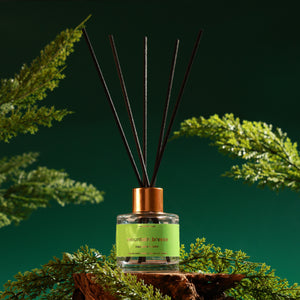
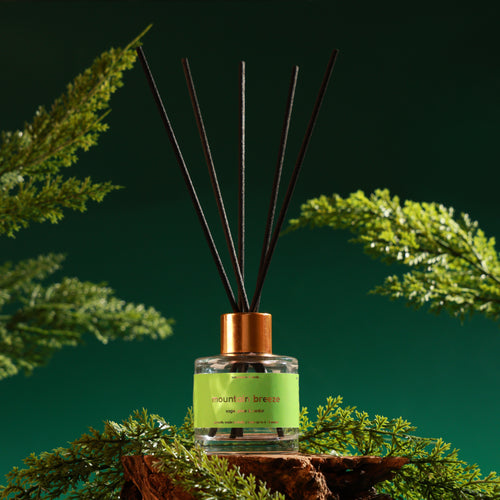
 Vaayu · reception, low and held₹11,999Shop → Mountain Breeze · a fixed reed register₹849Shop →
  Sukoon · smaller reception-and-cabin setups₹1,899Shop →
The two-minute test, run properly
Run the test late in the day, not first thing. Fragrance carried through shared air accumulates gradually across clinic hours, so a cabin that passes cleanly at 9am can still fail by mid-afternoon — 4pm is a fair, worst-case moment to check.
Stand inside the cabin with the door fully closed for two full minutes before judging anything. A quick look-in on the way past will always under-read the residue; give your nose the same two minutes a patient would actually spend in the room before forming an opinion.
If the fragrance is nameable, reduce reception's intensity in small steps and re-test at 4pm each time, rather than making one large cut and assuming it has fixed itself. There is no cabin-side adjustment to make — every change that matters happens outside the room.
What to buy for a residue that passes the two-minute test, by size
The equipment differs by premises size; the target — a residue that fails to register after two minutes with the door shut — does not.
| Route | Premises | Why | What it costs |
| Vaayu, wall-mounted at reception | 750 sq ft and above, several closed cabins | Fine adjustable intensity lets reception be dialled down in small steps until the residue passes the two-minute test | ₹11,999 |
| Vaayu, HVAC mount | A reception sharing central AC with cabins | Duct-side placement gives even control over how much residue reaches shared air, rather than leaving it to door gaps alone | ₹11,999 |
| Sukoon ultrasonic, reception only | 300–750 sq ft, reception and one or two cabins | Real coverage at a lower cost, with the humidity and refill trade-off to manage separately | ₹1,899 |
| Reed diffuser, Mountain Breeze, reception only | Under 300 sq ft, one small reception and cabin | A fixed, passive register is proportionate here, though it cannot be dialled down if the two-minute test fails | ₹749–₹849 |
| Aangan, HVAC-integrated | Above roughly 3,000 sq ft, many closed cabins | Duct-fed distribution across a floor plate this size, with Vaayu handling any separate zone or floor | ₹25,999 |
Clinic owners often ask me for a number — a percentage, a setting, something they can write down and hand to staff for the consultation room. I always have to disappoint them a little: there is no number for the cabin, because there is nothing in the cabin to set.
The test I actually use on-site is close to embarrassingly simple. I go and sit in the closed cabin myself, at whatever time of day the clinic is busiest, for two full minutes, and ask whether I could describe the fragrance to someone outside. If I can, we go back to reception and turn it down.
What surprises most owners is how often the fix is smaller than expected — a step or two on an intensity dial, not a different machine or a different fragrance. The cabin was never the problem; it was only ever reporting on reception.
Questions clinic owners ask about consultation-cabin strength
- Should the consultation room have ambient fragrance at all? — the containment answer this post's residue test assumes.
- Reception vs cabin — should intensity differ? — the gradient argument behind why the cabin never gets its own dial.
- How do I handle fragrance if some patients are sensitive? — the sensitivity case for keeping the residue this faint.
- Should fragrance be reduced in rooms where patients spend longer? — the dwell-time version of the same accumulation problem.
- Brand: the SOSA founder story.
SOSA products & prices (verified September 2026): Reed diffusers 50ml ₹749–₹849 (to 150 sq ft, 6–8 weeks at six reeds) · 130ml ₹1,249–₹1,349 (above 150 sq ft, 14–18 weeks) · reed refill 300ml ₹2,399. Ultrasonic: Boond ₹899 (~150 sq ft) · Sukoon ₹1,899 (270–320 sq ft, ships with three 15ml Hotel Collection fragrances) · Megh ₹3,499 (6L tank, ~100 hrs runtime, ~215 sq ft — a runtime machine, not a coverage upgrade). Waterless cold-air: Safar ₹3,999 (no published coverage figure) · Vaayu ₹11,999 (up to 1000 m³, roughly 2,000–3,000 sq ft; 400ml tank lasting about 90+ days; app and onboard control, 1h/4h/8h/24h run windows, adjustable intensity, key-lock, under 38 dB, freestanding or wall/HVAC mount, 5W, CE/RoHS/SGS) · Aangan ₹25,999 (8,000–10,000 sq ft). Hotel Collection water-based fragrance 15ml ₹299 · 100ml ₹999 · 300ml ₹1,799 is for ultrasonic machines; reed oil and Hotel Collection are not interchangeable. Reed diffusers are alcohol-free, phthalate-free, paraben-free, IFRA-compliant and low VOC, handmade in small batches in Pune. Every purchase funds a girl's education through Nanhi Kali. Prices and availability subject to change — see the live product pages.