



Too strong: you are aware of it continuously while sitting. Remove a reed.
Too weak: a visitor cannot detect it in the doorway. Add a reed, or move the bottle to where air moves.
2. Unremarkable from where you sit. Five minutes after sitting down, you should not be thinking about it. Continuous awareness is the definition of too strong, no matter how much you like the blend.
3. Reset your nose before you judge. Ten minutes outside the room, then walk back in. Assessing your own diffuser from the sofa you have occupied all afternoon will always tell you it has stopped working.
4. Correct with reeds first, then position. Too strong: remove one reed and wait a day. Too weak: add one and wait two days, or move the bottle to a doorway or passage where air moves. Both changes are free.
5. Set it per room, not per house. Six reeds by the front door, four to five in a living room, three to four in a bedroom, two to three in a small bathroom. The same bottle produces all of those settings.
Made in India, composed by an ISIPCA Versailles-trained perfumer — and a portion of every order supports girl-child education through Nanhi Kali.
Why there is a correct level at all
A home fragrance is doing two jobs that pull in opposite directions. It has to be perceptible to someone arriving, because that is when a house reads as looked after and that is the moment almost everyone actually bought it for. And it has to be ignorable by the people living there, because a smell you remain conscious of hour after hour stops being pleasant regardless of quality — the nervous system treats persistent unignorable input as an irritant, which is why a fragrance you loved in the shop can become oppressive by the third evening. The correct level is the one that satisfies both: above the detection threshold of a fresh nose at the door, below the level at which an adapted nose keeps reporting it from the sofa.
That window exists because olfactory adaptation is fast and specific. Within minutes of entering a scented space, receptors respond less to that particular molecule, and within days the fade is more or less total for a constant, unchanging smell. Adaptation is why the window is generous — you do not have to hit a narrow number — and it is also why your own judgement of your own diffuser is unreliable in one predictable direction. You will almost always conclude it is too weak, because you have adapted, and the usual result is adding reeds until guests are politely opening a window. The test that follows works around that by giving your receptors ten minutes to recover before you ask them anything. It is not sophisticated. It simply removes the one bias that makes this question hard to answer honestly at home.
The three decisions that actually matter here
 SOSA reedsFrom ₹749Give the bottle at least forty-eight hours first, so the fibre has saturated. Then leave the room — outdoors or another part of the house — for ten minutes. Walk back and stop in the doorway. You should register the scent immediately, without leaning in or concentrating. Now sit down where you normally sit and wait five minutes. You should have stopped noticing it. Present at the door, absent from the chair is the target, and any bottle that manages both is correctly set regardless of what the label recommends.
The five SOSA reeds, and where each sits naturally
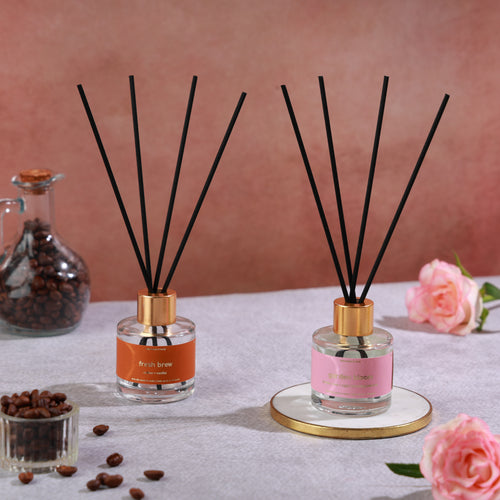
All five are 50ml from ₹749 or 130ml from ₹1,249, with six fibre reeds and a rating of about 150 sq ft. The doorway-and-sofa standard applies to all of them; what differs is the reed count each needs to reach it.
| Reed diffuser | Notes | Character | Best for |
|---|---|---|---|
|
Mountain Breeze ★ ₹849 / ₹1,349 |
Himalayan pine · sage · cedar | Hits both halves of the test easily — present at the door, forgotten on the sofa | Living rooms and halls at four to five reeds; the easiest blend to calibrate |
|
Morning Freshness ₹749 / ₹1,249 |
Malabar lemon · peppermint · eucalyptus | Reaches the doorway standard on fewer reeds than anything else in the range | Halls, kitchens and bathrooms; often correct at three where others need five |
|
Evening Calm ₹799 / ₹1,299 |
Kashmir lavender · chamomile | Needs more reeds to pass the doorway test, and rarely fails the sofa test | Bedrooms at three to four; anywhere the sofa standard is what worries you |
|
Garden Bloom ₹799 / ₹1,299 |
British rose · night-blooming jasmine | Passes the doorway test readily and can fail the sofa test in a small room | Larger sitting rooms and guest rooms at three to four reeds |
| Also in the range: Fresh Brew (Coorg coffee and Kerala vanilla) often fails the doorway test and passes the sofa test — it is a close-range blend, so judge it from the chair beside it rather than by this standard. See all five reed diffusers. | |||
The reed range · five scentsFrom ₹749Shop → 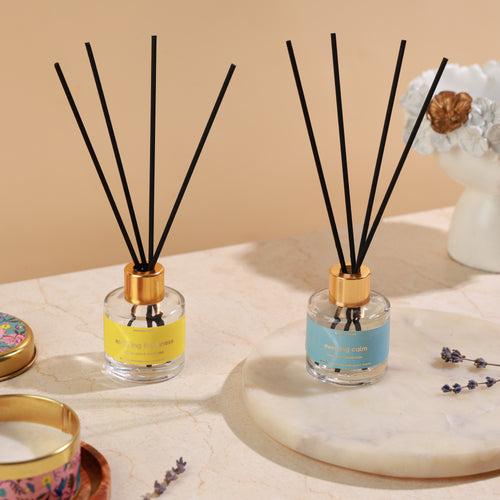 Day & Night duo · two rooms₹1,498Shop →
  Refills · 300ml₹2,399Shop →
Reeds, placement and flipping once you have a reading
Give every change forty-eight hours before you retest, and know that the two directions are not symmetrical. Adding a reed is slow — the new fibre has to saturate along its whole length before its tip contributes — while removing one takes effect within hours. So when a bottle is too strong, act immediately and retest tomorrow; when it is too weak, change one thing and be patient for two days rather than adding three reeds at once and overshooting.
If the doorway test is failing, look at position before you look at reed count, because placement is free and frequently decisive. A reed diffuser has nothing to push its output around the room, so it depends entirely on the air the room supplies — a console at the mouth of a passage or beside a door that opens several times a day will pass a test that the identical bottle fails on a low shelf behind an armchair. Three placements to avoid regardless of the reading: direct sunlight, which fades the fragrance and heats the oil; the direct blast of an AC vent or ceiling fan, which empties the bottle and pins the scent to one wall instead of distributing it; and bare polished wood or untreated stone, since reed oil marks both permanently if the bottle is knocked — stand it on a tray. Keep it out of reach of children and pets, and never decant.
Use flipping as a fine adjustment rather than a routine. Turning the reeds saturated-end up gives a real, immediate lift, so it is the right first move when a bottle has drifted below the doorway standard, and the wrong move when the sofa test is already borderline. Every flip costs bottle life, which is why a diffuser flipped daily runs nearer the bottom of its published band. If a bottle passes neither test after two or three months and flipping recovers nothing, the fibre has clogged with heavier fragrance molecules and the fix is fresh reeds — six come with every bottle, and a 300ml refill at ₹2,399 is the moment to fit them.
What to buy
Nothing here is a special calibration product — the test works on whatever you own. This is simply the sensible ladder, with real prices.
| Buy | What it is | Lasts | Price |
|---|---|---|---|
| Try one ★ | A 50ml reed diffuser — 6 fibre reeds included | 6–8 weeks | from ₹749 |
| The proper size | A 130ml — any room in daily use — set to four or five reeds for a living room | 14–18 weeks | from ₹1,249 |
| Two rooms | Day & Night duo — a hall at six reeds and a bedroom at three, from one purchase | 6–8 weeks each | ₹1,498 |
| Refill, do not rebuy | 300ml refill — refills a 130ml roughly twice; fit fresh reeds at the same time | Roughly 2 × 130ml fills | ₹2,399 |
| Fresh reeds | Failing both halves of the test after two or three months means clogged fibre, not an empty bottle | Replace at each refill | Included with each bottle |
Versailles
People ask me how strong a diffuser should be and expect me to say something about the room size. Room size matters less than the two moments that actually get judged: the second someone walks in, and the hour they spend sitting down. Everything useful about strength is contained in those two moments.
The reason so few homes are set correctly is not carelessness. It is that the owner is the worst-placed person in the house to assess it. Adaptation is fast and complete, and it biases every judgement in the same direction, so the natural drift of an unassisted home is upwards — more reeds, then a stronger blend, then a window open in February.
Ten minutes outside is enough to break that. Or, better, ask the next person who comes to the door. I would rather you spent nothing and got the setting right than bought a fourth bottle chasing a level you already had. A portion of every order supports girl-child education through Nanhi Kali.
Frequently asked questions
- Noticeable but not overpowering — the register this test aims at.
- Why can I not smell my reed diffuser? — adaptation, diagnosed properly.
- Strong or subtle: how to choose — room, household and hours at home.
- SOSA reeds by fragrance strength — the complete strength guide.
- Brand: the SOSA founder story.
SOSA products & prices (verified August 2026): Hotel Collection water-based ultrasonic diffuser fragrance 15ml ₹299 · 100ml ₹999 · 300ml ₹1,799 · Pack of 7 (15ml, all fragrances) ₹1,799; refills 100ml from ₹999. Seven scents: The Ritz-Carlton-inspired (white tea · bergamot · cedar), Westin-inspired (white tea · aloe · cedar), 1 Hotels-inspired (cedarwood · vetiver · green leaves), The St. Regis-inspired (amber · violet · woods), Shangri-La-inspired (jasmine · green tea · white tea), Four Seasons-inspired (citrus · floral · sandalwood), W Hotels-inspired (citrus · pepper · amber). Diffusers: Boond 300ml ₹899 · Sukoon 500ml ₹1,899 · Megh 6L ₹3,499. Water-based, phthalate-free, composed to IFRA standards for home diffusion; 3–6 drops per tank. Made in India, Pune. The Hotel Collection scents are SOSA's own interpretations inspired by the world's finest hotels; all hotel names are trademarks of their respective owners and are used only to describe the scent style — SOSA is an independent Indian fragrance house, not affiliated with or endorsed by any hotel brand. Prices and availability subject to change — see the live product pages.