




The first ten seconds of opening a closed room is the only accurate reading you get. Open the door, stand still, and write down what you notice before you speak to anybody. After a minute the reading is gone and does not come back that day.
Search enclosed, low and wet first. Floor traps and drains, the toilet's water seal and extract, AC filters, trays and drain lines, closed storage, the waste holding point, upholstery, the back corridor, the skirting line. In that order.
A finding is a location plus an hour plus a condition. Weather-linked points at moisture; hour-linked points at occupancy or cleaning; constant and unaffected by either points at plumbing or equipment. SOSA sells nothing that addresses any of the three.
2. Walk before the building opens, with the AC off if your practice normally starts it later. An overnight-closed room has concentrated whatever it produces, which is exactly what you want. Once doors are open and air is moving, the signal thins.
3. Use two people, separately, writing before speaking. Two independent lists compared afterwards are worth ten times one shared walk, because the first thing said out loud fixes what everybody else then smells. Where the two lists agree, you have a finding.
4. Search enclosed before open, low before high, wet before dry. Concentration is highest where air moves least. Reception is the last place to look, not the first, even though reception is where the complaint came from.
5. Open closed rooms and cupboards and take the first ten seconds. That is the measurement. Write it down standing in the doorway. After a minute in the room you have adapted and the reading is gone until tomorrow.
6. Record a location, an hour and a condition for every finding. Weather-linked findings point at moisture. Hour-linked findings point at occupancy or cleaning. Findings that are constant regardless of both point at plumbing, waste or equipment. The pattern names the category, and the category names the trade.
7. Do not add fragrance while you are looking. A second designed smell makes the first one harder to describe, and description is the whole diagnostic. If something is already running, take it out for the duration.
8. Nothing here is clinical, plumbing, building or regulatory advice, and this walk is not an inspection. Waste handling, infection control, ventilation standards, drainage and air handling belong to your own clinicians and contractors. I am telling you where a smell tends to hide, and being clear that SOSA sells no dehumidifier, no air purifier and nothing that removes an odour of any kind. Composed and made in small batches in Pune, and a portion of every order supports girl-child education through Nanhi Kali.
Part one — the protocol, the route and the record
Three things make the difference between a walk that finds the source and a walk that confirms what somebody already believed. None of them is about having a good nose; they are about when you use it, where you point it, and what you write down.
 Morning Freshness₹749 · only if nothing is foundReception is a large, frequently disturbed volume with a door opening onto the street, so anything produced there is diluted immediately. A cupboard, a wash area, a duct riser or a pantry is a small, still volume where the same production rate reaches a concentration ten or twenty times higher — which is why the smell that reaches your waiting room as a faint suggestion is a plain statement two rooms away. Order the walk by that logic rather than by geography. Enclosed before open: cupboards, stores, toilets, the pantry, the duct riser, the staff room. Low before high: floor traps, skirtings, the bases of walls and the underside of the reception desk, all read at knee height rather than standing. Wet before dry: anything with water in it or near it, which in a clinic means the wash area, the toilets, the pantry sink and every AC indoor unit's condensate tray. Take the reading at three heights where you can — knee, waist and standing — because a source at floor level and a source in a false ceiling produce very different gradients, and the gradient tells you which you have.
Part two — the nine stops, in the order a building hides things
The route, stop by stop, with what to do at each, what a positive finding is like, and who ends up fixing it. Thirty seconds a stop; the whole walk fits inside twenty minutes.
| Stop, in order | Do this, in about thirty seconds | What a positive finding is like | Category it points to | Who fixes it |
|---|---|---|---|---|
| 1 · Floor traps and drains ★ | Crouch at each trap in the wash area, pantry and toilets; note whether the trap looks dry | Sharp at knee height, absent standing; constant regardless of weather or hour | A dry or failed water seal — the single most common persistent source | Your plumber. Often a bucket of water first, as a test |
| 2 · Toilets and their extract | Open the closed door and take the first ten seconds; check whether the extract fan actually runs | Strong on opening, thinning within a minute of the door being held open | Extract not running, or not ducted anywhere useful | Your electrician or contractor; frequently a switched-off fan |
| 3 · AC indoor units — filters, tray, drain | Stand at the return grille of each unit for ten seconds, then at the supply | Strongest at the grille, appears with the cooling season rather than the rains | Condensate tray, drain line or loaded filters | Your AC contractor, usually a service visit you were due |
| 4 · Closed storage and the consumables store | Open each door, first ten seconds, and press the base of any cardboard carton | Strong on opening, soft carton bases, cockled paper and file covers | Secondary reservoir — card, paper and textile holding moisture | You, this afternoon, for nothing but the time |
| 5 · The waste holding point and the desk bin | Ten seconds at the holding point, then at knee height beside the reception bin | Worst late in the day and just before collection; sharpest close to the floor | Frequency and location of holding, not the bin itself | Housekeeping routine — a scheduling change, not a purchase |
| 6 · Upholstery, curtains and chair bases | Press your palm into two or three seat backs and read your hand, not the room | Only detectable at contact; absent when standing in the same room | Accumulated occupancy in soft furnishing | A deep clean of the fabric, or replacement at end of life |
| 7 · Back corridor, staff room and pantry fridge | Open the fridge and the staff room door; first ten seconds each | Distinct from anything at the front; often food rather than building | Housekeeping, and the room with the least air exchange in the building | You, free, and it is more often the answer than anyone expects |
| 8 · Skirtings and the base of external walls | Read at knee height along each external wall; look for a tide line or salting | Rises for two or three days after heavy rain, then settles | Moisture in the fabric — see the damp page in this family | Landlord, society or a waterproofing contractor |
| 9 · Reception, last of all | Leave the building for fifteen minutes, then re-enter through the patient door | Whatever is left after the eight stops above have been ruled out | If nothing else was found, this is where a fragrance question is fair | You — and only now is anything on this site relevant |
| The honest caveat: this is a way of organising your own observation and it is not an inspection, an audit or a survey. Nothing here is medical, clinical, plumbing, drainage, building, ventilation, waste-handling, infection-control or regulatory advice — all of that belongs to your own clinicians, contractors and licensed trades, and clinical waste in particular is governed by rules that are entirely theirs and not mine. SOSA sells no dehumidifier, no air purifier, no air filter and no odour-removing product of any kind, and no SOSA product removes, reduces, neutralises, absorbs or masks any smell. A diffuser adds a fragrance alongside what is already there. Where fragrance is eventually appropriate it belongs in reception and waiting only; examination rooms, diagnostics, consultation cabins, the procedure suite and any post-operative area take nothing, in any format, at any level, at any hour. | ||||
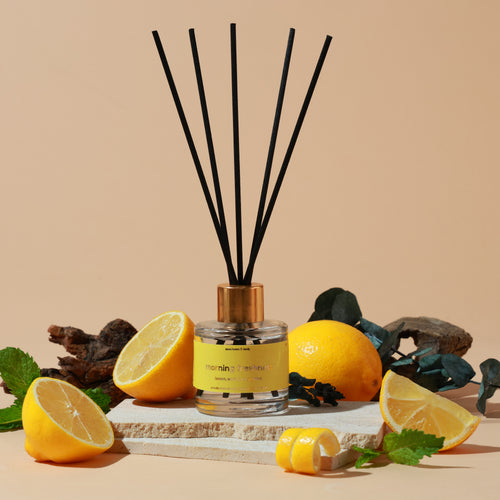 Morning Freshness · the least expensive start₹749Shop → Mountain Breeze · dry, two of six reeds₹849Shop →
  Sukoon · 150–320 sq ft, with a schedule₹1,899Shop →
Part three — what to do with what you found, including nothing
Most walks end at a trade, and I want to be honest about how ordinary the findings usually are. In my experience the two commonest are a dry floor trap in a wash area that has fallen out of daily use, and an AC condensate tray that has not been serviced since the last cooling season. Both are constant, both are unaffected by weather and hour, and both are exactly the profile people describe as persistent. Both are also cheap, quick and entirely outside our range: a trap is a plumber and often a bucket of water as a first test, and a tray is a service visit you were probably due anyway. The third commonest is a store cupboard full of cardboard against an external wall, which costs nothing but an afternoon. If your sheet points at any of those, stop reading about fragrance and go and deal with it, then re-walk the building a fortnight later with a cold nose and see what is left. Very often the answer is nothing, and the practice discovers it never had an ambience problem at all — it had a maintenance item that had been quietly getting worse for a year.
If the sheet points at a category rather than an object, the category tells you which page to read next and which trade to call. Rain-linked and seasonal is moisture, and moisture is a building repair — there is a page in this family devoted to damp in an older building, and its first line is that no scent machine will fix it. Clock-linked and worst by late afternoon is occupancy accumulation in a building with low air exchange, and the fix is a mid-day cross-ventilation window and the bin, both free. Clock-linked and worst just after cleaning is a protocol and sequencing question, and there are pages here for that too, one of which concludes with buying nothing. Constant and strongest at a grille is equipment. In every one of those categories the honest recommendation is the same: fix the thing, then wait, then re-measure. And in every one of them SOSA has nothing to sell you, which I would rather say plainly than dress up as a two-stage plan where the second stage happens to be our product.
Then there is the outcome practices are most surprised by, which is finding nothing at all. Two people, two mornings, nine stops each, and neither list has anything on it — at which point you have learnt something genuinely valuable: your building is fine, and what you are actually responding to is that reception smells of nothing in particular. That is not a fault. A clinic that smells of nothing is a clinic doing well, and I would think carefully before changing it, because a practice is judged on competence and ambience must never compete with that signal. But if you want the arrival zone to feel considered rather than merely neutral, that is now a small, clean decision instead of an attempt to solve a mystery. One source, dry, at the lowest useful level, in reception only, set back from the corridor to consultation, with a fragrance-free seat somewhere a person would ordinarily sit. Two of six reeds on a bottle from ₹749, or a Sukoon at ₹1,899 if the zone runs to 150–320 sq ft and you want a schedule. The target is considered, not scented, and if a patient can name the fragrance it is too strong.
Part four — findings, next steps, and what SOSA sells for each
Eight possible outcomes of the walk, what each one means you should do, whether we sell anything relevant, and when fragrance becomes a fair question again. We sell something for exactly one row.
| What the walk found | The honest next step | Does SOSA sell anything for this? | What it costs | When fragrance becomes a fair question |
|---|---|---|---|---|
| Nothing, on two lists, on two mornings ★ | Nothing to fix. Decide separately whether you want the arrival zone scented at all | Yes — this is the one row where we are relevant | ₹749–₹849 for one 50ml bottle at two of six reeds, free shipping above ₹499 | Now, at the lowest useful level, in reception only |
| A dry or failed floor trap | Plumber. Test with water first; a trap that has fallen out of use is the classic persistent source | No | A trade visit, not a SOSA price | Two weeks after the fix, on a re-walk |
| AC condensate tray, drain line or filters | Your AC contractor — a service visit, usually overdue | No | A service visit you were due anyway | After the next full week of cooling with no finding |
| A store cupboard of soft cardboard and old paper | Empty it today; move stock off the floor and off external walls | No | Zero, plus an afternoon | Immediately, if that was the only finding |
| Waste holding, or the bin behind the desk | Change the routine and the location; take it out of the building at lunch | No — and clinical waste rules are your clinicians', not ours | Zero | After a fortnight of the new routine |
| A tide line, salting or rain-linked rise at the skirting | Moisture. A building professional, and the damp page in this family | No. SOSA sells no dehumidifier and no air purifier | A repair, and then weeks of drying | Only after a full wet spell with no return |
| Worst just after cleaning, decaying over an hour | Sequencing and air exchange. Never layer fragrance over it | No, and the disinfectant page here recommends buying nothing | Zero | Once the pulse and any fragrance window no longer overlap |
| Worst by late afternoon, better after airing | Occupancy accumulation. A mid-day cross-ventilation window | Only a schedule: Boond ₹899 or Sukoon ₹1,899 | Zero for the ventilation; ₹899–₹1,899 if you want windows | After the free fix has run for a fortnight |
Versailles
A practice in a busy market building had been trying fragrances for eight months. They had bought three different things and were writing to ask which of ours was the strongest, which is usually the point at which I stop talking about products altogether.
I sent them the walk instead — nine stops, two people, first thing, written before speaking. They found it at stop one. A floor trap in a small wash area that had stopped being used when a room was repurposed, so nothing had run into it for months and the water seal had simply evaporated. Everything the sheet said fitted: constant, unaffected by rain, unaffected by the hour, strongest at knee height, and two rooms away from where anybody had ever complained.
A plumber dealt with it in an afternoon. They re-walked a fortnight later and both lists were blank. Then — and only then — they asked me about a bottle for reception, and it was a five-minute conversation instead of an eight-month one. I think about that practice whenever I am tempted to answer a question about strength. Composed and made in small batches in Pune, and a part of every order funds a girl's classroom through Nanhi Kali.
Frequently asked questions
- An older building with a damp smell — what to do when the walk points at moisture.
- Cleaning products, AC and fragrance together — what to do when it points at the cleaning hour.
- Why reception smells different after a full day and why it smells stale at opening.
- When to fix the building instead of adding fragrance — the decision rule for this whole family.
- Brand: the SOSA founder story.
SOSA range, specifications and prices used in this guide (verified August 2026): Vaayu ₹11,999 — waterless cold-air nebulisation of undiluted fragrance oil; no water, no heat, no added humidity, no white mineral dust. Coverage up to 1000 m³, about 2,000–3,000 sq ft. 400ml refillable tank lasting roughly 90+ days at a mid setting. Bluetooth app plus onboard controls, 1h / 4h / 8h / 24h run windows, day selection, adjustable intensity, auto-stop and key-lock. Under 38 dB. DC 12V / 1A, 5W. Freestanding or wall / HVAC mount. CE, RoHS and SGS certified. SOSA does not currently sell a separate Vaayu cold-air refill oil; the 400ml supplied in the box is the fragrance available at the time of writing, so a practice planning continuous or multi-site use should confirm current refill availability with SOSA before committing. The water-based Hotel Collection is made for ultrasonic machines and must not be used in a Vaayu. Other machines: Boond 300ml ₹899 (~150 sq ft, ultrasonic) · Sukoon 500ml ₹1,899 (270–320 sq ft, 16–18 hours on low, remote and steady/2H/4H timers, three 15ml fragrances included, ultrasonic) · Megh 6L ₹3,499 (~215 sq ft — a runtime and humidity machine that covers less than a Sukoon, never a coverage upgrade) · Safar ₹3,999 (waterless cold diffusion, cordless, 20ml, about 6.9cm, three speeds, 1/2/3-hour auto-off — sold as a car and travel diffuser, personal-scale only; SOSA publishes no coverage figure for it) · Aangan ₹25,999 (HVAC nebulising, ~8,000–10,000 sq ft) · Meenar ₹38,500 (commercial HVAC, 12,000–18,000 sq ft). Water-based Hotel Collection for ultrasonic machines: 15ml ₹299 · 100ml ₹999 · 300ml ₹1,799 · pack of seven ₹1,799; scents are inspired by the atmosphere of well-known hotels — SOSA is an independent Indian brand and is not affiliated with, endorsed by or supplying any hotel group. Reed diffusers ₹749–₹1,349 (50ml 6–8 weeks, 130ml 14–18 weeks, six fibre reeds, no 100ml size; replacement reeds are not sold separately). Reed oil cannot be used in an ultrasonic machine and Hotel Collection oil cannot be used in reeds. SOSA sells no room spray or home spray — every SOSA spray is a car perfume. Nothing in this guide is medical, clinical or safety advice. A fragrance diffuser adds a scent to the air. It does not clean, purify, filter, sanitise or disinfect air, does not remove or neutralise disinfectant, damp or occupancy smells, and has no effect on comfort, anxiety, waiting time, recovery or any clinical outcome. Some people are sensitive to airborne fragrance, which is why this guide recommends that examination rooms, diagnostic areas, consultation cabins, procedure suites and post-operative areas remain fragrance-free, that a fragrance-free seating option always exist, and that a diffuser is never mounted into shared HVAC in a clinical building. Decisions about clinical policy, ventilation standards, infection control and patient suitability rest entirely with the practice and its clinicians. A persistent stale, damp or disinfectant smell is a ventilation, moisture or cleaning problem — SOSA sells no dehumidifier and no air purifier, and fragrance should never be used to cover one. Coverage, runtime and longevity figures are manufacturer specifications and typical ranges, not guarantees, and vary with room volume, ceiling height, air exchange, occupancy and season. SOSA publishes no commercial or bulk pricing, no corporate account, no annual maintenance contract, no installation service, no stated warranty term and no multi-location programme; warranty length, spare parts, servicing and app platform availability are unconfirmed, and larger or multi-site enquiries should go through the contact page before any commitment. Composed and made in small batches in Pune, India. Free shipping above ₹499. A portion of every order supports girl-child education through Nanhi Kali. Prices subject to change — see the live product pages.