



2. Fix the door. A parent arrives holding a child — it must open with one hand.
3. Clean the glass, and take the old tape and laminated notices off it.
4. Move the seating. Break the row; end the sightline on a face, not a queue.
5. Sort the toilet. Hourly check, lidded bin, working extract, stocked, dry floor.
6. Manage the queue. Put the running delay where parents can see it and update it.
2. Fix the door and clean the glass. A parent arriving at a paediatric clinic has a child on one hip and usually a bag on the other shoulder, which means they have one hand. If your door needs two, or has a closer set so hard it fights them, or a threshold that catches a pram wheel, the very first physical interaction with your clinic is a small defeat. Adjust the closer, fix the handle, sort the threshold and check it works with a pram. Then clean the glass properly and take off the old tape, the adhesive residue, the faded stickers and any laminated notice that is not essential. Glass at child height gets handprints all day; put it on the twice-daily list rather than the weekly one.
3. Move the seating instead of buying seating. One long row of linked chairs facing the desk is the visual grammar of a queue. Break it into two shorter runs at an angle to each other, ideally with a low table between them, and make sure the sightline from the door ends on a person at the desk rather than on the back of a row of heads. Pull the seating away from the wall by a few centimetres so the floor can actually be cleaned behind it, and put something at the end of each run where a parent can set a bag down. This is an hour of moving furniture and it changes the room’s reading from waiting hall to room.
4. Sort out the patient toilet, and keep sorting it. It is the most closely inspected room in a paediatric clinic, because nearly every parent of a toddler ends up in it and looks at it carefully. It needs a lidded bin emptied often, a working extract fan that is actually switched on, stocked consumables, a dry floor and an hourly check with a card on the back of the door showing that the check happened. A clean, dry, well-ventilated toilet quietly settles the question of how the whole clinic is run, and it is also the single most effective odour-control measure available in most small clinics.
5. Tell parents how long it will be, without being asked. The wait itself matters less than whether anybody told them about it. A whiteboard at the desk carrying the current running delay, updated when it changes, plus a habit at reception of stating it on arrival, is the highest-yield change on this entire page and costs the price of a marker pen. A parent told on arrival that the doctor is running twenty-five minutes late experiences an organised clinic. A parent who discovers the same twenty-five minutes experiences an indifferent one, and no interior repairs that.
Made in India, composed by an ISIPCA Versailles-trained perfumer — and a portion of every order supports girl-child education through Nanhi Kali.

Why a renovation is usually aimed at the wrong target
The instinct when a clinic feels tired is to reach for the fabric — new flooring, a new counter, a repaint, perhaps a mural — because fabric is what a designer can quote for. But sit in a paediatric waiting room for forty minutes and note what parents actually react to, and the list barely touches fabric. They react to a door that fights them, a counter they cannot see over because of the file stacks, a chair with tape on the seat, a bin with the lid open, a toilet with a wet floor, a notice board they cannot decode, and a wait nobody has explained. Those are maintenance and habit problems wearing the costume of a design problem, and a renovation that does not address them produces a smarter room with the same faults in it. Plenty of very expensive paediatric fit-outs still have a propped fire door and a full nappy bin.
There is a practical advantage to the no-renovation route as well, beyond the money. Every one of these six changes is reversible, observable within a week, and cheap enough to try without a committee. You can break the seating row on Saturday and know by Wednesday whether the room feels different, and if it does not you can put the chairs back. A renovation does the opposite: it commits a large sum to a set of assumptions before anybody has tested whether those assumptions were the problem. The sensible sequence is to do the six jobs first, live with the result for a month, and only then decide what — if anything — is genuinely a building question. A good many clinics discover at that point that the answer is the lighting, which is a lamp change rather than a renovation, and that the fit-out was never the issue at all.
Two afternoons and two standing routines
 Optional, and lastFrom ₹749Strip the counter to the things that are used hourly and give everything else a drawer. Take the notice board down entirely, then put back only what a parent needs, printed properly and mounted once. Remove the cartons, the dead plant, the broken toy and the damaged chair from the waiting view — cupboard them or bin them, but do not simply move them to the corridor, which is where they usually end up. Then adjust the door closer, fix the handle, check a pram clears the threshold, clean the glass and scrape off the old tape. Every item on this card is free or nearly free, and together they change the room more than paint would.
Zone by zone, for a clinic doing no building work
This table exists to keep the six jobs and the fragrance question in their proper proportions. Almost all the work is in the first two rows, and none of it is a purchase.
| Area of the clinic | Scented? | Why | What we would use |
|---|---|---|---|
| Entrance and reception counter ★ | Yes, low | Door, glass, clutter and sightline — and scent only as a small optional finish afterwards | Reed from ₹749, or Sukoon ₹1,899 |
| Waiting seating and play corner | Minimum only | Break the row, clear the clutter, wash the toys — the longest dwell in the building sits here | Nothing separate; a laundry rota instead |
| Patient toilet and nappy-change | No | The most inspected room in the clinic, and the biggest odour source in most small ones | Extract, lidded bin, hourly check |
| Consultation and examination rooms | No | Declutter and tidy storage apply here too; nothing is added to the air in any of them | Nothing |
| Vaccination, injection and procedure rooms | No | Keep them out of the waiting sightline and keep the memory of them free of a distinctive scent | Nothing |
| Nebulisation, asthma and neonatal follow-up | Never | Respiratory patients and newborns — tidy, clean and ventilated, with nothing added | Nothing |
| Before any of this: do all six jobs before spending anything at all. If the door still needs two hands and the delay is still a secret, a fragrance purchase is money aimed at the wrong problem. | |||
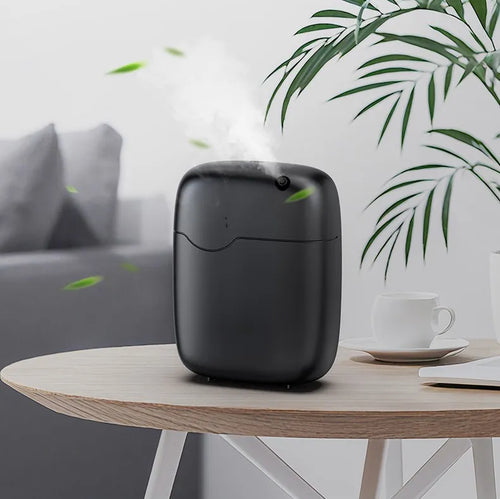
Small reception · no power neededFrom ₹749Shop →  Mid reception · has an off switch₹1,899Shop →
  Large lobby · timed, dialable₹11,999Shop →
The odour work that is also free — and where a purchase finally makes sense
Air the building before you open, and empty the bins on a schedule. The characteristic closed smell of a clinic at nine in the morning is the accumulated output of a shut room at roughly 0.2 to 0.5 air changes an hour overnight, and the fix is fifteen or twenty minutes of genuine cross-ventilation before the first patient, with windows on two sides open and the doors between them open too. Air conditioning does not do this — it recirculates and cools rather than ventilating, and its filter and drain pan are themselves common odour sources worth checking. Add a lidded bin in the nappy-change area emptied at least twice a day, and a second deliberate airing at the quiet point in the afternoon. All of that is free, and it removes odour rather than adding to it.
Only then does a fragrance purchase make sense, and it should be a small one. Fragrance is additive: it puts molecules in, it takes none out, so a clinic that still smells of the morning clean or a full bin will simply give parents both things at once. If the six jobs are done and the room is genuinely neutral, the proportionate spend for a no-renovation project is reeds at ₹749 to ₹1,349 or a Sukoon at ₹1,899 on three drops in intermittent mode. Choose a dry, low-sweetness direction such as Ritz-Carlton-inspired Quiet Luxury or Westin-inspired White Tea Serenity rather than anything gourmand or heavily floral.
And set the level with a nose that has been outside for thirty minutes. Everyone working in the clinic has adapted within about twenty minutes of arriving, so the request from inside the building is always for more — which is how most over-scented receptions got that way. Keep any unit high and aimed away from the seating, out of the 0.8–1.2 m band where a child breathes rather than the 1.5–1.7 m band where an adult does, and keep it out of reach of the play corner entirely. Every clinical area stays fragrance-free, be willing to switch the reception source off on request for a family with a scent-sensitive or asthmatic child, and put the decision through your own clinical governance, infection-control and housekeeping leads rather than through a supplier.
What we would actually install
Priced for a clinic that has deliberately decided not to renovate. The last row is on the table because six completed jobs frequently make the rest of it unnecessary.
| Option | Suits | Control you get | Price |
|---|---|---|---|
| Reed diffuser ★ | A small reception desk — a counter in a clinic doing no building work; no wiring, no wall fixing, no installer, three reeds not six | Reed count only — no switch, no timer | from ₹749 |
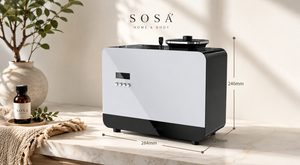
| Sukoon 500ml | A reception up to ~320 sq ft — a reception up to about 320 sq ft that wants an off switch at the desk and a level it can lower | On/off, intermittent mode, you control the drops | ₹1,899 |
| Vaayu | A large lobby or a zoned duct — a large reception that has already done the six jobs and is genuinely too big for passive diffusion | Duty cycle in seconds, timer, app scheduling | ₹11,999 |
| Aangan | Whole-facility HVAC — a multi-floor centre with zoned ducting — a renovation-scale decision rather than a Saturday one | Zone-level control, but only if the ducting is zoned | ₹25,999 |
| Nothing at all | A clinic that has cleared the clutter, fixed the door and put the delay on a board — the first impression has already moved, and nothing needs to be added to the air | Complete — and the correct answer more often than the trade admits | ₹0 |
Versailles
The single best-value change I have ever watched a clinic make cost eighty rupees. They bought a whiteboard marker and started writing the doctor’s running delay on a board at the desk. Complaints halved inside a month and nobody had touched the interior.
The second best cost nothing. A clinic in Nashik took every laminated notice off the reception glass, cleaned the glass properly, and put back three printed cards instead of eleven. Parents told them the reception looked as though it had been redone. It had not been redone; it had been cleared.
So when someone asks me how to improve a first impression without renovating, I am genuinely pleased, because the no-renovation answers are the good ones. Do the six jobs, air the building before you open, keep the toilet honest, and then — if you still want something at the counter — buy a reed, not a machine, and keep it out of every clinical room. Ask your own governance and infection-control leads to sign off anything that touches a clinical area. A portion of every order funds a girl’s classroom through Nanhi Kali.
Frequently asked questions
- What makes a clinic read as premium — six signals, ranked honestly.
- The first ten seconds, sequenced — door, sightline, sound, air.
- Making a clinic feel less institutional — the six signals to change.
- Which sensory details matter — sound, touch, temperature, sightline.
- Brand: the SOSA founder story.
SOSA products & prices (verified August 2026): Hotel Collection water-based ultrasonic diffuser fragrance 15ml ₹299 · 100ml ₹999 · 300ml ₹1,799 · Pack of 7 (15ml, all fragrances) ₹1,799; refills 100ml from ₹999. Seven scents: The Ritz-Carlton-inspired (white tea · bergamot · cedar), Westin-inspired (white tea · aloe · cedar), 1 Hotels-inspired (cedarwood · vetiver · green leaves), The St. Regis-inspired (amber · violet · woods), Shangri-La-inspired (jasmine · green tea · white tea), Four Seasons-inspired (citrus · floral · sandalwood), W Hotels-inspired (citrus · pepper · amber). Diffusers: Boond 300ml ₹899 · Sukoon 500ml ₹1,899 · Megh 6L ₹3,499. Water-based, phthalate-free, composed to IFRA standards for home diffusion; 3–6 drops per tank. Made in India, Pune. The Hotel Collection scents are SOSA's own interpretations inspired by the world's finest hotels; all hotel names are trademarks of their respective owners and are used only to describe the scent style — SOSA is an independent Indian fragrance house, not affiliated with or endorsed by any hotel brand. Prices and availability subject to change — see the live product pages.