

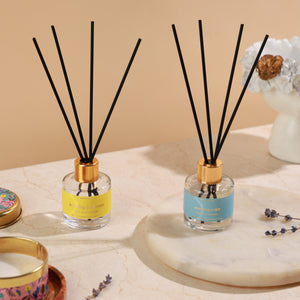



Duration: 6 to 8 weeks, against 14 to 18. About ₹105 a week against about ₹78.
Best used in: a 30–45 sq ft bathroom on two or three reeds, where it runs past ten weeks; as a second point in an awkward room; and as the way to try a blend before committing ₹1,249 to it.
2. What the extra ₹500 buys is weeks. A 50ml from ₹749 runs 6 to 8 weeks; a 130ml from ₹1,249 runs 14 to 18. That is about ₹105 a week against about ₹78, so the larger bottle is roughly a quarter cheaper per week of use as well as being fewer trips to a website. Over a year the small-bottle route is about seven purchases at ₹5,243 and the large-bottle route about three at ₹3,747 — roughly ₹1,496 more for identical coverage.
3. The 50ml is at its weakest at the top of its own range. This is the part worth understanding before you buy. A 150 sq ft room needs all six reeds to be held properly, and six reeds is the setting that empties a 50ml fastest — six weeks rather than eight, or about ₹125 a week. So the small bottle technically handles the biggest room it is rated for while being the most expensive possible way to keep that room scented.
4. It is at its strongest in a small room, where the big bottle is wrong. A 30 to 45 sq ft bathroom wants two or three reeds, not six, and on two or three reeds a 50ml runs well past ten weeks — roughly ₹75 a week, cheaper than the 130ml manages anywhere. A 130ml on six reeds in a space that small is simply too much. The 50ml is not the budget version of the 130ml. It is the correct product for small, closed, low-reed spaces.
5. And it is the honest way to try a blend. Five blends, ₹749 to ₹849, six to eight weeks each: that is a reasonable way to find out whether you actually want to live with Kashmir lavender or with Coorg coffee before committing ₹1,249 to four months of it. Buying a 130ml of something you turn out to dislike is the more expensive mistake by a distance.
Made in India, composed by an ISIPCA Versailles-trained perfumer — and a portion of every order supports girl-child education through Nanhi Kali.

Why reeds set coverage and millilitres do not
It is worth being precise about the mechanism, because almost every sizing mistake in home fragrance comes from getting it wrong. A reed diffuser has no fan, no pump and no heat. Fragrance oil travels up the porous core of each fibre reed by capillary action, reaches the exposed length standing above the bottle collar, and evaporates from that surface into the room. The rate at which fragrance enters the room is therefore a function of how much exposed fibre there is — six reeds against three, roughly double — and nothing at all to do with how much liquid is waiting underneath. Coverage is where that input rate reaches equilibrium against the room's air-change rate. The reservoir does not appear anywhere in that calculation.
The reservoir appears in a different calculation: how long before the input stops. That is the whole of the difference between the two sizes, and it is a real and useful difference — 6 to 8 weeks against 14 to 18, which is the difference between reordering seven times a year and three. But it means a very specific thing follows. If a room is too big for a 50ml, it is too big for a 130ml, and the answer is a second position or a machine rather than a larger bottle. A 200 sq ft living room does not become manageable because you upgraded the bottle; a 300 sq ft studio does not either. This one point, once it lands, saves people more money than any other in this cluster.
What the small bottle is actually for
 50mlFrom ₹749The same figure as the larger bottle, on the same six reeds, under the same conditions — a closed room with still air and a ceiling around nine feet. Open the door, run a fan, or raise the ceiling to twelve feet and the 50ml loses coverage exactly as the 130ml does; neither bottle has any advantage in a draught, because neither is pushing anything. Treat "up to about 150 sq ft" as a property of six reeds rather than a property of a bottle and the whole range becomes easy to size: reeds decide how far, millilitres decide how long, and shape decides how many positions.
Sizing by space — where a 50ml is right and where it is not
The 50ml covers every room in this table up to 150 sq ft. What changes is whether it is the sensible bottle for the job. One row is a room to buy nothing for.
| Space | What it needs | How many | Cost |
|---|---|---|---|
| A 30–45 sq ft bathroom ★ | Two or three reeds — the room the 50ml is genuinely best at, and it runs past ten weeks that way | One 50ml | from ₹749 |
| A 100 sq ft bedroom on three or four reeds | Covered easily, but the 130ml costs about ₹78 a week against ₹105 — buy small only to trial a blend | One, preferably the 130ml | from ₹749 or ₹1,249 |
| A 150 sq ft main room, six reeds | Covered — and emptied in about six weeks, roughly ₹125 a week. Right area, wrong bottle | One 130ml instead | from ₹1,249 |
| The blind leg of an L-shaped room that already has a bottle | A second point of origin, which is a position rather than a duration — the cheap way to fix shape | One 50ml | from ₹749 |
| A blend you have never smelled in your own home | Six to eight weeks is exactly long enough to find out — cheaper than disliking a 130ml for four months | One 50ml | from ₹749 |
| A store room, or a bedroom nobody sleeps in | Nothing. A passive bottle evaporates through every unvisited week at the same rate as a used one | None | ₹0 |
| A note on all of the above: every coverage figure here assumes a closed room, still air and a standard ceiling. Neither bottle size resists a draught better than the other, so if a room disappoints, the variable to change is the door, the ceiling or the position — never the millilitres. | |||
One room · the unitFrom ₹749Shop → 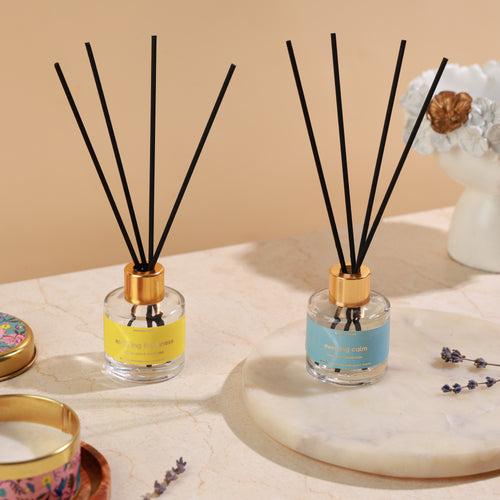 Two rooms · better value₹1,498Shop →
  Large room · a switch₹1,899Shop →
Reed counts, and the arithmetic over a year
Set the reeds for the room, then read the duration off that setting. This is the single most useful habit with a small bottle, because reed count moves its life around dramatically. Two or three reeds in a bathroom will take a 50ml past ten weeks; four in a small bedroom lands it near the top of its 6–8 week band; six in a 150 sq ft room brings it down to about six. So the same ₹749 bottle costs roughly ₹75 a week in one room and ₹125 in another, entirely because of a decision you make when you unpack it. Start low, wait forty-eight hours for the reeds to saturate along their full length, and add one at a time.
Then place it where the air moves gently and nowhere near where it moves fast. A shelf or console at chest height near a doorway will outperform a low bedside table in a still corner. Keep it out of direct sunlight, which fades fragrance and heats the oil into faster evaporation; out of the throw of a fan or an AC vent, which strips the reeds and stacks the scent against one wall; and off bare polished wood, since reed oil marks a finish permanently if the bottle is knocked. All three matter more in a 50ml than a 130ml for the obvious reason: there is less reserve to lose.
Then decide honestly whether this is a room you will keep scented. If yes, do the annual sum once and it settles the question: about seven 50ml bottles a year at ₹5,243 against about three 130ml at ₹3,747, and the gap widens again if you refill rather than rebuy, since a 300ml refill at ₹2,399 fills a 130ml roughly twice. If no — a guest room used at Diwali, a rented flat you leave in April, a scent you are unsure about — then the 50ml is not a compromise at all, and buying the larger bottle would be the mistake. The Day & Night duo at ₹1,498 is two 50ml bottles against ₹1,548 bought separately, which is the neat way to solve two small rooms at once.
What to buy
The 50ml row is starred here because this page is about that bottle — but read the second row before you decide, because for a main room it is the cheaper one.
| Buy | What it covers | Lasts | Price |
|---|---|---|---|
| One 50ml ★ | A single reed diffuser — a 30–45 sq ft bathroom on two or three reeds, a blind leg, a trial, or a room you will leave in three months | 6–8 weeks | from ₹749 |
| One 130ml | The value size — any main room you intend to keep scented — about ₹78 a week against ₹105, and three reorders a year not seven | 14–18 weeks | from ₹1,249 |
| The duo | Day & Night duo — two small rooms at once for ₹1,498 against ₹1,548 separately, six to eight weeks each | 6–8 weeks each | ₹1,498 |
| Sukoon | 500ml ultrasonic — a room past about 200 sq ft, where neither bottle size is the answer and a second position or a machine is | Runs when you switch it on | ₹1,899 |
| 300ml refill | The running cost — refills a 130ml roughly twice and takes the running cost to about ₹75 a week | Roughly 2 × 130ml fills | ₹2,399 |
Versailles
The question behind this question is usually "can I get away with the cheap one", and I want to answer the literal version first because it is the one people get wrong. Yes — the 50ml covers exactly what the 130ml covers. Up to about 150 square feet, closed and still, on six reeds. The two bottles throw identically. Anyone who tells you the bigger bottle reaches further has not thought about how a reed diffuser works.
What you do not get is time, and time is what you are actually buying in a room you live in. Seven small bottles a year is ₹5,243. Three large ones is ₹3,747. It is the same room, the same scent, the same strength — about ₹1,496 more for the privilege of ordering four extra times. If it is your bedroom or your living room, buy the 130ml and stop thinking about it.
But I would not want the 50ml read as the lesser product, because in a bathroom it is the better one. Two reeds in forty square feet is a lovely, quiet, correct amount of fragrance, and it will outlast the big bottle in your bedroom. It is also the sensible way to try a blend — I would much rather you spent ₹749 finding out that Fresh Brew is not for you than ₹1,349. A portion of every order funds a girl's classroom through Nanhi Kali.
Frequently asked questions
- How big a room can a 130ml handle? — the same answer, and why it surprises people.
- Cost per week: 50ml against 130ml — the arithmetic in full.
- Two 50ml or one 130ml? — two rooms briefly, or one room for months.
- The complete sizing and quantity guide — every home type, three builds.
- Brand: the SOSA founder story.
SOSA products & prices (verified August 2026): Hotel Collection water-based ultrasonic diffuser fragrance 15ml ₹299 · 100ml ₹999 · 300ml ₹1,799 · Pack of 7 (15ml, all fragrances) ₹1,799; refills 100ml from ₹999. Seven scents: The Ritz-Carlton-inspired (white tea · bergamot · cedar), Westin-inspired (white tea · aloe · cedar), 1 Hotels-inspired (cedarwood · vetiver · green leaves), The St. Regis-inspired (amber · violet · woods), Shangri-La-inspired (jasmine · green tea · white tea), Four Seasons-inspired (citrus · floral · sandalwood), W Hotels-inspired (citrus · pepper · amber). Diffusers: Boond 300ml ₹899 · Sukoon 500ml ₹1,899 · Megh 6L ₹3,499. Water-based, phthalate-free, composed to IFRA standards for home diffusion; 3–6 drops per tank. Made in India, Pune. The Hotel Collection scents are SOSA's own interpretations inspired by the world's finest hotels; all hotel names are trademarks of their respective owners and are used only to describe the scent style — SOSA is an independent Indian fragrance house, not affiliated with or endorsed by any hotel brand. Prices and availability subject to change — see the live product pages.