

The free gain: pull the reeds up so they stand taller out of the neck, and spread them so they are not pressed together. Same six reeds, more working surface.
The paid gain: going from six to nine reeds is an audible change, and costs roughly proportional bottle life — nearer five weeks than eight on a 50ml.
The gain that is not a gain: pushing reeds deeper into the oil. Fibre below the oil line evaporates nothing.
2. But surface is length × count × clearance, and count is the crudest of the three. Reeds pulled up so they stand tall out of the neck expose more fibre than the same reeds pushed down. Reeds spread apart expose more than reeds pressed together.
3. Immersion depth buys you nothing. The submerged part of a reed is plumbing. It supplies oil upward; it does not evaporate. Pushing reeds further into the bottle reduces the exposed length and makes the room quieter, which is the opposite of what most people intend.
4. Surface only works if air reaches it. A reed with a large exposed length standing in a dead alcove is delivering into still air that nothing carries away. Gentle passing air near a doorway, waist-to-chest height, is what turns surface into a scented room.
5. The cost is paid in weeks, in proportion. Nine reeds on a 50ml is nearer five weeks than eight; ten is nearer four to five. Free surface — standing height and clearance — costs nothing at all.
6. And there is a point where more reeds stops adding surface. Past nine or ten in a standard neck, reeds crowd each other and the clearance term falls as fast as the count term rises.
Composed and handmade in small batches in Pune, and a portion of every order supports girl-child education through Nanhi Kali.
Part one — the three terms in the surface equation
If you want one sentence to carry away from this page, it is that a reed diffuser's output is set by how much wetted fibre is standing in moving air. Everything else — count, bottle size, neck width, how you arrange them — matters only insofar as it changes that quantity. Break it into its three terms and the free gains become obvious.
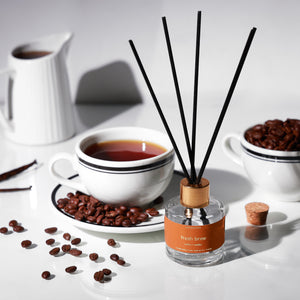
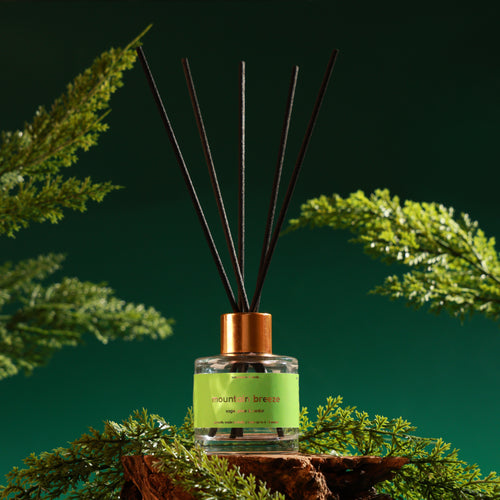
 Fresh Brew₹849 · 9.5/10Count is the term you can change most decisively, and I am not going to pretend otherwise: adding three reeds to a six-reed bottle produces a noticeably fuller room within a day. Every SOSA bottle ships with six because that is the count each composition is balanced and rated at, in both the 50ml and the 130ml. What count buys in presence it charges in weeks, roughly in proportion — nine reeds turns six to eight weeks into something closer to five on a 50ml; ten turns it into four or five. It is also reversible in ten seconds, which makes it the ideal tool for a hosting week and a poor one for a permanent habit. Fibre reeds rather than rattan matters for this term specifically: rattan's pores clog in Indian humidity, so a rattan bundle's effective count falls over a monsoon while a fibre one does not.
Part two — one bottle, five configurations of the same six reeds
Everything below is a single 50ml bottle of a single composition. Only the arrangement changes. The purpose of the table is to show how much of the range of outcomes is available without adding anything at all.
| Configuration | Standing height above the neck | Clearance between reeds | Effective working surface | How the room reads |
|---|---|---|---|---|
| Six reeds, tall and fanned ★ | Maximum, ends still submerged | Good — each reed has air around it | The full designed area | The composition as rated, holding to the end of the bottle |
| Six reeds pushed deep | Reduced by a third or more | Good, but there is less of each reed to clear | Noticeably lower than designed | Quiet — commonly misread as a weak fragrance |
| Six reeds leaning on the rim | Reduced, and angled away from the airflow | Poor along the contact length | Lower still, and uneven between reeds | Patchy; some reeds dry at the tip, others saturated |
| Nine reeds, tall and fanned | Maximum | Adequate — the neck is full but not crushed | Genuinely higher than six | Audibly fuller, at roughly five weeks instead of eight |
| Twelve reeds crushed together | Maximum, but several reeds splay outward | Poor — most fibre faces other fibre | Little more than nine, sometimes less | Heavy at the bottle, oily at the rim, empty in about a month |
| The honest caveat: these are descriptive comparisons from in-house testing and customer correspondence, not measurements — I am not claiming a percentage for any of them, because room volume, ceiling height, ventilation and season move the result more than the arrangement does. What the table is for is the ranking, which holds everywhere: raise and spread before you add, and never mistake depth into the oil for strength. | ||||
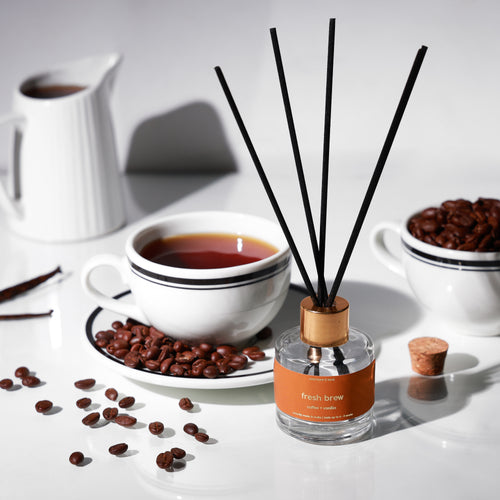 Fresh Brew · 9.5/10from ₹849Shop →
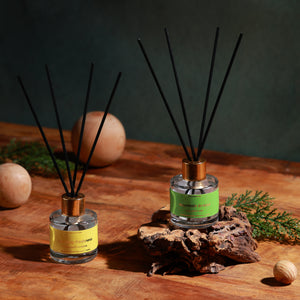
 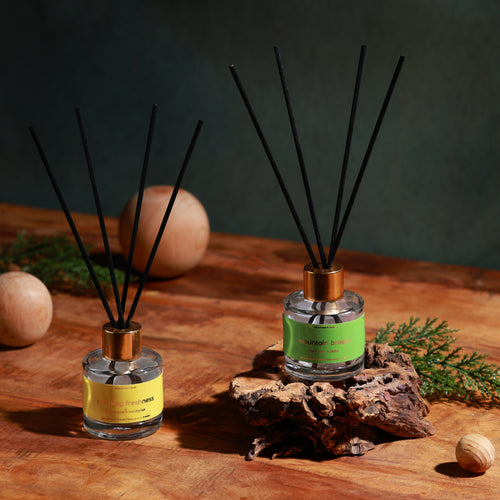 Fresh & Grounded duo₹1,548Shop →
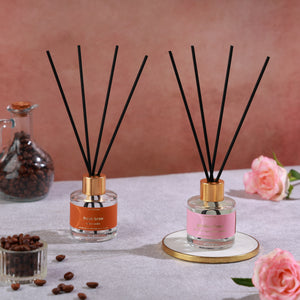
 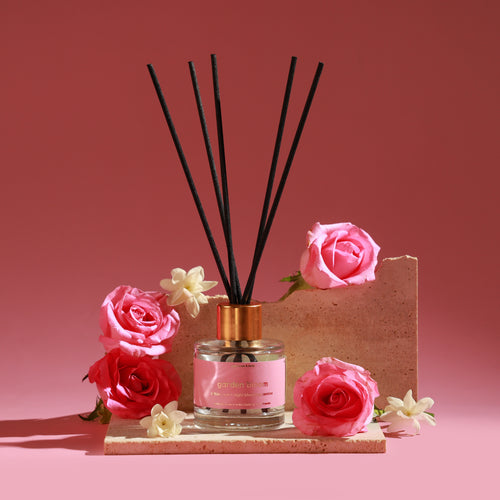 Garden Bloom · 8.9/10from ₹799Shop →
Part three — how to buy surface without buying reeds
Start with the bottle in front of you. Lift every reed out, wipe the neck, and put them back in only as deep as they need to go — far enough that the ends stay under the oil as the level falls over the weeks, and no further. On a 50ml that is usually less depth than people assume. Then fan them, so that no reed is lying along another for more than an inch or two, and so none is resting on the rim at an angle. Wear gloves and stand the bottle on a tray while you do it; reed oil marks wood and stone. That single ten-minute exercise typically recovers more working surface than adding two sticks would, and it costs nothing in weeks. While the reeds are out, look at them: dark, crusted or stiff fibre is a set at the end of its working life, and refreshing reeds every few months is our standing guidance. Reeds are the consumable and the oil is the stable part, which is the reverse of how most people treat them.
Then give the surface some air to work into. Surface in still air is a reed evaporating into a small stagnant envelope of already-saturated air, which is a real phenomenon and the reason a bottle in an alcove or behind a sofa reads as dead. What you want is gentle, incidental movement — a console or open shelf near a doorway or walkway, roughly waist to chest height, with clear space around the glass and no direct sun on it. What you do not want is a draught: a split AC blowing across the bottle or a ceiling fan directly above strips the reeds hard, so the room smells of very little and the bottle empties weeks early. It is the one arrangement that costs you on both sides at once, and it is common in Indian flats. Both of those points belong properly to the placement posts in this cluster, so I will leave them there and simply say that surface without airflow is not strength.
Only then reach for the count, and reach for it with the price in mind. Six to nine is the useful move; nine to twelve mostly buys crowding, and the returns flatten well before the cost does. If you have raised, spread, aired and gone to nine reeds and the space is still bigger than the fragrance, the constraint is no longer surface — it is that output per bottle is fixed, and the only way to raise the total in a room is another source. Two 50ml at opposite ends of an open living-dining will beat one heroic bottle in the middle every time, and the Fresh & Grounded duo at ₹1,548 exists for exactly that. Two scents in one connected space need a shared note or you get a seam: Mountain Breeze and Morning Freshness meet on green eucalyptus, Fresh Brew and Garden Bloom on warmth and soft musk. And past roughly 250 to 300 square feet of connected open volume, or when what you want is a room loud on demand rather than constantly, a Sukoon at ₹1,899 is the honest answer rather than a third bottle.
Part four — buying surface, cheapest first
The same argument as a sequence of moves, ordered by what each one costs you. Work down it and stop at the first line that gives you the room you wanted.
| Move | Which term it changes | What it costs in bottle life | Price |
|---|---|---|---|
| 1. Pull the reeds up so they stand taller ★ | Length — often a third more emitting fibre | Nothing, at the same count | Free |
| 2. Fan them so none lies against another | Clearance — recovers surface you already own | Nothing | Free |
| 3. Clear the space around the bottle and raise it to chest height | Turns surface into a scented room | Nothing, and it often extends the bottle | Free |
| 4. Flip all six weekly, gloves on | Restores the surface to its designed rate | A small, worthwhile amount | Free |
| 5. Refresh reeds that are dark, stiff or months old | Surface that has stopped wicking is not surface | Nothing — but reeds are not sold separately | See the note below |
| 6. Go from six reeds to nine | Count — the only decisive lever | About five weeks instead of six to eight on a 50ml | Free in rupees, paid in weeks |
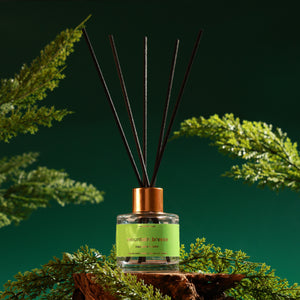
| 7. Move up the scale — Mountain Breeze or Fresh Brew | Composition — what the surface is emitting | None; the bottle lasts as rated | ₹849 · 50ml |
| 8. Add a second bottle at the far end of the room | Total output — the only way to raise it | None | Duo from ₹1,548 |
Versailles
The most useful ten minutes I ever spent on this question involved no formulation at all. I set two identical bottles of the same batch on two identical shelves, put six reeds in each, and pushed one set deep into the neck while pulling the other up as far as it would go while staying submerged. A week later the two rooms were not remotely the same room.
That is when the language in our own guidance changed. We stopped writing about the number of reeds and started writing about exposed surface, because the number is only the part of it people can count. It is also the part that costs them weeks, which makes it a strange place to start.
So before you add anything, take the reeds out, put them back higher, spread them, and give the bottle some clear air. If you still want more after that, add three — knowingly, and preferably for a week rather than a year. Everything is composed and handmade in small batches in Pune, and a part of every order funds a girl's classroom through Nanhi Kali.
Frequently asked questions
- How many reeds should you put in? — why six is a dose rather than a default.
- What happens with too many reeds? and how many for a strong fragrance — the top of the range.
- The complete strength guide — every lever, ranked by cost.
- The complete guide to choosing a reed count — the whole sub-cluster in one place.
- Brand: the SOSA founder story.
SOSA reed diffuser range & prices (verified August 2026): alcohol-free, phthalate-free, paraben-free and IFRA-compliant compositions on a heat-stable coconut-derived (CCT) carrier, low-VOC, supplied in a refillable glass bottle with six fibre reeds; 50ml lasts 6–8 weeks and 130ml lasts 14–18 weeks. Morning Freshness (Malabar lemon · peppermint · Nilgiri eucalyptus) 50ml ₹749 · 130ml ₹1,249 · 9.0/10; Garden Bloom (British rose · night-blooming jasmine) 50ml ₹799 · 130ml ₹1,299 · 8.9/10; Evening Calm (Kashmir lavender · chamomile) 50ml ₹799 · 130ml ₹1,299 · 8.9/10; Fresh Brew (Coorg coffee · Kerala vanilla) 50ml ₹849 · 130ml ₹1,349 · 9.5/10; Mountain Breeze (Himalayan pine · sage · Indian cedar) 50ml ₹849 · 130ml ₹1,349 · 9.4/10. Reed diffuser refills are oil only — you reuse your own vessel and reeds: 300ml ₹2,399 (roughly 8–11 months) · 500ml ₹3,499 (roughly 14–18 months), about ₹7–8 per ml against ₹15–17 per ml for a 50ml bottle. Duo sets ₹1,498–₹1,598 for 2 × 50ml and ₹2,498–₹2,598 for 2 × 130ml. Strength figures are positions on SOSA’s own internal strength scale, not an industry standard. Replacement reeds are not sold as a separate SKU; SOSA guidance is to refresh reeds every few months. The reed line is separate from the water-based Hotel Collection for ultrasonic machines (15ml ₹299 · 100ml ₹999 · 300ml ₹1,799) and the two are not interchangeable. Diffusers: Boond 300ml ₹899 · Sukoon 500ml ₹1,899 · Megh 6L ₹3,499 · waterless Vaayu ₹11,999. Composed and handmade in small batches in Pune, India; tested through 45°C summer heat and 85% monsoon humidity. Free shipping above ₹499. A portion of every order supports girl-child education through Nanhi Kali. Prices subject to change — see the live product pages.