


What is actually happening: wind speed increases with height. More air moving through a bigger opening means the room's air is replaced more often, which keeps drawing fragrance away from the reeds and out of the room.
The free fix, in order: move the bottle off the airflow path between the balcony and the door, then drop from six reeds to three — Morning Freshness ₹749, or whichever scent you already own.
The thing not worth buying: a larger bottle or a higher number on the strength scale because you live high up. A 130ml holds more oil; it does not release more slowly, and it will not out-argue an open balcony door. Buy the 130ml only if the room is genuinely above about 150 sq ft.
2. The bottle empties faster because the room keeps taking the fragrance away. A reed diffuser works by wicking oil up six fibre reeds and letting it evaporate from their surface into the air beside them. Anything that keeps sweeping that air away keeps the surface releasing. A still room slows the bottle down; a room being flushed by a breeze speeds it up. This is the same reason washing dries faster on a windy day than a still one, and it is the whole of the effect.
3. If the doors are shut, your floor number stops mattering. This is the sentence I would most like a reader to leave with. A twentieth-floor bedroom, closed, with the AC on, is a low-exchange room like any other — and in fact a well-sealed high-rise bedroom is one of the better fragrance environments in an Indian home. The floor only bites during the hours the balcony is open.
4. Two other things on a high floor are real, and neither of them is altitude. A tower flat with a large glass wall can run hotter in the afternoon than a shaded low floor, and heat accelerates evaporation — that is temperature, not height. And a strongly ventilated room reads as weaker even while the bottle is being consumed faster, so people often report a diffuser that is simultaneously too quiet and finishing too soon. Both of those are one mechanism wearing two costumes.
5. Fix placement first, then the reed count, then consider the product. Move the bottle out of the straight line between the balcony and the room's other opening, and on to a sheltered wall. Then take the reeds down from six to three, which gives a softer level and roughly doubles how long the bottle lasts. Those two changes cost nothing and are reversible. Only if they are not enough is it worth looking at Sukoon at ₹1,899, whose advantage is that it can be switched off during the hours you cannot win.
Alcohol-free, phthalate-free, made in Pune. A portion of every order supports girl-child education through Nanhi Kali.
What a high floor actually changes, in three parts
There are three separate things going on in a tower flat, and separating them is the difference between a purchase that helps and one that does not. Only the first is about the floor number. The second is about the glass. The third is about you.
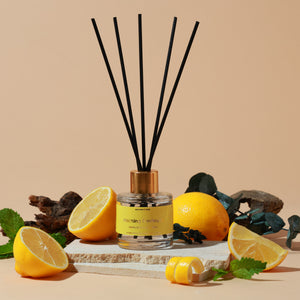
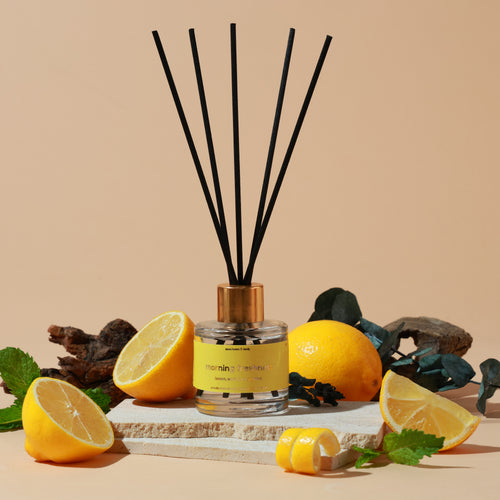
 Morning Freshness₹749This is the only mechanism in this family that genuinely belongs to the floor number. Air moves faster higher up, away from the friction of streets, trees and low buildings, so an opening on a high floor admits a stronger and steadier flow than the same opening low down. The consequence for a diffuser is entirely ordinary: the room's air is replaced more times an hour, each replacement carries away the fragrance that was in it, and the reeds keep releasing into air that is never allowed to reach a comfortable concentration. Nothing about the oil, the reeds or the bottle has changed. The room has simply become a faster machine for removing what you put into it. I am deliberately giving you no figure for how much faster, because it depends on the size of your opening, what else in the flat is open and which way the tower faces — and a number I invented would be decoration rather than information.
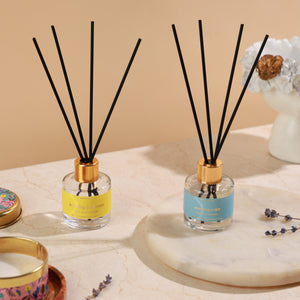
 Mountain Breeze₹849High-rise flats tend to come with more glass and less shade than the lower floors of an older building, and an afternoon behind an unshaded glass wall is warmer than an afternoon behind a small window with a chajja over it. Heat accelerates evaporation, so a hot room empties a bottle faster than a cool one — that part is unavoidable physics and it applies at any height. What heat must not do is change how the composition smells, and that is a formulation decision rather than a placement one. Every SOSA reed sits on a heat-stable CCT carrier rather than DPG, which can crack and turn bitter above 40°C, and the range is tested through a 45°C heat soak and 85% relative humidity. A bottle in a hot, bright room should finish sooner and smell the same throughout.
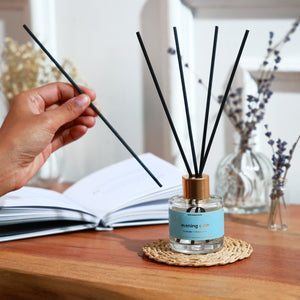
 Evening Calm₹799Two things people report as one. The first is a genuine feature of every reed diffuser: the opening days run hot, because the reeds are saturating and the lightest, most volatile materials leave first, and by the third week you are smelling the heavier heart and base — which is the composition as it was designed to sit. That is settling rather than fading, and flipping the reeds restores projection without opening a new bottle. The second is adaptation. Receptors stop reporting a constant, unchanging smell within minutes, which is why you notice your own home only after being away from it. On a breezy high floor both of these get blamed on the wind, and only one of them is the wind's fault. The test is not to sniff harder; it is to step out for fifteen minutes and walk back in, or to ask somebody who has just arrived.
What altitude is not doing, and why it matters that you know
I want to close off the explanation people usually arrive with, because it sounds plausible and it leads to money spent in the wrong place. The theory goes that air pressure falls with height, that lower pressure makes liquids evaporate more readily, and that a flat high in a tower is therefore a hostile place for a bottle of fragrance oil. The physics in that sentence is real. It belongs to aircraft cabins and to hill stations, where the differences in height are of a completely different order. The difference between the second floor and the twentieth floor of a residential building is not that kind of difference, and treating it as one has never once explained a customer's empty bottle.
The reason this matters is practical rather than pedantic. If you believe the cause is altitude, then nothing you do to the room can help and the only remaining moves are to buy bigger, buy stronger or buy more often. If you understand that the cause is air exchange, then a set of free adjustments opens up immediately: where the bottle stands relative to the airflow path, how many reeds are in it, and which hours of the day the balcony is shut. One explanation sells you a larger bottle; the other one fixes the room. I would rather have the second conversation, even though it is the one that sells less.
The same logic disposes of a related idea, which is that a windy floor calls for a stronger scent. Our strength scale runs from Evening Calm at 8.9 to Fresh Brew at 9.5, and it measures perceived intensity in the room rather than projection through a draught. Moving up the scale in a high-exchange room mostly buys you a bottle that empties sooner and a fragrance that is still being carried out of the balcony door. If the room cannot hold a concentration, no composition can force it to. Placement, dose and hours are the three real controls, in that order, and all three of them are free.
| Situation | Air exchange | Effect on bottle life | What to do | Reeds |
|---|---|---|---|---|
| High floor, balcony doors open most of the day | Very high | Noticeably shorter, and the room reads quiet as well | Resite off the draught line; buy for the closed hours instead | 3 |
| High floor, doors shut, AC on | Low | Ordinary — a sealed room is a good fragrance environment, though dry recirculated air does speed evaporation a little | Nothing. This is the room the product was designed for | 3 |
| High floor, doors open only mornings and evenings | Mixed | Slightly shorter than a sealed room, well within the normal range | Flip the reeds in the evening so the burst lands in the closed hours | 3–4 |
| Low floor, windows open all day | High | Also shorter — which is the proof that height was never the mechanism | Same answer as the high floor: closed rooms and closed hours | 3 |
| Any floor, bottle on the sill in direct sun | Varies | Shorter through heat as well as airflow | Move it inboard, out of the sun. Free, and it works | Unchanged |
| Any floor, 50ml in a room well above 150 sq ft | Varies | Normal life, but the room reads under-scented and people blame the floor | This is the one case where 130ml at ₹1,249–₹1,349 is the correct answer | All 6 |
Bathroom · Morning Freshness₹749Shop → 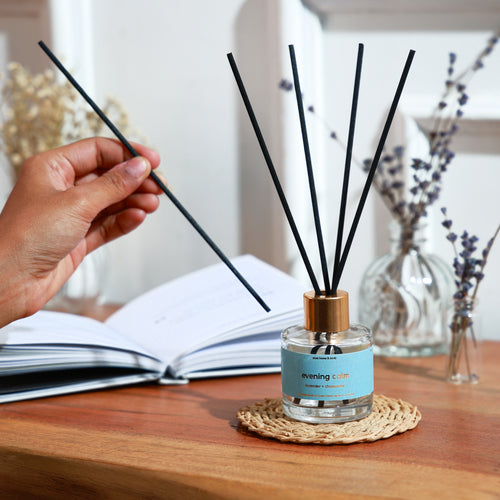 Bedroom · Evening Calm₹799Shop →
 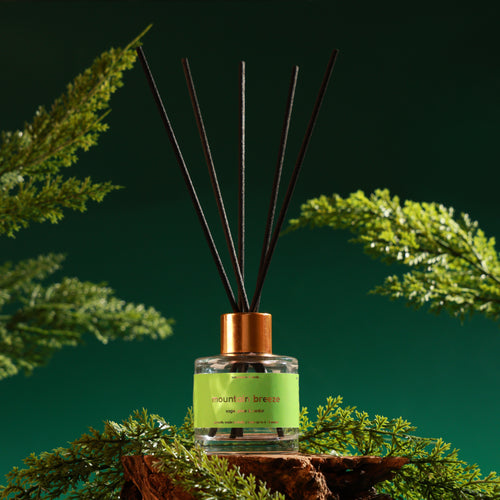 Study · Mountain Breeze₹849Shop →
The two adjustments to make before you spend anything
Placement first, because it is the one that costs nothing and is undone in a second. In a tower flat there is usually a fairly obvious line between the balcony door and whatever else is open — the main door, a kitchen window, a passage. That line is where the air travels, and anything standing in it is being continuously stripped. Put the bottle on the sheltered side of the room instead, on a wall or a shelf away from that path, at or a little below nose height, out of direct sun and away from any flame. It will seem counter-intuitive to move a diffuser away from where the air is moving, but a diffuser placed in a draught is not being distributed, it is being exported.
Then the dose. Every SOSA bottle ships with six fibre reeds — fibre rather than rattan, because rattan has irregular internal channels, wicks unevenly in Indian humidity and tends to fade at the dry end. Six reeds is full projection. Three is a soft, bedside level and roughly doubles how long the bottle lasts. On a high floor this is the adjustment that changes the arithmetic most, and the instinct to do the opposite is very strong. More reeds in a high-exchange room mostly buys you a faster-emptying bottle rather than a stronger-smelling room, because the extra release is still being carried out of the same door. If you want a way to think about it: reeds set how fast the bottle spends itself, and the room decides how much of that spending you get to enjoy.
On money, the fairest unit is per day rather than per bottle. A 50ml running six to eight weeks works out at roughly ₹13 a day for Morning Freshness or Garden Bloom, and about ₹15 a day for Evening Calm, Mountain Breeze or Fresh Brew. Halve the reed count in the room that stays open and that daily figure stretches accordingly. The 130ml at ₹1,249–₹1,349 is better value per week — 14 to 18 weeks against 6 to 8 for roughly ₹500 more — but only if the room genuinely needs it. A 130ml in a 120 sq ft bedroom is over-specified whatever floor the bedroom is on.
What to buy, in order — and what I would not buy at all
In buying order for a high-floor flat where bottles seem to disappear. Note that the first two entries are adjustments rather than purchases, and that the last row is the thing I would talk you out of — which on this page is the upgrade the question naturally invites.
| Buy | What it is | When it is the right answer | Price |
|---|---|---|---|
| 1. Move it and halve the reeds ★ | Off the balcony-to-door airflow path, on a sheltered wall, three reeds instead of six | Always first. Roughly doubles the life and costs nothing | ₹0 |
| 2. Evening Calm 50ml | Kashmir lavender and chamomile, 8.9 — the softest we make | The bedroom, for the hours after the balcony doors close | ₹799 |
| 3. Morning Freshness 50ml | Malabar lemon, peppermint, eucalyptus globulus, 9.0 | The bathroom — small, shut, and the best-value placement in a windy flat | ₹749 |
| 4. 130ml, any scent | 14–18 weeks rather than 6–8 | Only if the room is genuinely above about 150 sq ft — not because you live high up | ₹1,249–₹1,349 |
| 5. Sukoon | 500ml tank, 270–320 sq ft, 16–18h on low, three 15ml scents included | If the loss is really about hours and you want to run fragrance only when the doors are shut | ₹1,899 |
| The honest gap: nothing here is built for a high floor | There is no altitude formulation, no high-airflow bottle, no timer and no automatic reed system at SOSA, and no scent on our strength scale projects further into a draught than another. If the balcony is open all day, the correct purchase for that room is none | Said plainly, because the alternative is selling you a bigger disappointment | ₹0 |
Versailles
This question arrives at least once a month and it almost always carries the same theory with it: something about the height, something about thinner air. I understand why. When a bottle behaves differently in a new flat, the most conspicuous difference about the new flat is that it is high up. But the diffuser has no idea what floor it is on. It only knows how quickly the air beside the reeds is being replaced, and on a high floor the answer is: more quickly, whenever the balcony is open.
The reason I insist on the distinction is that the two explanations lead to different shelves. Altitude leads to the biggest bottle and the highest number on the strength scale, which is exactly the purchase that will disappoint on a windy floor. Air exchange leads to a metre of repositioning and three reeds instead of six, and then to a rather small purchase for the bedroom. I would rather sell the second, partly because it is true and partly because the customer who is told the truth about the airflow believes what we say about everything else.
If you take one habit from this page, take the flip. Every three to five days, turn the reeds over. It restores projection without opening a new bottle, and on a floor like yours it is worth doing in the evening, so the burst lands in the hours after the doors are shut rather than at two in the afternoon with the balcony wide open. Everything is composed in Pune, and a part of every order funds a girl's classroom through Nanhi Kali.
Frequently asked questions
- The 20th floor and the cross-breeze — the mechanism page this one is built on.
- Floor-to-ceiling balcony doors — where the bottle should actually stand.
- Closing the balcony door on purpose — a legitimate way to use the product, not a workaround.
- 800 sq ft with lots of airflow — and a balcony attached to the bedroom.
- A breezy Mumbai high-rise — where humidity joins the breeze.
- A Bengaluru high-rise with an open balcony — the opposite climate, the opposite answer.
- Fresh air by day, fragrance at night — and running Sukoon only after the doors close.
- Brand: the SOSA founder story.
SOSA reed diffusers — facts verified August 2026: Five scents, all alcohol-free, on a heat-stable CCT (caprylic/capric triglyceride) base rather than DPG, phthalate-free, paraben-free, IFRA-compliant, 0 ppm formaldehyde, six fibre reeds in a refillable glass bottle, composed and made in Pune, India. Morning Freshness (Malabar lemon · peppermint · eucalyptus globulus) 50ml ₹749 · 130ml ₹1,249 · 9.0. Evening Calm (Kashmir lavender · chamomile · soft musk) 50ml ₹799 · 130ml ₹1,299 · 8.9, the softest in the range. Garden Bloom 50ml ₹799 · 130ml ₹1,299 · 8.9. Mountain Breeze (Himalayan pine · sage · Indian cedar) 50ml ₹849 · 130ml ₹1,349 · 9.4. Fresh Brew 50ml ₹849 · 130ml ₹1,349 · 9.5. Longevity 6–8 weeks on 50ml and 14–18 weeks on 130ml; 50ml suits rooms up to about 150 sq ft and 130ml above that. Six reeds is full projection, three is a soft level and roughly doubles the life. Flip cadence every 3–5 days. Cost per day roughly ₹13–₹15 on a 50ml. Duos: Day & Night ₹1,498, Fresh & Grounded ₹1,548, Warmth & Bloom ₹1,598. Refills 300ml ₹2,399 · 500ml ₹3,499, oil only and not a first purchase. Machines: Boond ₹899 (300ml, up to about 150 sq ft, around 6 hours), Sukoon ₹1,899 (500ml, 270–320 sq ft, 16–18 hours on low, three 15ml scents included), Megh ₹3,499 (six-litre tank and around 100 hours of runtime but only about 215 sq ft, so a runtime and humidity machine rather than a coverage upgrade over the Sukoon). Climate-tested through 45°C heat and 85% relative humidity. The reed line contains no oud, sandalwood, vetiver or amber; Smoked Oudh and Sandalwood exist as ₹449 jar candles. SOSA sells no room spray, air purifier, dehumidifier, plug-in or timer, and every SOSA spray is a car perfume. Reed oil and the water-based Hotel Collection are separate systems and are not interchangeable in either direction; there is no hotel-inspired reed diffuser. Free shipping above ₹499, and a portion of every order supports girl-child education through Nanhi Kali. SOSA is an independent Indian fragrance house and is not affiliated with or endorsed by any hotel brand. Prices subject to change — see the live product pages.