

The scorecard: across eight axes, reed diffusers win on price, closed rooms, power independence, silence and certainty of supply. Cold-air wins on reach, control and consistency across a big volume.
Why that is not a tie: reach is the one axis you cannot trade for the others. If your problem is 2,000 sq ft of connected volume, winning five axes does not help you.
The honest catch: the Vaayu ships with 400ml and SOSA does not currently sell a separate Vaayu refill oil. Reed refills, by contrast, are on sale at ₹2,399 for 300ml.
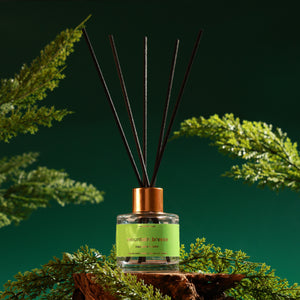
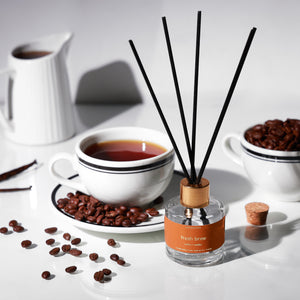
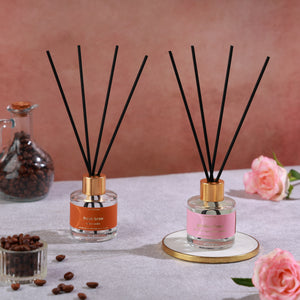
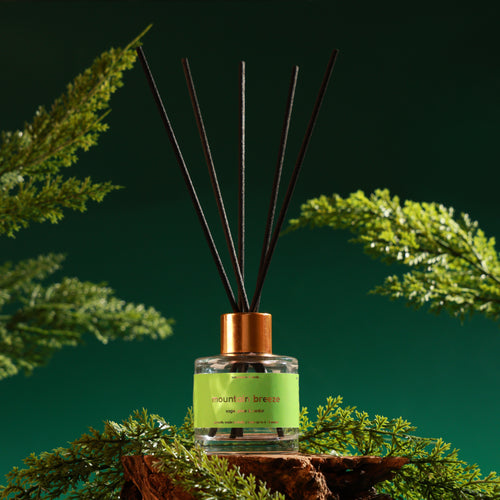
2. For a room, reeds win and it is not close. ₹749–₹849 for a 50ml lasting six to eight weeks. No socket, no cord, no noise, nothing to switch on, and it goes on working through a power cut. Six fibre reeds, flipped weekly.
3. For a connected volume, a passive source has no mechanism to succeed. Output per bottle is fixed; the only way to raise the total is another bottle, and past a certain size that becomes eight bottles and a management problem rather than a solution.
4. The middle is real and most people belong in it. A Sukoon at ₹1,899 covers 270–320 sq ft, runs 16–18 hours on low, and comes with a remote and steady/2H/4H timers. If one normal room on demand is the job, buy that and close the tab.
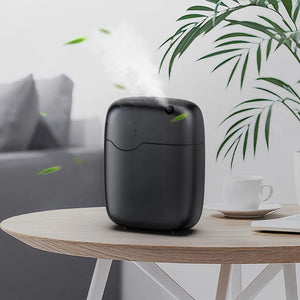
5. The Vaayu at ₹11,999 is a change of category, not a bigger bottle. Waterless cold-air nebulisation, up to 1000m³, a 400ml tank specified at 90+ days a fill, app and onboard control, 1h / 4h / 8h / 24h timers, key-lock, 5W, under 38 dB, CE, RoHS and SGS certified.
6. Read the gap before you spend. SOSA does not currently sell a separate Vaayu refill oil. The 400ml in the box — four Hotel Collection fragrances at 100ml each — is the supply available today. The water-based Hotel Collection for ultrasonic machines is a different product and is not a Vaayu refill. Ask SOSA about availability if continuity matters to you.
7. Most homes end up running both. That is not a compromise; it is the correct answer for a building with doors in it.
The Vaayu is made in India; our reed fragrances are composed and handmade in small batches in Pune, and a portion of every order supports girl-child education through Nanhi Kali.
Part one — passive, active, and the axis nobody puts on a comparison chart
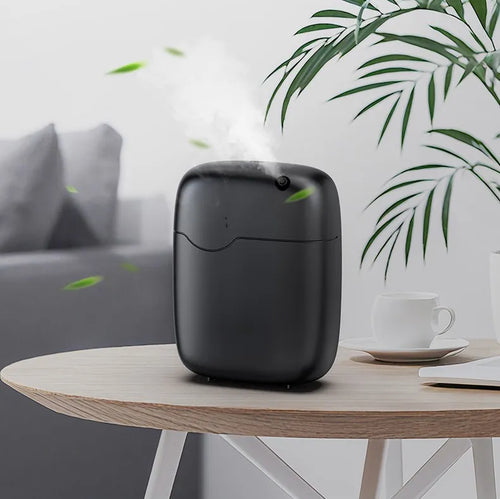
Comparison tables in this category almost always compare outputs. That is the wrong place to start, because the two formats do not differ in how much fragrance they can hold — they differ in whether anything moves it. One of these devices releases fragrance and hopes; the other releases fragrance and delivers it. Below are the two mechanisms stated properly, and then a third property that decides more purchases than either of them and appears on no product page I have ever read.
 Vaayu₹11,999 · 1000m³A cold-air machine forces pressurised air past undiluted oil, shearing it into droplets fine enough to stay airborne, and the same air stream that made the mist then carries it out into the room. Propulsion and atomisation are the same event. That is why the Vaayu's figure is quoted as up to 1000m³ rather than in square feet: the machine fills a volume, and the honest translation to floor area depends on your ceiling. At a standard 10-foot ceiling, 1000m³ works out near 3,000 sq ft; under a double-height 20-foot ceiling the same volume is nearer 1,700 sq ft of floor. That is arithmetic on the manufacturer's specification, not a measurement in your house, and real results move with ventilation, doors and season.
Part two — the eight axes, scored honestly
Here is the comparison as a scorecard rather than a sales sheet. I have written the axes in the order they actually decide purchases, and I have marked the winner of each without adjusting for what I would prefer to sell. Reed diffusers take five of the eight. Read the last column before you read the tally.
| Axis | What it really asks | Reed diffuser | Cold-air (Vaayu) | Winner |
|---|---|---|---|---|
| 1. Reach ★ | Can it cross a connected volume? | No propulsion — a point source. Honest ceiling near 250–300 sq ft | Up to 1000m³, about 2,000–3,000 sq ft by ceiling height | Cold-air, decisively |
| 2. Control | Can you turn it on, off, up and down? | No. Reed count is the only adjustment and it takes days to register | 1h / 4h / 8h / 24h timers, adjustable intensity, app, auto-stop, key-lock | Cold-air |
| 3. Consistency across a floor | Does the far end smell like the near end? | Steep gradient from the bottle outwards; several bottles means several gradients | One source, one composition, distributed by the same air stream | Cold-air |
| 4. Cost of entry | What does it take to start? | ₹749–₹849 for 50ml, ₹1,249–₹1,349 for 130ml | ₹11,999 — roughly sixteen times a 50ml bottle | Reeds, by a distance |
| 5. Behind a closed door | Will it scent a room nobody has wired? | Yes — no socket, no cord, sits on any shelf on a tray | No. A closed door is a wall; the machine cannot reach past it | Reeds |
| 6. Power independence | What happens in a four-hour cut? | Nothing at all. It keeps working | It stops, and resumes on its schedule when power returns | Reeds |
| 7. Silence | Can you hear it in a quiet bedroom? | Completely silent — there is no moving part | Under 38 dB. Quiet, and not the same thing as silent | Reeds |
| 8. Certainty of supply | Can you buy more fragrance next year? | Yes — oil-only refills 300ml ₹2,399, 500ml ₹3,499 | No separate Vaayu refill oil is sold today — 400ml in the box is the supply | Reeds, clearly |
| The honest caveat: the reed diffuser wins axes four to eight — five of the eight — and I would rather publish that than pretend otherwise. But axes are not interchangeable. If your problem is axis one, nothing on the list below it can substitute for it, because no combination of price, silence and supply certainty will carry fragrance across 2,000 sq ft. Equally, if axis one is not your problem — and for most Indian homes it genuinely is not — then a reed diffuser beats a ₹11,999 machine on every axis you actually care about, and you should buy the ₹849 bottle without embarrassment. | ||||
 Passive · one roomfrom ₹849Shop →
  Active · 270–320 sq ft₹1,899Shop → Active · up to 1000m³₹11,999Shop →
Part three — where the passive format is not merely cheaper but genuinely better
I would be selling badly if I let the reach argument stand as a verdict on the format. A reed diffuser wins outright in every room with a door that closes, and a large house is mostly rooms with doors that close. Bedrooms, bathrooms, a study, a guest wing, a dressing room, a puja room — a machine standing on the common floor scents none of them, and no cold-air specification changes that. In those spaces the passive format is not a downgrade; it is the correct instrument. It sits on a shelf, needs no socket in a wall that has none, costs ₹799 to replace if it is knocked over, and cannot be reprogrammed by a curious visitor. It also keeps working through a power cut, which in most of India is a practical property rather than a theoretical one.
There are two further advantages that are rarely stated. The first is certainty of supply, and it is the axis where I have to mark against my own machine. Reed oil refills are on sale now at ₹2,399 for 300ml and ₹3,499 for 500ml — about ₹7–8 per millilitre against ₹15–17 for a new 50ml bottle — so I can tell you what a reed position costs to run for the next three years. I cannot tell you the same for a Vaayu, because there is no separate cold-air refill in our catalogue today and I am not going to invent one to complete a table. The second is variety: five bottles can be five different compositions, and one machine is one composition until you empty and rinse it. A house that changes as you walk through it is a legitimate thing to want, and only the passive format gives it to you cheaply.
So the honest boundary sits here. Work the free levers before you spend anything — flip all six reeds weekly, move the bottle into gentle passing air near a doorway at roughly waist to chest height and away from an AC vent, close the room for an hour, then add reeds if you accept a shorter bottle. If after all of that a single connected space still defeats you, decide whether it is a room or a volume. A room wants a Sukoon at ₹1,899. A volume of 800 sq ft and upwards, or a whole floor you want on a schedule, is the only case in which ₹11,999 is a sensible sentence to write. And please note that a Megh at ₹3,499 is not the step in between — it covers about 215 sq ft, less than the Sukoon, and is a runtime and humidity machine rather than a coverage upgrade.
Part four — route your actual complaint to its axis
Most people arrive at this comparison holding a sentence rather than a specification. Below, the sentences I receive most often, matched to the axis they belong on and the cheapest honest fix. Three of the six cost nothing, and only one of them ends at ₹11,999.
| What you said | The axis it belongs on | The honest fix | Cost |
|---|---|---|---|
| "I can only smell it standing next to the bottle" ★ | Axis 1 — reach, at small scale | Move it into passing air by a doorway, waist to chest height, then flip all six reeds | Free |
| "It smelled lovely for a week and then stopped" | Not an axis — the plateau, plus your own nose adapting | Flip weekly; ask a visitor rather than trusting your own nose at home | Free |
| "I want the house to smell of something before guests arrive" | Axis 2 — control and latency | A powered source with timers. Sukoon for one room; Vaayu for a floor | ₹1,899 or ₹11,999 |
| "One bottle is not enough for my living-dining" | Axis 1 at medium scale | Two 50ml at opposite ends beat one 130ml in the middle — output per bottle is fixed | From ₹1,498 as a duo |
| "Each room smells different and I want one house" | Axis 3 — consistency | Either one composition everywhere, or one machine on the connected floor | From ₹749 each, or ₹11,999 |
| "Eight bottles across a villa is too much to manage" | Axis 3 plus labour | One machine on the common floor, reeds kept only behind closed doors | ₹11,999 + reeds |
| "Will I be able to buy more oil for the machine?" | Axis 8 — supply | Write to SOSA first. No separate Vaayu refill oil is sold today | Ask before you spend |
Versailles
I wrote this scorecard because I kept meeting people who had been sold the wrong end of it. A reader in Pune had four of our 130ml bottles standing in a double-height living room and was writing to ask whether a fifth would do it. It would not have done it, and neither would a sixth, and telling her so cost me a sale I could easily have taken.
The reason is on axis one. Adding bottles raises the total fragrance released into a volume, but it does not give any of that fragrance somewhere to go; you end up with four small islands of scent in a large quiet room rather than one scented room. Understanding that saved her about ₹5,000 and eventually cost her ₹11,999, which she spent with her eyes open rather than in hope.
What I will not do is write a comparison in which the expensive product wins everything. It does not. Our reed diffusers are silent, cheap, indifferent to power cuts and — this is the part that stings — better supplied, because you can buy reed oil from us today and you cannot buy cold-air oil separately. That is a real gap and I would rather name it than have you find it in month four. Everything we compose is handmade in small batches in Pune, and a portion of every order funds a girl's classroom through Nanhi Kali.
Frequently asked questions
- Cold-air vs ultrasonic — the mechanism, and why one adds water to the room and one does not.
- SOSA reed diffuser vs Vaayu — the two ends of one range, and when ₹749 is the better answer.
- One machine or several reeds? — consistency against character, and why both are legitimate.
- Which SOSA system for your room size — the whole range mapped to measured spaces.
- Brand: the SOSA founder story.
SOSA Vaayu specifications (verified from the live product page, August 2026): ₹11,999 (the product page displays a rounded ₹12,000). Waterless cold-air nebulisation — pressurised air atomises undiluted fragrance oil into a dry nano-mist; no water, no heat, residue-free. Coverage up to 1000m³, about 2,000–3,000 sq ft. 400ml refillable tank, 90+ days per fill at a mid intensity setting. Bluetooth app plus onboard buttons, 1h / 4h / 8h / 24h timers, adjustable mist intensity, auto-stop and key-lock. Under 38 dB. DC 12V / 1A, 5W. 165 × 80.5 × 215 mm, 0.9 kg, black or white. Freestanding or wall / HVAC mount. CE, RoHS and SGS certified. Ships with four SOSA Hotel Collection fragrances at 100ml each (400ml in total) in one of three combos chosen at checkout. SOSA does not currently sell a separate Vaayu refill oil; the 400ml supplied in the box is the fragrance available at the time of writing, and buyers who need long-term supply should confirm current refill availability with SOSA before purchasing. The cold-air oil supplied with the Vaayu is a different product from the water-based Hotel Collection sold for ultrasonic machines (15ml ₹299 · 100ml ₹999 · 300ml ₹1,799), which must not be used in a Vaayu despite sharing scent names. Other SOSA machines: Boond 300ml ₹899 (~150 sq ft) · Sukoon 500ml ₹1,899 (270–320 sq ft) · Megh 6L ₹3,499 (~215 sq ft — a runtime and humidity machine, not a coverage upgrade) · Aangan ₹25,999 (~8,000–10,000 sq ft) · Meenar ₹38,500 (12,000–18,000 sq ft) · Safar car diffuser ₹3,999. Reed diffusers 50ml ₹749–₹849 (6–8 weeks) · 130ml ₹1,249–₹1,349 (14–18 weeks) · duo sets ₹1,498–₹1,598 · oil-only refills 300ml ₹2,399 / 500ml ₹3,499. Runtime, consumption and coverage figures are manufacturer specifications and vary with intensity setting, run hours, ceiling height, ventilation and season; any per-month or per-day figure in this guide is arithmetic on those specifications, not a measurement. Electricity costs vary by state tariff. No claim is made that scenting affects ratings, reviews, bookings, occupancy, revenue, health, mood or air quality. Free shipping above ₹499. A portion of every order supports girl-child education through Nanhi Kali. Prices subject to change — see the live product pages.