


What actually returns a patient: the consultant, the clinical outcome, the wait, appointment availability, billing clarity, distance and insurance. The environment sits well below all of those and cannot be separated from them.
The defensible reason to fix it anyway: the drain traps, the bin schedule, the linen route and the drain pan are real operational failures whether or not anybody ever returns because of them. A facility that smells looked after is looked after. The Vaayu at ₹11,999 holds the last part steady. No clinical claim, and a diffuser is not an air purifier.
2. What returns a patient is, in rough order: the consultant, the outcome, the wait, appointment availability, billing clarity, distance and insurance. The physical environment is below all of those. Anybody telling a clinic otherwise has not sat in one.
3. So do not build a business case on retention. If your proposal says that scenting will increase repeat visits by some percentage, it will be challenged by the first person in the room who understands attribution, and they will be right to challenge it.
4. Build it on the thing that is true instead. The dry drain trap, the unemptied dressing bin, the soiled-linen route through a public corridor and the biofilm in the drain pan are real failures with real causes. Correcting them is worth doing whether or not a single patient ever returns because of it, and a facility that smells looked after is one that is being looked after.
5. Then measure what you can actually measure. Complaints that mention the toilets. Time from arrival to first acknowledgement at the desk. Whether the extract fan has a service date. Seats occupied at peak against seats provided. Those numbers are real, they are yours, and they improve the things that do bring patients back.
A portion of every order supports girl-child education through Nanhi Kali.
Why the number cannot be produced
Suppose you install scenting in March and your repeat-visit rate is two points higher in June. What caused it. In the same quarter you also replaced two chairs, took on a new paediatrician, moved to a different appointment system, raised your consultation fee, saw the monsoon arrive, and watched a competitor open near the station. The two points are real and their cause is unrecoverable. That is not a failure of your record-keeping; it is the ordinary condition of a live clinic, and it applies equally to any vendor's case study, because the clinic in their case study was also changing six things at once. You cannot run a controlled comparison on your own facility — you have one building, one set of consultants and one catchment, and there is no version of it running without the fragrance for you to compare against. Any figure produced in these circumstances is an attribution, not a measurement, and attributions are what people sell when measurements are unavailable.
What you can measure, and what you cannot
If a group wants numbers — and procurement usually does — these are the ones that are actually available to a clinic, alongside the ones that are not. The second column is the honest verdict on measurability and the fourth is what to track instead. Every item in the fourth column is something your own team can count this month without a vendor, a survey instrument or a consultant.
| The question | Can it be measured | Why | What to track instead |
|---|---|---|---|
| Did scenting increase repeat visits ★ | No | No control group, one building, and six other changes in the same quarter. Any figure is an attribution rather than a measurement | Track the operational items below and stop attributing |
| Did it raise patient satisfaction scores | No, not attributably | Satisfaction moves with waiting time, staff civility and the consultant. Isolating an environmental variable inside that is not possible in a live clinic | Complaints that specifically mention the toilets, the air or the waiting hall |
| Are patients complaining about how the place smells | Yes | This is a count your front desk already holds, and it is the single most useful environmental number a clinic has | Complaints per month, with the room named |
| Is the housekeeping sequence actually being done | Yes | A printed opening checklist with a name against each line either has ticks on it or it does not | Checklist compliance, weekly |
| Is the building comfortable at peak | Yes | Temperature at the back row at five in the evening, and seats occupied against seats provided | Two readings a day for a fortnight |
| Is the equipment doing its job | Yes | Toilet extract fan service date, AC filter date, drain pan date, and four diffuser refills a year on a 400ml tank | A maintenance log with dates on it |
Vaayu · four refills a year₹11,999Shop → 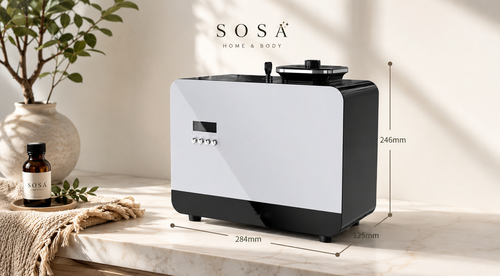 Aangan · a whole floor₹25,999Shop →
  Westin-inspired · lightest₹299Shop →
The defensible reason, and how to run it
Start with the free work, because it is the part that carries the actual argument. Bins and dressing waste out of the building the night before; mops dried flat rather than left standing in buckets; at T-60m, housekeeping opens up and water goes down every drain trap in every toilet and every unused sink, on a printed checklist with a person's name against the line; at T-45m the air conditioning goes on so the building reaches temperature before the first patient does. At T-30m the diffuser goes on low in the entrance and reception zone. At T-0 the first appointment arrives and the level has arrived before them. At midday nobody turns anything up because the hall filled — busy is an occupancy and air-change situation and adding fragrance to it makes the room worse. At close the timer stops the machine with the last appointment rather than running it overnight into an empty building. And the rule that governs the whole sequence: if something smells and you have not found the cause, keep looking. A persistent smell in a medical facility is information — a dry trap, a bin schedule, a linen route, a drain pan, damp behind a wall, an extract fan that has stopped — and fragrance over it removes the signal that told housekeeping something was wrong. Everything worth fixing before spending anything sets that out at length, and it is the page I would read before this one if a budget is being written.
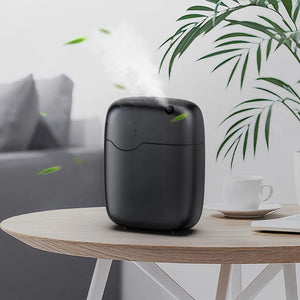
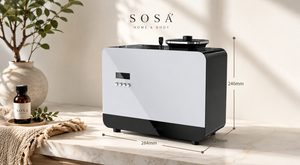
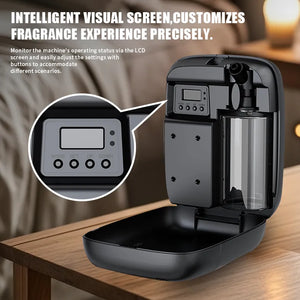
Then the machine and the arithmetic, in the terms a procurement lead will ask for. The Vaayu at ₹11,999 covers up to 1000m³, roughly 2,000 to 3,000 sq ft of public space, on a 400ml tank that lasts about 75 days on a clinic's opening hours — four refills a year per unit, which is a model somebody can build in ten minutes and defend in a budget meeting. It is waterless, so nothing is standing in water in a building that runs twelve hours a day and nobody has to own a daily emptying and drying routine; it runs under 38 dB, which matters where reception shares a wall with a cabin; it holds 1h/4h/8h/24h timers and app control so the facilities team sets it rather than the front desk; and it key-locks, which is the reason it can stand in a public hall at all. Size it with the sum and not with the brochure: square feet divided by 10.76, multiplied by ceiling height in metres, counting only the volumes you actually scent. Clinical rooms come out of that calculation entirely, because they are fragrance-free and their doors are shut, which in most clinics removes forty to sixty per cent of the plan area — so a group that was quoted for two machines per branch very often needs one. For a group running several branches, the same scent and the same setting across all of them is one purchase order and one line in the facilities budget, and where a clinic should spend first puts that spend in its proper order against seating, ventilation and housekeeping.
Then the zones and the limits, because this is where an honest programme stays honest. Scent the entrance and lobby, reception and registration, the shared and departmental waiting areas, the corridors between departments, the lift and stair lobbies, administration and the café corner. Leave consultation and examination rooms, treatment and procedure rooms, day-care surgery and recovery, dressing rooms, blood- and sample-collection rooms, laboratories, pharmacy dispensing, sterile stores, imaging rooms, oncology day-care and paediatric clinical areas fragrance-free — all of them, as a default rather than as a concession. On formats and their limits: the water-based Hotel Collection bottles at ₹299 for 15ml run in the ultrasonic Sukoon, Boond and Megh, which hold standing water and add 30 to 50 ml of water an hour to the air — right for one administrative cabin with a named owner, wrong for public clinical property. The Vaayu and Aangan take their own undiluted oil and the Vaayu arrives with four scents. An alcohol-free reed diffuser from ₹749 needs 24 to 72 hours to establish and fades past about a metre, so it belongs in a cabin rather than a hall. Candles are not appropriate in a healthcare facility at all, because an open flame is a fire-safety and insurance matter. SOSA does not make a room spray. And the principle the whole page rests on: buy it because the building will be better, not because somebody promised you a figure. The figure does not exist, the better building does, and only one of those two will still be true at your next accreditation.
The SOSA edit
What a clinic should actually buy and in what order, given that the retention argument is unavailable. The first two rows cost nothing and carry the entire defensible case. The machine is third. The last row is the figure this page declines to give, printed where a headline claim would normally sit.
| Buy | What it is | When it earns its place | Cost |
|---|---|---|---|
| 1. The operational failures ★ | Dry traps, the dressing-waste schedule, the linen route, the AC drain pan, the extract fan on a light switch | First. Each is a real defect with a real cause, worth correcting whether or not anybody ever returns because of it | ₹0 |
| 2. The numbers you can actually produce | Complaints naming a room, checklist compliance, temperature at the back row at five, maintenance dates | Second. These are measurable, they are yours, and they improve the things that genuinely bring patients back | ₹0 |
| 3. SOSA Vaayu and the lightest of the seven | Waterless, no standing water tank, up to 1000m³, 400ml ≈75 days, timers, app, under 38 dB, key-lock | Third. Public zones only, one setting, four refills a year per unit, and a named person to do them | ₹11,999 / ₹299 |
| 4. SOSA Aangan | Up to 3,000m³, 800ml, HVAC-connected or standalone, programmable, under 42 dB | Only where the coverage sum genuinely exceeds 1000m³ — a large integrated centre or an atrium, not a polyclinic | ₹25,999 |
| 5. Alcohol-free reeds | An administrative cabin or a records room. 24–72 hours to establish and very little reach past a metre | Fifth, and only for the rooms where a machine would be absurd. Not in a paediatric waiting area | from ₹749 |
| The number we will not give: a retention figure | There is no defensible measurement of whether scenting brings patients back, and none is offered here | Printed rather than implied. Ask any vendor who quotes one how they controlled for a new consultant | — |
Versailles
The request I get from clinic groups more than any other is for a slide. One slide, with a number on it, that a centre head can put in front of a board to justify ₹11,999 a branch — and I have never been able to produce it honestly, because the study that would produce it cannot be run in a working clinic. You would need two identical facilities with the same consultants, the same catchment, the same season and the same billing, differing only in the air. That building does not exist, and the versions of it that appear in vendor decks are usually a retail study from another decade with a healthcare photograph on top.
So the slide I do supply says something smaller. It says that the traps are watered every morning by a named person, that the dressing waste leaves on a schedule, that the linen does not cross the waiting hall, that the drain pan is on the maintenance list, and that after all of that a low unnameable background runs in the public zones for twelve hours a day and stops. No claim attached. Four refills a year and a locked lid. In my experience that slide passes a board more easily than the one with the percentage on it, because nobody in the room has to defend a figure they cannot source — and because a facility that has done that list is, demonstrably, a facility that is being looked after.
Everything is made and supported from Pune, and a part of every order funds girl-child education through Nanhi Kali. You get a space that smells like somewhere looked after; a girl gets a classroom. That equation has always felt right to me.
Frequently asked questions
- Does the smell of a clinic affect how patients judge its standards — the same restraint, applied to first impressions.
- Lighting, temperature, sound and smell: what actually shapes how a medical centre feels — the four variables, ranked.
- Is professional scenting worth the cost for a multi-speciality clinic — the economics without the claims.
- Housekeeping, ventilation, seating and scent: where should a clinic spend first — the spending order in full.
- Brand: the SOSA founder story.
Facts verified August 2026: Product facts used in this guide. SOSA Vaayu ₹11,999: waterless cold-air nebulising diffuser, atomises undiluted fragrance oil to a dry residue-free nano-mist with no water reservoir, coverage up to 1000m³ (approximately 2,000–3,000 sq ft), 400ml refillable tank lasting up to about 75 days per fill, Bluetooth app plus onboard control, 1h/4h/8h/24h timer scheduling, adjustable intensity, under 38 dB, DC 12V/1A at 5W, 165 × 80.5 × 215 mm and 0.9 kg, freestanding or wall or HVAC mounted, auto-stop and key-lock, CE, RoHS and SGS certified, supplied with four hotel-inspired fragrances. SOSA Aangan ₹25,999: HVAC-connected or standalone commercial nebulising diffuser, coverage up to 3,000m³ (roughly 8,000–10,000 sq ft), 800ml reservoir, metal body, programmable schedules, under 42 dB. Ultrasonic machines are water-based, hold standing water and consume 30–50 ml of water an hour: Sukoon ₹1,899 (500ml, 270–320 sq ft, 16–18 hours on low, 3–6 drops per tank, steady/2H/4H timers, three 15ml Hotel Collection scents included), Boond ₹899 (300ml), Megh ₹3,499 (6 litres). Hotel Collection water-based fragrance 15ml ₹299, 100ml ₹999, 300ml ₹1,799, Pack of 7 at 15ml ₹1,799 against ₹2,093 bought singly; the Vaayu and Aangan take their own undiluted oil rather than these water-based bottles. Alcohol-free reed diffusers from ₹749, requiring 24–72 hours to reach their working level. Free shipping above ₹499. Coverage arithmetic: cubic metres equal floor area in square feet divided by 10.76 and multiplied by ceiling height in metres, counting only the volumes that are actually scented. This guide makes no medical, therapeutic or clinical claim of any kind for fragrance: a diffuser does not purify, disinfect or clean air, and does not treat, calm or affect any patient or condition. Fragrance is housekeeping and presentation. Clinical areas should be left fragrance-free, and a persistent odour should be traced to its source and corrected rather than covered. SOSA is not affiliated with or endorsed by any hotel brand. Prices subject to change — see the live product pages.