

What does not transfer: stone, brass, ceiling height, joinery, lighting design. All fixed to the building; all read as fragments when miniaturised into a gift.
What does transfer: textile, one very good object, and scent. Of those three, scent is the only one that does not have to match a palette you have never seen.
Don't buy this if: they have said they dislike scented things, someone in the house is asthmatic or there is a newborn, the flat is a tiny sealed studio, or they already run home fragrance they chose themselves.
2. Buy the rule instead of the look. The transferable part of a hotel interior is a set of habits: one material palette, one scent, one lighting temperature, nothing switched on and off. The scent habit is the only one you can hand over in a box.
3. Give it to the entrance. Hotels spend their scent budget at the threshold because that is where an impression is formed and where air moves most. In a flat that means a console, shelf or side table within a few feet of the door, waist to chest height, clear of an AC vent and out of direct sun.
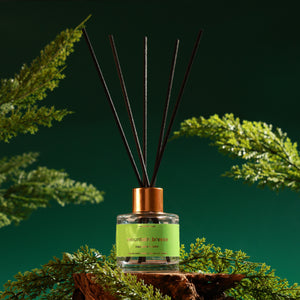
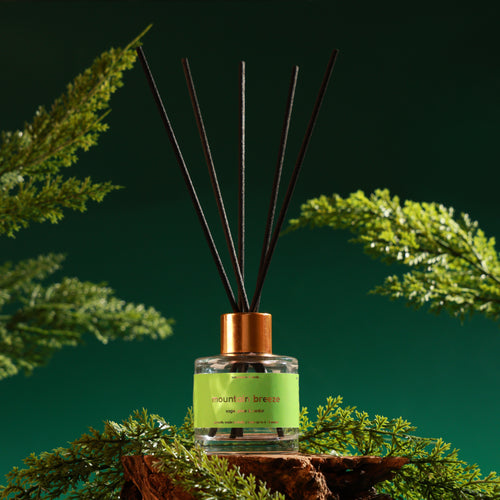
4. Choose the scent from their materials, not from your taste. A stone, oak and linen interior takes dry woods — Mountain Breeze, pine, sage and Indian cedar, ₹849. A softer, more classical, more upholstered interior takes Garden Bloom at ₹799. A very pared-back, cool, minimal flat takes Morning Freshness at ₹749.
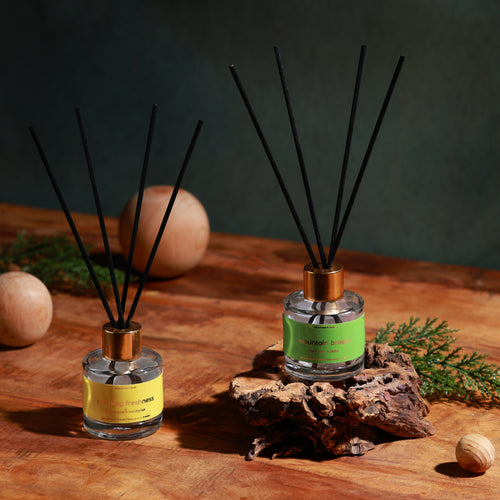
5. Insist, gently, on one scent per floor. The single commonest mistake in a well-decorated Indian home is three unrelated fragrances running in four rooms. If you give two, give two that share a note — Morning Freshness and Mountain Breeze meet on green eucalyptus; Fresh Brew and Garden Bloom meet on warmth and soft musk.
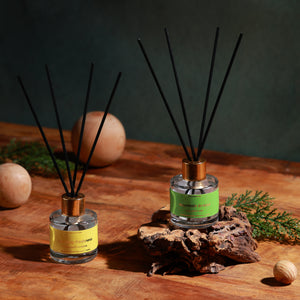
6. Check the object, because it will be judged. Plain glass, six plain fibre reeds, no printing, no ornament, refillable. If a gift is going to stand permanently on a console in a room somebody has designed, its silhouette matters as much as its contents.
7. Do not claim it is a hotel product. It is not. It is the method, made properly, by an independent house in Pune.
Composed and handmade in small batches in Pune, and a portion of every order supports girl-child education through Nanhi Kali.
Part one — the three things that survive the journey from a hotel to a flat
A hotel interior is an enormous, expensive, fixed system, and almost none of it can be lifted out. The useful exercise before you buy anything is to sort the components into what is attached to the building, what is attached to the budget, and what is attached to a decision. The first two cannot be gifted at any sensible price. The third can be gifted for under two thousand rupees, because a decision weighs nothing.
 Garden Bloom₹799 · classicalHere is the thing a hotel does that a beautifully decorated private home almost never does. It picks one fragrance and holds it — same scent, same level, every floor, every day, nobody adjusting anything. Meanwhile the average well-appointed Indian flat runs a lavender something in the bedroom, a lemon spray in the kitchen, an incense habit in the puja corner and a candle that comes out for guests, and the result at the front door is a seam rather than a scheme. Giving somebody one good composition for their entrance is not giving them a product; it is giving them the rule. It costs ₹749 to ₹849 for a 50ml that runs 6–8 weeks, or ₹1,249 to ₹1,349 for a 130ml that runs 14–18, and it is the only part of a hotel interior that fits in a bag.
Part two — hotel interior elements, costed and rated for gifting
The components of an interior somebody admires, sorted by whether they can be given at all. I have costed them honestly, including the ones that are better than anything I sell.
| Interior element | Giftable? | Realistic cost to attempt | What I would do instead |
|---|---|---|---|
| The scent at the entrance ★ | Yes, completely | ₹749–₹1,598 | Nothing — this is the buy. One composition, at the door, constant |
| Bed and bath linen | Yes, if you know the size | Expensive for anything convincing | Buy it only in off-white, or do not buy it |
| Lighting temperature | Partly | Modest — warm lamps or bulbs | Underrated gift, but you must know their fittings |
| Stone, brass, joinery | No | Any price, and still a fragment | Skip. Miniatures of fixed materials read as souvenirs |
| Flowers in the lobby | Once | Recurring, and gone in a week | Lovely, but it is a service gift and it does not repeat |
| Art and objects | Rarely | Unbounded | Do not buy art for someone with a scheme you are not part of |
| The honest caveat: a reed diffuser will not make anybody's flat resemble a hotel, and you should not present it that way. SOSA is an independent house in Pune, not affiliated with, licensed by or endorsed by any hotel or hotel group, and the reed range is not a hotel-inspired line. What you are giving is a habit that happens to be borrowed from good hotels — and a well-made bottle to carry it. | |||
Mountain Breeze · stone & timberfrom ₹849Shop → 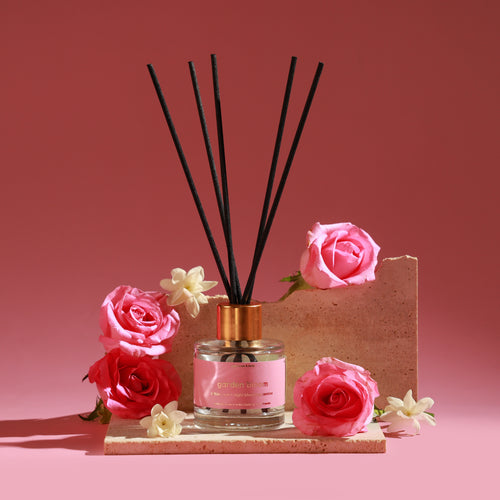 Garden Bloom · classicalfrom ₹799Shop →
  Fresh & Grounded duo₹1,548Shop →
Part three — when not to give this, including two cases specific to this recipient
The universal nos first, because they apply here as everywhere. Do not give home fragrance to somebody who has said they dislike scented things — people say it about their homes more often than about themselves, and they mean it. Do not give it into a house with a newborn, an asthmatic, or anybody with a diagnosed fragrance sensitivity; a passive diffuser runs continuously and a nursery is not the room for one. Do not give it for a tiny sealed studio with one window that never opens, where a composition dosed for an ordinary Indian room becomes the whole atmosphere. And do not give it to somebody who already runs home fragrance they chose themselves — in this particular group that is a real risk, because people who care about interiors are the likeliest of anyone to have got there first.
Then two nos that belong specifically to the interiors person. The first is that the object will be judged, permanently and every day, because unlike a candle a reed diffuser never goes back in a cupboard. If your recipient has a console with three carefully chosen things on it, you are proposing a fourth, and it has to earn that place on its silhouette alone. I think plain glass with six plain fibre reeds does earn it — there is no coloured wax, no printed slogan, no ornament, and the bottle is refillable so it stays rather than being replaced by a different-looking one. But you should look at it and decide, rather than assume. The second is subtler: a person who has just finished a renovation may not want another decision. A gift that requires them to choose where it goes, in a house where every placement has been agonised over, can land as work. The fix is one sentence when you hand it over — near the door, chest height, flip the reeds weekly — which converts a decision into an instruction.
And the honest limits of the format, since this reader will notice them faster than most. A reed diffuser is passive: no fan, no heat, no switch. It takes a day or two to establish, it cannot be turned up before guests arrive, and past roughly 250–300 sq ft of connected open volume it stops filling the space — a large open-plan living-dining with a double-height section is beyond it. Two bottles at opposite ends beat one big bottle in the middle, because output per source is fixed. If your recipient's home is genuinely large, or if what they want is a room that goes strong on demand, the honest gift is an ultrasonic machine: the Sukoon at ₹1,899 covers 270–320 sq ft, runs 16–18 hours a fill on low and includes three 15ml fragrances from the separate water-based Hotel Collection. Say that rather than selling somebody a third bottle.
Part four — the gift edit, chosen from their material palette
Not by budget this time but by the room they have made, because with this recipient the fit matters more than the spend. Read the materials you can see in their photographs — you will have seen photographs — and buy from the left-hand column. Strength figures are positions on SOSA's own internal scale at six reeds, not an industry standard.
| Their material palette | Give | Why it sits right | Price |
|---|---|---|---|
| Stone, oak or teak, linen, neutral ★ | Mountain Breeze | Dry pine, sage and cedar read as a material rather than a perfume · 9.4 | ₹849 / ₹1,349 |
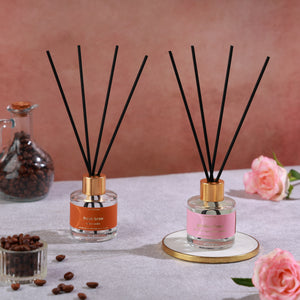
| Upholstered, classical, formal, rugs | Garden Bloom | Rose and night jasmine, rounded, presence without insistence · 8.9 | ₹799 / ₹1,299 |
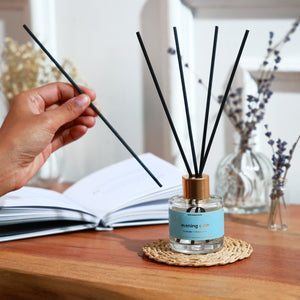
| Cool, pared-back, white, very few objects | Morning Freshness | Lemon, peppermint and Nilgiri eucalyptus — cold and clean, no sweetness · 9.0 | ₹749 / ₹1,249 |
| Warm, dark, layered, a lot of hosting | Fresh Brew | Coorg coffee and Kerala vanilla — the fullest presence in the range · 9.5 | ₹849 / ₹1,349 |
| A quiet bedroom-led home, low light | Evening Calm | Kashmir lavender and chamomile — deliberately the softest thing we make · 8.9 | ₹799 / ₹1,299 |
| Open-plan, entrance plus living room | Fresh & Grounded duo | Two bottles that meet on green eucalyptus, so there is no seam between rooms | ₹1,548 / ₹2,548 |
Versailles
The bottles are plain on purpose, and the reason is exactly the reader of this page. A reed diffuser is not a candle that comes out for guests and goes back in a drawer — it stands on a surface for eight weeks or eighteen and is seen every single day, usually in the most looked-at part of a house. Anything printed on it becomes an instruction you have to read a thousand times. So: glass, liquid, six fibre reeds standing straight, and nothing else. If somebody with an eye is going to give it a place, that is the least I can do.
Fibre rather than rattan is not an aesthetic decision, it is a functional one. Rattan's natural pores clog in Indian humidity, which is why so many handsome imported diffusers stop wicking somewhere in the second week of a Bombay monsoon and stand there looking decorative and doing nothing. Fibre keeps drawing. The base is a coconut-derived CCT, alcohol-free and phthalate-free, which trades a smaller opening week for a flatter plateau that does not turn acrid in a 45°C May.
I should say the obvious thing about hotels once more, since this page is full of them. SOSA has no relationship with any hotel or hotel group — no licence, no endorsement, no affiliation — and the reed range was not designed after anybody's lobby. It is five compositions of my own, made in Pune. I am not going to call the brand luxury either; the whole reed range runs from ₹749 to ₹2,598 and pretending otherwise would insult the person this page is written for. What I will defend is the material and the restraint, which is what luxury actually consists of before the pricing arrives. A part of every order funds a girl's classroom through Nanhi Kali.
Frequently asked questions
- What do you gift someone who loves five-star hotels? — the arrival, and why it is mostly smell.
- The best reed diffuser gift for a hotel lover — constancy as the structural argument.
- Home gifts for someone with luxury taste — why expensive homes are under-scented.
- The complete SOSA luxury gifting guide — all nine guides in this cluster, in one place.
- Brand: the SOSA founder story.
SOSA reed diffuser range & prices (verified August 2026): alcohol-free, phthalate-free, paraben-free and IFRA-compliant compositions on a heat-stable coconut-derived (CCT) carrier, low-VOC, supplied in a refillable glass bottle with six fibre reeds; 50ml lasts 6–8 weeks and 130ml lasts 14–18 weeks. Morning Freshness (Malabar lemon · peppermint · Nilgiri eucalyptus) 50ml ₹749 · 130ml ₹1,249 · 9.0/10; Garden Bloom (British rose · night-blooming jasmine) 50ml ₹799 · 130ml ₹1,299 · 8.9/10; Evening Calm (Kashmir lavender · chamomile) 50ml ₹799 · 130ml ₹1,299 · 8.9/10; Fresh Brew (Coorg coffee · Kerala vanilla) 50ml ₹849 · 130ml ₹1,349 · 9.5/10; Mountain Breeze (Himalayan pine · sage · Indian cedar) 50ml ₹849 · 130ml ₹1,349 · 9.4/10. Reed diffuser refills are oil only — you reuse your own vessel and reeds: 300ml ₹2,399 (roughly 8–11 months) · 500ml ₹3,499 (roughly 14–18 months), about ₹7–8 per ml against ₹15–17 per ml for a 50ml bottle. Duo sets ₹1,498–₹1,598 for 2 × 50ml and ₹2,498–₹2,598 for 2 × 130ml. Strength figures are positions on SOSA’s own internal strength scale, not an industry standard. Replacement reeds are not sold as a separate SKU; SOSA guidance is to refresh reeds every few months. The reed line is separate from the water-based Hotel Collection for ultrasonic machines (15ml ₹299 · 100ml ₹999 · 300ml ₹1,799) and the two are not interchangeable. Diffusers: Boond 300ml ₹899 · Sukoon 500ml ₹1,899 · Megh 6L ₹3,499 · waterless Vaayu ₹11,999. Composed and handmade in small batches in Pune, India; tested through 45°C summer heat and 85% monsoon humidity. Free shipping above ₹499. A portion of every order supports girl-child education through Nanhi Kali. Prices subject to change — see the live product pages.