

The build, in one line: a heat-stable CCT carrier (caprylic/capric triglyceride, coconut-derived) rather than the cheap DPG most diffusers sit on; six fibre reeds rather than rattan; alcohol-free, phthalate-free, paraben-free, IFRA-compliant, 0 ppm formaldehyde; climate-tested through a 45°C heat soak and 85% RH monsoon; refillable glass.
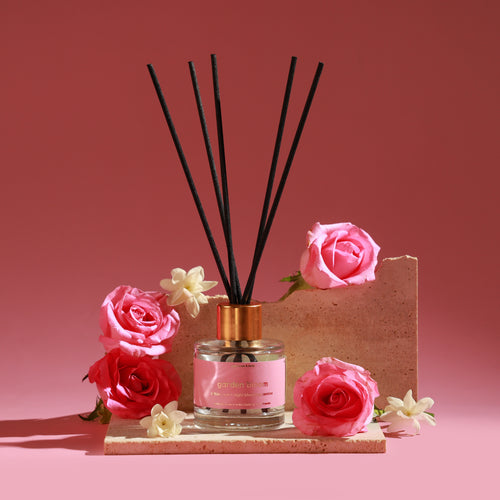
The one to give her: Garden Bloom at ₹799 — because the indole in its jasmine is held below the fecal threshold so it stays floral above 30°C, and a woman who buys jasmine diffusers has met the alternative.
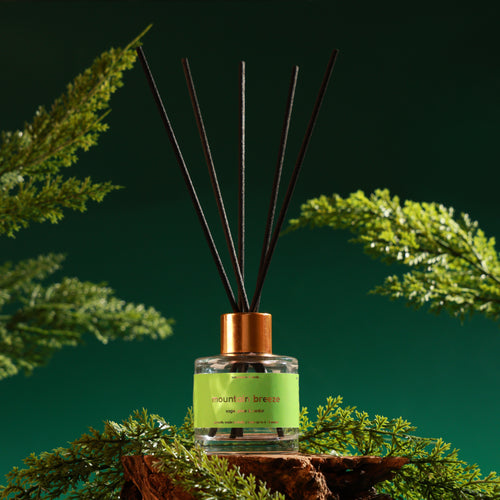
If she prefers dry and green: Mountain Breeze ₹849 — 9.4 on the SOSA scale, the deepest woody we make.
The honest gap: she will ask about oud, and there is no oud, sandalwood, vetiver or amber reed diffuser at SOSA. The Smoked Oudh candle at ₹449 and the Nawaab attar at ₹399 are the real answers in that register, and neither is a reed.
2. The carrier is the whole argument. DPG is the industry default because it is cheap and because it dissolves almost anything. It also degrades above about 40°C, and when it does, the fragrance sitting in it goes bitter or sour. That is why a diffuser that was lovely in February smells wrong by May in Delhi. CCT is a coconut-derived triglyceride, it is stable through a 45°C heat soak, and it costs more per litre. It is the least glamorous line on our specification and the one she will actually feel.
3. Six fibre reeds, not rattan. Rattan is a natural cane with an irregular pore structure that swells and clogs in humidity — which is why so many diffusers give you two strong weeks, then a slow fade, then a jar of oil with dry sticks in it. Fibre reeds are more porous and wick evenly at 85% RH. Every SOSA bottle ships with six, and the reed count is the volume dial: six for a living room, three or four for a bedroom, two or three in a small bathroom, where a 50ml will run close to three months.
4. Then check what is not in it. Alcohol-free, phthalate-free, paraben-free, IFRA-compliant and 0 ppm formaldehyde — most plug-in air fresheners test somewhere between 800 and 2,000 ppm of phthalate. A woman who runs fragrance in her home all year is exposed to whatever is in it all year, and this is the part of the specification she is most likely not to have checked on anything she has bought before.
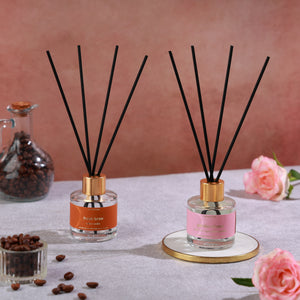
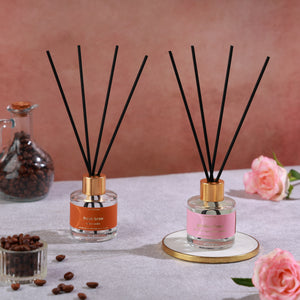
5. Choose the scent last, and choose it for her rooms. Garden Bloom ₹799 for a hall or living room; Evening Calm ₹799 at 8.9 for a bedroom; Mountain Breeze ₹849 at 9.4 for a study; Morning Freshness ₹749 for a kitchen or bathroom; Fresh Brew ₹849 at 9.5 only if you know she likes coffee.
Composed in Pune by an ISIPCA Versailles-trained perfumer, in a refillable glass bottle. Free shipping above ₹499, and a portion of every order supports girl-child education through Nanhi Kali.
The three things that decide a reed diffuser, and none of them is the scent
When somebody who loves beautiful-smelling spaces tells me a diffuser was disappointing, she almost always describes it as a fragrance failure — it went sour, it stopped working, it smelled cheap after a month. In nearly every case she is describing a mechanical failure wearing a fragrance costume. A reed diffuser is three components: an oil that carries the fragrance, a stick that lifts it into the air, and the composition itself. The market competes almost exclusively on the third, because the third is the one that photographs and the one that fits on a label. The first two decide whether the third survives contact with an Indian room.
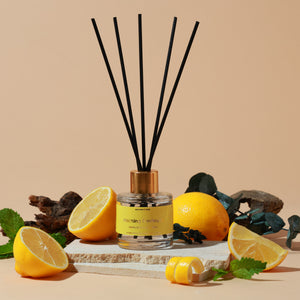
 Garden Bloom₹799Perfume oil is never sold neat in a diffuser; it is dissolved in a carrier, and the carrier is roughly three-quarters of what is in the bottle. The default across the category is DPG — dipropylene glycol — because it is inexpensive, odourless and dissolves nearly every aroma material. Its weakness is thermal. Above roughly 40°C it begins to break down, and the by-products of that breakdown are what your nose reads as bitter, sour or faintly acrid. A north Indian living room in May reaches that temperature without trying. So does a west-facing shelf in Mumbai in August, and so does the top of a cabinet in a flat that has been shut for a fortnight.
Every SOSA reed is built on CCT — caprylic/capric triglyceride, a coconut-derived carrier that is thermally stable through the range an Indian home actually reaches. It costs materially more per litre and it is the reason a SOSA bottle at week seven smells like a slightly quieter version of week one rather than a different fragrance altogether. We heat-soak every scent to 45°C and hold it at 85% relative humidity before release, and we test in sealed AC bedrooms as well, because a room with no air exchange is its own kind of stress test.
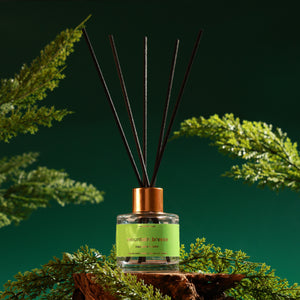
 Mountain Breeze₹849Rattan is a natural cane, and like all natural canes its capillary channels are irregular, variable between sticks and vulnerable to swelling. In a dry European flat that is tolerable. In Indian humidity the channels take up moisture and partially close, and the wicking rate collapses — which produces the pattern everyone recognises and everyone blames on the oil: two strong weeks, a long fade, and then a jar of oil with dry sticks standing in it. The oil is still there. It simply cannot get up the stick any more.
SOSA ships six fibre reeds with every bottle. Fibre is manufactured rather than grown, which means the pore structure is consistent along the whole length and from stick to stick, it is more porous than rattan to begin with, and it does not clog at 85% RH. The practical consequence is that the reeds remain a control rather than becoming a fault: six for a living room, three or four for a bedroom, two or three in a 50 sq ft bathroom, where a 50ml bottle will then run close to three months. Flip them every three to five days for the bright and green scents, every five to seven for the floral, and you get a lift each time without spending anything.
 Evening Calm₹799A woman who loves beautiful-smelling spaces does not run a diffuser occasionally. She runs one continuously, in a bedroom, for years. That turns a cosmetic specification into a domestic one. Every SOSA reed is alcohol-free — which also removes the sharp solvent lift you get in the first hour from alcohol-based products — phthalate-free, paraben-free, IFRA-compliant and tested at 0 ppm formaldehyde. For context, most plug-in air fresheners test somewhere in the region of 800 to 2,000 ppm of phthalate. The bottle is refillable glass rather than a sealed plastic unit, so the object stays and only the oil is replaced.
None of this is exciting and all of it is the reason I would give this bottle to somebody who already knows the category. It is the part she cannot verify from a product photograph, cannot smell in a shop, and has almost certainly never been told about any diffuser she has previously owned.
The composition decisions that never make it onto the label
Build is not only chemistry and hardware. There are decisions inside the formula itself that exist purely to survive an Indian year, and they are invisible in a note list — which is the point I most want to make to a recipient who reads note lists carefully. A note list tells you what a fragrance is made of. It tells you nothing about whether it will still be that fragrance in eight weeks.
The clearest example is Garden Bloom. Jasmine's characteristic warmth comes partly from indole, and indole is a material with a threshold: below a certain concentration it reads as heady and floral, and above it, it reads as something considerably less pleasant. Temperature moves that boundary, which is why so many jasmine products smell beautiful in a shop in December and animalic in a flat in April. We hold the indole deliberately below that threshold, accepting a slightly quieter jasmine at room temperature in exchange for a jasmine that is still floral above 30°C. Sneha B. in Mumbai called the combination unfairly elegant; Priya S. in Bengaluru simply said she expected it to turn awful by April and it has not. Both of those are reviews of a formulation decision, not of a scent.
The second example is Morning Freshness, and it addresses the failure this recipient will have experienced most often. Citrus molecules are the smallest and lightest in perfumery, so they leave a bottle first — which is why the average citrus diffuser is thrilling for ten days and then quietly over. Underneath the cold-pressed Malabar lemon and the peppermint sits a eucalyptus globulus base that slows the lemon's evaporation by roughly three to four times, turning a ten-to-fourteen-day citrus into a 6–8 week one. It is also low-VOC and within CARB guidance. Devika S. in Mumbai got seven weeks out of a 50ml running four reeds, and wrote that most citrus diffusers smell like dishwashing liquid while this one smells like an actual cut lemon. Again: that is a build review wearing the language of taste.
The third is Mountain Breeze, where the risk is not fading but shifting. Pine and cedar contain terpenes that oxidise, and oxidised pine is the sharp, faintly chemical smell every Indian household associates with disinfectant. Anjali R. in Pune ran the 130ml through an entire monsoon and reported the sentence I would have written for the specification myself: pine stayed pine, no bitterness, no chemical shift. A carrier that does not degrade is half of that; the rest is holding the sage and cedar high enough to keep the composition green rather than letting it collapse into timber.
| Component | The category default | What it does in an Indian room | The SOSA build |
|---|---|---|---|
| Carrier oil ★ | DPG — cheap, odourless, universal solvent | Degrades above roughly 40°C; the fragrance reads bitter or sour by May | Heat-stable CCT, coconut-derived, stable through a 45°C heat soak |
| Reeds | Rattan cane, often four or five | Irregular pores swell and clog at high humidity — two strong weeks, then fade | Six fibre reeds, consistent pore structure, no dry-stick fade |
| Climate testing | Rarely stated | Unknown behaviour in heat, monsoon or a sealed AC bedroom | 45°C heat soak, 85% RH monsoon hold, sealed AC bedroom testing |
| Solvent lift | Frequently alcohol-based | Sharp first hour, then a noticeable drop | Alcohol-free throughout — no solvent spike, no drop |
| Regulatory | Often unstated; plug-ins commonly test 800–2,000 ppm phthalate | Continuous year-round exposure in a bedroom | Phthalate-free, paraben-free, IFRA-compliant, 0 ppm formaldehyde |
| Bottle | Sealed or part-plastic, disposable | The whole object is thrown away with the oil | Refillable glass; 300ml refill ₹2,399 tops up the bottle she keeps |
| Longevity, 50ml | Highly variable, front-loaded | Strong fortnight, long silence | 6–8 weeks; 14–18 weeks on the 130ml |
Indole held low · Garden Bloom₹799Shop → 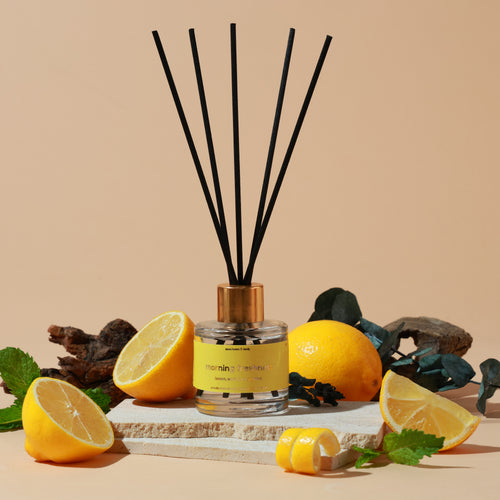 Eucalyptus base · Morning Freshness₹749Shop →
  No terpene shift · Mountain Breeze₹849Shop →
The honest case against giving her fragrance at all
I owe this recipient a paragraph that costs me a sale, because she is the one person on this list who might already have the answer. If she has a house scent she is loyal to — a specific bottle she has repurchased more than twice — do not give her a competing one. Scent loyalty is unusually firm, and a rival bottle arriving as a gift is a small argument with a decision she is happy with. In that situation the correct gift is either a different format in a register she does not own, or something outside the category altogether. There is no shame in the second option and it is frequently the right one.
I would also be fair about the things this page implicitly displaces. A beautifully made candle is a better gift than a diffuser for a recipient who wants a ritual rather than a background — someone who lights something deliberately at the end of a working day, and for whom the flame is half the point. A diffuser gives you continuity; a candle gives you an occasion, and those are genuinely different goods. If she is the second kind, our hand-poured jar candles at ₹379 or the Sandalwood candle at ₹449 are the honest recommendation and I would rather you bought one of those than the wrong ₹799 bottle.
And there are homes where the category should be left alone entirely. A flat in the middle of renovation already has too much in the air. A household where somebody has stated a scent aversion is not a household to test a theory in — although it is worth knowing that Evening Calm is deliberately calibrated at 8.9, the softest thing we make, and Ananya R. in Hyderabad keeps one in her bedroom precisely because she is migraine-prone and cannot tolerate plug-ins. And a home with a very new baby that has asked for nothing added should have nothing added. Naming those three is not a disclaimer. It is the reason the rest of this page is worth believing.
What to buy, in order — and the gap she will ask about
Ranked for a recipient who knows the category, which changes the order: the scents that demonstrate the build most clearly come first, and the safest scent comes third rather than first. Before the table, two facts she will test you on. There is no reed diffuser under ₹749 and no diffuser machine under ₹899, so if your budget is below ₹500 the reed is genuinely unavailable and the answer is a candle, a wax melt or a 3ml attar. And the ₹299 Hotel Collection 15ml bottle is a refill for an ultrasonic machine — it is water-based, it cannot go in a reed diffuser, and on its own it is not a gift.
| Buy | What it is | Why it beats what she already buys | Price |
|---|---|---|---|
| 1. Garden Bloom 50ml ★ | British rose, jasmine sambac, soft musk — 8.9 | Indole held below the fecal threshold, so the jasmine stays floral above 30°C. She has met the alternative | ₹799 |
| 2. Mountain Breeze 50ml | Himalayan pine, sage, Indian cedar — 9.4, the deepest woody | Terpenes that do not oxidise into disinfectant; ran a full monsoon with no chemical shift | ₹849 |
| 3. Morning Freshness 50ml | Cold-pressed Malabar lemon, peppermint, eucalyptus globulus — 9.0 | The eucalyptus base slows lemon evaporation 3–4×: 6–8 weeks instead of a fortnight | ₹749 |
| 4. Garden Bloom 130ml | The same build in the size a room above 150 sq ft needs, 14–18 weeks | Where she will notice the carrier most — a large, warm, west-facing room in summer | ₹1,299 |
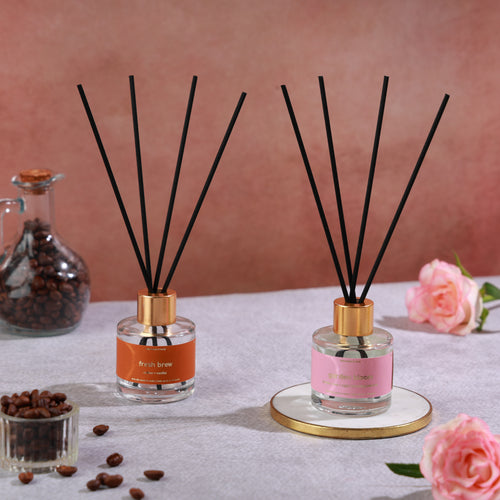
| 5. Warmth & Bloom duo | Fresh Brew and Garden Bloom, two 50ml bottles, two registers | Lets her keep the one she prefers and move the other to a second room | ₹1,598 |
| No oud, sandalwood, vetiver or amber reed: the honest gap | The reed line is five scents and none is a resin or a heavy wood beyond Mountain Breeze's pine and cedar. There is also no hotel-inspired reed — those scents are water-based and ultrasonic-only. The real answers in that register are the Smoked Oudh or Sandalwood candle, or the Nawaab attar | She will ask. Say so before she does | ₹449 · ₹399 |
Versailles
When I came back from Versailles I assumed the interesting work in home fragrance would be the compositions. It was not. The interesting work turned out to be everything the label does not mention — the carrier, the sticks, the temperature at which a beautiful accord stops being beautiful. I spent longer on the decision to move off DPG than on any single formula in the range, because DPG is cheap and universal and switching to CCT changes the cost of every bottle we will ever make.
The reason I did it is that I kept meeting the same woman. She loved fragrance, she had bought a great many diffusers, and she had concluded that the category simply does not last in India. She was almost right. What does not last in India is a formulation designed for a European room and shipped here unchanged. A 45°C heat soak and 85% humidity are not edge cases in this country; they are Tuesday in May and Thursday in July, and a product that has not been held at both before release is a guess.
So if you are buying for somebody who knows this category, my only real advice is to tell her what she is holding. Say that it is CCT rather than DPG and that this is why it will not turn. Say the reeds are fibre rather than rattan and that this is why the last fortnight still smells of something. Say that the jasmine is deliberately quieter at room temperature so that it survives April. She will not have been told any of that before, by anyone, about anything she has bought — and being told is genuinely the gift. Everything is composed and made in Pune, and a part of every order funds a girl's classroom through Nanhi Kali.
Frequently asked questions
- Looks expensive and Under ₹500 for women — a named material, completeness, restraint, and no reed at this price — what to buy instead.
- Under ₹1,000 for women and Home fragrance for her — the ceiling where the reed opens up, and choose the room before the scent.
- The reed for her and She loves her home — why the jasmine comes forward after dark, and never edit a room somebody curated.
- Her taste unknown — the four blind-buy criteria in full.
- The decision tree — one bottle, no reading.
- The complete guide for her — every decision in one place.
- Brand: the SOSA founder story.
SOSA facts verified August 2026: Five reed diffuser scents, all alcohol-free, on a heat-stable CCT (caprylic/capric triglyceride) carrier, phthalate-free, paraben-free, IFRA-compliant, 0 ppm formaldehyde, six fibre reeds in a refillable glass bottle, composed and made in Pune, India, and climate-tested through a 45°C heat soak, 85% RH monsoon humidity and sealed AC bedrooms. Morning Freshness (Malabar lemon · peppermint · eucalyptus globulus) 50ml ₹749 · 130ml ₹1,249 · 9.0 on the SOSA strength scale; the eucalyptus globulus base slows lemon evaporation approximately 3–4× and the composition is low-VOC and within CARB guidance. Evening Calm (Kashmir lavender · chamomile · soft musk) 50ml ₹799 · 130ml ₹1,299 · 8.9, the softest in the range. Garden Bloom (British rose · night-blooming jasmine sambac · soft musk) 50ml ₹799 · 130ml ₹1,299 · 8.9, with indole held below the fecal threshold so the jasmine remains floral above 30°C. Mountain Breeze (Himalayan pine · sage · Indian cedar) 50ml ₹849 · 130ml ₹1,349 · 9.4. Fresh Brew (Coorg coffee · Kerala vanilla · caramel) 50ml ₹849 · 130ml ₹1,349 · 9.5. Longevity 6–8 weeks on 50ml and 14–18 weeks on 130ml. Duos ₹1,498–₹1,598 for two 50ml bottles; refills 300ml ₹2,399 · 500ml ₹3,499. Smoked Oudh and Sandalwood scented candles ₹449; jar candles ₹379; attar roll-ons from ₹379 for 3ml. Hotel Collection oils are water-based and ultrasonic-only — 15ml ₹299 is a refill, not a standalone gift — and there is no hotel-inspired reed diffuser. There is no reed diffuser under ₹749 and no machine under ₹899, and no oud, sandalwood, vetiver or amber reed diffuser. Free shipping above ₹499. SOSA is an independent Indian fragrance house and is not affiliated with or endorsed by any hotel brand. Prices subject to change — see the live product pages.