


Why fresh scents smell like air freshener: cheap synthetic lemon and pine (which your nose learned in a cleaning product first), a front-loaded curve that blasts then dies, a DPG carrier that goes acrid above about 40°C, and phthalates used to slow evaporation on the cheap.
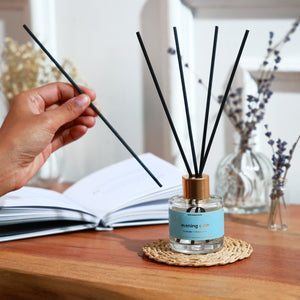
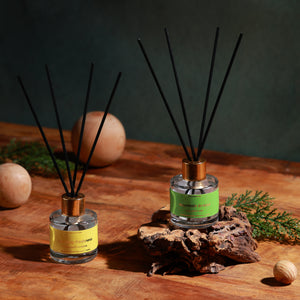
The pine version of the same problem: Mountain Breeze ₹849. The lavender version: Evening Calm ₹799.
The honest gap: SOSA is a small independent house and does not publish third-party lab certificates on its product pages. The phthalate, paraben and formaldehyde figures quoted here are batch-verified in-house, and I would rather say that than let "tested" imply an external laboratory.
2. The problem is the material, not the note. Synthetic lemon and synthetic pine are two of the cheapest aroma materials in existence, and they are the two your nose met first in a cleaning product. They do not smell bad. They smell filed. A real material is a different object and does not trigger the filing.
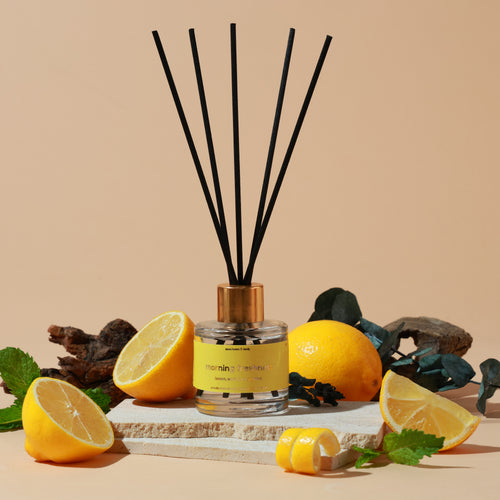
3. Then check the shape, not just the strength. A cheap fresh formula loads its top notes so the first week is dramatic and the fourth is empty — a blast, then nothing, which is precisely the shape of an aerosol. A composed fresh fragrance is quieter on day one and still there in week six. Morning Freshness runs 6–8 weeks on a 50ml rather than the ten-to-fourteen-day citrus fade, because the eucalyptus base slows lemon evaporation roughly three to four times.
4. Then check what it is dissolved in. Most reed diffusers sit on DPG, which cracks above about 40°C and goes sour or acrid at high humidity — the off-note people describe as "chemical" or "like a public toilet". Every SOSA reed sits on a heat-stable CCT base, coconut-derived, tested through 45°C heat soak and 85% RH monsoon humidity. Fading and turning are two different failures, and only one of them is the formula's fault.
5. Then check what else is in that carrier. Phthalates are used to slow evaporation cheaply and they off-gas indoors; most plug-ins test at 800–2,000 ppm. Every SOSA reed is phthalate-free, paraben-free, IFRA-compliant and 0 ppm formaldehyde, and Morning Freshness is low-VOC within CARB guidance. Those figures are batch-verified in-house — we are a small independent house and do not publish third-party certificates.
Alcohol-free, six fibre reeds, refillable glass bottle, composed in Pune. A portion of every order supports girl-child education through Nanhi Kali.
The three mechanisms inside the bottle
I want to be precise about what people are actually reporting when they say a fragrance smells like an air freshener, because the phrase sounds like an aesthetic verdict and is in fact a technical one. Nobody says it about a rose. Nobody says it about coffee or vanilla or oud. It is said almost exclusively about the fresh family — lemon, pine, lavender, "clean linen" — and that is a clue, because it means the complaint is not about smelling strong or smelling cheap in general. It is about a specific set of materials and a specific evaporation behaviour that the fresh family shares with the aerosol can, and that the warm families do not. Three of the four mechanisms live inside the bottle and are described below. The fourth lives in the carrier and has its own section.
 Morning Freshness₹749Synthetic lemon and synthetic pine are two of the cheapest aroma materials in existence, which is exactly why they are in your floor cleaner, your surface spray and your dishwashing liquid. And because they are in all of those, they are almost certainly where your nose first met the idea of a lemon smell that was not attached to a lemon. The consequence is not that the material smells bad. It is that your brain filed it under "cleaning" years ago and cannot unfile it — the association is doing the work, not the molecule. A real cold-pressed Malabar lemon is a materially different object, with the bitter peel and the faint green underneath that no reconstruction bothers to include, and a real Himalayan pine has none of the flat, sharp, one-dimensional quality of pine disinfectant. This is why the single most repeated sentence in Morning Freshness reviews is a version of "smells like an actual cut lemon, not floor cleaner". Buyers are not paying us a compliment about quality. They are reporting which mental folder the smell landed in.
 Mountain Breeze₹849This is the mechanism almost nobody names, and it is the one I would put first if I were ranking them by how much damage it does. A cheap fresh formula loads its top notes heavily, so the first three days are dramatic and the shop-floor sniff is spectacular. It is a deliberate commercial decision: the first impression sells the second bottle. But a curve that peaks immediately and collapses inside a fortnight is precisely the profile of an aerosol — a blast, then nothing — and that shape is itself the air-freshener signature, independent of what materials are in it. You can build a front-loaded formula out of genuinely lovely oils and it will still read as an air freshener, because your nose recognises the behaviour before it identifies the note. A composed fresh fragrance does the opposite: it is quieter on day one than the cheap one beside it, and it is still there in week six. Morning Freshness uses a eucalyptus globulus base to hold the lemon down, slowing its evaporation roughly three to four times — which is why a 50ml runs 6–8 weeks instead of the ten-to-fourteen-day citrus fade, and why the same bottle in a 130ml runs 14–18 weeks.
 Evening Calm₹799A reed diffuser is mostly carrier. The fragrance is a small percentage of what is in the bottle; the rest is the liquid that dissolves it and climbs the reeds, and that liquid has a chemistry of its own. Most reed diffusers sit on DPG, because DPG is cheap and dissolves almost anything. DPG also cracks above about 40°C and goes sour or acrid at high humidity, and that acrid off-note is exactly what people are describing when they say a diffuser smells "chemical", "sharp" or "like a public toilet". Note that this has nothing to do with the perfume. It is the solvent degrading underneath a perfectly good composition. Fading and turning are two entirely different failures and only one of them is the formula's fault — a fragrance that quietly gets weaker has simply run its course, while a fragrance that develops a new and unpleasant note has had its carrier fail. Every SOSA reed sits on a heat-stable CCT base, caprylic/capric triglyceride, coconut-derived, tested through 45°C heat soak and 85% RH monsoon humidity. It costs more per litre than DPG and it is the reason a buyer in Pune can write "lasted exactly through one monsoon — pine stayed pine, no bitterness, no chemical shift".
The fourth mechanism — what else is dissolved in that carrier
The three mechanisms above decide whether a fragrance smells like an air freshener. The fourth decides what you are breathing while it does, and I want to state it as a specification rather than a warning, because home fragrance is an industry full of people shouting about ingredients they do not understand and I have no interest in joining them. Phthalates are used in fragrance to slow evaporation cheaply. That is their function: they are a fixative, and they do the same job that a properly composed base note does, at a fraction of the cost and none of the craft. They also off-gas indoors over the life of the product, which is why they have gradually been designed out of better formulas. Most plug-in air fresheners test in the region of 800 to 2,000 parts per million phthalate. Every SOSA reed diffuser is phthalate-free, paraben-free, IFRA-compliant and 0 ppm formaldehyde, and Morning Freshness is low-VOC within CARB guidance.
There is a connection between the fourth mechanism and the second that is worth making explicit, because it is the part that makes this a formulation question rather than a safety leaflet. A formula that cannot afford a real base note has two ways to stop its top notes leaving: use a synthetic fixative, or accept the collapse. The cheap fresh diffusers on the shelf have chosen one or the other, and you can usually tell which. If it is loud for a week and gone by the third, it accepted the collapse. If it is loud for a week and then flat but somehow still present for two months, something in the bottle is holding it down that is not a fragrance material. The eucalyptus globulus base in Morning Freshness is the expensive version of that same decision — a real material doing the fixing, which is why the bottle both lasts 6–8 weeks and still smells like a lemon in week six rather than like a memory of one.
Here is the honest gap, and I would rather put it in the middle of the page than bury it near the bottom. SOSA is a small independent house and we do not publish third-party laboratory certificates on our product pages. The phthalate, paraben and formaldehyde figures quoted throughout this page are batch-verified in-house against our raw-material specifications and our own testing, and they are accurate to the best of our knowledge — but "batch-verified in-house" is a materially weaker claim than "certified by an accredited external laboratory", and it would be dishonest to let the word "tested" blur the two. If external certification is your threshold for a purchase, it should be, and this is not yet the range that meets it. Ask us for the batch documentation and we will send it; ask us for a third-party certificate and we do not have one to send.
| The tell | Air-freshener-style fresh | A composed fresh (the SOSA reeds) |
|---|---|---|
| Material | Synthetic lemon or synthetic pine reconstruction — two of the cheapest aroma materials there are, and the two your nose learned in a cleaning product first | Cold-pressed Malabar lemon · Himalayan pine · Kashmir lavender — named materials, not categories |
| Week one | Dramatic. Front-loaded top notes designed for the first impression and the shop shelf | Quieter than the cheap bottle beside it, deliberately. 9.0 on the SOSA strength scale for Morning Freshness — mild-medium, bright |
| Week six | Gone, or a jar of oil with sticks in it. The ten-to-fourteen-day citrus fade is the usual pattern | Still there. 6–8 weeks on a 50ml, 14–18 weeks on a 130ml |
| At 45°C | DPG cracks above about 40°C — the scent goes sour, bitter or sharp in a Delhi May | Tested through a 45°C heat soak. It fades in the end; it does not turn |
| At 85% humidity | Acrid off-note — the "chemical" or "public toilet" smell people report in the monsoon | Tested through 85% RH monsoon humidity. Pine stays pine |
| Carrier | DPG, usually undisclosed. Cheap, dissolves anything, degrades in heat and damp | Heat-stable CCT — caprylic/capric triglyceride, coconut-derived. Alcohol-free |
| Phthalate content | Rarely disclosed. Most plug-ins test at 800–2,000 ppm; phthalates slow evaporation cheaply and off-gas indoors | Phthalate-free, paraben-free, IFRA-compliant, 0 ppm formaldehyde — batch-verified in-house, not third-party certified |
| Reed type | Rattan. Clogs in Indian humidity, giving the fade-then-nothing pattern people blame on the oil | Six fibre reeds in every bottle — more porous, wicks evenly in humidity, no dry-stick fade |
Not floor cleaner · Morning Freshness₹749Shop →  Not Phenyl · Mountain Breeze₹849Shop →
 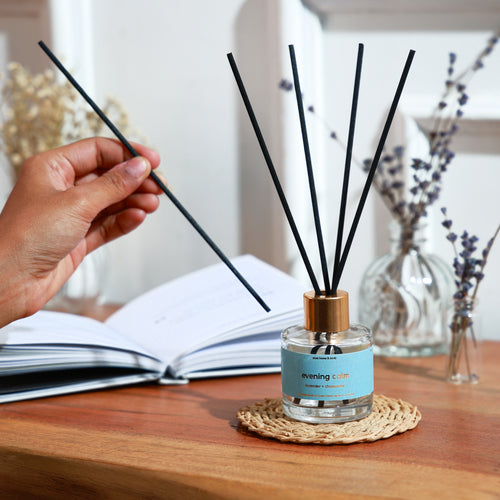 Not fabric softener · Evening Calm₹799Shop →
The four-question test you can run in any shop, on any brand
Everything above collapses into four questions. They take about ninety seconds to ask, they work on a website as well as a shelf, and they are deliberately written so that they can be turned on us as easily as on anybody else. If a brand cannot answer three of the four, that is itself the answer — not because they are hiding something, but because a house that has made these four decisions on purpose always knows what it decided.
Question one: what is the actual material? Look for a proper noun in the note list. "Lemon" is a category and costs nothing to write; "cold-pressed Malabar lemon" is a material somebody had to source, price and defend. Same with pine — "pine" versus "Himalayan pine", and same with lavender: "lavender" versus "Kashmir lavender". This is not snobbery about naturals, and a good synthetic has a legitimate place in a composition. It is that the specific synthetics doing duty as fresh in cheap products are the exact ones your nose has already catalogued as cleaning, and a brand that names its origin is telling you it did not reach for the shorthand.
Question two: what longevity is stated, and for what volume? This is the front-loading test, and it is the most useful of the four because the answer is nearly always printed. Under three weeks for a 50ml means the formula is front-loaded, and front-loading is the aerosol curve. Between six and eight weeks means somebody built a base under the top notes. Be suspicious of unusually long claims too, particularly a long life on a fresh scent with no base note listed, because something in the bottle is doing the fixing and it may not be a fragrance material. For reference: SOSA quotes 6–8 weeks on a 50ml and 14–18 weeks on a 130ml, and Morning Freshness gets there on a eucalyptus globulus base that slows the lemon's evaporation three to four times.
Question three: what is the carrier? Ask outright. The two answers you will get are DPG or a triglyceride such as CCT, and the third answer — silence — should be read as DPG, because CCT is expensive enough that anybody using it puts it on the label. This is the question that predicts whether your diffuser will turn in an Indian summer rather than simply fade, and it matters most if the bottle is going anywhere warm or damp: a west-facing living room in May, a bathroom in August, a kitchen at any time of year. It also matters if the product will sit in a warehouse through a monsoon before it reaches you, which most of them do.
Question four: what does the brand disclose about phthalates? Not "is it natural", which is a marketing word with no definition, but the specific disclosure: phthalate-free, paraben-free, formaldehyde figure, IFRA compliance. Most plug-ins test at 800–2,000 ppm phthalate and almost none of them say so anywhere on the box. A brand that publishes the figures has at minimum thought about them. And then push one step further, which is where this test turns back on us: ask how those figures were verified. In-house batch verification against raw-material specifications is genuine and is what SOSA does; accredited third-party certification is stronger and is what we do not currently publish. Both are real answers. "Tested" on its own is not one.
What to buy for each version of the problem — and the honest gap
The complaint arrives in three forms, because there are three fresh materials that the cleaning aisle got to first. Lemon became floor cleaner and dishwashing liquid, pine became Phenyl and disinfectant, and lavender became fabric softener and hospital corridor. Each has an answer in this range, and the reviews line up so precisely along those three lines that I could have written this section out of the review feed alone. One thing this range does not answer is the fourth version of the complaint, and I will come to it in the last row of the table, because "clean linen" deserves more than a footnote on a page about synthetic shorthand.
| Buy | What it is | The complaint it answers | Price |
|---|---|---|---|
| 1. Morning Freshness 50ml ★ | Cold-pressed Malabar lemon, peppermint, eucalyptus globulus — 9.0, mild-medium and bright, low-VOC within CARB guidance | "Citrus diffusers smell like floor cleaner." Real lemon, and a base that stops the fortnight fade. 6–8 weeks | ₹749 |
| 2. Mountain Breeze 50ml | Himalayan pine, sage, Indian cedar — 9.4, the deepest woody in the range | "Pine smells like Phenyl." Rohit B. in Hyderabad: "Was terrified this would smell like Phenyl. It's the opposite. Real pine — crisp green, never sharp." | ₹849 |
| 3. Evening Calm 50ml | Kashmir lavender, chamomile, soft musk drydown — 8.9, the softest thing we make | "Lavender smells like fabric softener." Ananya K. in Bengaluru: "Finally a lavender that doesn't smell like fabric softener." | ₹799 |
| 4. Fresh & Grounded duo | Morning Freshness and Mountain Breeze together — the lemon answer and the pine answer, 50ml × 2 | If both the citrus and the pine in your house have let you down. ₹1,548, or ₹2,548 for 130ml × 2 | ₹1,548 |
| 5. 300ml refill | Tops up the glass bottle and fibre reeds you already own | Once one of the three is clearly the one you keep going back to | ₹2,399 |
| No "clean linen", no aquatic: the honest gap | There is no marine, ozonic or cotton-musk accord in the reed range. And the "clean linen" accord is one of the most heavily synthetic categories in all of home fragrance — there is no linen to extract, so it is built entirely from aroma chemicals. On a page about synthetic shorthand, you deserve to know that | Evening Calm is the nearest honest answer for soft clean skin; Mountain Breeze is the nearest for cool open air. Neither is clean linen and I will not pretend otherwise | ₹799 / ₹849 |
Versailles
The first brief I ever wrote for myself, before there was a company, was one sentence long: a lemon that does not remind anyone of a bucket. It sounds trivial and it took the longest of anything in the range, because the obstacle was never the perfumery. Cold-pressed Malabar lemon is easy to buy. The obstacle was that a fresh fragrance is competing with a memory, and the memory got there first.
What that taught me is that the four mechanisms on this page are not four separate quality problems. They are four separate ways of arriving at the same wrong association. Cheap material triggers it directly. A front-loaded curve triggers it through behaviour, even with good material. A cracked carrier triggers it by adding an acrid note that belongs to cleaning products. And a phthalate fixative is what a formula uses when it has not paid for a base note — the tell of a shortcut rather than the shortcut itself. Fix one and you have a nicer air freshener. You have to fix all four.
I have tried to write this so it can be used against us. If Morning Freshness at ₹749 does not answer all four questions to your satisfaction — and on the fourth one, third-party certification, it honestly does not yet — then the right thing is for you to buy something that does. Everything is composed in Pune, and a part of every order funds a girl's classroom through Nanhi Kali.
Frequently asked questions
- Best fresh reed diffuser fragrances — the three registers of fresh, and which one you actually mean.
- Scenting a whole home — one bottle or three, and how to zone a flat.
- Bedrooms, living rooms and bathrooms — the same scents, different reed counts.
- The hotel question — why there is no hotel-inspired reed diffuser, and what to do instead.
- If you don't like heavy scents — the SOSA strength scale, explained.
- Which one should you buy — and the complete fresh buying guide.
- Brand: the SOSA founder story.
SOSA reed diffusers — facts verified August 2026: Five scents, all alcohol-free, on a heat-stable CCT (caprylic/capric triglyceride, coconut-derived) base rather than DPG, phthalate-free, paraben-free, IFRA-compliant, 0 ppm formaldehyde, six fibre reeds in a refillable glass bottle, composed and made in Pune, India. Morning Freshness (Malabar lemon · peppermint · eucalyptus globulus) 50ml ₹749 · 130ml ₹1,249 · 9.0 on the SOSA strength scale · low VOC within CARB guidance · eucalyptus base slows lemon evaporation 3–4×. Evening Calm (Kashmir lavender · chamomile · soft musk) 50ml ₹799 · 130ml ₹1,299 · 8.9, the softest in the range. Garden Bloom (British rose · night-blooming jasmine) 50ml ₹799 · 130ml ₹1,299 · 8.9. Mountain Breeze (Himalayan pine · sage · Indian cedar) 50ml ₹849 · 130ml ₹1,349 · 9.4. Fresh Brew (Coorg coffee · Kerala vanilla · caramel) 50ml ₹849 · 130ml ₹1,349 · 9.5, the deepest in the range. Longevity 6–8 weeks on 50ml and 14–18 weeks on 130ml. Duos: Day & Night ₹1,498, Fresh & Grounded ₹1,548, Warmth & Bloom ₹1,598 (50ml × 2). Refills 300ml ₹2,399 · 500ml ₹3,499. Climate-tested through 45°C heat soak and 85% RH monsoon humidity. Comparative figure of 800–2,000 ppm phthalate refers to typical plug-in air fresheners, not to SOSA products. The reed line contains no oud, no sandalwood, no vetiver, no amber, no orange blossom and no aquatic, marine or clean-linen accord; where this guide is asked for one of those it says so rather than stretching the nearest scent to cover it. Reed diffuser oil and the water-based Hotel Collection are separate products and are not interchangeable in either direction; there is no hotel-inspired reed diffuser. Free shipping above ₹499. A portion of every order supports girl-child education through Nanhi Kali. SOSA is independent and not affiliated with any hotel brand. Prices subject to change — see the live product pages.