

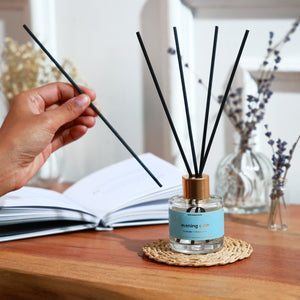
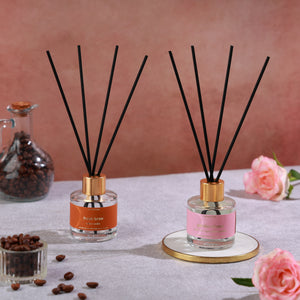

If you want soft rather than floral: Evening Calm — Kashmir lavender and chamomile, the softest thing we make. ₹799.
The test to apply anywhere: ask what the second flower is. If there isn't one, you are buying a note rather than a fragrance.
The honest gap: there is exactly one true floral in the SOSA reed line. No tuberose, gardenia, lily, peony, orange blossom, osmanthus, ylang-ylang, magnolia, champa or marigold — and no single-note rose either, deliberately. If one of those is the flower in your head, we do not make it.
2. Understand what you are actually buying when you buy a soliflore. One flower, on a label, with nothing else to do. In a perfume that is a virtue, because you take the perfume off. In a room you are inside it for fourteen hours a day, and by the second week you are no longer smelling a rose — you are smelling a decision somebody made once, repeated at you until you stop noticing it or start resenting it.
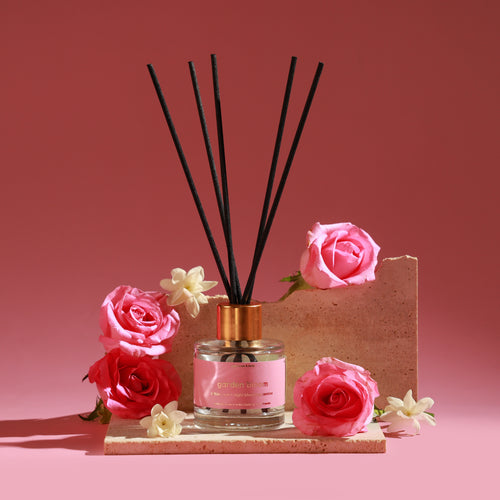
3. A composition has somewhere to go. The rose in Garden Bloom is the structure and the daylight register: crisp, green-stemmed, the smell of a garden rose rather than a rose product. The jasmine is the warmth, and it comes up in the evening and in the heat, because that is what night-blooming jasmine does. Two flowers, two jobs, two different times of day. That is why it does not flatten.
4. Ask the question that works on any brand's shelf: what is the second flower? If the answer is that there isn't one, you are buying a note rather than a fragrance, and you should expect it to behave like a note — loud on day one, invisible or tiresome by week three.
5. Then use the reeds as the volume dial. Six reeds is full strength for a living room or an entryway; three or four for a bedroom; two or three in a small bathroom, where a 50ml bottle will run close to three months. Flip Garden Bloom's reeds every five to seven days. That single adjustment resolves most complaints about a floral being too much.
Alcohol-free, phthalate-free, made in Pune. A portion of every order supports girl-child education through Nanhi Kali.
Soliflore versus composition — the argument this whole family turns on
A soliflore is a fragrance built around one flower. It is an honourable old form and some of the finest perfumes ever made are soliflores. But a perfume and a room fragrance are solving different problems, and the difference is duration. You wear a perfume for three hours and you can leave it in another room. A reed diffuser is on for as long as you are awake and for the eight hours you are not, in a space you cannot step out of when it stops being charming. Everything that makes a soliflore elegant on skin — its singularity, its insistence, the fact that it says one thing very clearly — becomes a liability at fourteen hours a day. The three cards below are the three reasons, in the order they matter.
 Garden Bloom₹799A single-note floral has one statement and it makes it identically at seven in the morning, at two in the afternoon and at eleven at night. There is no second act, because there is no second material to take over when the first one warms up. Within a fortnight your nose has fully catalogued it and one of two things happens: either it disappears entirely, which is a waste of ₹799, or it becomes conspicuous in the wrong way — you notice it every time you walk in, and what you notice is not a rose, it is a decision somebody made once and never revisited. A composed floral avoids this because different parts of it dominate at different temperatures and different hours, so the room is never quite giving you the same sentence twice.
 Warmth & Bloom₹1,598In Garden Bloom the two flowers are not there for the label, they are there because they do different jobs. The British rose is the structure and the daylight register — crisp, slightly green at the stem, the thing that keeps the fragrance legible in a bright morning room where a heavier floral would read as syrup. The night-blooming jasmine is the warmth, and it lifts in the evening and in heat, which is exactly what sambac does on the plant. Underneath both is a soft musk drydown that stops the two flowers from sitting on top of the room like a vase and instead settles them into it. Sneha B. put it better than any brief I have written: "finally a rose that isn't Phenyl rose. The jasmine warmth is the bonus. The combination is unfairly elegant."
 Evening Calm₹799This is the technical half of the same argument. Real rose contains over three hundred aromatic compounds — the famous ones, the fugitive green ones, the honeyed ones, the faintly tea-like ones — and what makes it smell like a rose is the crowd, not the soloist. Take the supporting cast away and you are left with the two or three loudest molecules, which is the shorthand, and the shorthand for rose is soap. Your nose learned it in a bathroom, on a cake of it, long before it learned the flower. Real jasmine, meanwhile, contains indole, and the shorthand for jasmine is not soap; it is something considerably worse. That is the entire reason we do not sell a single-note rose and never will, and the reason Aanya M.'s review is the one I quote most often: "the first one that smells like a real rose garden — not like Lifebuoy rose soap."
The indole problem — and why cheap jasmine goes off in an Indian summer
Indole is a molecule found in real jasmine, and it is the most honest illustration in perfumery of how much concentration matters. At low concentration indole reads as floral, warm and slightly animalic — it is the thing that makes jasmine smell alive rather than pretty. Above a certain threshold it reads as frankly fecal. Nothing about the molecule changes. Only the amount does, and the amount your nose perceives is a function of how much is in the bottle and how fast it is leaving it. The second half of that sentence is where India comes in, because evaporation rate is driven by temperature, and Indian rooms run hot. A jasmine formulated for a temperate European living room at 21°C is being asked to behave in a Chennai flat at 34°C, and it will not. It will cross the threshold sometime in March and stay across it until October.
This is the real explanation for a complaint I hear constantly and which almost nobody diagnoses correctly: my jasmine diffuser was lovely when I bought it and turned unpleasant in the summer. The oil did not spoil. The formulation was simply never built for the temperature. Garden Bloom is formulated with indole held deliberately below the fecal threshold, at a level chosen so that the jasmine stays warm and floral above 30°C rather than tipping over — which costs a little of the swagger a jasmine can have in a cool room, and buys you a fragrance that is the same fragrance in April as it was in December. Priya S. described the outcome exactly: "the jasmine is the real surprise. It stays warm and floral all summer — I expected it to turn awful by April. It hasn't." She expected it to turn because every jasmine she had previously owned had.
The carrier does the other half of this job. Most reed diffusers on the market sit on DPG, which is cheap and which cracks above roughly 40°C — that is the mechanism behind a diffuser going sour, bitter or acrid in a Delhi May. Every SOSA reed sits on a heat-stable CCT base, a coconut-derived caprylic/capric triglyceride, tested through a 45°C heat soak, 85% monsoon humidity and sealed air-conditioned bedrooms. A floral is the family where this matters most, because floral materials are the ones with the least margin for error: a woody scent that shifts a little still smells like wood, and a floral that shifts a little smells like a mistake.
All five SOSA reed scents, ranked for a floral buyer
The complete line, with what is in each bottle, where it sits on the strength scale, and how honestly it answers to the word floral. The bottom three rows are the ones that are not floral, listed because a guide that shows you only the products matching your search is an advertisement rather than a guide.
| Scent | Notes | Strength | How floral it really is | Best room | 50ml |
|---|---|---|---|---|---|
| Garden Bloom ★ | British rose · night-blooming jasmine · soft musk | 8.9 · medium floral | The only true floral — and a two-flower composition, not a soliflore | Entryway, drawing room, bedroom | ₹799 |
| Evening Calm | Kashmir lavender · chamomile · soft musk | 8.9 · softest in range | Herbal-floral rather than floral — lavender is a flower, but it reads as calm, not bloom | Bedside, guest room, evening bath | ₹799 |
| Morning Freshness | Malabar lemon · peppermint · eucalyptus globulus | 9.0 · mild-medium, bright | Not floral at all — a citrus-mint, and the one to pair with a floral in another room | Bathroom, kitchen, home office | ₹749 |
| Fresh Brew | Coorg coffee · Kerala vanilla · soft caramel | 9.5 · deepest in range | Not floral — a warm gourmand. Sits beside a floral well, which is why the duo exists | Living room, study, winter | ₹849 |
| Mountain Breeze | Himalayan pine · sage · Indian cedar | 9.4 · deep woody | The anti-floral of the range — dry, green, resinous. Buy it if a floral is what you are escaping | Bedroom, study, yoga room | ₹849 |
Composed floral · Garden Bloom₹799Shop → 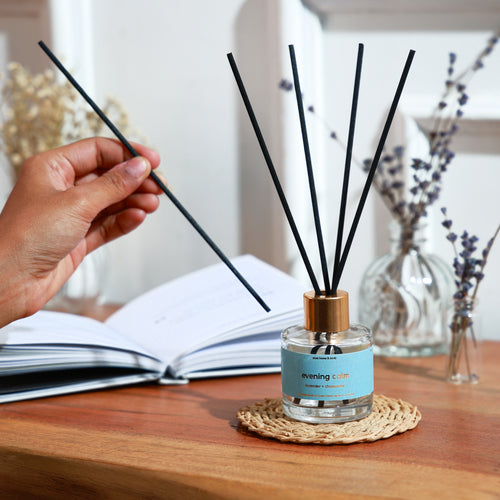 Herbal-floral · Evening Calm₹799Shop →
  Ultrasonic only · Shangri-La-inspired₹299Shop →
Where a floral belongs, and how many reeds it wants
Florals are placed wrongly more often than any other family, and the error is nearly always the same one: people put them where they cook. A floral and a meal argue with each other — the rose and the tadka are both mid-weight, both persistent, and neither will yield — which is why the kitchen is the one room I would give to Morning Freshness instead. The rooms that suit a floral are the ones where the smell is the first thing a person meets: an entryway, a hall console, a drawing room, the landing at the top of a staircase. Ritu K. put the 130ml in an entryway and reported that three separate guests asked which hotel it reminded them of, which is precisely the mechanism — a composed floral at the door tells someone what kind of house they have walked into before anyone speaks.
Reed count is the volume dial and almost nobody uses it as one. Every bottle ships with six fibre reeds, fibre rather than rattan, because rattan clogs in Indian humidity and gives you the strong-then-nothing pattern people blame on the oil. Use all six in a drawing room or an entryway. Use three or four in a bedroom — a floral in a bedroom at six reeds is the single commonest reason someone decides they have gone off florals. Use two or three in a small bathroom, where a 50ml will then run close to three months. Flip Garden Bloom's reeds every five to seven days; it is a slower cadence than the bright scents want, because the musk drydown does not need the same encouragement. Sizes follow rooms rather than budgets: 50ml for anything up to about 150 sq ft at ₹799, and the 130ml at ₹1,299 above that, running 14–18 weeks.
One more piece of placement advice specific to this family. A composed floral is designed to shift across the day, so put it where you will actually pass it at different hours — a hall you cross in the morning and again at night will show you both halves of the fragrance, whereas a spare room you enter twice a week will only ever show you whichever half is dominant at that moment. Keep it off a windowsill in direct sun and out of the draught of a running split AC, both of which strip the rose off the top and leave you sitting with the drydown. And if you are scenting a whole flat, do not buy two bottles of the same thing: a home that smells identical in every room stops registering as a smell at all inside a week. The Warmth & Bloom duo at ₹1,598 exists for exactly this — floral at the door, coffee and vanilla in the room you sit down in.
The floral edit, in buying order — and the gap
Here is the whole range as it applies to somebody who arrived asking for a floral, in the order I would actually buy it, followed by what this range does not contain. There is exactly one true floral in the SOSA reed line. No tuberose, no gardenia, no lily, no peony, no orange blossom, no osmanthus, no ylang-ylang, no magnolia, no champa and no marigold — and no single-note rose either, which is a deliberate refusal rather than an omission. If one of those is the flower in your head, I would rather tell you now than sell you the nearest thing and let you discover it in a fortnight. The one honest neighbour on the other side of the house is the Shangri-La-inspired Hotel Collection scent, which is water-based and needs an ultrasonic machine.
| Buy | What it is | When it is the right answer | Price |
|---|---|---|---|
| 1. Garden Bloom 50ml ★ | British rose + night-blooming jasmine + soft musk — a composition, not a soliflore | First, for every floral buyer. ₹799 settles the question | ₹799 |
| 2. Garden Bloom 130ml | The same composition, sized for above 150 sq ft — 14–18 weeks | For an entryway, a drawing room or an open-plan floor | ₹1,299 |
| 3. Evening Calm 50ml | Kashmir lavender and chamomile — herbal-floral, 8.9, the softest thing we make | If what you actually want is soft rather than floral | ₹799 |
| 4. Warmth & Bloom duo | Garden Bloom and Fresh Brew together — floral at the door, gourmand in the room | If you are scenting a flat rather than a single room | ₹1,598 |
| 5. 300ml refill | Tops up the bottle and reeds you already own | Once Garden Bloom is clearly the one you keep going back to | ₹2,399 |
| No tuberose, no gardenia, no single-note rose: the honest gap | The reed line has no tuberose, gardenia, lily, peony, orange blossom, osmanthus, ylang-ylang, magnolia, champa or marigold, and no soliflore rose. The Shangri-La-inspired Hotel Collection scent (jasmine · green tea · white tea) is the only other floral in the house — water-based, ultrasonic only, so it needs a Sukoon or a Boond | Said plainly rather than stretched to fit | ₹299 + ₹1,899 or ₹899 |
Versailles
The commercially sensible thing would have been to make a rose. Rose is the most searched flower in Indian home fragrance by a distance, and a single-note rose is cheap to build, easy to name and easy to sell. I did not make one, and I am not going to. Not out of principle for its own sake, but because I know what happens to it: a soliflore rose in an Indian room is one loud molecule doing a job that three hundred of them were supposed to share, and within a fortnight your nose has correctly identified it as soap.
So Garden Bloom was built as a composition from the first trial. The British rose does the daylight and holds the structure; the night-blooming jasmine does the evening and the warmth, which is what sambac does anyway; the musk drydown underneath keeps them in the room rather than on a table. Two of the hardest decisions in it are invisible on the label — how much indole to leave in, which is the difference between a jasmine that is alive and a jasmine that is unbearable at 34°C, and what to carry it on, which is the difference between a floral that lasts and one that turns.
If you take one thing away from this page, take the question. What is the second flower? Ask it of us, ask it of anyone, and notice how often there is no answer. And if the flower you actually want is a tuberose or a gardenia or a marigold, we do not make it — I would rather you know that from me than find out from the bottle. Everything is composed in Pune, and a part of every order funds a girl's classroom through Nanhi Kali.
Frequently asked questions
- A floral home and Bedrooms — where a floral belongs and where it does not, and florals at three reeds.
- Living rooms and Bathrooms — the cooking problem florals have, and why a floral behaves differently in 50 sq ft.
- The hotel question and Not too sweet — there is no hotel-inspired reed, and what is nearest, and sweetness is a formulation choice, not a flower.
- Modern florals — what separates a modern floral from a nostalgic one.
- The decision tree — one bottle, no reading, if you want one bottle and no argument.
- The complete floral guide — every decision in one place.
- Brand: the SOSA founder story.
SOSA reed diffusers — facts verified August 2026: Five scents, all alcohol-free, on a heat-stable CCT (caprylic/capric triglyceride) base, phthalate-free, paraben-free, IFRA-compliant, 0 ppm formaldehyde, six fibre reeds in a refillable glass bottle, composed and made in Pune, India. Garden Bloom (British rose · night-blooming jasmine, sambac/mogra · soft musk drydown) 50ml ₹799 · 130ml ₹1,299 · 8.9 on the SOSA strength scale · 4.9 from 138 verified reviews · indole held below the fecal threshold so the jasmine stays floral above 30°C · 45 days to 2 months on the 50ml. Evening Calm (Kashmir lavender · chamomile · soft musk) 50ml ₹799 · 130ml ₹1,299 · 8.9, the softest in the range. Morning Freshness (Malabar lemon · peppermint · eucalyptus globulus) 50ml ₹749 · 130ml ₹1,249 · 9.0. Mountain Breeze (Himalayan pine · sage · Indian cedar) 50ml ₹849 · 130ml ₹1,349 · 9.4. Fresh Brew (Coorg coffee · Kerala vanilla · soft caramel) 50ml ₹849 · 130ml ₹1,349 · 9.5, the deepest in the range. Longevity 14–18 weeks on the 130ml. Duos: Day & Night ₹1,498, Fresh & Grounded ₹1,548, Warmth & Bloom ₹1,598 (50ml × 2) and ₹2,598 (130ml × 2). Refills 300ml ₹2,399 · 500ml ₹3,499. Climate-tested through 45°C heat soak and 85% RH monsoon humidity. The reed line contains no tuberose, gardenia, lily, peony, orange blossom, osmanthus, ylang-ylang, magnolia, champa or marigold, and no single-note rose; where this guide is asked for one of those it says so rather than stretching the nearest scent to cover it. The Hotel Collection is water-based and ultrasonic-only — 15ml ₹299 · 100ml ₹999 · 300ml ₹1,799 — and the Shangri-La-inspired scent (jasmine · green tea · white tea) is the only other floral in the range; machines are Boond ₹899 and Sukoon ₹1,899. Reed diffuser oil and the water-based Hotel Collection are separate products and are not interchangeable in either direction; there is no hotel-inspired reed diffuser. Free shipping above ₹499. A portion of every order supports girl-child education through Nanhi Kali. SOSA is an independent Indian fragrance house; the Hotel Collection scents referenced here are SOSA's own interpretations inspired by the world's finest hotels and SOSA is not affiliated with or endorsed by any hotel brand. Prices subject to change — see the live product pages.