



Why Does My House Smell Stale Even Though I Clean It Every Day?

Why Does My House Smell Stale Even Though I Clean It Every Day?

★ Diagnosis before fragrance · what a mop cannot reachReeds from ₹749 · Hotel Collection from ₹299 · Sukoon ₹1,899A portion funds girl-child education
★ Home odour diagnosis · stale smell
A spotless home can still smell closed — because cleaning and smell are two different problems
Cleaning removes soil from hard surfaces. A stale smell lives in three places a mop never reaches: the air itself, soft furnishings, and wet traps.
The short version
Start here
A closed Indian flat exchanges roughly 0.2–0.5 of its air an hour. Two windows open on opposite sides takes that to 3–8. Nothing you can buy beats it.
Air-change rate
Costs nothing
Textiles are the reservoir. Curtains, sofa fabric, mattresses and rugs absorb odour molecules and release them slowly for days after the source itself is gone.
Where it actually hides
Sofa · curtains · bedding
You cannot smell your own home. Olfactory adaptation is close to complete in twenty minutes. Walk out, stay out for half an hour, and judge the first breath back in.
How to test honestly
The twenty-minute test
Fragrance is additive, never subtractive. Scent laid over a live source gives you both smells at once, which reads worse than the original problem.
The order that matters
Source → air → fabric → scent
Only once the room is genuinely clean and dry: a reed diffuser from ₹749 for always-on background, or a Sukoon at ₹1,899 when you want a switch.
The last step, not the first
Reeds ₹749 · Sukoon ₹1,899
Cleaning removes soil from hard surfaces. A stale smell lives in three places a mop never reaches: the air itself, soft furnishings, and wet traps.
The short version
Start here
A closed Indian flat exchanges roughly 0.2–0.5 of its air an hour. Two windows open on opposite sides takes that to 3–8. Nothing you can buy beats it.
Air-change rate
Costs nothing
Textiles are the reservoir. Curtains, sofa fabric, mattresses and rugs absorb odour molecules and release them slowly for days after the source itself is gone.
Where it actually hides
Sofa · curtains · bedding
You cannot smell your own home. Olfactory adaptation is close to complete in twenty minutes. Walk out, stay out for half an hour, and judge the first breath back in.
How to test honestly
The twenty-minute test
Fragrance is additive, never subtractive. Scent laid over a live source gives you both smells at once, which reads worse than the original problem.
The order that matters
Source → air → fabric → scent
Only once the room is genuinely clean and dry: a reed diffuser from ₹749 for always-on background, or a Sukoon at ₹1,899 when you want a switch.
The last step, not the first
Reeds ₹749 · Sukoon ₹1,899
Diagnosis first — if the cause is damp, drainage or a filter, fragrance is not the fix Reeds from ₹749 for always-on rooms · Sukoon ₹1,899 when you want a switch Composed by an ISIPCA Versailles-trained perfumer · phthalate-free


Founder Diaries · Why does my home smell like this?
By Sonal Sahani · ISIPCA Versailles 10 min read Updated August 2026
If your home is genuinely clean and still smells closed, the problem is not your cleaning. It is that cleaning and smell are two different jobs. A mop removes soil from hard surfaces; a stale smell is airborne molecules being re-released by materials a mop never touches. You are solving the wrong problem very thoroughly — which is why the smell comes back within hours of a spotless morning.
Quick answers — read this first
The three places it hides: the air itself (a closed flat changes only 0.2–0.5 of its air an hour), soft furnishings (curtains, sofa, mattress, rugs hold and slowly re-release odour), and wet traps (drains, the washing-machine gasket, the kitchen bin, damp cloths).

The test: leave the house for thirty minutes and judge your first breath back in. You go nose-blind to your own home in about twenty.

The order: source, then air, then fabric, then fragrance. Never fragrance first.
The short answer
Short answer: Because daily cleaning addresses surfaces, while a stale smell comes from stagnant air and porous materials. In a closed flat the air is exchanged only about 0.2–0.5 times an hour, so anything released into it — skin lipids oxidising, cooking residue, dust, damp — simply stays. Ten minutes of cross-ventilation displaces more of it than an hour of mopping.
What to check, in order: Wet traps first (drains, washing-machine gasket, bin, damp cloths, the area under the sink), then soft furnishings (curtains, sofa, mattress, rugs, cushion covers), then ventilation habit, then the AC filter if the room is air-conditioned. The cause is almost always in that list.
Where fragrance fits: Last, and only after the cause is dealt with. Home fragrance adds pleasant molecules; it removes nothing. Once the room is clean and dry, a reed diffuser from ₹749 gives you a continuous background, or the Sukoon at ₹1,899 gives you scent you can switch on and off.
Straight answer
Why does my house smell stale even though I clean it every day?
1. Because the air is not being replaced. A shut flat with the windows closed exchanges roughly 0.2–0.5 of its air an hour. Everything released into that air — cooking, bodies, damp, dust — accumulates. Open two windows on opposite sides of the home for five to ten minutes and you displace more air than in the previous eight hours. Cross-ventilation, not one open window, is what does it.

2. Because soft furnishings are holding it. Curtains, upholstery, mattresses, rugs and cushion covers absorb odour molecules into the fibre and release them slowly for days. This is why a room can smell of last week's cooking after every hard surface has been washed. Fabric is the reservoir, and fabric needs washing, airing or sunlight — not more floor cleaner.

3. Because something wet is quietly involved. A dry P-trap in a rarely-used bathroom, the rubber gasket of a front-loading washing machine, a damp cloth left folded, the underside of the kitchen bin, the tray under the fridge. Each is small, none is visible during normal cleaning, and any one of them will scent a whole flat.

4. Because you cannot smell your own house. Olfactory adaptation is essentially complete within about twenty minutes. You are the least reliable judge of your own home's smell, and you only notice it on returning. Leave for half an hour, or ask someone who has just walked in.

5. And fragrance belongs at the end. Scent is additive. Put it over a live source and a visitor gets both smells at once, which is a worse impression than the original. Deal with the cause, ventilate, handle the fabric — then add a reed diffuser or a Sukoon as the finishing layer.

Made in India, composed by an ISIPCA Versailles-trained perfumer — and a portion of every order supports girl-child education through Nanhi Kali.
TL;DR: a clean house can still smell stale because cleaning treats surfaces while smell comes from stagnant air, porous fabric and small wet traps. Ventilate properly, wash or air the soft furnishings, find the wet thing — and only then add fragrance, which covers nothing and finishes everything.
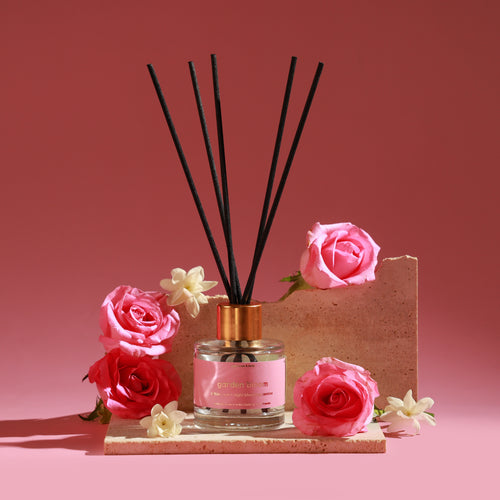
SOSA reed diffusers, five scents
After the cause is dealt with
SOSA reed diffusers From ₹749
This is step four, not step one. Once the room is genuinely clean and dry, a SOSA reed diffuser holds a quiet background scent with no electricity and nothing to operate — 50ml from ₹749 for 6–8 weeks, 130ml from ₹1,249 for 14–18, six fibre reeds included. Composed and made in India, in Pune.

Why a spotless home can still smell closed

Cleaning and smelling clean are different physical problems, and conflating them is the reason this question is so common. Mopping, wiping and dusting remove soil — solid and greasy matter sitting on hard, non-porous surfaces. A smell is not soil. It is volatile organic compounds suspended in the air, arriving there either from a source that is still active or from a material that absorbed them earlier and is now letting them back out. Neither of those lives on your floor. You can therefore have a genuinely immaculate flat that smells closed within two hours of being cleaned, and nothing about that is a failure of effort.

The single biggest variable is air-change rate. A modern Indian flat with the windows and doors shut — especially one running an air conditioner, which recirculates rather than ventilates — exchanges somewhere around 0.2 to 0.5 of its internal air volume per hour. Open two windows on opposite walls and that rises to roughly 3 to 8. In practice five to ten minutes of genuine cross-ventilation moves more air out of your home than the whole previous night. Mopping actually works against you here in one small way: it adds moisture to a closed room, and higher humidity both slows evaporation of what is already there and makes odour molecules easier to perceive. That is why the smell often returns just as the floor finishes drying.

The three places a stale smell actually lives

1
HIDING PLACE ONE · THE AIR
Stagnation, not dirt
SOSA reed diffusersStep fourFrom ₹749If a room is shut all day it is breathing its own air. Everything a household emits — skin lipids oxidising, residual cooking compounds, dust, moisture from breathing and bathing — builds up because nothing is carrying it away. The fix is free and takes ten minutes: open two openings on opposite sides of the home and let air pass through, rather than cracking one window and hoping. Do it in the morning and again in the evening. In a monsoon-humid city do it when the rain pauses, and use a fan to push air out of a window rather than pulling damp air in.
The number: closed, roughly 0.2–0.5 air changes an hour. Cross-ventilated, 3–8. That gap is larger than any product can close.
2
HIDING PLACE TWO · SOFT FURNISHINGS
The reservoir nobody washes
Porous materials absorb odour molecules and release them back into the room slowly, over days. Curtains are the worst offender because they are large, rarely washed, and often hang exactly where cooking air travels. Then upholstery, mattresses, cushion covers, rugs and — in a small flat — clothes left hanging on a chair. This is the mechanism behind the specific complaint that a room "smells of nothing in particular, just closed": you are smelling a slow, mixed re-release from every fabric surface in it. Wash what is washable, air the rest in sunlight where you can, vacuum upholstery rather than only the floor, and strip and wash the bed weekly. Sunlight is genuinely useful here — UV and heat drive off absorbed volatiles faster than airing in shade.
Quick check: press your nose into the curtain, the sofa back and a cushion in turn. One of them will smell distinctly more like the room than the others. That is your reservoir.
3
HIDING PLACE THREE · SOMETHING WET
Small, invisible, and enough on its own
Almost every stubborn household smell that survives cleaning has water somewhere in it. The usual suspects, in rough order of likelihood: a dry P-trap in a bathroom or utility drain that is not used often, so the water seal has evaporated and sewer gas is coming up; the rubber door gasket of a front-loading washing machine, which holds stagnant water and grows biofilm; damp cloths and mops left folded rather than dried; the underside and lid of the kitchen bin; the drip tray under the refrigerator; and the cabinet under the sink, where a slow leak can go unnoticed for months. Each takes minutes to check and any one of them can scent an entire flat on its own.

Symptom to cause: reading your own house

Work down this table until a row matches what you actually notice. The confirmation column matters as much as the cause — guessing wrong here means cleaning the same thing repeatedly and getting the same result.

The diagnosis table
What you notice, what it usually is, and how to be sure
What you notice Most likely cause How to confirm it What actually fixes it
Smell returns within hours of cleaning ★ Air-change rate — the room is not being ventilated, only cleaned Cross-ventilate for ten minutes and re-enter after thirty. If it is gone, this is it. Twice-daily cross-ventilation; a fan pointed out of a window
Room smells "closed" but nothing specific Soft furnishings re-releasing absorbed odour Smell the curtain, sofa back and cushions individually at close range Wash curtains and covers; vacuum upholstery; air in sunlight
Sharp or sour note that comes and goes A wet trap — dry P-trap, washing-machine gasket, bin, damp cloth Follow it at floor and drain level, and run water down every unused drain Pour a mug of water down unused drains weekly; wipe and dry the gasket
Worse in the morning, better by noon Overnight occupancy in a closed room — bodies, bedding, no air exchange Open the bedroom fully for ten minutes on waking and see if it clears Air the bed before making it; ventilate on waking; wash bedding weekly
Worse in humid or rainy weather Moisture raising perceived odour and slowing drying Compare a dry day with a wet one in the same room Dehumidify or ventilate in dry spells; never dry clothes in a closed room
Visible dark patches, or a musty earth smell Mould or a damp ingress — not an odour problem Look behind furniture on external walls, under sinks, at ceiling corners Find the moisture source and remove the growth. Do not fragrance this.
If none of these fit: leave the house for an hour, come back and follow your nose room by room without touching anything. The first room that registers is where to start, and it is very often not the room you assumed.
Shop this guide
Where fragrance comes in — after the work, not instead of it
The SOSA principle
Cleaning treats surfaces. Smell lives in the air, in the fabric, and in something wet.
Which is why a spotless home can smell closed two hours after it was cleaned, and why the answer is rarely another product.

The order of operations

Do these in sequence, because each step makes the next one meaningful. First, find and remove the source. Spend twenty minutes on the wet-trap list: run water down every drain you rarely use, open and wipe the washing-machine gasket, empty and wash the bin including the lid and underside, look under the sink with a torch, and dry every cloth and mop properly rather than folding it damp. If you find something here, most of the problem usually goes with it.

Second, move the air, properly and on a schedule. Cross-ventilation for five to ten minutes twice a day beats any amount of half-measures. Open two openings on opposite sides so air has somewhere to go. If one side is a busy road or the weather is against you, put a fan in the window blowing outwards — that pulls the whole room's air out behind it rather than pushing street air in. In an air-conditioned room, remember the AC is recirculating: it cools, it does not ventilate, and its filter should be washed monthly.

Third, deal with the fabric, which is where the residue actually lives. Wash curtains at least seasonally, bedding weekly, cushion covers monthly. Vacuum upholstery with the brush attachment rather than only vacuuming the floor. Air rugs and mattresses in direct sunlight when the weather allows. Fourth, and only now, add fragrance. At this point the room is neutral, and a scent has something clean to sit on top of rather than something to argue with. For a room that should always smell settled with no effort — an entrance, a bathroom, a hall — a reed diffuser from ₹749 runs continuously on capillary action with no electricity. For a living room where you want scent before people arrive and none at 2am, the Sukoon at ₹1,899 with a Hotel Collection scent from ₹299 gives you a switch. The two are different tools, not competing ones.

Fragrance is an additive layer, not a subtractive one — it never removes anything.
— Sonal Sahani, SOSA

What to do, in order

The first three steps cost nothing and do most of the work. The fourth is the one you buy, and it is genuinely worth buying — but it is fourth for a reason.

The order that works
Four steps, and only one of them is a purchase
Step What to do When Cost
1. Remove the source Run water down unused drains, wipe the washing-machine gasket, wash the bin, check under the sink, dry every cloth Before anything else ₹0
2. Move the air Cross-ventilate ten minutes twice daily — two openings on opposite sides, or a fan blowing outwards Daily, five to ten minutes ₹0
3. Deal with what holds it Wash curtains and covers, vacuum upholstery, air bedding and rugs in sunlight, wash the AC filter monthly Weekly to monthly ₹0
4. Then the always-on layer ★ A SOSA reed diffuser — a continuous background for entrances, halls and bathrooms with nothing to switch or refill 50ml 6-8 weeks · 130ml 14-18 from ₹749
5. Or the on-demand layer Sukoon with a Hotel Collection scent — scent you can run for an hour before guests and switch off afterwards; covers roughly 270–320 sq ft Run it when you want it ₹1,899
Honest notes before you buy: the order above is not padding, it is the whole method. Home fragrance is an additive layer — it puts pleasant molecules into the air, it does not remove unpleasant ones. Scenting over a live odour source gives you both smells at once, which reads worse than the original problem, and it removes the signal that was telling you something needed attention. Three causes in particular are never a fragrance problem: visible or suspected mould, which is a health issue and needs the moisture source found and the growth removed; a drain or sewer smell, which usually means a dry P-trap or a failed seal and is a plumbing job; and a gas-like or burning smell, which should be treated as an emergency, not an odour. Persistent damp in a wall or ceiling is a building fault and needs a professional. Once the room is genuinely clean and dry, SOSA reed diffusers run oil-based fragrance with no electricity, while the Sukoon (₹1,899) runs the water-based Hotel Collection — the two liquids are not interchangeable. Reed fragrance is composed and made in India, in Pune; both are phthalate-free and composed to IFRA standards for home diffusion, not for skin or ingestion. A portion of every order supports girl-child education through Nanhi Kali.
SOSA Sukoon 500ml ultrasonic cool mist diffuser
The on-demand layer
SOSA Sukoon · 500ml ₹1,899
Once the room is clean and dry, the Sukoon at ₹1,899 gives you scent with a switch — run it for an hour before people arrive rather than all day. It takes 3-6 drops of the water-based Hotel Collection (from ₹299) and covers roughly 270-320 sq ft. A reed diffuser is the opposite trade: no switch, no effort, always on.
SS
ISIPCA
Versailles
A note from Sonal

I sell home fragrance, so it would be convenient for me to tell you that a stale-smelling home needs a diffuser. It usually does not. It needs ten minutes of cross-ventilation and a look at whatever in the house is quietly wet. I would rather say that plainly than sell you something that will make the problem smell more complicated without making it better.

The mistake I see most is people scenting over a live source. Fragrance is additive — it puts molecules in, it never takes any out. Lay a lovely blend over a drain smell and your guest does not smell fragrance; they smell both, at once, and that is a worse first impression than the drain on its own. It also hides the signal that was telling you something needed attention.

So: source, air, fabric, then scent. When you get to the fourth step, buy for the room rather than for the bottle — a reed where you want something permanent and effortless, a Sukoon where you want a switch. And do the twenty-minute test honestly, because you genuinely cannot smell your own house. A portion of every order funds a girl's classroom through Nanhi Kali.

Frequently asked questions

Why does my house smell stale even though I clean it every day?
Because cleaning removes soil from hard surfaces, while a stale smell comes from stagnant air and from porous materials re-releasing absorbed odour. A closed flat exchanges only about 0.2–0.5 of its air an hour, so anything emitted into it stays. Ten minutes of cross-ventilation, washing the curtains and bedding, and finding whatever is quietly wet will do more than any amount of additional cleaning.
How do I find the source of a stale smell in my home?
Leave the house for at least thirty minutes so your nose resets, then walk back in and go room by room without touching anything, noting where it registers first. Then check the wet-trap list: unused drains with dry P-traps, the washing-machine gasket, the kitchen bin, damp cloths, under the sink, the fridge drip tray. Then smell curtains, sofa and cushions individually at close range.
Will a reed diffuser or a diffuser get rid of a stale smell?
No — and no home fragrance will, from any brand. Fragrance is additive: it adds pleasant molecules and removes nothing. Over a live source you get both smells together, which is worse than the original. Home fragrance is genuinely good at giving a clean, neutral room a consistent character, which is a real and worthwhile job — but it is the last step, not the first.
Why can I only smell my house when I come back from outside?
Olfactory adaptation. Your nose stops registering a constant, unchanging smell within roughly twenty minutes, because it is built to detect change rather than steady state. This is completely normal and it makes you the least reliable judge of your own home. Use the returning-from-outside moment as your honest measurement, or ask someone who has just arrived.
Should I use a reed diffuser or a Sukoon once the room is clean?
A reed diffuser from ₹749 for rooms that should simply always smell settled — entrances, halls, bathrooms — since it runs continuously with no electricity and nothing to operate. The Sukoon at ₹1,899 for a living room or bedroom where you want scent on demand and silence the rest of the time; it takes 3–6 drops of the water-based Hotel Collection from ₹299 and covers roughly 270–320 sq ft. The two liquids are not interchangeable.
After the cause is dealt with
Fix the smell first — then give the room a character
SOSA reed diffusers composed and made in Pune, 50ml from ₹749 for 6–8 weeks or 130ml from ₹1,249 for 14–18, six fibre reeds included. Or the Sukoon at ₹1,899 with a Hotel Collection scent from ₹299 when you want a switch rather than something always on. Neither removes an odour — that is what the first three steps are for. A portion of every order supports girl-child education through Nanhi Kali.
Shop SOSA reed diffusers → See the Sukoon ₹1,899
Continue the read
More on diagnosing a home smell
Editorial standards & sources
About this guide: Written by Sonal Sahani, ISIPCA Versailles-trained founder and perfumer at SOSA Home & Body. Odour diagnosis here is general building and household guidance, not a substitute for a plumber, an electrician or a damp specialist where one is needed. Fragrance longevity and coverage figures are SOSA's own for the stated products; the underlying principles — sorption into soft materials, air-change rate and olfactory adaptation — are general.

SOSA products & prices (verified August 2026): Hotel Collection water-based ultrasonic diffuser fragrance 15ml ₹299 · 100ml ₹999 · 300ml ₹1,799 · Pack of 7 (15ml, all fragrances) ₹1,799; refills 100ml from ₹999. Seven scents: The Ritz-Carlton-inspired (white tea · bergamot · cedar), Westin-inspired (white tea · aloe · cedar), 1 Hotels-inspired (cedarwood · vetiver · green leaves), The St. Regis-inspired (amber · violet · woods), Shangri-La-inspired (jasmine · green tea · white tea), Four Seasons-inspired (citrus · floral · sandalwood), W Hotels-inspired (citrus · pepper · amber). Diffusers: Boond 300ml ₹899 · Sukoon 500ml ₹1,899 · Megh 6L ₹3,499. Water-based, phthalate-free, composed to IFRA standards for home diffusion; 3–6 drops per tank. Made in India, Pune. The Hotel Collection scents are SOSA's own interpretations inspired by the world's finest hotels; all hotel names are trademarks of their respective owners and are used only to describe the scent style — SOSA is an independent Indian fragrance house, not affiliated with or endorsed by any hotel brand. Prices and availability subject to change — see the live product pages.
Retour au blog