



What the room does with it: almost nothing. A shut bedroom exchanges roughly 0.2–0.5 of its air an hour and the AC does not change that number at all.
What holds it: the bed. Several square metres of absorbent textile in contact with two bodies for a third of every day, absorbing and slowly re-releasing.
2. Because carbon dioxide is the honest proxy, even though it has no smell. CO2 itself is odourless. What makes it useful is that it rises on exactly the same curve as everything else two occupants are emitting, so a room that feels stuffy is a room where CO2 has climbed and everything alongside it has climbed too. This is why "stuffy" and "smells different" are the same complaint described two ways, and why the fix for both is the same: exchange the air.
3. Because the AC has been drying the air, not the bedding. The evaporator coil pulls moisture out of the air that passes over it, which is why it drips. It does not reach into the duvet you are lying under, where breath and body moisture have been accumulating all night against a warm body. That is why a bed can feel faintly damp in the morning in a room that is measurably dry, and why a made bed keeps that moisture sealed in the fabric for the rest of the day.
4. Because bedding is the largest fabric reservoir in the flat. Porous materials absorb odour molecules and release them slowly over days. A double bed is several square metres of sheet, pillowcase, duvet and mattress in continuous contact with two bodies for a third of every day — nothing else in the home comes close. Skin lipids transferred to a pillowcase oxidise into the specific flat note most people identify as "morning bedroom", and washing weekly changes that more than anything else on this list.
5. And you are the least reliable judge of it. Olfactory adaptation is essentially complete within twenty minutes, and you were in that room for eight hours. Your morning nose is reporting nothing useful. Step out for half an hour and judge the first breath on your return. Once the room is aired and the bed is clean, a reed diffuser or a Sukoon gives the bedroom a character — lightly, because a sealed cooled room does not flush anything out.
Made in India, composed by an ISIPCA Versailles-trained perfumer — and a portion of every order supports girl-child education through Nanhi Kali.
What a sealed, cooled room accumulates over a night
It helps to stop thinking of the bedroom as a place and start thinking of it as a container with an input and almost no output. The inputs run all night: carbon dioxide and water vapour from two sets of lungs, moisture and lipids from skin, whatever is evaporating off hair products and night creams, and a slow contribution from every textile in the room. The output is one number — the air-change rate — and in a shut Indian bedroom it sits at roughly 0.2 to 0.5 changes an hour, meaning the air is replaced somewhere between once every two hours and once every five. Over eight hours, with the door shut, that is nowhere near enough to keep up with two people. Open two windows on opposite sides and the rate jumps to something like 3 to 8 changes an hour, which is the whole difference.
The air conditioner sits oddly in this picture because it is doing real work that feels like ventilation and is not. It removes heat and it removes moisture from the air passing over its coil, both of which make the room more comfortable. It introduces no outside air whatsoever — the indoor and outdoor units are joined by refrigerant pipes, not by a duct. There is also a perception effect worth knowing. Cold air suppresses volatility, so while the room is at 19°C you register less of what is in it. As the unit cycles down towards morning and the room warms, the same molecules become easier to smell. The room did not deteriorate at 6am; it simply became warm enough for you to notice eight hours of accumulation all at once.
The three loads, and which one is yours
 Step fourFrom ₹799The largest contributor and the cheapest to fix. Two adults breathing for eight hours into a room turning over a fifth to a half of its air per hour produces a measurably different atmosphere by morning, and doubling the occupancy doubles the load without changing the volume. Ten minutes of genuine cross-ventilation on waking displaces more air than the entire night of cooling did. Two openings on opposite sides, so air has an entrance and an exit — a single cracked window achieves very little, because there is nowhere for the air to go.
Symptom to cause: reading eight hours of occupancy
The useful split is between a smell that is simply flat and one with a definite character. Flat is almost always air exchange. A character — musty, sour, damp — has a specific source.
| What you notice | Most likely cause | How to confirm it | What actually fixes it |
|---|---|---|---|
| Flat and stuffy, clears within minutes of opening up ★ | Occupancy load in a room that exchanged almost no air for eight hours | Open two openings on opposite sides for ten minutes and re-enter after thirty | Ten minutes of cross-ventilation on waking and again before bed |
| Started when a second person began sleeping in the room | Doubled emission into an unchanged volume with an unchanged air-change rate | Compare a night alone with a night with two, everything else identical | Air on waking; wash bedding weekly rather than fortnightly; consider dry mode |
| Concentrated in the bed rather than the room | Skin lipids oxidising on the pillowcase and moisture held in the duvet | Press your face into your pillow, then into a fresh pillowcase from the cupboard | Weekly sheets, monthly protectors, duvet thrown back instead of the bed made |
| Specifically musty or sock-like, worse when the compressor engages | Biofilm on the wet evaporator coil being pushed out by the blower | Run fan-only for two minutes, then cooling for two, and compare the two | Wash the filters; jet clean the coil before the season; fan-dry before shutdown |
| Fine at 2am, obvious in the last hour before waking | The room warming as the unit cycles down, making accumulated molecules easier to perceive | Note the room temperature at the moment it becomes noticeable | Air on waking; deal with the bedding, which is what the warmth is revealing |
| Earthy or cellar-like, with dark speckling behind the headboard | Mould on a cold external wall — a health issue, not an odour problem | Pull the bed away from the wall and check the plaster behind it with a torch | Find the moisture source and remove the growth. Do not fragrance this. |
| If none of these fit: sleep one night with the window open and the AC off, and one night sealed and cooled, and compare the two mornings honestly. Two nights of data separates occupancy from the machine faster than any amount of speculation. | |||
Reeds · always-on roomsFrom ₹749Shop →  Sukoon · when you want a switch₹1,899Shop →
  Hotel Collection · the scentFrom ₹299Shop →
The night-and-morning routine
Before bed, reduce what the room has to hold. Air it for ten minutes with two openings on opposite sides before you shut everything and switch the AC on — starting from clean air is worth more than it sounds when nothing will be exchanged for the next eight hours. Get worn clothes off the chair and into a basket, because they are a fabric reservoir like any other. And if the weather is humid, run the unit in dry mode for part of the night, which pulls more moisture out of the air and slows everything down.
On waking, open the room before you make it tidy. Window and door, ten minutes, air moving through rather than sitting still; a fan in the window blowing outwards if the weather or the street is against you. Throw the duvet right back and leave the bed open the whole time, so the night's moisture leaves the fabric instead of being sealed in by a neatly made bed. This is the single highest-yield thing on the page and it costs nothing at all.
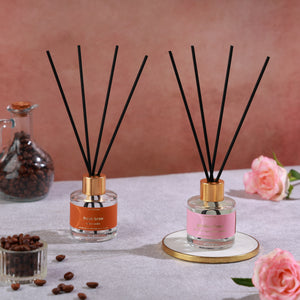
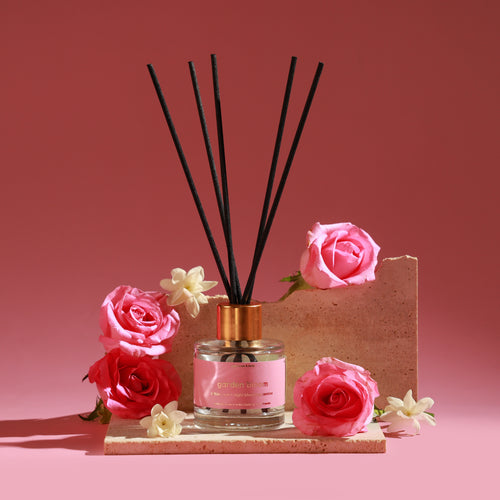
Then the weekly and monthly work, and only then the scent. Sheets and pillowcases weekly; pillow protectors monthly; the mattress into direct sunlight when you can manage it. AC filters washed monthly and dried fully before refitting, with ten minutes of fan-only before every shutdown so the coil dries. Once that is all in place, the room is neutral and worth giving a character to. A reed diffuser from ₹749 runs continuously with no electricity — use four reeds rather than six, because a sealed cooled room accumulates rather than flushes, and Evening Calm, Kashmir lavender and chamomile, suits a bedroom better than anything bright. If you would rather nothing ran while you slept, the Sukoon at ₹1,899 with three drops of a Hotel Collection scent from ₹299 gives you an hour before bed and then silence.
The order that works
Everything that matters most here is free and takes ten minutes twice a day. The purchase is fourth, and it is a small one.
| Step | What to do | When | Cost |
|---|---|---|---|
| 1. Remove the source | Wash the AC filters monthly, dry the coil with ten minutes of fan-only before shutdown, check the drain runs outside | Before anything else | ₹0 |
| 2. Move the air | Ten minutes of cross-ventilation before bed and again on waking — the AC exchanges no outside air at all | Daily, five to ten minutes | ₹0 |
| 3. Deal with what holds it | Weekly sheets, monthly protectors, duvet thrown back rather than the bed made, mattress aired in sunlight | Weekly to monthly | ₹0 |
| 4. Then the always-on layer ★ | A SOSA reed diffuser — a quiet overnight background for two people in a cooled bedroom — four reeds, away from the vent | 50ml 6-8 weeks · 130ml 14-18 | from ₹749 |
| 5. Or the on-demand layer | Sukoon with a Hotel Collection scent — an hour of scent before bed and nothing running while you sleep; three drops is plenty | Run it when you want it | ₹1,899 |
Versailles
This question usually arrives with a slight edge of embarrassment, as though a bedroom that smells of having been slept in is a personal failing. It is not. It is two people, eight hours and an air-change rate of about a third. The room is doing exactly what a sealed container does with a continuous input. The answer is not to clean harder or to buy something stronger; it is to open two windows for ten minutes and to stop making the bed the second you get out of it.
The bedding is the part people underestimate. It is the largest area of absorbent fabric most flats contain, and it spends a third of every day in direct contact with skin. Washed weekly and left open to dry each morning, it stops being a reservoir and becomes just bedding. Washed fortnightly and made immediately, it holds the previous night and hands it back to you the next one.
When you get to the fragrance step, be light-handed. An air-conditioned bedroom is sealed and cool: cool slows evaporation from the reeds, sealed means whatever does evaporate stays. Four reeds of something quiet is plenty for a room you sleep in, placed away from the vent. And do the honest test — leave for half an hour and judge the first breath back, because you cannot smell your own bedroom after eight hours in it. A portion of every order funds a girl's classroom through Nanhi Kali.
Frequently asked questions
- Why does my AC room smell stale in the morning? — a night of recirculation with no fresh air.
- After two people sleep in it all night — the occupancy load in detail.
- Why pillows and bedding change how a bedroom smells — the largest fabric load in the house.
- Fragrancing an AC bedroom after the fix — why a cool room needs less, not more.
- Brand: the SOSA founder story.
SOSA products & prices (verified August 2026): Hotel Collection water-based ultrasonic diffuser fragrance 15ml ₹299 · 100ml ₹999 · 300ml ₹1,799 · Pack of 7 (15ml, all fragrances) ₹1,799; refills 100ml from ₹999. Seven scents: The Ritz-Carlton-inspired (white tea · bergamot · cedar), Westin-inspired (white tea · aloe · cedar), 1 Hotels-inspired (cedarwood · vetiver · green leaves), The St. Regis-inspired (amber · violet · woods), Shangri-La-inspired (jasmine · green tea · white tea), Four Seasons-inspired (citrus · floral · sandalwood), W Hotels-inspired (citrus · pepper · amber). Diffusers: Boond 300ml ₹899 · Sukoon 500ml ₹1,899 · Megh 6L ₹3,499. Water-based, phthalate-free, composed to IFRA standards for home diffusion; 3–6 drops per tank. Made in India, Pune. The Hotel Collection scents are SOSA's own interpretations inspired by the world's finest hotels; all hotel names are trademarks of their respective owners and are used only to describe the scent style — SOSA is an independent Indian fragrance house, not affiliated with or endorsed by any hotel brand. Prices and availability subject to change — see the live product pages.