


Why an old club is often worse ventilated than a new one: it was built to be ventilated by its windows. When those were sealed and split coolers were retrofitted, the building gained cooling and lost its fresh-air provision entirely, because a recirculating unit cools the same air rather than replacing it.
What actually holds odour: in order of how much they hold and how long they hold it — carpet underlay, deep upholstery, layered curtains, then carpet pile, felt and baize, then paper and book cloth, then timber and its finish. The underlay is the one nobody inspects and the one that holds most.
The order of work: source → moisture → ventilation and air change → cleaning → only then fragrance. On an old property expect this to take weeks rather than days, because the mass has to be brought to a new equilibrium and it will keep releasing while you work.
The honest gap: SOSA sells no air purifier and no dehumidifier and makes no air-quality claim; nothing in the range removes an odour, because fragrance adds fragrance. Separately, no purchasable refill oil is listed for the waterless commercial machines — that fragrance is specified and quoted per property through the contact page.
2. The loading never stopped, so the level is an equilibrium rather than a history. This is the part that surprises committees. The smell is not a fossil from the nineteen-sixties. Every evening of service adds to the store, and the store loses material only as fast as ventilation and cleaning remove it. Where removal is slower than loading, the equilibrium level rises year after year until it is noticeable, and then it stays noticeable. That is why a club can be immaculate, freshly painted, with new curtains in the lounge, and still smell exactly as it did before the refurbishment — because the underlay was not lifted and the air change was not altered.
3. Low air change is usually the binding constraint, and in an old building it is often self-inflicted. These properties were designed to ventilate through their windows: high ceilings, cross-ventilation, deep verandahs, fanlights above doors. Over the decades the windows were sealed for cooling, the fanlights were boarded, and split coolers were fitted room by room. A split unit cools the air in the room and returns it to the room. It is not a ventilation system and it introduces no outside air at all. So the building lost the ventilation it was designed around and gained a machine that makes the same air colder, which does nothing whatever to the store in the carpet.
4. Intermittent occupancy concentrates the problem into specific rooms. A closed door is a real boundary. The card room used on Tuesdays and Fridays, the committee room used monthly, the two function rooms used for weddings and the old billiards room nobody has a purpose for are each sealed volumes holding their own microclimate for days at a time. They are almost never included in a morning purge, they are frequently on no mechanical ventilation whatever, and they are usually the rooms with the highest fabric content in the building. Ask any long-standing member which room in the club smells oldest and they will name one of those four without hesitating.
5. Fragrance is genuinely last here, and on an old property the gap between last and first is weeks. The order is source, moisture, ventilation and air change, cleaning, and only then fragrance — and I say that knowing it delays a sale by a season. Fragrance laid over a musty building produces a mixture, and a mixture of a pleasant odour and an unpleasant one is reliably judged worse than the unpleasant one alone, because it reads as concealment rather than as cleanliness. Once the building underneath is in order, waterless cold-air nebulising is the right mechanism — Vaayu ₹11,999 for a zone, Aangan ₹25,999 where there is real air handling to connect into. Alcohol-free, phthalate-free, IFRA-compliant, composed in Pune, and a portion of every order supports girl-child education through Nanhi Kali.

The sponge that keeps charging
The most useful mental model I can give a house committee is a sponge in a sink. Material goes in whenever the club is used. Material comes out whenever air moves through the building or a cleaner removes it. The smell in the room is not the history of the club; it is the current level in the sponge, and that level is set by the ratio of loading to removal. This is why the two interventions that reliably work are not glamorous — reduce what goes in, increase what comes out — and why the intervention that does not work is adding something pleasant on top. Below are the three structural facts about an old club that keep that ratio in the wrong place.
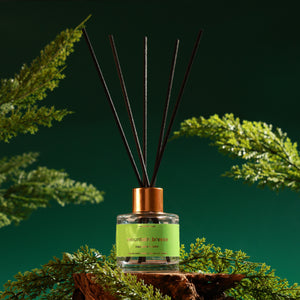
 Mountain Breeze₹849When a club refurbishes, it replaces what members can see. New carpet is laid, curtains are remade, walls are painted, chairs are recovered. What survives almost every refurbishment is the underlay, the stuffing inside the older chairs, and the felt or baize on the tables. The underlay is the deepest store in the building, it is directly beneath the pile that everything lands on, and it is the one layer that has never in living memory been lifted, dried or replaced. Recovering a chair over its original stuffing is the same problem in miniature: the new fabric is clean and the store beneath it is untouched, which is why a lounge can smell exactly as it did the month before a substantial refurbishment and why the committee that paid for the refurbishment finds this so difficult to accept. Ask the question directly at your next meeting: when was the underlay last lifted, and has it ever been dried after a monsoon. In most clubs the honest answer is that nobody knows.
 Aangan₹25,999A closed door is a genuine boundary for air and therefore for smell. Two rooms with a door between them are two separate volumes with separate microclimates; an open plan of the same total area is one volume however irregular its shape. In an old club that boundary works against you, because the rooms with the most fabric in them are also the rooms that are shut most of the time. The card room, the committee room, the old billiards room, the function suite used a dozen times a year: each sits closed for days, at whatever temperature and moisture level it settled to, with a deep store releasing into still air and nothing carrying the result away. Then it is opened on a Friday evening, forty people use it, and it is shut again. The loading is intermittent but the removal is close to zero, so the level in those rooms is the highest in the building. Two free interventions change this more than any purchase: prop those doors open whenever the plant runs, and include them explicitly in the morning routine rather than treating them as out of use.
Vaayu₹11,999Every store in the building behaves differently wet and dry, and an old property has more routes for water than a new one: solid walls without a modern damp course, flat roof repairs over a century of alterations, plant rooms below ground, condensate from a dozen split units running to wherever the fitter found a fall, and a monsoon that arrives annually whether the carpets were dried after the last one or not. A damp underlay is a deeper store than a dry one and a slower one, so the same club smells markedly worse in some months than others even though nothing about its furniture has changed. Before anybody considers fragrance, find where the water is: the wall behind the bookcase, the corner of the function room that is always cold, the plant room under the stairs, the gully that cannot be seen from a standing position. And separately, check every water seal in the building, because in a property with a dozen little-used cloakrooms a dried trap is close to certain and it produces a low sour note that everybody confidently misdescribes as damp.
Aangan₹25,999A closed door is a genuine boundary for air and therefore for smell. Two rooms with a door between them are two separate volumes with separate microclimates; an open plan of the same total area is one volume however irregular its shape. In an old club that boundary works against you, because the rooms with the most fabric in them are also the rooms that are shut most of the time. The card room, the committee room, the old billiards room, the function suite used a dozen times a year: each sits closed for days, at whatever temperature and moisture level it settled to, with a deep store releasing into still air and nothing carrying the result away. Then it is opened on a Friday evening, forty people use it, and it is shut again. The loading is intermittent but the removal is close to zero, so the level in those rooms is the highest in the building. Two free interventions change this more than any purchase: prop those doors open whenever the plant runs, and include them explicitly in the morning routine rather than treating them as out of use.
Vaayu₹11,999Every store in the building behaves differently wet and dry, and an old property has more routes for water than a new one: solid walls without a modern damp course, flat roof repairs over a century of alterations, plant rooms below ground, condensate from a dozen split units running to wherever the fitter found a fall, and a monsoon that arrives annually whether the carpets were dried after the last one or not. A damp underlay is a deeper store than a dry one and a slower one, so the same club smells markedly worse in some months than others even though nothing about its furniture has changed. Before anybody considers fragrance, find where the water is: the wall behind the bookcase, the corner of the function room that is always cold, the plant room under the stairs, the gully that cannot be seen from a standing position. And separately, check every water seal in the building, because in a property with a dozen little-used cloakrooms a dried trap is close to certain and it produces a low sour note that everybody confidently misdescribes as damp.
Why an old club often ventilates worse than a new one
This is the single most counter-intuitive point in the subject and the one that changes the most decisions, so it is worth stating carefully. An old club was designed as a naturally ventilated building. Its high ceilings, tall shuttered windows, fanlights over the doors, cross-ventilated plans and deep shaded verandahs were the ventilation system, and they worked continuously without anybody operating them. Over the following decades almost every such property did the same three things: sealed or fixed the windows to make cooling viable, boarded or glazed the fanlights, and fitted split coolers room by room as budget allowed. The result is a building that has lost the ventilation it was designed around and gained a machine that recirculates. A split unit cools the air in the room and gives it back to the room; it introduces no outside air whatever. A modern club with a central air handling unit and a fresh-air duct is, on this one measure, better provided for than a nineteenth-century club with beautiful proportions.
What follows from that is a set of questions rather than a purchase. Does any part of the property have a genuine fresh-air provision, and if so which rooms does it actually serve? Can the fanlights be reopened, which in a heritage building is often both the cheapest and the most sympathetic intervention available. Can the windows in the rooms that still have working sashes be opened for an hour every morning as a written instruction rather than at the discretion of whoever is on duty. Is there an extract anywhere other than the kitchen and the cloakrooms. And where the building does have air handling, is it running on recirculation to save energy, because recirculation moves the accumulation around the property rather than out of it. Those five questions have cost a club nothing and they will change its smell more than any machine on this page.
There is a perceptual consequence too, and it is one an old club should think about before it commissions anything. Air that leaves takes the fragrance with it. A sealed, poorly ventilated club accumulates fragrance just as it accumulates everything else, so a setting that seemed right on the day of installation becomes heavy within a fortnight and members start describing the lounge as stuffy rather than as strongly scented, which is worse because you cannot act on it. Conversely, once you have improved the air change, the same machine at the same setting will read lighter, because the building is now removing fragrance faster than it did. The same machine behaves oppositely in the two conditions. This is why fragrance has to come after ventilation in the order of work and not alongside it: commission a fragrance into a building whose air change you are about to change and you will have specified a setting for a building that no longer exists.
What holds odour, and for how long
This is the table I put in front of a house committee when the discussion turns to what to clean and in what order. It is organised by depth of store rather than by room, because the budget question is which material to spend on, and the answer is almost never the material members can see. The last row is the one the committee will want to argue about, and it is in the table precisely for that reason.
| Material | How deep a store it is | How long it keeps releasing | What the cleaning cycle should be |
|---|---|---|---|
| Carpet underlay ★ | The deepest in the building, and the least inspected | Effectively indefinitely, and far longer when damp | Lift it, dry it, replace it on refurbishment — never carpet over it |
| Deep upholstery and original stuffing | Very deep, especially under recovered fabric | Months to years, releasing continuously | Strip rather than recover, or accept that recovering changes only the surface |
| Layered curtains, pelmets, blackout linings | Deep, and usually cleaned least often of anything in the room | Weeks to months after each loading | On a written annual cycle, linings included, and dried properly |
| Carpet pile, rugs, runners | Moderate, but it is where everything lands first | Days to weeks, with cooking aerosols at the long end | Deep clean and full drying on a stated cycle; vacuum after the morning purge |
| Felt, baize, acoustic fabric, table linen | Moderate and very exposed | Days, which is why the card room reads as the oldest room | Frequent, and never stored damp |
| Paper, book cloth, bound volumes | Shallow individually, considerable in a library wall | Continuous and slow — and in a heritage library this is character, not a fault | Air and stable moisture, not cleaning. Do not scent the library |
| Timber panelling, joinery, parquet, finishes | Shallow at the surface, but very large in area | Slow and low-level; contributes the dry part of an old club’s character | Maintain the finish; this is the part worth protecting |
| Fragrance | Not a store and not a remedy | It adds fragrance. It removes nothing at all | Specify it last, after the four steps above — Vaayu ₹11,999 onwards |
Zone · Vaayu₹11,999See it → Air system · Aangan₹25,999See it → Larger property · Meenar₹38,500See it →
Why commissioning an old building takes weeks, not days
Here is the practical consequence of everything above, and it is the point at which most club projects go wrong. In a new building with hard surfaces you can set a machine on a Monday and judge it on a Wednesday, because the room has almost no store and reaches its new state quickly. In an old club the soft mass has to be brought to a new equilibrium, and that takes weeks in both directions. After a deep clean and a change to the air change, the building keeps releasing for weeks as the stores unload, so the improvement arrives gradually and a committee that inspects on day three will conclude that nothing has happened. Then, when fragrance is finally introduced, the same stores begin taking that up as well; the carpet and the upholstery absorb the new composition and start returning it, so the perceived level in the room continues to rise for weeks after the setting stopped changing.
Two errors follow from ignoring this, and between them they account for most of the complaint files I have read. The first is turning the intensity up in week one. The room is quiet on day two, so somebody raises the setting; by week four the stores have charged and the lounge is heavy, at which point the same person lowers it, the stores unload slowly against the lower setting, and the building spends a season oscillating. The fix is procedural rather than technical: set the intensity once, write the setting down on a sheet with a date, turn the key-lock, and refuse to change it for a full month. The second error is judging it from inside the building. Anybody who has been in the club since seven in the morning has stopped reporting the fragrance long before opening, while it carries on arriving exactly as before; the person holding the dial is the one person in the property who cannot assess it. Walk in from the car park, take a member with you, and write one line a week for four weeks.
There is a composition consequence as well, which matters more in an old club than anywhere else. A fragrance dosed very low is mostly its heart and its base, because top notes are the first thing lost, so a composition chosen at full strength on a blotter across a committee table can be unrecognisable at the level a heritage lounge should actually run at. Dry, structured registers — cedar, vetiver, tea, bergamot — keep their outline when they are quiet. Sweet and powdery registers lose their shape and read as a vague smell of perfume, which in a room that also has a faint residual weight to it is the worst available outcome. That is the perfumery reason, quite apart from the heritage one, that an old club should be scented drier and quieter than its committee expects. For the waterless commercial machines the fragrance itself is specified and quoted per property rather than bought from a shelf, and for an old building that is an advantage: the composition can be chosen for the level it will actually run at, in that building, rather than for how it performs in a bottle.
The order of work, and the two gaps
This is the sequence I would put in a committee paper for an old property, with the price against each line. The first four lines are building work and cleaning, not fragrance, and they are where the result comes from. The last row is the pair of things this range does not contain; both of them come up in every first conversation, so they belong in the table rather than in a footnote.
| Step | What it is | Why it comes here in the order | Cost |
|---|---|---|---|
| 1. Find the sources ★ | Every dried water seal, the damp wall behind the bookcase, the plant room, the condensate runs, the waste bay | Because one open gully or one wet corner will defeat everything else you spend, and both are invisible from a standing position | No purchase |
| 2. Deal with the moisture | Dry the underlay and upholstery properly, get the water ingress fixed, deal with condensate, dry after every monsoon as a routine | Damp material is a deeper and slower store than dry material, which is why the same club smells worse in some months than others | Building and drying works |
| 3. Raise the air change | A genuine fresh-air provision rather than more cooling; fanlights and sashes reopened; full fresh air before opening; closed rooms propped open while the plant runs | Usually the binding constraint, and in a retrofitted old building the one that has quietly been removed | Mostly no purchase |
| 4. Clean the absorbent mass | Underlay lifted, upholstery stripped rather than recovered, curtain linings included, felt and baize on a stated cycle | This is the reservoir. Until it is emptied the building will keep handing decades back, whatever is installed on top | A cleaning contract |
| 5. Only then, fragrance | Vaayu at the arrival zone, dry and quiet, set once, written down, key-locked, and left alone for a month | Because fragrance on a clean old building reads as care, and fragrance on a musty one reads as concealment — and because the stores take weeks to settle | ₹11,999 |
| Two honest gaps: what SOSA does not sell you | SOSA sells no air purifier and no dehumidifier, makes no health, air-quality or VOC claim, and nothing in the range removes an odour — fragrance adds fragrance. Separately, no purchasable refill oil is listed for the waterless commercial machines; that fragrance is specified and quoted per property | Said plainly, because a house committee will check both, and because on an old property the first four steps are worth more than the fifth | Quoted |
Versailles
The oldest club I have worked in had just finished a refurbishment it was rightly proud of, and the complaint that arrived two months later was that the building smelled exactly as it had before. New carpet in the lounge. New curtains. Chairs recovered in a beautiful dull green. Walls repainted. And the same closed weight in the room at four in the afternoon that had been there for years.
Nothing had gone wrong with the refurbishment. The underlay had been left in place beneath the new carpet, the chairs had been recovered over their original stuffing, the curtain linings had been reused behind new face fabric, and the fanlights over the corridor doors had been boarded in the nineteen-seventies and stayed boarded. Every visible thing had been replaced and every store had been kept. When we eventually lifted a corner of the carpet in the bay window, the underlay beneath it had been damp for long enough to have taken the shape of the boards.
What changed that building was a drying contract, new underlay, four fanlights reopened, and a written instruction that the card room door stayed propped whenever the plant ran. We put a single zone unit at the arrival threshold four months later, dry and low and nowhere near the library, and the general manager set it once and turned the key-lock. I would rather tell a club that story and lose a season of the sale than take an order in month one, because a machine installed into a musty old building does not solve the problem; it hides it just well enough that nobody looks under the carpet for another five years. And the part of the smell that is timber, paper and a century of polish should never be touched at all. That is not a fault to be corrected. It is the thing your members are members for. Everything we make is composed in Pune, and a part of every order funds a girl’s classroom through Nanhi Kali.
Frequently asked questions
- What to fix first — the family pillar: the whole ordered checklist, with fragrance as the last line.
- Why it is worst at opening and why the monsoon makes it worse — the overnight purge, and relative humidity.
- What carpets, leather, curtains and wood actually hold — material by material, with the consequence for cleaning cycles.
- Why the lounge changes by evening — the day’s load, and where it goes.
- Why the reed works at the desk but not across the lobby and why ten of them still fail — the passive mechanism, at club scale.
- Why a spray vanishes in a lobby and stronger fragrance or better diffusion — an event versus a system, and a free test.
- Brand: the SOSA founder story.
SOSA commercial scenting — facts verified August 2026: Vaayu ₹11,999, waterless cold-air nebulising, coverage up to 1000 m³ ≈ 2,000–3,000 sq ft, 400ml refillable sealed tank lasting up to about 90+ days depending on intensity and hours, Bluetooth app plus onboard buttons, run windows of 1h / 4h / 8h / 24h, day selection, adjustable intensity, auto-stop and key-lock, under 38 dB, freestanding, wall-mounted or HVAC-return mounting, DC 12V / 1A at 5W, CE, RoHS and SGS, black and white. Aangan ₹25,999, HVAC or AHU connection or standalone wall-mount or lay-flat, coverage up to 3,000 m³ ≈ 8,000–10,000 sq ft, 800ml reservoir, under 42 dB, DC 12V at 14W, intelligent PCB with programmable work and pause cycles and daily schedules, metal body 3.9 kg at 284 × 125 × 246 mm, black or white, one-year warranty, imported; it has no app and no Bluetooth, and no certifications are published for it. Meenar ₹38,500 is the larger-property option and is specified on enquiry; no coverage figure is published for it here. Ultrasonic machines: Sukoon ₹1,899 at 270–320 sq ft, Boond ₹899 at up to about 150 sq ft, Megh ₹3,499 with a six-litre tank and around 100 hours of runtime but only about 215 sq ft of coverage. Reed diffusers ₹749–₹849 for 50ml lasting 6–8 weeks and ₹1,249–₹1,349 for 130ml lasting 14–18 weeks, six fibre reeds, alcohol-free, phthalate-free, paraben-free, IFRA-compliant, 0 ppm formaldehyde, heat-stable CCT carrier, refillable glass bottle, tested at 45°C and 85% RH, composed in Pune. The Hotel Collection fragrance oils are water-based and ultrasonic-only at 15ml ₹299, 100ml ₹999 and 300ml ₹1,799; they are not for reed diffusers and not for the waterless commercial machines. No purchasable refill oil is listed for the waterless commercial machines — that fragrance is specified and quoted per property. SOSA publishes no leather fragrance in any format and no tobacco or smoky fragrance for any diffuser. SOSA sells no air purifier, no dehumidifier and no room spray for interiors, and makes no health, air-quality, VOC or mould claim. No dealer programme, reseller margin, trade price, territory or service contract is published. Free shipping above ₹499. A portion of every order supports girl-child education through Nanhi Kali. SOSA is an independent Indian fragrance house; the Hotel Collection scents are SOSA’s own interpretations inspired by the world’s finest hotels, and SOSA is not affiliated with or endorsed by any hotel brand. Prices subject to change — see the live product pages.