
- The direct, honest answer
- What a warm gourmand gives you, and where that warmth lives here instead
- The three decisions before you buy
- Warmth, without sugar, across this range
- How to test whether saffron-and-oudh warmth is enough
- What to buy, sized for a first honest test
- A note from Sonal
- Questions from readers who love warm gourmands
2. What a warm gourmand actually gives you is richness and roundness, more than sugar itself. The best warm gourmands feel enveloping and cosy — a sense of density and comfort that happens to arrive via sweetness in a gourmand, but doesn't have to. Named that way, richness and roundness are qualities this range can genuinely deliver.
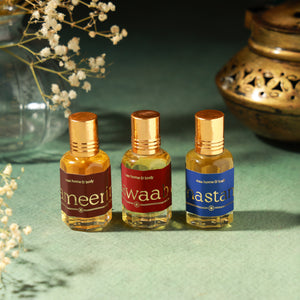
3. Ameeri builds that richness from Persian saffron and soft oudh instead of sugar. Saffron brings a warm, slightly spiced intensity; soft oudh brings depth and resin. Together with Taif rose and Indian sandalwood, they create a warmth that reads as full and comforting without a single sugared material anywhere in the blend.
4. Be direct about the trade: SOSA's attar range carries no vanilla, no gourmand and no coffee note. What Ameeri shares with a warm gourmand favourite is the warmth and the softness, not the sugar — a spice-and-resin richness standing in for a sugared one, honestly described rather than dressed up as the real thing.
5. A 3 ml bottle at ₹385 is the right-sized way to test whether that spice-and-resin warmth satisfies the same craving. Some warm-gourmand lovers find saffron and soft oudh genuinely rich enough on their own; others discover the sugar itself was doing more of the work than they realised, and that's worth learning at ₹385 rather than guessing.
This isn't a post that calls a saffron-and-oudh attar a gourmand to close a sale — it's one that shows you exactly where the same warmth comes from when sugar isn't part of the formula.
What a warm gourmand gives you, and where that warmth lives here instead
A warm gourmand — think vanilla and amber, tonka and spice, praline and musk — is built to feel enveloping. The sweetness is one part of that effect, but a lot of the actual comfort comes from density and roundness: these fragrances rarely feel thin or sharp, and they tend to sit close and full on the skin rather than projecting outward in a bright line. That density is a real, separable quality from the sugar itself, even though the two usually arrive together in a gourmand's formula.
This range gets to that same density from a completely different direction. Persian saffron is a genuinely warm, slightly bitter-sweet spice material — it doesn't taste like sugar, but it carries real intensity and richness in the same emotional register a gourmand's spice notes occupy. Soft oudh adds resin and depth underneath it, doing some of the same 'enveloping' work a gourmand's amber base does, without a trace of the actual sweetness. Layered with Taif rose and Indian sandalwood in Ameeri, the result is a full, warm, rounded composition that a gourmand lover can recognise the shape of, even though none of the individual materials match.
The honest limit is worth stating clearly: this is spice-and-resin warmth, not sugared warmth. If what you love about warm gourmands is specifically their edible sweetness, saffron and oudh will not reproduce that, and no amount of good writing changes the chemistry. But if what you love is the richness, the density, the sense of a fragrance that wraps around you rather than sitting on the surface — that's exactly what Ameeri is built to do, sourced honestly from spice and resin rather than sugar. It's worth adding that this substitution runs both ways in perfumery generally: plenty of niche houses build 'gourmand-adjacent' fragrances around amber, resin and spice with no actual food material in them at all, precisely because density and warmth were always separable from sugar to begin with. Ameeri sits in that same honest tradition — it was never trying to be a gourmand, it was built to be warm on its own terms.
The three decisions before you buy
 Ameeri₹385If you love warm gourmands mainly for how dense and enveloping they feel, Ameeri's saffron-and-oudh richness is a genuine match. If it's specifically the sugar you're chasing, no attar in a range with no gourmand materials will satisfy that.
Warmth, without sugar, across this range
None of these four attars is a gourmand — this table is about which ones deliver richness and density through spice and resin, and which ones don't.
| Attar | Source of richness | How it reads | Verdict for a warm-gourmand lover |
| Ameeri | Persian saffron, soft oudh, Taif rose, Indian sandalwood | Warm, dense and rounded — spiced and resinous rather than sugared | The closest fit — start here |
| Mastani | Oudh, Damask rose, night-blooming jasmine | Darker and more shadowed, still no sweetness anywhere in it | A richer alternative once the basic bridge is confirmed |
| Nawaab | White royal oud, Mysore sandalwood, Kashmir saffron | Dry and resinous, but drier and less rounded than Ameeri — an austere warmth, not a cosy one | Worth trying once Ameeri is familiar, not as a first step |
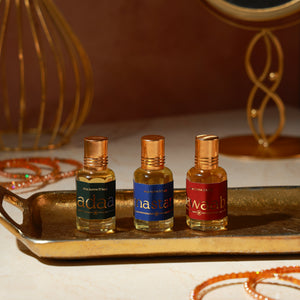
| Adaa | Bergamot, green cardamom, jasmine sambac, white musk | Bright, clean and cool — no density or richness at all | Not built for this reader's warmth — skip first |
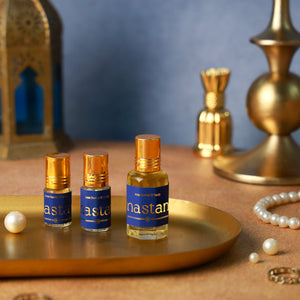
| The Attar Trio | Ameeri, Mastani and Nawaab, one size each | A useful spread across three different registers of warmth, once the bridge is understood | A sensible second step, not a first buy |
Ameeri · richness from saffron and oudh, no sugar₹385Shop → 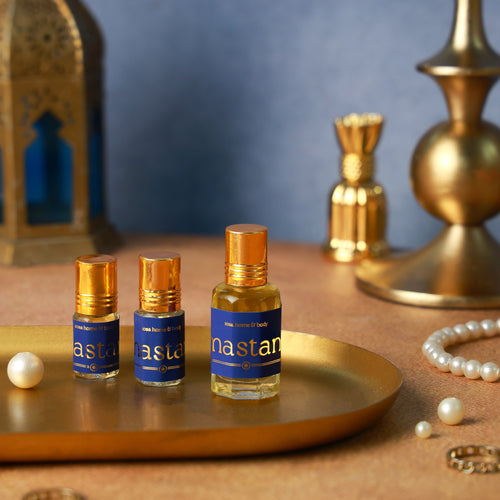 Mastani · the same warmth, darker and more shadowed₹389Shop →
 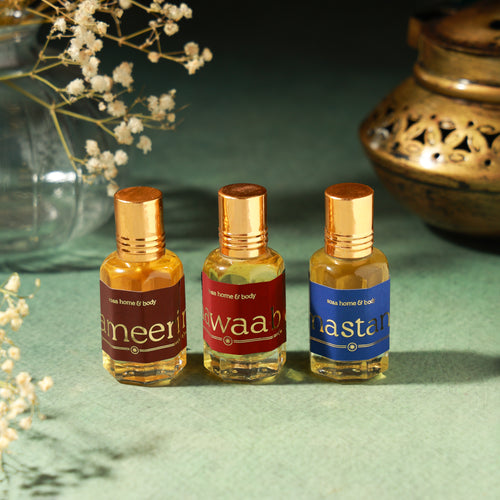 The Attar Trio · compare all three registers₹1,055Shop →
How to test whether saffron-and-oudh warmth is enough
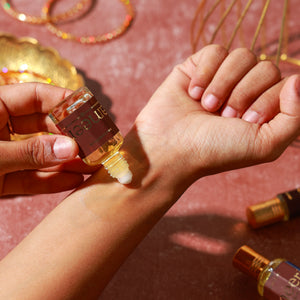
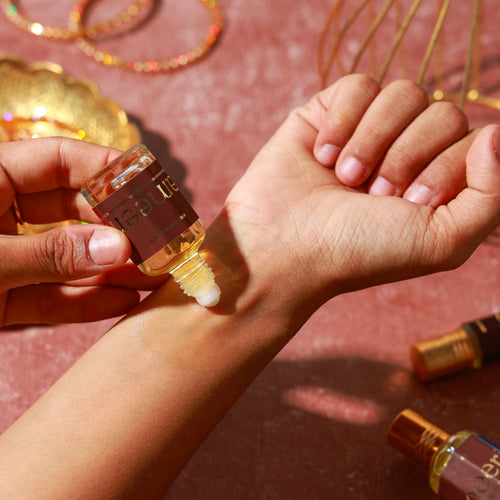
Apply Ameeri to a clean wrist and give it time before judging — the first half hour is mostly rose and the top notes of saffron, and the deeper, more resinous sandalwood-and-oudh warmth that a gourmand lover is really testing for develops later.
Pay specific attention, by the afternoon, to whether the fragrance feels dense and enveloping or whether it feels thin by comparison to what you're used to. That's the actual test — not whether it tastes sweet, which it won't, but whether the richness itself lands.
One wear, one wrist, is enough to answer this honestly. If the density is there and only the sugar is missing, that's the bridge working exactly as described. If the whole thing feels lighter than a gourmand to you regardless of the sugar, that's useful information too — worth comparing against Mastani's darker build before ruling this range out.
What to buy, sized for a first honest test
Matched to how rich and dark you want the warmth, once the no-gourmand honesty is understood.
| Route | Best for | Why | What it costs |
| Ameeri, 3 ml | The right first test for this reader | Saffron and soft oudh carry a rich, spiced warmth without any sugared material in the blend | ₹385 |
| Mastani, 3 ml | A reader who wants more shadow and depth than Ameeri's brighter build | Oudh, Damask rose and night-blooming jasmine — darker, still no sweetness | ₹389 |
| Ameeri, 6 ml or 12 ml | Once 3 ml confirms the saffron-and-oudh richness satisfies the craving | The same profile, sized for regular rather than trial wear | ₹679 / ₹1,165 |
| The Attar Trio | A reader who wants to compare Ameeri's warmth against Mastani's and Nawaab's drier register over time | One size each of all three | ₹1,055 |
| Adaa | Not recommended here | Bright and citrus-led — the opposite of the density a warm-gourmand lover is chasing | ₹379 |
Warm gourmand lovers are some of the most specific noses I hear from, because a good gourmand does real work — it isn't just sweet, it's dense, layered, enveloping. I take that seriously enough not to tell you Ameeri is a gourmand, because it isn't. There's no vanilla, no tonka, no praline, no amber built the sugared way a gourmand base usually is. That would be an easy, comfortable lie to tell, and I'm not going to tell it.
What I can tell you, from training in materials that build both gourmand accords and attar bases, is that Persian saffron and soft oudh do a genuinely similar job to a gourmand's spice and amber — they build density, warmth and a sense of fullness on the skin, just through resin and spice rather than sugar. On the right nose, that lands in nearly the same emotional place a good warm gourmand does, minus the sweetness entirely.
I'd rather send a warm-gourmand lover to Ameeri with that honestly explained than let them assume it's a hidden gourmand and feel misled on the first wear. ₹385 for 3 ml is cheap enough to find out for yourself whether spice-and-resin richness answers the same craving sugar usually does — and if it doesn't, that's a fair and useful thing to learn. What I'd genuinely rather avoid is a reader buying 12 ml on the strength of a hopeful comparison and discovering, months in, that the sugar was the part they missed all along. A small bottle first protects both of us from that outcome.
Questions from readers who love warm gourmands
- I Love Vanilla Perfumes — Which Attar Should I Try? — this series's entry point, for the broader vanilla question this post narrows from.
- I Love Vanilla but Don't Want My Perfume Oil to Smell Like Cake — What Should I Choose? — a neighbouring bridge for a reader already rejecting sweetness specifically.
- Which Attar Should a Gourmand Lover Wear in Hot Weather? — practical wearing advice once a warm gourmand lover has settled on this range.
- Which SOSA Attar Should a Vanilla and Gourmand Perfume Lover Try? — this series's short, direct answer once the honest bridge is understood.
- Brand: the SOSA founder story.
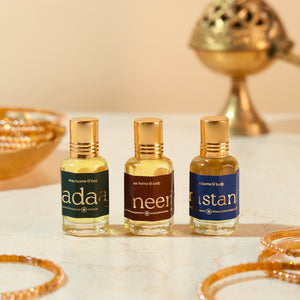
SOSA attars & prices (verified September 2026): All four are alcohol-free roll-on attars in 3 ml, 6 ml and 12 ml. Adaa (bergamot, green cardamom, jasmine sambac, white musk) ₹379 · ₹669 · ₹1,149. Ameeri (Taif rose, Indian sandalwood, Persian saffron, soft oudh) ₹385 · ₹679 · ₹1,165. Mastani (night-blooming jasmine, Damask rose, oudh) ₹389 · ₹685 · ₹1,179. Nawaab (white royal oud, Mysore sandalwood, Kashmir saffron) ₹399 · ₹699 · ₹1,199. The Ameeri + Nawaab + Mastani trio is ₹1,055 · ₹1,859 · ₹3,189. Prices are the live store prices at the time of writing.