


Why a boardroom is different from a lounge: it is small, it is closed, and it is often running at minimal fresh air with the door shut. A sealed volume accumulates fragrance rather than dispersing it, so the same machine that sits invisibly under a lounge behaves quite differently across two hours in a room of twenty-five square metres.
Where the identity goes instead: the corridor, the lift lobby and the approach. Perceived strength is set by the step between two spaces, so a scented corridor and a clean boardroom produce a clear, deliberate arrival into calm — which is exactly what a chairman wants and costs nothing extra.
What to do with the budget: air change and a turnaround routine. Clear the cups, take the food out, open the door and run the air between meetings. Most boardroom smell complaints are about the previous meeting, not about the absence of perfume.
The honest gap: SOSA has no product I would recommend putting inside a boardroom, and I would rather say so than sell one. No purchasable refill oil is listed for the waterless commercial machines either — that fragrance is specified and quoted per property through the contact page.
2. Because it is a small closed volume, and small closed volumes accumulate. Fragrance schemes are designed around rooms of hundreds of cubic metres with air moving through them. A boardroom is a fraction of that, with a door that stays shut and, during a long meeting, often minimal fresh air. Air that leaves a room takes the fragrance with it; air that does not leave lets it build. The same machine behaves in opposite ways in those two conditions, and a setting judged in a lounge will be wrong in a boardroom by a wide margin.
3. Because the sitting is long and the occupants are captive. Two to three hours in a chair, no ability to move to a different part of the room, and a document in front of them. Long dwell always argues downward, and a boardroom takes that argument past the lowest setting and out the other side, to nothing.
4. Because half the room did not choose to be there. A members’ lounge is full of people who joined the club. A boardroom is full of their bankers, lawyers, auditors and counterparties. A guest who finds the room heavy will not raise it — they will sit through it, decline the second coffee, and remember the club as a place where the air was odd. That complaint never reaches a house committee in a usable form.
5. Put the identity in the corridor and let the door do the work. Perceived strength is set by the step between two spaces rather than by the level in either, so a corridor carrying the club’s fragrance and a boardroom carrying none produces a distinct, deliberate moment of arrival into calm. Vaayu ₹11,999 on the corridor, mounted in the airflow path or into an HVAC return, does that job with a key-lock to keep the setting where you put it. Alcohol-free, phthalate-free, IFRA-compliant, composed in Pune. A portion of every order supports girl-child education through Nanhi Kali.

Why a small closed room behaves differently from a large open one
A great deal of confusion about meeting-room scenting comes from treating a boardroom as a small lounge. It is not a small lounge; it is a different physical situation. A closed door is a genuine boundary for fragrance. Two rooms with a door between them are two zones however adjacent they are, and one large open plan is a single volume however irregular its shape. That means the boardroom is not receiving a diluted share of whatever the floor is getting — it is its own sealed box, and whatever happens inside it happens only inside it.
The second mechanism is the one that catches people out. Air that leaves a room takes the fragrance with it; air that stays lets it accumulate. A lobby with automatic doors and a busy air system needs fragrance replaced continuously because it is constantly being carried away. A boardroom with the door shut and a conservative fresh-air setting is the opposite case: whatever enters largely stays. Over the first twenty minutes of a meeting a level that felt correct on walking in continues to build, while every person in the room simultaneously stops reporting it, because the nose reports change rather than constancy. The result is a room that is objectively stronger at the end of the meeting than at the start and subjectively weaker to everybody sitting in it. That is not a combination any operator can manage by feel.
Then add what else is accumulating. Ten people in a closed room for three hours are ten sources of personal fragrance, several of them wearing something they have worn for two decades. There is coffee, there is warm equipment, there is upholstery and carpet holding the last meeting. Absorbent mass — carpet and underlay, upholstered chairs, heavy curtains, timber panelling — takes up odour and releases it slowly afterwards, which is precisely why a boardroom can smell of yesterday at nine in the morning. Into that already crowded situation, an ambient fragrance does not arrive as a top note over a clean base. It arrives as one more thing in a mixture, and a mixture of a pleasant odour with an unpleasant one is reliably judged worse than the unpleasant one alone, because it reads as concealment. The fix for a stuffy boardroom is air change and a cleaning routine, not perfume. SOSA sells no air purifier and no dehumidifier and makes no air-quality claim of any kind; fragrance adds fragrance, and that is all it does.
 Aangan₹25,999Nine complaints out of ten about a meeting room are about residue rather than about the absence of a scheme. Write a turnaround routine and hold staff to it: cups and glasses out immediately, any food removed from the floor entirely rather than left on a sideboard, waste taken out of the room, the door propped open and the air run between bookings, and a scheduled clean of the upholstery and the carpet rather than only the table. If the boardroom sits on the club’s air handling, ask the engineer for a fresh-air purge on that zone in the gap between meetings and before opening in the morning. This is unglamorous and it is the entire answer for most clubs.
Vaayu₹11,999The club’s identity is not lost by leaving the boardroom bare — it is concentrated. Perceived strength is governed by the step between two spaces, not by the absolute level in either, which is why a lobby feels clearly fragranced when the street was not, and why a quiet room feels quiet when the corridor was louder. Scent the corridor, the lift lobby and the waiting area at a light, continuous level, leave the meeting rooms clean, and the door becomes a transition a guest registers without being able to say why. A chairman walking three people from the lift into a still, clean room has had the club’s fragrance delivered to them twice over — once on arrival and once by its withdrawal.
Aangan₹25,999Nine complaints out of ten about a meeting room are about residue rather than about the absence of a scheme. Write a turnaround routine and hold staff to it: cups and glasses out immediately, any food removed from the floor entirely rather than left on a sideboard, waste taken out of the room, the door propped open and the air run between bookings, and a scheduled clean of the upholstery and the carpet rather than only the table. If the boardroom sits on the club’s air handling, ask the engineer for a fresh-air purge on that zone in the gap between meetings and before opening in the morning. This is unglamorous and it is the entire answer for most clubs.
Vaayu₹11,999The club’s identity is not lost by leaving the boardroom bare — it is concentrated. Perceived strength is governed by the step between two spaces, not by the absolute level in either, which is why a lobby feels clearly fragranced when the street was not, and why a quiet room feels quiet when the corridor was louder. Scent the corridor, the lift lobby and the waiting area at a light, continuous level, leave the meeting rooms clean, and the door becomes a transition a guest registers without being able to say why. A chairman walking three people from the lift into a still, clean room has had the club’s fragrance delivered to them twice over — once on arrival and once by its withdrawal.
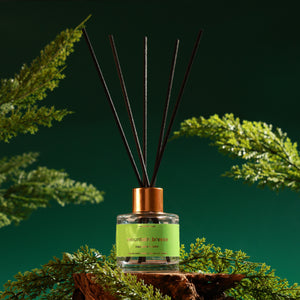
 Mountain Breeze₹849A reed diffuser on the credenza. It is a passive capillary device producing a fragrant zone about two metres across, which in a boardroom means whoever sits at that end of the table gets a meaningfully different experience from whoever sits at the other. Two bottles do not fix it: two passive sources make two hills with a valley between them. An ultrasonic machine in the corner. It dilutes oil in water and throws a wet mist, so it adds humidity to a sealed room full of people and equipment, and can leave a fine mineral deposit on dark surfaces. A spray before the meeting. SOSA sells no room spray — every SOSA spray is a car perfume — and in any case a spray is an event rather than a system: a sharp peak that has collapsed by the second agenda item.
The consent problem, and why nobody will ever tell you
This is the part of the argument that has nothing to do with perfumery and everything to do with how clubs receive information. A members’ lounge is populated by people who pay to be in the building, know the general manager by name, and will happily say at the bar that the lounge smells strong this week. That feedback loop works. A boardroom is populated by the members’ guests, and a guest has no standing and no interest in commenting on the air in a room they were brought to for a negotiation. They will not mention it to the member, who will not mention it to the club. The absence of complaint about a boardroom is therefore worth nothing as evidence.
There is a second asymmetry. Two people in the same room genuinely perceive different intensities, because dwell time, seated height, position relative to the airflow and recent exposure all differ. In a boardroom that spread is wide: the chairman has been in the room since before the others arrived and has adapted; the guest who came straight from the street is meeting the room at full strength; the person seated directly under the supply grille is in a different olfactory position from the person at the far end. A single output cannot serve all of them, and the only defensible way to resolve it is to choose the setting the most sensitive person can tolerate. In a room this small, over this long a sitting, that setting is zero.
And there is the matter of what the room is for. People come into a boardroom to concentrate on something that matters to them, often for longer than they wanted to. Anything in that room that is managed — a fragrance, music, a particular quality of light — will eventually be noticed by somebody, and once noticed it reads as the building intruding on a private conversation. Restraint is the luxury signal, and it is free. A club that leaves its boardroom clean and quiet has made a decision that its most senior guests will register as confidence, even though none of them will ever attribute it to anything.
The meeting-room floor, room by room
This is how I would set out a meeting-room floor for a house committee. It is organised by volume and enclosure rather than by room name, because those two variables decide the answer here far more than function does. Note that every closed room on the list is unscented and every circulation space is scented — that inversion is the whole scheme.
| Space | Volume and enclosure | How long people stay | Decision | What serves it |
|---|---|---|---|---|
| Private boardroom ★ | Smallest volume, door closed, minimal fresh air | Two to three hours, seated, captive | Unscented | Turnaround routine and air change. No machine in the room |
| Small meeting rooms and syndicate rooms | Small, closed, often no openable window | Thirty to ninety minutes | Unscented | The same routine, on a shorter cycle |
| Video and conference rooms | Small, closed, warm equipment | An hour or more, seated | Unscented | Extraction and a clean between bookings |
| The corridor serving the meeting rooms | Open, moving air, connected to the lift lobby | Passing through, repeatedly | Scented, light and continuous | Vaayu in the airflow path or an HVAC return |
| Lift lobby and the waiting area | Open, connected to the corridor | A few minutes, standing | Scented, same identity | Usually the same zone unit |
| Secretary’s desk and the approach | Open, part of the corridor volume | Minutes | Scented, not from behind the desk | Position in the moving air, away from staff |
| Washrooms off the floor | Small, closed, high turnover | A few minutes | Light and bright | Reeds are genuinely right at this scale |
| Any room where food is served or plated | Varies | An hour or more | Neutral, without exception | Nothing. Ambient fragrance competes with the kitchen |
Corridor · Vaayu₹11,999See it → Air system · Aangan₹25,999See it → Larger property · Meenar₹38,500See it →
The narrow exception, stated precisely
There is a set of conditions under which a very low setting in a meeting room is defensible, and because a blanket rule invites people to ignore it, here it is in full. All four conditions have to hold together. First, the room is not really closed — it is a glazed meeting space with an open side or a permanently open door, sitting inside a larger volume that is already scented, so it is part of one air mass rather than a sealed box. Second, the sittings are short: half-hour bookings, tours, brief introductions, not board meetings. Third, no food is served in it. Fourth, the setting is the lowest the equipment offers and is key-locked there, and the level is judged by somebody walking in from outside rather than by whoever has been on the floor all morning.
Meet all four and a light level is reasonable, because the room is behaving like a bay of the open plan rather than like a boardroom. Fail any one of them and the answer returns to nothing. In practice, the room most clubs are actually asking about — the panelled one with the long table, the heavy door and the portrait of a past president — fails at least two conditions before the conversation begins. And a fifth consideration overrides all four when it applies: if the room is used for private dining, it is a dining room for that purpose and stays neutral, because ambient fragrance competes with the food, flattens wine, and is the one intervention a chef and a sommelier will both object to in the same meeting.
On sizing, one clarification that saves time in a specification meeting. Coverage is published in volume rather than floor area, and on a meeting-room floor that distinction does real work, because a double-height waiting area or an atrium void consumes coverage a square-foot figure hides entirely. A closed door is a boundary and an open plan is one volume, so six meeting rooms off a corridor are six zones you are choosing not to scent plus one corridor you are. I will not publish a machine count as a formula; the honest number depends on connected volume, ceiling height, door positions, whether the floor runs on its own air handling or shares the club’s, and the occupied hours. Send those to the contact page and the answer becomes specific. One further point, because it surfaces at commissioning otherwise: the Aangan connection into an air handling unit is a mechanical integration and a real one, but no digital integration exists on any SOSA machine — no building-management interface, no automation protocol, no smart-home connection.
What to buy instead — and the two gaps
If a club came to me with a budget line for the boardroom, this is what I would spend it on, in order. Two of the five lines are not purchases at all, and the last line is a pair of things SOSA does not publish, which belong in the table rather than in a footnote nobody reads.
| Step | What it is | Why it comes here in the order | Cost |
|---|---|---|---|
| 1. Write the turnaround routine ★ | Cups and food out, waste removed, door open and air run between bookings, upholstery and carpet on a cleaning cycle | Because nearly every boardroom smell complaint is about the previous meeting, and fragrance over it reads as a cover-up | No purchase |
| 2. Put the boardroom on the unscented list, in writing | Boardroom, syndicate rooms, video rooms, and any room where food is served | A scheme that names its exclusions is the one a committee and a chef both believe | No purchase |
| 3. Vaayu on the corridor outside | Up to 1000 m³, in the airflow path or an HVAC return, under 38 dB, key-locked after setting | The corridor is where the identity belongs, and the step at the door is what a guest actually perceives | ₹11,999 |
| 4. Aangan if the floor is one air system | Up to 3,000 m³ on HVAC, 800ml, programmable work and pause cycles and daily schedules | Only where the air handling genuinely serves the circulation you want scented — and only if the meeting rooms can be kept off it | ₹25,999 |
| 5. Reeds in the washrooms off the floor | Mountain Breeze and the rest, 50ml or 130ml, six fibre reeds, refillable glass | A two-metre fragrant zone is exactly the right specification for a washroom and exactly the wrong one for a boardroom | ₹749–₹1,349 |
| Nothing for the room itself, and no listed commercial refill: the honest gaps | SOSA has no product I would put inside a boardroom, and no room spray exists in the range at all — every SOSA spray is a car perfume. Separately, no purchasable refill oil is listed for the waterless commercial machines; that fragrance is specified and quoted per property | Said plainly, because a committee will ask for both and because quoted fragrance is the norm in commercial scenting rather than an evasion | Quoted |
Versailles
I was once asked to sit in on a board meeting at a club that had just completed a scenting scheme, on the reasonable basis that the perfumer should experience her own work in the room where it mattered most. The scheme was good. The lobby was right, the corridor was right, and the boardroom had been included because the committee could not see a reason to leave it out. By the end of the second hour I had a headache, and I had composed the fragrance.
Nothing was wrong with the composition, and nothing was wrong with the setting as it had been judged in the corridor. What was wrong was the room: twenty-odd square metres, a heavy door, a conservative fresh-air setting, ten people, coffee, and three hours. The level that disappeared into a corridor accumulated in that box, and every person in it had stopped reporting it long before it became a problem. Nobody said anything. Two of the people present were guests of the club and would sooner have missed a flight than mention the air.
We took the boardroom out of the scheme entirely and put a turnaround routine in its place. The general manager told me afterwards that the room was being described as fresh, which is the word people reach for when a building has been aired rather than fragranced. I would rather a club hear that from me before the order than afterwards. Set the corridor once, key-lock it, write the setting down, judge it only by walking in from outside — and leave the boardroom alone. Everything we make is composed in Pune, and a part of every order funds a girl’s classroom through Nanhi Kali.
Frequently asked questions
- What a premium business club should smell like — the family pillar, and what premium means when the room’s job is work.
- Private meeting rooms — the same default, with the conditions under which a light setting is defensible.
- The executive networking lounge and a club used by founders and senior executives — density, and competing personal fragrance.
- Coworking areas inside a club and consistency across networking, meeting and lounge spaces.
- Premium without the hotel-lobby register, dark timber interiors, and scent and the membership experience.
- Brand: the SOSA founder story.
SOSA commercial scenting — facts verified August 2026: Vaayu ₹11,999, waterless cold-air nebulising, coverage up to 1000 m³ ≈ 2,000–3,000 sq ft, 400ml refillable sealed tank lasting up to about 90+ days depending on intensity and hours, Bluetooth app plus onboard buttons, run windows of 1h / 4h / 8h / 24h, day selection, adjustable intensity, auto-stop and key-lock, under 38 dB, freestanding, wall-mounted or HVAC-return mounting, DC 12V / 1A at 5W, CE, RoHS and SGS, black and white. Aangan ₹25,999, HVAC or AHU connection or standalone wall-mount or lay-flat, coverage up to 3,000 m³ ≈ 8,000–10,000 sq ft, 800ml reservoir, under 42 dB, DC 12V at 14W, intelligent PCB with programmable work and pause cycles and daily schedules, metal body 3.9 kg at 284 × 125 × 246 mm, black or white, one-year warranty, imported; it has no app and no Bluetooth, and no certifications are published for it. Meenar ₹38,500 is the larger-property option and is specified on enquiry; no coverage figure is published for it here. Ultrasonic machines: Sukoon ₹1,899 at 270–320 sq ft and Boond ₹899 at up to about 150 sq ft. Reed diffusers ₹749–₹849 for 50ml lasting 6–8 weeks and ₹1,249–₹1,349 for 130ml lasting 14–18 weeks, six fibre reeds, alcohol-free, phthalate-free, paraben-free, IFRA-compliant, 0 ppm formaldehyde, heat-stable CCT carrier, refillable glass bottle, tested at 45°C and 85% RH, composed in Pune. The Hotel Collection fragrance oils are water-based and ultrasonic-only at 15ml ₹299, 100ml ₹999 and 300ml ₹1,799; they are not for reed diffusers and not for the waterless commercial machines. No purchasable refill oil is listed for the waterless commercial machines — that fragrance is specified and quoted per property. SOSA publishes no leather fragrance in any format and no tobacco or smoky fragrance for any diffuser. SOSA sells no air purifier, no dehumidifier and no room spray for interiors, and makes no health, air-quality, VOC or mould claim. No dealer programme, reseller margin, trade price, territory or service contract is published. Free shipping above ₹499. A portion of every order supports girl-child education through Nanhi Kali. SOSA is an independent Indian fragrance house; the Hotel Collection scents are SOSA’s own interpretations inspired by the world’s finest hotels, and SOSA is not affiliated with or endorsed by any hotel brand. Prices subject to change — see the live product pages.