



Why the intuition fails: distribution needs air that lingers in the room. A vent's jet is fast and directional; it removes vapour from the reeds quicker than capillary action replaces it and disperses it into a stream nobody stands in.
What it costs: weeks off the bottle, a weaker room, and reeds that dry out at the exposed end while oil is still sitting in the glass. Three losses at once.
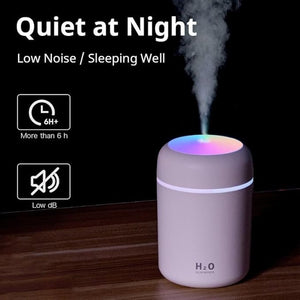
The legitimate version: if you genuinely want machine-driven distribution, buy a machine — a Sukoon at ₹1,899 covers 270–320 sq ft. Do not ask a passive format to be an active one.
2. You lose on both sides of the ledger at once. The bottle empties early and the room smells of less. Every other placement mistake costs you one or the other; this one takes both.
3. The distribution you were hoping for does not happen. The vent produces a fast, narrow jet that crosses the room and breaks against a wall. Fragrance carried in it is diluted along the way and dumped where nobody sits, instead of accumulating in the body of the room.
4. "Near" and "in the path" are different things. A console a few feet below a wall split can be entirely calm, because the throw passes overhead. Judge by a strip of tissue held at bottle height, not by how close the unit looks.
5. The fix is free and immediate. Move the bottle to the far diagonal, waist to chest height, on a tray, ideally near a doorway where people pass. Flip all six reeds when you do it, and the room will usually change the same evening.
6. If mechanical distribution is what you actually want, buy the right machine. A Sukoon at ₹1,899 covers 270–320 sq ft, runs 16–18 hours on low and comes with timers. That is a different job from a reed diffuser, and worth naming plainly rather than pretending a vent can do it.
Composed and handmade in small batches in Pune, and a portion of every order supports girl-child education through Nanhi Kali.
Part one — why a sensible instinct produces a bad result
I want to be fair to the instinct, because it is not stupid. Every other fragrance format in a home is helped by moving air: incense trails smoke across a room, a spray hangs in a draught, a candle's warm plume rides a current. So if the strongest air movement in the house comes out of a vent, that seems the place to launch fragrance from. The step that breaks is the assumption that a reed diffuser has a reservoir of vapour waiting to be swept away. It has no such reservoir. It has a rate.
 Mountain Breeze₹849 · 9.4/10The first loss is time. A 50ml is rated at six to eight weeks with six reeds, and in the correspondence we receive, bottles standing in a split's direct throw come back finishing meaningfully inside that window — often by a matter of weeks rather than days. That is SOSA working guidance from customer reports and our own placement tests, not a laboratory figure, and it varies with how fast and how directly the air hits. The second loss is presence: those same customers describe rooms that smell of nothing while the level visibly falls. The third loss is the reeds. Fibre reeds are the consumable in this system, and a stripped, dried reed end does not recover fully even after a flip. Since replacement reeds are not sold separately — an honest gap in our range — a vent quietly consumes the one component you cannot simply reorder.
Part two — what the stream costs, position by position
Here is the same bottle — a 50ml with its standard six reeds, rated at six to eight weeks — imagined in five positions relative to a vent. The week figures are our working guidance rather than measurements; the pattern is what matters, and the pattern is consistent.
| Position relative to the vent | Air speed at the reeds | How the room reads at week four | Likely life of a 50ml | What you actually lose |
|---|---|---|---|---|
| Far diagonal, out of the path ★ | Slow, well-mixed circulation | Even, present across the room | Normal 6–8 weeks, often the long end | Nothing — this is the target |
| Beside the unit, outside the throw | Calm; the jet passes elsewhere | Normal, sometimes very good | Normal | Nothing, if the tissue confirms it |
| Directly beneath a high wall split | Usually calm, occasionally not | Normal when calm | Normal when calm | Only the risk of guessing wrong |
| Two to four feet into the throw | Constant, unmistakable movement | Thin; strong only right at the glass | Noticeably short of the window | Weeks, presence, and reed condition |
| On the unit, or in the louvre's mouth | Maximum, continuous | Almost nothing in the room | Well short — the worst case we see | Everything, including the reeds |
| The honest caveat: the bottle-life columns here are SOSA working guidance drawn from in-house placement testing and customer correspondence, not laboratory data, and they move with unit type, air speed, room volume and season. The direction of the effect is reliable even when the magnitude is not: air over the reeds always costs you oil, and only sometimes gives you a room. Strength ratings elsewhere on this page are positions on SOSA's internal scale at six reeds, not an industry standard. | ||||
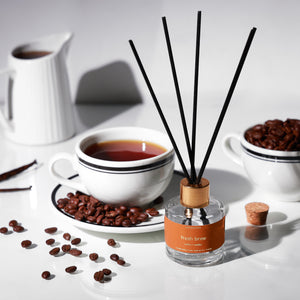
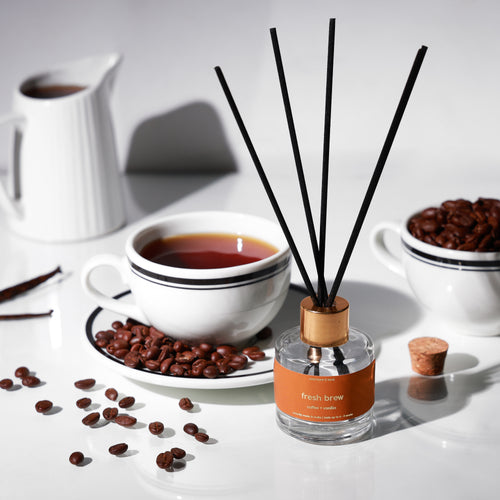
Fresh Brew · 9.5/10from ₹849Shop → 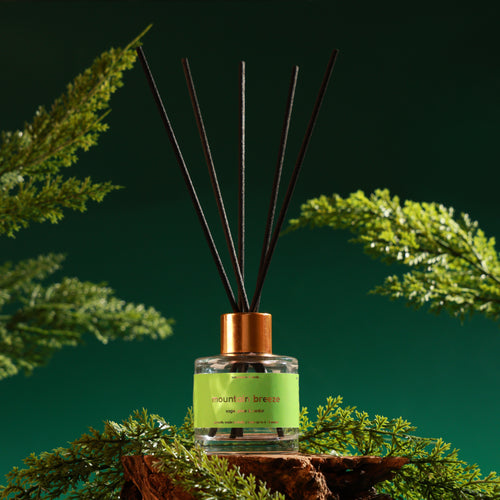 Mountain Breeze · 9.4/10from ₹849Shop →
  Sukoon · 270–320 sq ft₹1,899Shop →
Part three — what you were actually trying to do
Underneath the vent question there is almost always a real, reasonable goal, and it is worth naming because the goal is achievable even though the method is not. Usually it is one of three. Some people want the fragrance to reach a second space — a corridor, an adjoining dining area, a stairwell — and hope the AC will push it through. Some want the room to smell strong quickly, before guests arrive. And some simply find that the room reads quiet and are reaching for the only source of energy in it. None of those three is solved by a vent, and each has a straightforward answer that does not cost you a bottle.
For reaching a second space, the answer is a second source, not more force. Output per bottle is fixed; the only way to raise the total fragrance in a home is another bottle, which is why two 50ml at opposite ends of an open living-dining beat one 130ml in the middle. For speed, accept that reeds cannot surge — the format is constant and passive by design, and a room that must smell different within twenty minutes is asking for a machine. And for a quiet room, work the free ladder in order: flip all six reeds, move the bottle into gentle passing air near a doorway at waist-to-chest height, close the room for an hour before you judge it, and only then add reeds, which costs bottle life roughly in proportion — nine reeds takes a 50ml closer to five weeks than eight.
There is also a version of the vent idea that is legitimate, and it is worth stating precisely. You do want the room's air to circulate; you simply want it to circulate around the bottle rather than through it. That is the difference between intermittent and continuous movement. A door opening, a person walking past, a ceiling fan on its lowest setting several feet away — these stir the room in bursts, distributing fragrance without holding the reeds in a permanent gale. Intermittent human traffic is the airflow a reed diffuser is designed around. Continuous mechanical air is not, and no amount of good intentions changes which side of that line a vent falls on.
Part four — the right way to get what you wanted
Three goals, the vent version of each, and the version that actually works. The first two rows cost nothing at all.
| What you want | The vent version | What to do instead | Cost |
|---|---|---|---|
| A fuller room, generally ★ | Put the bottle in the airflow | Flip all six, move to the far diagonal near a doorway | Free |
| Noticeably more presence | Aim the louvre at it | Add two to three reeds, accepting a shorter bottle | Free · 50ml runs nearer 5 weeks at nine reeds |
| More presence without losing weeks | Nothing the vent can do | Move up the scale to Fresh Brew 9.5 or Mountain Breeze 9.4 | ₹849 · 50ml |
| Fragrance in a second room or corridor | Blow it through the doorway | A second bottle in that space — sources, not force | From ₹749, or a duo from ₹1,498 |
| Scent on demand, before guests | Turn the AC up an hour early | An ultrasonic Sukoon, 270–320 sq ft, timers and remote | ₹1,899 · three 15ml scents in the box |
| To recover a bottle a vent has drained | — | Refresh the reeds, then refill the oil and place it properly | ₹2,399 · 300ml, roughly 8–11 months |
Versailles
We ran this as a side-by-side once, because arguing about it in the studio was getting us nowhere. Two identical bottles of the same batch, six reeds each, opened on the same morning. One went on a shelf in the direct throw of the split; the other went on a console on the far diagonal. The one in the throw went down faster and smelled of less, and the difference was not subtle by the third week.
What struck me most was the state of the reeds. The ones in the stream had gone pale and stiff at the exposed end while there was still plenty of oil in the glass. Since we do not sell reeds separately, that is the part of the loss I mind most, and I would rather say so than let it happen quietly in someone's living room.
So the answer to this question is a simple no, with no hedging. Move the bottle. If what you actually wanted was a room that changes when you press something, buy a machine and let the reeds do the constant, low, background work they are built for. Everything is composed and handmade in small batches in Pune, and a part of every order funds a girl's classroom through Nanhi Kali.
Frequently asked questions
- Does air conditioning affect reed diffusers? — three effects, two harmful, one helpful.
- Where to place one in an AC room — the tissue survey and the diagonal rule.
- Stronger, or just faster? — intermittent versus continuous air, in full.
- The complete airflow and placement guide, and the complete strength guide.
- Brand: the SOSA founder story.
SOSA reed diffuser range & prices (verified August 2026): alcohol-free, phthalate-free, paraben-free and IFRA-compliant compositions on a heat-stable coconut-derived (CCT) carrier, low-VOC, supplied in a refillable glass bottle with six fibre reeds; 50ml lasts 6–8 weeks and 130ml lasts 14–18 weeks. Morning Freshness (Malabar lemon · peppermint · Nilgiri eucalyptus) 50ml ₹749 · 130ml ₹1,249 · 9.0/10; Garden Bloom (British rose · night-blooming jasmine) 50ml ₹799 · 130ml ₹1,299 · 8.9/10; Evening Calm (Kashmir lavender · chamomile) 50ml ₹799 · 130ml ₹1,299 · 8.9/10; Fresh Brew (Coorg coffee · Kerala vanilla) 50ml ₹849 · 130ml ₹1,349 · 9.5/10; Mountain Breeze (Himalayan pine · sage · Indian cedar) 50ml ₹849 · 130ml ₹1,349 · 9.4/10. Reed diffuser refills are oil only — you reuse your own vessel and reeds: 300ml ₹2,399 (roughly 8–11 months) · 500ml ₹3,499 (roughly 14–18 months), about ₹7–8 per ml against ₹15–17 per ml for a 50ml bottle. Duo sets ₹1,498–₹1,598 for 2 × 50ml and ₹2,498–₹2,598 for 2 × 130ml. Strength figures are positions on SOSA’s own internal strength scale, not an industry standard. Replacement reeds are not sold as a separate SKU; SOSA guidance is to refresh reeds every few months. The reed line is separate from the water-based Hotel Collection for ultrasonic machines (15ml ₹299 · 100ml ₹999 · 300ml ₹1,799) and the two are not interchangeable. Diffusers: Boond 300ml ₹899 · Sukoon 500ml ₹1,899 · Megh 6L ₹3,499 · waterless Vaayu ₹11,999. Composed and handmade in small batches in Pune, India; tested through 45°C summer heat and 85% monsoon humidity. Free shipping above ₹499. A portion of every order supports girl-child education through Nanhi Kali. Prices subject to change — see the live product pages.