



Why: dwell time. Every default in the scenting trade is written for a space crossed in twenty seconds with a fresh nose.
The second problem: soft toys, cushions, mats, curtains and carpet absorb fragrance and release it back for days after you switch off.
Before any of it: bins, ventilation, laundry cadence and a nappy-change routine. Those produce more of the room’s smell than any diffuser will.
2. The occupant cannot leave, and will not complain. Every other argument in ambient scenting assumes a person who can walk out of the room if they dislike it. A child waiting to be seen cannot. They are seated where they were put, often feverish, sometimes nauseated, occasionally with a cough that has been going for a week. A parent might mention it to the desk; a four-year-old will not. The absence of complaints from a paediatric waiting room is not evidence that the level is right — it is evidence that the people most exposed to it have no way of telling you.
3. Children breathe lower than you install. A seated or standing child’s breathing zone sits roughly 0.8–1.2 m from the floor. An adult’s sits at 1.5–1.7 m. Almost every scent machine in a clinic is installed on a desk, a side table or a low console — which puts the output squarely in the child’s zone and above nobody else’s. The person you are least designing for receives the strongest dose. If anything goes into this room, it goes high on a wall and points away from the seating.
4. The room stores fragrance and gives it back. A children’s waiting area is unusually full of soft material: plush toys, foam play mats, fabric cushions, curtains, upholstered benches, sometimes carpet. All of it absorbs airborne odour and re-releases it slowly, and almost none of it is ever washed. That means the level in the room is not the level your machine is producing — it is the machine plus everything the room has accumulated since you installed it. This is why an intensity that seemed correct in week one feels heavy in month three.
5. And the smell you are trying to solve is usually not a fragrance problem. When a clinic asks about scenting the waiting room, the trigger is almost always a specific smell: the nappy-change corner, the bin by the water cooler, the AC that has run all morning without ever bringing in outside air, the wet-mop finish after the eleven o’clock clean. Fragrance adds molecules and removes none of those. Deal with the source and the room usually needs nothing further.
Made in India, composed by an ISIPCA Versailles-trained perfumer — and a portion of every order supports girl-child education through Nanhi Kali.
Why the waiting room is the hardest room in the clinic to get right
Ambient scenting as a trade grew up in hotels, retail and hospitality, and every convention it carries was set in those rooms. A lobby is a transit space: a guest crosses it in twenty seconds with a nose that has just come in from outside, so the level has to register immediately or it does nothing at all. That is what the default duty cycles, the recommended drop counts and the standard six-reed configuration are calibrated to produce. A paediatric waiting room inverts every one of those assumptions. The occupancy is long rather than brief, the noses have already adapted, the occupants are seated rather than moving, and a meaningful proportion of them are unwell. Applying lobby settings to that room is not a small overshoot; it is the wrong calibration entirely.
The second difficulty is that nobody who works in the clinic can judge it. Olfactory adaptation is essentially complete within about twenty minutes, so by mid-morning the receptionist, the nurse and the doctor have all stopped perceiving the fragrance — while the family who walked in ninety seconds ago perceive it at full strength. Because staff cannot smell it, they conclude it has run out and ask for more. This one mechanism is behind the majority of over-scented clinic receptions, and it does the most damage in the waiting room, because that is where the difference between a level that is imperceptible and a level that is oppressive is measured in the smallest increments. Any level you set must be set by a nose that has been outside for half an hour, and re-checked a fortnight later.
Three tests to run before you buy anything for this room
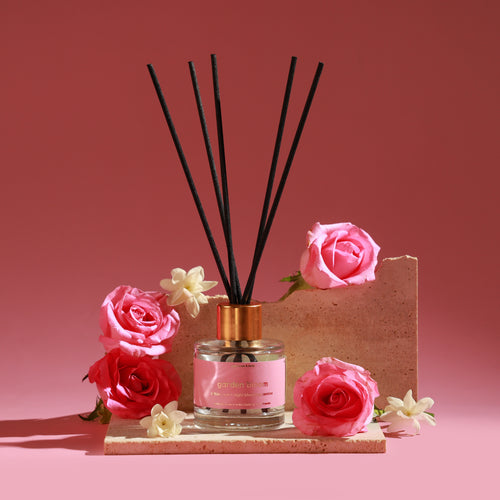
 Three reedsFrom ₹749Not a walk-through — a sit. Arrive from outside, take a seat where the children sit, and stay for forty minutes without a phone. You will notice, in order: the bin, the nappy-change corner, whether the air is moving at all, the acoustics, and only then anything anyone has added. Whatever bothers you at minute thirty is the actual problem in that room, and in most clinics it is not the absence of fragrance. Do this before you spend anything, and repeat it at the busiest hour of the week rather than at nine in the morning when the space has just been aired.
Zone by zone, with the waiting area broken out
This table splits the waiting area into its parts, because they are not one thing. The seating, the play corner and the nappy-change area have three different answers, and only one of them is ever a yes.
| Area of the clinic | Scented? | Why | What we would use |
|---|---|---|---|
| Reception desk and entrance ★ | Yes, low | Short dwell, arriving noses, and the only point where a signature registers as intended | Reed on three reeds from ₹749 |
| Waiting seating | Minimum, or nothing | Thirty to sixty minutes seated, mostly children, some unwell — the longest exposure in the clinic | Drift from the reception source only, never its own unit |
| Children’s play corner | No | Lowest breathing zone in the building, and everything in it is handled and mouthed | Nothing — keep equipment out of the zone |
| Nappy-change and feeding corner | No | A live odour source; adding fragrance here produces both smells rather than one | Nothing — lidded bin, twice-daily emptying |
| Consultation and examination rooms | No | A seated child cannot move away, and clinicians use their own sense of smell | Nothing |
| Nebulisation, asthma and isolation waiting | Never | Respiratory patients and infectious waiting — the least tolerance for any added airborne load | Nothing |
| Before any of this: bin type and emptying frequency, the nappy-change routine, whether the room is aired before opening, the AC filter and drain pan, and a written washing cadence for toys, cushions and curtains. Every one of those changes the waiting room’s smell more than a diffuser will. | |||
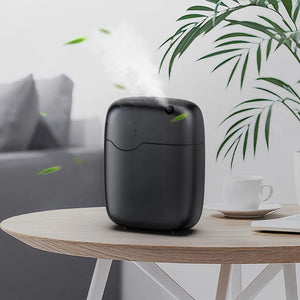
Small reception · no power neededFrom ₹749Shop →  Mid reception · has an off switch₹1,899Shop →
 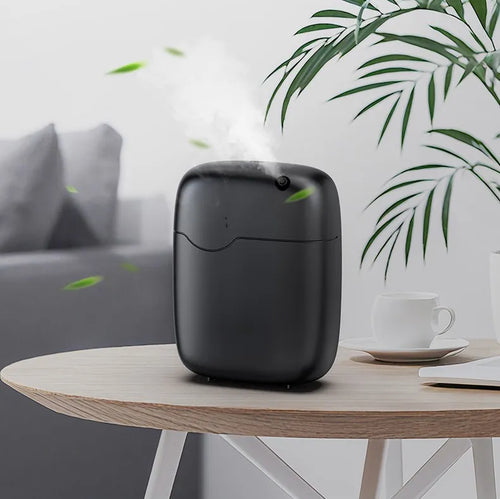 Large lobby · timed, dialable₹11,999Shop →
If you decide to scent it anyway, here is the discipline
Put the source at the desk, not in the seating. The waiting area should receive fragrance only as drift from the reception point, never from a unit of its own. That single decision does most of the work: it guarantees the seating runs at a fraction of the reception level, it keeps equipment away from children, and it means the room with the longest dwell is never the room nearest the emitter. On a reed diffuser, use three reeds rather than six. On a Sukoon, three drops in intermittent mode rather than six in continuous. On a Vaayu, the shortest on-time and the longest off-time the unit offers, scheduled to clinic hours only.
Set the level with a nose from outside, and again a fortnight later. Nobody who has been in the building since morning can judge this; adaptation completes in about twenty minutes and then works against you, because staff who cannot smell the fragrance will ask for more of it. Send someone out for half an hour and have them judge their first breath on returning, standing at the seating rather than at the desk. Repeat at two weeks, which is when most clinics have quietly crept upward. If any parent ever remarks on the fragrance — even approvingly — treat that as the instruction to reduce, because a comment means it has crossed from ambience into presence.
Then build in the off switch and the laundry. A clinic scenting a waiting room should be able to stop it within seconds and should be willing to, on request, for a family with an asthmatic or scent-sensitive child; a short line at the desk saying so turns a possible complaint into evidence of care. Pair that with a written washing cadence for the soft items, because they are storing whatever you run. Choose the direction with the same restraint — dry and low-sweetness, such as Westin-inspired White Tea Serenity, and nothing gourmand, sweet or heavily floral in a room where children sit for forty minutes.
What we would actually install
Sized for the reception desk, because that is where the source belongs. The last row is here because for a waiting room it is frequently the right one.
| Option | Suits | Control you get | Price |
|---|---|---|---|
| Reed diffuser ★ | A small reception desk — the default answer for a waiting room, on three reeds, placed at the desk and not in the seating | Reed count only — no switch, no timer | from ₹749 |
| Sukoon 500ml | A reception up to ~320 sq ft — a larger reception where a reed will not carry, in intermittent mode on three drops with a real off switch | On/off, intermittent mode, you control the drops | ₹1,899 |
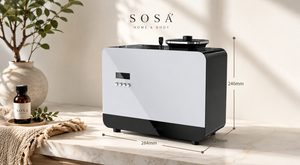
| Vaayu | A large lobby or a zoned duct — a genuinely large lobby, where the duty cycle can be run below any passive diffuser’s floor | Duty cycle in seconds, timer, app scheduling | ₹11,999 |
| Aangan | Whole-facility HVAC — a multi-floor centre with zoned ducting — and only where the clinical zones are excluded at the duct | Zone-level control, but only if the ducting is zoned | ₹25,999 |
| Nothing at all | Any clinic where bins, ventilation and laundry are already right, and any waiting area serving newborn, respiratory or infectious lists | Complete — and the correct answer more often than the trade admits | ₹0 |
Versailles
I have sat in a lot of clinic waiting rooms with a notebook, and the thing that strikes me every time is how long forty minutes actually is. You notice the chairs. You notice the noise. You notice the bin. Fragrance is nowhere near the top of that list, and when it is, it is because there is too much of it. I have never once sat in a paediatric waiting room and thought it needed a scent added.
The request usually arrives phrased as a design question and turns out to be an operational one. Somebody has noticed the room smells different by evening than it did at nine, and reached for a diffuser. What has actually happened is that ninety children have passed through, the bin has not been emptied since morning, the AC has recirculated the same air all day and the cushions have been quietly absorbing all of it since the clinic opened. A diffuser does not touch any of that.
So my answer for this room is minimum or nothing, and I am comfortable losing the sale on it. If the clinic is genuinely well kept and the owner still wants a signature at the door, put three reeds on the reception desk and let the seating catch only what reaches it. Keep every clinical room out of it, keep the play corner out of it, be able to switch it off for a family who asks, and put the whole decision through your own clinical governance and infection-control leads rather than through a fragrance supplier. A portion of every order funds a girl’s classroom through Nanhi Kali.
Frequently asked questions
- Children sit here for 30 to 60 minutes — the dwell-time argument in full.
- Should the play area be scented? — no — and why the floor decides it.
- Do toys and cushions hold odours? — yes, and a laundry cadence that works.
- A premium waiting area without fragrance — seating, acoustics, sightlines, cleanliness.
- Brand: the SOSA founder story.
SOSA products & prices (verified August 2026): Hotel Collection water-based ultrasonic diffuser fragrance 15ml ₹299 · 100ml ₹999 · 300ml ₹1,799 · Pack of 7 (15ml, all fragrances) ₹1,799; refills 100ml from ₹999. Seven scents: The Ritz-Carlton-inspired (white tea · bergamot · cedar), Westin-inspired (white tea · aloe · cedar), 1 Hotels-inspired (cedarwood · vetiver · green leaves), The St. Regis-inspired (amber · violet · woods), Shangri-La-inspired (jasmine · green tea · white tea), Four Seasons-inspired (citrus · floral · sandalwood), W Hotels-inspired (citrus · pepper · amber). Diffusers: Boond 300ml ₹899 · Sukoon 500ml ₹1,899 · Megh 6L ₹3,499. Water-based, phthalate-free, composed to IFRA standards for home diffusion; 3–6 drops per tank. Made in India, Pune. The Hotel Collection scents are SOSA's own interpretations inspired by the world's finest hotels; all hotel names are trademarks of their respective owners and are used only to describe the scent style — SOSA is an independent Indian fragrance house, not affiliated with or endorsed by any hotel brand. Prices and availability subject to change — see the live product pages.