



Run-on time: fifteen to twenty minutes after every shower, not the eight minutes you were in the room. The room is at its wettest at the moment you finish.
The fan needs an inlet: a 10–15mm gap under the door, or leave it ajar while the fan runs.
Remove water by hand: squeegee the walls and glass, dry the mat elsewhere. What you wipe off is water the fan never has to move.
2. Give the fan somewhere to draw air from. Extraction needs an inlet. If your bathroom door is well fitted with a threshold strip and no gap underneath, the fan is working against a partial vacuum and its real flow collapses. A 10–15mm gap under the door, or a small vent grille in it, restores it. As a free interim, prop the door open a couple of inches while the fan runs on after your shower. You will hear the fan change note when the air is actually able to move.
3. Take the water out by hand before the fan has to. A squeegee costs very little and removes a genuinely significant amount of water from shower walls and glass in thirty seconds — water that would otherwise have to evaporate into the room and be extracted. Wring and hang the bath mat outside the bathroom rather than leaving it flat on wet tiles. Hang towels spread out, not folded over a rail, and ideally not in the bathroom at all in an internal room.
4. Reduce what stays wet permanently. Because you cannot air the room, anything that holds water in it holds water for a long time. Keep the floor clear: no bucket with an inch of standing water, no toilet-brush holder full of old liquid, no plastic mug face-up in a corner. Scrub grout properly and replace any silicone that has blackened at the edges, since both are the places growth establishes first when a room never fully dries.
5. And check the drains before you blame the ventilation. A closed room concentrates whatever enters it, so a slow leak of sewer gas from a trap that has evaporated or been siphoned reads as a general "closed" smell rather than an obvious drain one. Pour a mug of water into every drain in the room, including the floor trap, and see whether the character changes within the hour. If it does, this is plumbing, not ventilation, and not fragrance.
Made in India, composed by an ISIPCA Versailles-trained perfumer — and a portion of every order supports girl-child education through Nanhi Kali.

Why having no window changes the entire problem
A room with a window has a background rate of air change even when the window is shut, because building fabric leaks and windows leak more than anything else in it. Open that window with the door open too and the room gets a very large exchange in a few minutes. A windowless bathroom has neither of these. Its only connection to outside air is a duct with a fan in it, and a fan that is not running is a closed pipe with a flap on the end. This is the one room in an Indian flat where ventilation is genuinely binary: it is happening, or it is not. Everything else about the room follows from that. There is no slow background drying, no help from a breeze, and no way to rescue it after the fact by opening something.
The consequence is that drying rate — not cleanliness — decides how the room smells. Water arrives in large quantities twice a day and leaves only during fan minutes. If the fan runs for eight minutes a day, the grout, the silicone, the mat, the towel rail and the ceiling above the shower spend almost the whole day damp, and permanently damp surfaces grow biofilm and mould. That is what "closed" smells like: it is not stale air in the way a shut bedroom is stale, it is a low continuous production of growth compounds from surfaces that never get a chance to dry. Which is also why cleaning an internal bathroom more often produces so little improvement — you are resetting a population that has ideal conditions to regrow in, rather than removing the conditions. Change the drying and the smell changes; change the cleaning frequency and very little does.
Three things to set up once, and then stop thinking about
 Step fourFrom ₹749If your fan is wired to the light switch, it runs during the shower and stops as you leave — which is the exact moment the room reaches maximum moisture. Ask an electrician for a run-on timer module on the existing fan: it is a small, inexpensive change and it makes the correct behaviour happen without you. A humidity-sensing fan does the same thing by measuring rather than counting, and suits a household with variable shower habits. A third option, if rewiring is not possible, is a separate switch placed outside the bathroom door where you will see it on your way past. Fifteen to twenty minutes after every shower is the target, every time.
Symptom to cause: an internal bathroom
In a room with no window, almost every odour question resolves to drying rate or to a drain. Use the confirmation column — several of these look identical from the doorway and have completely different fixes.
| What you notice | Most likely cause | How to confirm it | What actually fixes it |
|---|---|---|---|
| Room smells closed within a couple of hours of a shower ★ | Fan stopped with the light; the room never dried | Run the fan twenty minutes tonight and judge the room in the morning | A run-on timer module or a humidity-sensing fan; squeegee the walls |
| Fan runs but the mirror stays fogged | No make-up air, or a clogged impeller and duct | Tissue test at the grille, door shut and then open two inches | A 10–15mm gap under the door; clean the impeller; check the duct terminates outside |
| A specific sour note near the floor | The bath mat, the bucket or the toilet-brush holder holding old water | Pick each one up and smell it individually away from the room | Hang the mat outside the bathroom; empty and wash the holder; clear the floor |
| Grout grey, silicone edges blackened | Sustained dampness allowing growth in porous materials | Scrub one small area hard and compare it with the line next to it | Stiff brush into the grout; cut out and replace blackened silicone |
| Sulphurous or eggy rather than closed | A dry or failed P-trap — this is plumbing | Pour a mug of water into every drain and reassess after an hour | Refill the traps; if it returns, get the stack and vent checked. Not a fragrance job. |
| Dark spreading patches on the ceiling | Mould from continuous condensation — a health issue | Look at the ceiling above the shower and in the corner furthest from the fan | Fix the extraction and remove the growth. Do not scent over it. |
| If none of these fit: leave the fan running continuously for a whole weekend and see what the room is like on Monday. If it becomes noticeably better, your problem is purely fan minutes and a timer will solve it permanently. If nothing changes, the fan is not moving air and you should be looking at the duct. | |||
Reeds · always-on roomsFrom ₹749Shop →  Sukoon · when you want a switch₹1,899Shop →
  Hotel Collection · the scentFrom ₹299Shop →
Building the routine, then adding the scent
Start by confirming the fan actually moves air, because everything else assumes it does. Hold a sheet of tissue against the grille with the fan running: it should stick unaided. If it does not, try again with the door open two inches and again with the cover off, then take the cover off properly and vacuum the impeller and housing, and follow the duct with a torch to confirm it reaches an external terminal rather than stopping in a false ceiling. There is no point timing a fan that is not extracting.
Then fix the schedule, permanently rather than behaviourally. Get a run-on timer module fitted, or a humidity-sensing fan, so that fifteen to twenty minutes of extraction happens after every shower whether or not anyone remembers. Add the door gap so the fan has an inlet. Those two changes together typically do more for a windowless bathroom than any amount of additional cleaning, because they change the number of hours a day the room spends damp — which is the variable that decides whether growth establishes at all.
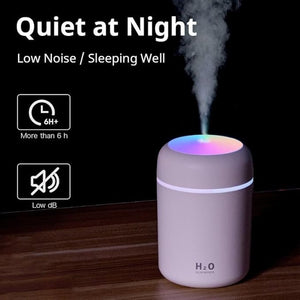
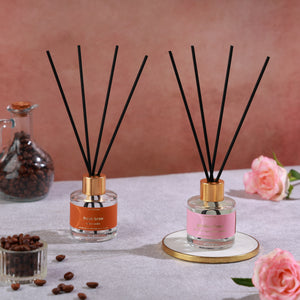
Then remove standing water and porous reservoirs, and then scent it. Squeegee, dry the mat elsewhere, clear the floor, scrub the grout, replace dead silicone, and pour a mug of water down every drain weekly so no trap dries out. Give it two weeks. When the room is genuinely neutral on your first breath walking in from outside, add a background — and an internal bathroom is a particularly good case for a reed diffuser at 50ml from ₹749, because it needs no socket, has nothing to switch, and works continuously in a room nobody is standing in. Use two or three of the six reeds, not all six: the room is small, warm and humid, all of which raise evaporation and perceived intensity, and six reeds in a 40 sq ft internal room reads as air freshener. Place it away from the direct line to the extract grille so the fan is not simply pulling your fragrance out through the duct. If the bathroom is large or opens onto a dressing area with a socket, the Sukoon at ₹1,899 with 3–6 drops of a Hotel Collection scent from ₹299 covers roughly 270–320 sq ft and gives you a switch instead.
What to do, in order
The first three steps are about water and minutes, and they are where a windowless bathroom is actually fixed. The fourth is the one you buy, and in this particular room it is unusually well suited.
| Step | What to do | When | Cost |
|---|---|---|---|
| 1. Remove the source | Tissue-test and clean the fan, confirm the duct reaches outside, pour water down every drain weekly | Before anything else | ₹0 |
| 2. Move the air | Run-on timer or humidity sensor for fifteen to twenty minutes after every shower, plus a gap under the door | Daily, five to ten minutes | ₹0 |
| 3. Deal with what holds it | Squeegee the walls, dry the mat outside the room, clear standing water, scrub grout, replace dead silicone | Weekly to monthly | ₹0 |
| 4. Then the always-on layer ★ | A SOSA reed diffuser — a background that runs without a socket or a switch in a room nobody stands in, at two or three reeds | 50ml 6-8 weeks · 130ml 14-18 | from ₹749 |
| 5. Or the on-demand layer | Sukoon with a Hotel Collection scent — a switch for a larger bathroom or an adjoining dressing area; covers roughly 270-320 sq ft | Run it when you want it | ₹1,899 |
Versailles
If you have an internal bathroom, the most useful thing I can tell you is not about fragrance at all. It is to spend a small amount on a run-on timer module for the fan you already own. Fifteen to twenty minutes after each shower will do more for that room than anything in our range, and I would rather you did it first, because a diffuser in a room that never dries is money spent on the wrong problem.
The second thing is the door. People fit a lovely tight bathroom door, sometimes with a draught excluder, and then cannot understand why the fan sounds strong and achieves nothing. A fan needs air to come in. A gap under the door is not sloppy carpentry, it is part of the design. Half the windowless bathrooms I have been asked about were sealed shut by somebody being tidy.
Where I do think we help is afterwards. A windowless bathroom is small, warm and unattended, which is exactly the brief a reed diffuser is built for — no socket, no switch, always running. Two or three reeds is plenty; six is too many for that volume and you will smell it from the corridor. Keep it out of the fan's line, and expect a 50ml to run its full 6–8 weeks. A portion of every order funds a girl's classroom through Nanhi Kali.
Frequently asked questions
- Musty even with an exhaust fan — the five ways a fan fails.
- Worse during monsoon — when extraction stops being a drying tool.
- How hotels actually do it — continuous extraction and low continuous scent.
- Why the air freshener makes it worse — odour blending, not cancellation.
- Brand: the SOSA founder story.
SOSA products & prices (verified August 2026): Hotel Collection water-based ultrasonic diffuser fragrance 15ml ₹299 · 100ml ₹999 · 300ml ₹1,799 · Pack of 7 (15ml, all fragrances) ₹1,799; refills 100ml from ₹999. Seven scents: The Ritz-Carlton-inspired (white tea · bergamot · cedar), Westin-inspired (white tea · aloe · cedar), 1 Hotels-inspired (cedarwood · vetiver · green leaves), The St. Regis-inspired (amber · violet · woods), Shangri-La-inspired (jasmine · green tea · white tea), Four Seasons-inspired (citrus · floral · sandalwood), W Hotels-inspired (citrus · pepper · amber). Diffusers: Boond 300ml ₹899 · Sukoon 500ml ₹1,899 · Megh 6L ₹3,499. Water-based, phthalate-free, composed to IFRA standards for home diffusion; 3–6 drops per tank. Made in India, Pune. The Hotel Collection scents are SOSA's own interpretations inspired by the world's finest hotels; all hotel names are trademarks of their respective owners and are used only to describe the scent style — SOSA is an independent Indian fragrance house, not affiliated with or endorsed by any hotel brand. Prices and availability subject to change — see the live product pages.