




Above it: four hours ≈ ₹2.80 an hour · eight hours ≈ ₹1.40.
Below it: one hour ≈ ₹11.15 · thirty minutes ≈ ₹22.30. At that point the money belongs in a room that is already occupied.
The exception: an entrance hall. Judge it on arrivals, not hours.
2. Above the line the figures get good very quickly. Four hours a day — a normal living room in the evening — is 448 hours and about ₹2.80 an hour. Eight hours, which is a bedroom, is 896 hours and about ₹1.40. Nothing else in the house comes close to those two rooms, which is exactly why every allocation article in this cluster ends up recommending that you concentrate on them rather than spreading across five.
3. Below the line it deteriorates faster than people expect. One hour a day is 112 hours and about ₹11.15 an occupied hour. Half an hour is 56 hours and about ₹22.30 — sixteen times what the same bottle costs in a bedroom. Five minutes a day, which is a store room, is around nine hours across the bottle's life and roughly ₹134 an hour. The bottle has not changed at all; you have simply moved it somewhere nobody is.
4. Sleeping hours count, but not at full weight. This is the honest caveat. You are asleep for most of a bedroom's eight hours, and adaptation means you stop registering a constant smell within about twenty minutes of lying down anyway. What a bedroom bottle actually buys is the first breath on walking in and the first breath on waking. That is still worth having — it keeps the bedroom second on every purchase list — but it is why a living room used four conscious hours is not obviously worse value than a bedroom used eight.
5. The exception is the entrance, and it fails the test outright. A foyer might hold somebody for two minutes a day and still deserve fragrance, because it is the one space almost always met with a fresh, unadapted nose. Judge it on arrivals per week rather than hours per day. If people come and go daily, put a bottle where it is met on the way in — often the entrance side of the living room, which covers both jobs for one purchase.
Made in India, composed by an ISIPCA Versailles-trained perfumer — and a portion of every order supports girl-child education through Nanhi Kali.
Why hours, and not square feet, decide this
Almost every question about how many diffusers a home needs is answered with area, and area is the wrong denominator. A reed diffuser is a passive evaporative source running continuously. Fragrance climbs the porous core of each reed, evaporates from the exposed tip, and the rate is set by exposed reed surface, room temperature and air-change rate. Occupancy appears nowhere in that list, which means a bottle spends itself at the same speed in an empty room as in a full one. Once you accept that, the only sensible way to compare two rooms is to divide the price by the hours somebody is actually in them — and that single calculation reorders a shopping list more decisively than any coverage figure does.
The second reason hours beat square feet is that the perception of fragrance is not evenly distributed across those hours either. Olfactory adaptation is essentially complete within about twenty minutes, so the first minutes in a room are worth far more than the hours that follow. This cuts both ways and it is worth being honest about both. It slightly weakens the bedroom, where most of the eight hours are spent asleep and adapted — a bedroom bottle really buys two moments a day, the walk in and the wake up. And it rescues the entrance hall entirely, because a foyer holding somebody for ninety seconds delivers those ninety seconds at full perceptibility, every single time anybody arrives. Hours are the right first filter. Arrivals are the correction you apply afterwards, and between them they explain why the honest shopping list for most homes is two or three bottles rather than six.
Above the line, below it, and the one exception
 130mlFrom ₹1,249A living room used four hours an evening: 448 occupied hours across the bottle, about ₹2.80 an hour. A bedroom slept in for eight: 896 hours, about ₹1.40. A home office used six hours on weekdays: roughly 480 hours across the same period, about ₹2.60. All three comfortably justify the larger bottle, which is also the cheaper one by the week — 14–18 weeks at about ₹78 against 6–8 at about ₹105 for the 50ml.
Sizing by space — the test applied, room by room
This is the threshold turned into a shopping list. Applied to one ordinary flat it buys three bottles and refuses four, and the three rows that spend nothing are the ones that make it work.
| Space | What it needs | How many | Cost |
|---|---|---|---|
| Main bedroom — about eight hours a night ★ | 896 occupied hours across a 130ml, roughly ₹1.40 an hour. Four reeds, not six | One 130ml | ₹1,299 |
| Living room — about four hours an evening | 448 occupied hours, roughly ₹2.80 an hour. Six reeds, placed towards the entrance side of the room | One 130ml | ₹1,249 |
| Home office or study — about three hours a day | 336 occupied hours, roughly ₹3.70 an hour. Comfortably above the line, and the third bottle in most homes | One 130ml | ₹1,349 |
| Dining room used forty minutes a day | Nothing. About 75 occupied hours and roughly ₹17 each — and if it opens onto the living room, the bottle there is already in the same air space | None | ₹0 |
| Guest bedroom, used a few nights a year | Nothing. Move a running bottle in forty-eight hours before they arrive and take it back afterwards | None | ₹0 |
| Passage, store room or utility balcony — five minutes a day | Nothing. About nine occupied hours across the bottle, roughly ₹134 an hour. A passage is a transit space | None | ₹0 |
| A note on all of the above: the three purchases above come to ₹1,299 + ₹1,249 + ₹1,349 = ₹3,897, leaving ₹103 from ₹4,000, and the three ₹0 rows are what make that affordable. All coverage figures assume six reeds, a closed room, still air and a standard ceiling; occupancy decides whether to buy at all, and coverage decides what to buy. | |||
One room · the unitFrom ₹749Shop → 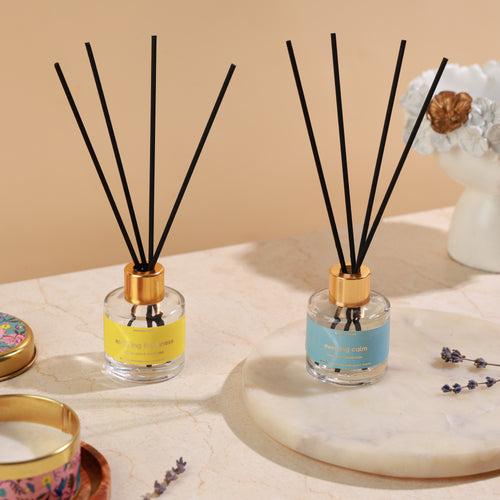 Two rooms · better value₹1,498Shop →
  Large room · a switch₹1,899Shop →
Reeds, sleeping hours, and applying the test to your own flat
Do the calculation on the back of an envelope, once. Write down each room, an honest estimate of the hours somebody is consciously in it on a normal day, and multiply by 112 — the days a 130ml runs. Divide ₹1,249 by that number. Anything under about ₹6 an occupied hour is a comfortable purchase; anything over about ₹12 should wait; anything over ₹20 should not be bought at all. Be honest about the hours rather than aspirational — the dining room you intend to start using and the study you plan to work from are common and expensive fictions, and this is the arithmetic that exposes them before the money leaves.
Then set reeds by room rather than by rule. Above the line, six reeds suits a living room and four a bedroom, since six in a room you sleep in is a level most people find too present. Reed count is the only volume control a diffuser has and it moves both dials at once: more reeds is a stronger room and a shorter bottle, fewer is a calmer room and a longer one. In a room that only just clears two hours, three reeds is often right — it stretches the bottle towards the top of its range, which improves the cost per occupied hour of the marginal room specifically. Give any new bottle forty-eight hours before judging it, and judge it from the doorway rather than from the sofa.
And treat the rooms below the line as a movement problem, not a purchase. A guest room, a dining room used for occasions, a formal sitting room: all of these read beautifully with a bottle moved in two days ahead and returned afterwards, and all of them waste fourteen to eighteen weeks if given one permanently. Once the rooms above the line are running, a 300ml refill at ₹2,399 fills a 130ml roughly twice and is the cheapest way to keep them going; it is also the natural moment to fit fresh reeds, since clogged fibre is the commonest reason a bottle seems finished while there is still liquid in it. Evening Calm for the bedroom, Mountain Breeze for a study.
What to buy
Buy from this table only for rooms that clear about two hours a day. Applied to an ordinary three-bedroom flat that is usually three lines, and four rooms that get nothing.
| Buy | What it covers | Lasts | Price |
|---|---|---|---|
| One 50ml | A single reed diffuser — a room that only just clears two hours, or a small bathroom entered many times briefly | 6–8 weeks | from ₹749 |
| One 130ml ★ | The value size — any room above about two hours a day — ₹1.40 an occupied hour at eight, ₹2.80 at four | 14–18 weeks | from ₹1,249 |
| The duo | Day & Night duo — two qualifying rooms from today, at 6–8 weeks each rather than 14–18 | 6–8 weeks each | ₹1,498 |
| Sukoon | 500ml ultrasonic — a large qualifying room past about 200 sq ft, where a switch also stops the spend while nobody is there | Runs when you switch it on | ₹1,899 |
| 300ml refill | The running cost — the cheapest way to keep the qualifying rooms running once you own the glass | Roughly 2 × 130ml fills | ₹2,399 |
Versailles
I like this question because it has a number rather than an opinion at the end of it. Roughly two hours a day. Below that, a ₹1,249 bottle is costing you more per occupied hour than the room is giving back — ₹11.15 an hour at one hour a day, ₹22.30 at half an hour — and the same money in the living room is buying hours at ₹2.80.
The caveat I always add is that sleeping hours are not worth quite what they look like. You are asleep for most of them and adapted for the rest, so a bedroom bottle really buys the walk in at night and the first breath in the morning. That is genuinely worth having and it keeps the bedroom high on the list. It just is not eight hours of enjoyment, and I would rather say so.
The exception is the entrance, and it is the one place I will happily argue against my own rule. A hall holds people for two minutes and it is the only room in the house that is always smelled with a fresh nose. Usually you do not even need a separate bottle for it — move the living-room one to the entrance side of the room and you have covered both for ₹1,249. A portion of every order funds a girl's classroom through Nanhi Kali.
Frequently asked questions
- Rooms nobody uses — the far end of this same arithmetic.
- A weekend-only room — 32 occupied days out of 112.
- Which three rooms come first — the order the hours produce.
- A room that is always closed — closed and used against closed and empty.
- Brand: the SOSA founder story.
SOSA products & prices (verified August 2026): Hotel Collection water-based ultrasonic diffuser fragrance 15ml ₹299 · 100ml ₹999 · 300ml ₹1,799 · Pack of 7 (15ml, all fragrances) ₹1,799; refills 100ml from ₹999. Seven scents: The Ritz-Carlton-inspired (white tea · bergamot · cedar), Westin-inspired (white tea · aloe · cedar), 1 Hotels-inspired (cedarwood · vetiver · green leaves), The St. Regis-inspired (amber · violet · woods), Shangri-La-inspired (jasmine · green tea · white tea), Four Seasons-inspired (citrus · floral · sandalwood), W Hotels-inspired (citrus · pepper · amber). Diffusers: Boond 300ml ₹899 · Sukoon 500ml ₹1,899 · Megh 6L ₹3,499. Water-based, phthalate-free, composed to IFRA standards for home diffusion; 3–6 drops per tank. Made in India, Pune. The Hotel Collection scents are SOSA's own interpretations inspired by the world's finest hotels; all hotel names are trademarks of their respective owners and are used only to describe the scent style — SOSA is an independent Indian fragrance house, not affiliated with or endorsed by any hotel brand. Prices and availability subject to change — see the live product pages.