
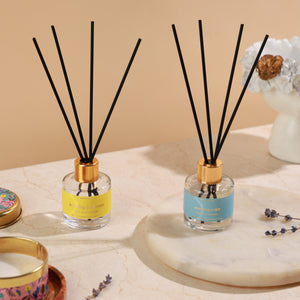
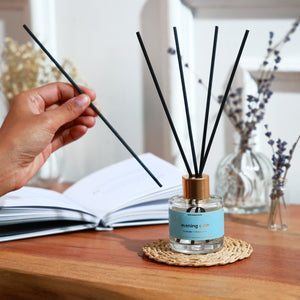



If you want two good places: two reeds is exactly right, and I would buy them deliberately rather than apologetically. A bed end and a desk end, or a bedroom that opens into a dressing area, are two zones. You can even run different scents in them.
Before either, do the free things: ceiling fan on low in a closed room — the one change that adds transport rather than emission — then move the existing bottle closer to where you actually are, nose height on a surface, six reeds for an open room or three at a bedside, and shut the door.
The money, honestly: a 50ml reed at ₹749–₹849 runs 6–8 weeks, roughly ₹13–₹15 a day. Two bottles is twice that, indefinitely. Sukoon at ₹1,899 is once, covers 270–320 sq ft and actually moves air — but it needs power, filling and has a lifespan, where a reed never breaks and works in a power cut.
2. Yes if two places is the goal. This is the distinction that decides the purchase. A long bedroom with a bed at one end and a desk at the other is not one volume you are trying to fill evenly — it is two places you sit in, several metres apart, at different times of day. Two point sources serve two places extremely well. You may even want different scents in them, which one machine cannot do at all.
3. Do the free things before either. Turn the ceiling fan on low with the door closed and the bottle out of the direct downdraught; this is the only free change that supplies transport rather than emission, and it is the closest a reed setup ever gets to evenness. Move the bottle you already own towards where you actually spend time. Put it at or slightly below nose height, on a surface. Use six reeds in an open room and three at a bedside, where three is a soft level and roughly doubles the life.
4. Know what the second bottle costs over time. A 50ml at ₹749–₹849 runs 6–8 weeks, which is roughly ₹13–₹15 a day. Two bottles is twice that, and it repeats for as long as you want the room scented. That is not an argument against it — plenty of people are happy with it — but it should be a decision rather than a drift.
5. If it is evenness you want, buy the mechanism, not the second bottle. Sukoon at ₹1,899 covers 270–320 sq ft, runs 16–18 hours on low from a 500ml tank, and moves air. It also dilutes the oil in water, adds humidity to the room, needs filling, and can leave a fine white mineral dust in a hard-water city. Both sides of that are true.
Alcohol-free, phthalate-free, IFRA-compliant, made in Pune. A portion of every order supports girl-child education through Nanhi Kali.
Two hills and a valley — walk it yourself and you will feel it
Here is the experiment, and it costs nothing to imagine. Stand at the wall where the first diffuser is. Concentration is at its highest — this is the part you already like. Walk towards the opposite wall and it falls away steadily, because you are moving away from a source with nothing pushing its vapour after you. Halfway across, you are as far from that bottle as you can get without leaving the room. Now put a second bottle on the far wall and walk the same line. You start high, fall, reach a low point in the middle, and climb again as the second source takes over. That is two hills with a valley between them. It is a better room than it was — the middle is not as poor as it was, because a little of each source reaches it — but it is emphatically not a plateau, and the low point has stayed in the same place.
The reason is structural rather than a matter of dosage. A reed diffuser is a point source with no transport. Oil climbs six fibre reeds by capillary action and evaporates at whatever rate the room’s temperature, humidity and airflow allow, and then it is entirely at the mercy of two processes: molecular diffusion, which is far too slow to cross metres of a room usefully, and whatever air the room happens to be moving, which does nearly all the work and is not under the bottle’s control. Two bottles double the emission and add nothing whatever to transport. You have built two of the same thing rather than one better thing.
There is one more piece of this worth knowing, because it explains why the valley feels deeper than it is. Perception compresses gradients. Your nose reports change far better than steady state, so as you walk out of a peak you experience a sharp drop rather than the smooth decline that is physically happening, and the room reads as having edges it does not have. Nothing is faulty. You are simply a very good detector of differences and a rather poor meter of levels.
The three cases where two diffusers genuinely is the right purchase
I do not want this page to read as a blanket no, because for a real proportion of people writing this question the answer is yes — just for a different reason than the one they had in mind. Here are the situations where I would buy the second bottle without hesitating.
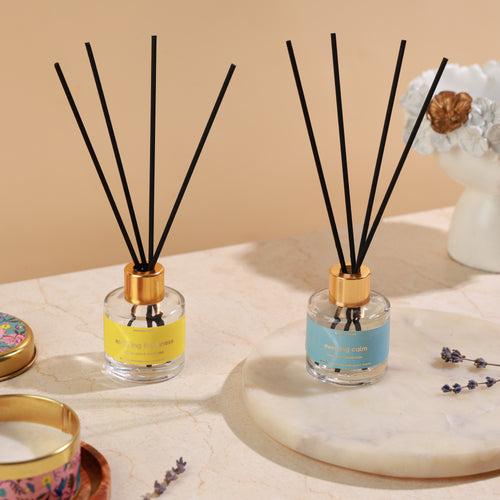
 Evening Calm₹799This is the strongest case and it is common in Indian flats, where a bedroom often has a bed at one end and a desk, a dressing table or a reading chair at the other, sometimes around a corner. You are not asking for one uniform volume. You are asking for two good places, which you occupy at different hours. A point source is excellent at making one good place, so two of them make two, and the fact that the middle is weaker matters very little because nobody spends any time in the middle of a bedroom. Buy the second bottle for the second chair, not for the space between them.
 Mountain Breeze₹849One machine, however good, runs one scent at a time. Two bottles can run two, and that is a genuine advantage rather than a compromise — bright and citrus where you get ready, soft and herbal where you sleep. It also solves a problem people rarely name until it happens to them: a home that smells identical everywhere stops registering as a smell within about a week, because there is no transition anywhere to notice. Two registers in one long room give you two arrivals a day. The Day & Night duo at ₹1,498 exists precisely for this, and its advantage is hedging and zoning rather than a discount — it is two 50ml bottles, not a boxed set.
 Morning Freshness₹749A machine needs a socket, and in a bedroom the sockets are usually already spoken for. A machine makes some noise, and some people will not have that beside a bed at all. A machine has to be filled or charged, and it has a lifespan. A machine is also ₹1,899 today rather than ₹749 today. Against all of that, a reed diffuser is silent, needs no power, works right through a power cut, has nothing to fill, nothing to charge and nothing to remember, and it never breaks because there is nothing in it to break. If those constraints are yours, two reeds is a perfectly rational arrangement and I would not argue you out of it — as long as you buy it knowing it gives you two zones rather than one even room.
Two reeds against one machine, scored honestly
The comparison as I would make it for one bedroom, conceding every row that two passive sources genuinely win. The last line names the thing neither arrangement solves and the gap in our own range.
| What you care about | Two reeds | One Sukoon ₹1,899 | Who wins |
|---|---|---|---|
| Evenness across one volume | Two peaks, a valley between | Moves air; 270–320 sq ft | The machine, clearly |
| Two separate places used at different hours | Excellent — one good spot each | One source, one strongest point | Two reeds |
| Two different scents at once | Yes | No — one tank, one scent | Two reeds |
| Silence and no socket | Silent, no power, works in a power cut | Needs a socket and makes some sound | Two reeds |
| Maintenance | Flip every 3–5 days; nothing to fill or charge | Fill the 500ml tank; clean it; hard water can leave white dust | Two reeds |
| Cost shape | ₹749–₹849 each, 6–8 weeks, roughly ₹13–₹15 a day — twice over, indefinitely | ₹1,899 once, plus oil. Needs power and has a lifespan | Depends on how long you intend to keep scenting the room |
| What neither fixes: the gap in the range | Between Safar ₹3,999 — named and sold as a car and travel diffuser, with no published room coverage figure — and Vaayu ₹11,999, rated to 1000 m³ or roughly 2,000–3,000 sq ft, SOSA has no mid-sized waterless bedroom machine. Vaayu is the wrong purchase for one bedroom | Named rather than sold around | |
Two zones · Day & Night₹1,498Shop → 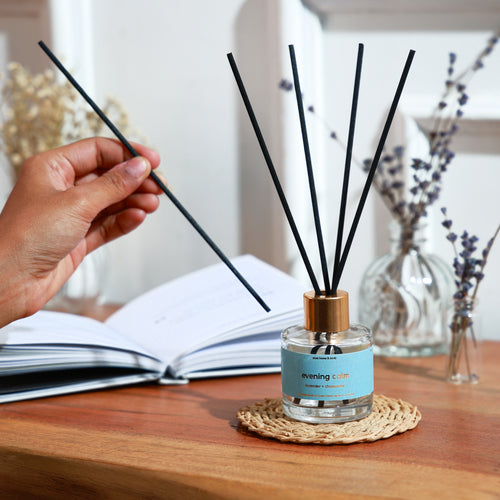 One zone · Evening Calm₹799Shop →
  One even room · Sukoon₹1,899See it →
The arithmetic, and the counterweights I will not leave out
Let me put the money on the table, because it is the part people work out privately and get slightly wrong. A 50ml SOSA reed is ₹749 to ₹849 and runs six to eight weeks, which comes to roughly ₹13 to ₹15 a day — a much fairer way to look at it than the sticker price, since a ₹749 bottle that runs two months is a different purchase from a ₹749 object. Two bottles in one bedroom is twice that, and it continues for as long as you want the room to smell of something. Against that sits Sukoon at ₹1,899 once, plus oil. I am deliberately not going to compute a running cost for the machine and set it against the reed, because SOSA publishes no oil-consumption rate for its machines and a number I invented would be worse than no number at all.
The counterweights matter as much as the arithmetic. A machine needs power, which means a socket you may not have to spare beside a bed. It needs filling or charging, which means remembering. It has a lifespan, as all appliances do. A reed diffuser has none of those requirements: it is silent, it works during a power cut, it asks nothing of you but a flip of the reeds every three to five days, and it never breaks. There is also a repeat-purchase answer that is worth knowing if consumption is your real concern — a 300ml refill at ₹2,399 is roughly six 50ml fills for a bottle and reeds you already own, and running three reeds instead of six roughly doubles how long each fill lasts. Refills are oil only, so they are never a first purchase, but for somebody tired of repurchasing bottles they are the honest answer.
What to buy, in what order
In the order I would actually work through it, with the free options first because a page that skips them to sell a second bottle deserves to be ignored. The last row is the honest gap.
| Step | What it is | When it is the right answer | Price |
|---|---|---|---|
| 1. Ceiling fan on low, door closed ★ | The only free change that adds transport rather than emission | Before any second purchase. It does more for evenness than a second bottle | Free |
| 2. Move the bottle you own | Halve the distance to where you sit, nose height, on a surface, out of the draught | If there is one place that matters more than the others | Free |
| 3. A second reed — the duo | Two 50ml bottles, two scents, two zones. Day & Night ₹1,498, Fresh & Grounded ₹1,548, Warmth & Bloom ₹1,598 | A long or L-shaped room used at both ends, or wanting different scents by hour | ₹1,498–₹1,598 |
| 4. Sukoon ultrasonic | 500ml, 270–320 sq ft, 16–18h on low, three 15ml Hotel Collection scents. Moves air. Water-diluted, adds humidity, needs filling | When evenness across one volume is genuinely the requirement | ₹1,899 |
| 5. A 300ml refill | Roughly six 50ml fills, oil only, for a bottle and reeds you already own | If the real objection is how often you repurchase. Never a first purchase | ₹2,399 |
| The honest gap: two of anything is not evenness | Two passive sources make two hills. And between Safar ₹3,999 and Vaayu ₹11,999 — 1000 m³, roughly 2,000–3,000 sq ft — SOSA has no mid-sized waterless bedroom machine | Stated rather than worked around | ₹1,899 |
Versailles
The second diffuser is the most reasonable wrong purchase in home fragrance, and I want to say that carefully, because nobody who makes it is being foolish. If you have been told that a diffuser scents a room, then two diffusers scenting a room more is a perfectly sound piece of reasoning. The premise is what is off. A reed diffuser does not scent a room; it scents a zone, and two of them scent two zones.
So the question I would ask you before you order is a simple one: are you trying to fix a place, or a space? If there are two places in that bedroom you actually sit or lie in, buy the second bottle with my blessing, put each one within reach of its own chair, and consider running two different scents so that moving between them is an event rather than a continuation. If what you want is a room that reads the same everywhere, no number of bottles gets you there, and I would rather you spent ₹1,899 once on something that moves air than ₹799 twice on something that does not.
What I would never do is talk down the reed on the way to that recommendation. It is silent, it takes no socket, it works in a power cut, there is nothing to fill or charge or remember, it never breaks, and it costs about thirteen or fifteen rupees a day. Those are not small virtues in a bedroom. They are simply not the same virtue as evenness. Everything is composed in Pune, and a part of every order funds a girl’s classroom through Nanhi Kali.
Frequently asked questions
- My diffuser is across the bedroom and I can’t smell it from my bed — the four changes, in order.
- How to make the fragrance reach the bed — why distance is the dominant lever.
- Should it go on the bedside table? — yes, and it is not a compromise.
- Only 100 sq ft and still nothing from the bed — small does not mean even.
- A 10 × 12 bedroom with the diffuser near the door — the worst spot in the room.
- Move it closer, or buy better projection? — move it, and why free comes first.
- Fragrance wherever I am — are reeds enough? — for evenness, honestly no.
- Strong walking in, gone once in bed — two mechanisms stacking.
- Reaching the bed without the bottle beside it — where active diffusion legitimately begins.
- Brand: the SOSA founder story.
SOSA facts verified August 2026: Reed diffusers in 50ml and 130ml only — Morning Freshness ₹749 / ₹1,249, Evening Calm ₹799 / ₹1,299, Garden Bloom ₹799 / ₹1,299, Mountain Breeze ₹849 / ₹1,349, Fresh Brew ₹849 / ₹1,349. 50ml suits rooms up to about 150 sq ft and runs 6–8 weeks; 130ml suits above 150 sq ft and runs 14–18 weeks; roughly ₹13–₹15 a day. Six fibre reeds, not rattan, in a refillable glass bottle, on a heat-stable CCT carrier rather than DPG, alcohol-free, phthalate-free, paraben-free, IFRA-compliant, 0 ppm formaldehyde, tested at 45°C and 85% RH, composed in Pune. Six reeds is full output; three is a soft bedside level and roughly doubles the life; flip every 3–5 days. Duos are two 50ml bottles: Day & Night ₹1,498, Fresh & Grounded ₹1,548, Warmth & Bloom ₹1,598; 130ml duos ₹2,498 / ₹2,548 / ₹2,598. Refills 300ml ₹2,399, roughly six 50ml fills, and 500ml ₹3,499 — oil only, never a first purchase. Machines: Boond ₹899, Sukoon ₹1,899 (500ml, 270–320 sq ft, 16–18h on low), Megh ₹3,499 (6 litres, about 100 hours runtime, only about 215 sq ft), Safar ₹3,999 (waterless cold diffusion of undiluted oil, 20ml, three speeds, 1/2/3-hour timer — named and sold as a car and travel diffuser, with no published room coverage figure), Vaayu ₹11,999 (up to 1000 m³, roughly 2,000–3,000 sq ft). Between Safar and Vaayu SOSA has no mid-sized waterless bedroom machine. Reed oil and the water-based Hotel Collection are separate products and are not interchangeable in either direction; there is no hotel-inspired reed diffuser. No health, air-quality or sleep claims are made for any SOSA product, and fragrance does not remove an unwanted smell — deal with the source, then ventilate, then fragrance. Free shipping above ₹499. A portion of every order supports girl-child education through Nanhi Kali. SOSA is an independent Indian fragrance house; the Hotel Collection is SOSA’s own interpretation inspired by the world’s finest hotels, and SOSA is not affiliated with or endorsed by any hotel brand. Prices subject to change — see the live product pages.