

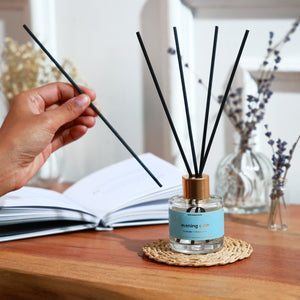


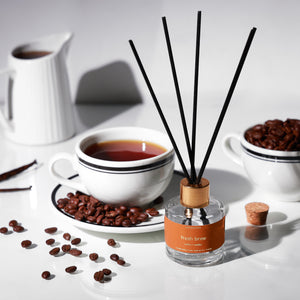
Commonest cause: still air — a corner, a cabinet, a bottle boxed in by walls or furniture, or a shelf too low for the scent to reach nose height.
The fix, in order: move it onto a route where air passes, raise it to waist–chest height, then take the reed count to six. All three are free.
2. Strong up close is proof that the bottle is fine. It rules out clogged reeds, a spent bottle and an unsaturated set in one sniff. Whatever you do next, do not do it to the fragrance — the fragrance is the part that is demonstrably working.
3. Move it onto a route where air passes. A hallway console, a shelf beside a doorway, a sideboard on the path between two rooms. Air is pushed around a home by doors opening, people walking and windows — put the bottle in that traffic rather than out of it.
4. Get it up, and get it clear. Waist to chest height rather than floor level, with open air on at least two sides. Out of cabinets, out from behind curtains and cushions, forward from the wall. Soft furnishings absorb fragrance as readily as they absorb sound.
5. Then reed count — and be realistic about what it buys. Six reeds raise output at the source and will push the boundary out somewhat. They will not turn a still corner into a scented room. Never use more than the six supplied.
Made in India, composed by an ISIPCA Versailles-trained perfumer — and a portion of every order supports girl-child education through Nanhi Kali.

Concentration at the tip is not the same thing as scent in a room
Two different quantities get confused whenever somebody says a diffuser is weak. The first is concentration at the source: how much fragrance is in the small volume of air immediately around the reed tips. The second is dispersal: how much of that loaded air ends up in the parts of the room where people actually stand. A reed controls the first and has no influence whatsoever over the second. Nothing in the bottle moves air. Left entirely undisturbed, fragrance molecules spread by diffusion alone, which is a slow, aimless business over the distances of a living room — the reason a still corner produces a rich pocket of scent around the glass and almost nothing three feet away.
What actually moves scent around a home is bulk air movement: a door swinging, somebody walking past, a window cracked open, warm air rising off a sunlit wall, the general circulation of a room in use. This is why the same bottle behaves like two different products depending on where it stands, and why the fix costs nothing. It is also why raising the source only helps so much. Going from four reeds to six increases what is available to be carried, and you will notice the boundary move outwards a little — but if there is nothing doing the carrying, you are simply making a slightly larger puddle. Air first, then reeds. That order is the whole answer to this particular complaint.
The three things that set how far a reed reaches
The distance test
Do this once now and again forty-eight hours after you move the bottle. Same time of day, same doors open or shut. It converts a vague impression into something you can actually compare.
| Where you stand | What you should notice | What it tells you |
|---|---|---|
| Nose to the reeds ★ | Clear, rich, unmistakable | Supply is fine — this is a transport problem, not a weak bottle |
| An arm's length away | Obvious without leaning in | Normal. If there is nothing here, check the reed count and the calendar |
| Two to three metres | Present but soft | The honest working radius of a reed in still air |
| At the room doorway | Noticeable as you pass through | If yes, airflow is doing its job. If no, the bottle is in the wrong place |
| Walking in from outside | The whole room reads as scented | The only test that bypasses your own adaptation — the one that counts |
| 48 hours after moving it | The same five distances again | Compare honestly. A good move shows up at the doorway first |
| Nothing at any distance, including at the bottle: that is a different problem — clogged reeds or an unsaturated new set. See all five reed diffusers and the diagnostic guide. | ||
The reed range · five scentsFrom ₹749Shop → 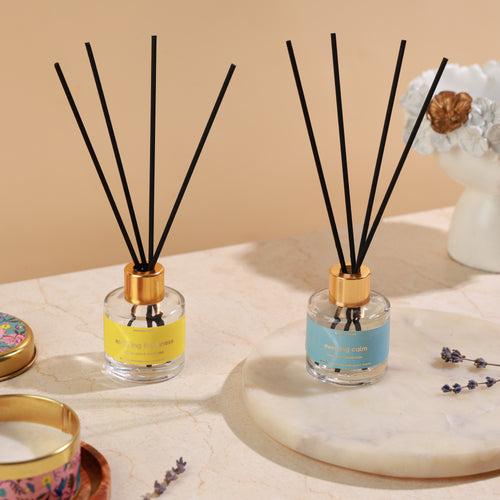 Day & Night duo · two rooms₹1,498Shop →
 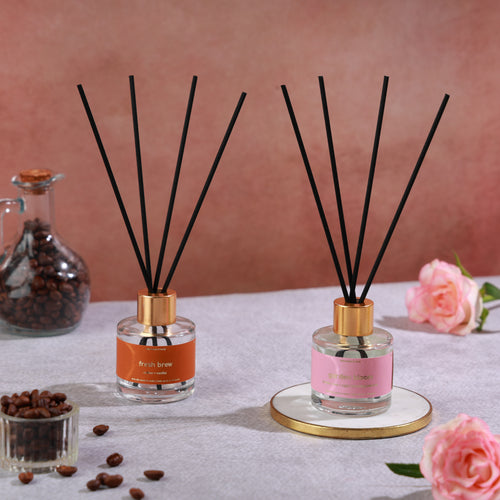 Refills · 300ml₹2,399Shop →
Reeds, placement and flipping — the three things you control
Set the reed count to match the job rather than the room's dimensions: six for a hall, a living room or a kitchen, four for a bedroom, two or three for a small bathroom. If your complaint is a short radius, six is where you want to be — but add them after you have solved the airflow, so that you can tell which change did the work. Beyond six there is nothing to gain: the neck is sized for six, extra sticks wick unevenly, the bottle empties faster and it becomes easy to knock over. And never top up or thin the liquid to compensate.
Placement is the whole subject of this piece, so give it the full attention. The target is gentle, regular air movement at roughly nose height with open air around the bottle: a hallway console, a shelf beside a doorway, a sideboard on a route people actually walk. Avoid still corners, closed cabinets, low shelves, and the crowded back of a bookcase. Avoid direct sunlight, which fades the fragrance and warms the oil, and the direct blast of a vent or fan, which empties the bottle and pushes everything to one wall. Stand it on a tray — reed oil marks polished wood and untreated stone permanently if it is knocked — and keep it well out of reach of children and pets. Never decant it into another container.
Flipping is worth a mention here mainly for what it will not do. Turning the reeds saturated-end up every three to five days lifts output at the source for a day or two, which is real and useful, and it costs bottle life, so daily flipping is a trade rather than a gift. But a lifted source in still air still has nothing carrying it across the room, so flipping is close to useless as an answer to a short radius. Use it when you want a temporary lift in a room that already circulates. And if throw has dropped everywhere after two or three months, that is clogged fibre rather than placement: fit the fresh six from your last bottle, and use a 300ml refill at ₹2,399 rather than replacing the glass.
What actually widens the radius
Ordered by what each thing genuinely buys you. Note that only the last two rows involve money, and the last row is a different product for a different job.
| If this is you | Do this | What it costs |
|---|---|---|
| Strong at the bottle, nothing at two metres ★ | Move it onto a route where air passes — doorway, passage, sideboard | Free |
| It sits low, or boxed in | Raise it to waist–chest height with open air on at least two sides | Free |
| Running three or four reeds | Take it to all six — a higher source, and a slightly wider boundary | Free; shortens the bottle |
| Reeds over two months old | Fit the fresh six that came with your last bottle | Included with each bottle |
| Room far larger than 150 sq ft | A second bottle at the far end — two sources, not one louder one | 50ml ₹749 · 130ml ₹1,249 |
| You want scent on demand instead | An ultrasonic Sukoon — water-based Hotel Collection, never reed oil | ₹1,899 |
Versailles
This is the complaint I most enjoy receiving, because the answer is almost always free and the person is usually a step away from spending money they do not need to spend. Strong at the bottle means every part of the product is doing what it was designed to do. The failure is in the geometry of the room, not in the glass.
I have watched a 50ml at ₹749 on a hallway console outperform a 130ml in a corner of the same flat, repeatedly and obviously. It is not a subtle effect. Air is the delivery mechanism, and a bottle placed out of the air is a bottle with no delivery mechanism at all.
So before you consider a larger size or a stronger blend, spend two days on a different shelf. If a person walking in from outside still cannot smell it after that, the room is bigger than one bottle covers and a second one is the honest answer. A portion of every order supports girl-child education through Nanhi Kali.
Frequently asked questions
- Does placement affect scent throw? — airflow, height and obstruction in detail.
- Why can I not smell my reed diffuser? — the full diagnostic, in order.
- Should I add more reeds? — yes, with one honest caveat.
- The complete scent throw guide — the three levers, ranked.
- Brand: the SOSA founder story.
SOSA products & prices (verified August 2026): Hotel Collection water-based ultrasonic diffuser fragrance 15ml ₹299 · 100ml ₹999 · 300ml ₹1,799 · Pack of 7 (15ml, all fragrances) ₹1,799; refills 100ml from ₹999. Seven scents: The Ritz-Carlton-inspired (white tea · bergamot · cedar), Westin-inspired (white tea · aloe · cedar), 1 Hotels-inspired (cedarwood · vetiver · green leaves), The St. Regis-inspired (amber · violet · woods), Shangri-La-inspired (jasmine · green tea · white tea), Four Seasons-inspired (citrus · floral · sandalwood), W Hotels-inspired (citrus · pepper · amber). Diffusers: Boond 300ml ₹899 · Sukoon 500ml ₹1,899 · Megh 6L ₹3,499. Water-based, phthalate-free, composed to IFRA standards for home diffusion; 3–6 drops per tank. Made in India, Pune. The Hotel Collection scents are SOSA's own interpretations inspired by the world's finest hotels; all hotel names are trademarks of their respective owners and are used only to describe the scent style — SOSA is an independent Indian fragrance house, not affiliated with or endorsed by any hotel brand. Prices and availability subject to change — see the live product pages.