




The four things that decide the share: is the pan under the hood, was the hood on before the pan heated, is the air path out genuinely clear, and is anything else — an open window, a ceiling fan, an AC — pulling air sideways across the hob.
The bit it always misses is aerosolised oil, which lands on fabric and re-releases for days. That part is a wash, not an extraction.
2. Because of when it is switched on and off. A chimney only captures while it is running. Switched on when you see smoke, it has missed the first minute — which for Indian cooking is the minute the oil is hottest and throwing off the most aerosol. Switched off as you plate up, it misses the residual plume still rising from a hot pan and hot food. On three minutes early, off ten minutes late, is a free upgrade.
3. Because the air has nowhere good to go. Suction figures on the box assume a short, straight duct. A real installation with a long horizontal run, two bends, a crushed flexible pipe or a closed damper flap delivers a fraction of that. And a ductless unit does not remove anything from the flat at all — it filters grease, passes the air through carbon, and returns it to the kitchen. Once that carbon is saturated, the odour goes straight back into the room.
4. Because something else is pulling air across the hob. A hood works on a gentle, upward, uninterrupted flow. A ceiling fan on high, an AC blowing across the kitchen, or a window open on the wrong side will shear the plume sideways before it reaches the hood. In an open-plan flat the living room is often the path of least resistance, so the plume travels there instead of upward. Cross-ventilate before and after cooking, not during the first minutes of a tadka.
5. And what the hood misses is oil, not steam. The uncaptured share is largely aerosolised oil droplets carrying odour compounds. They land on the sofa, the curtains and the cushions and release slowly for days. No extraction system reaches that, and neither does fragrance — it is a wash-and-vacuum job, after which a reed diffuser or a Sukoon is worth having.
Made in India, composed by an ISIPCA Versailles-trained perfumer — and a portion of every order supports girl-child education through Nanhi Kali.
What a chimney can do, and what it was never going to do
The mental model most people carry is that a chimney sucks the smell out of the kitchen. It does not. It intercepts a buoyant plume on its way up, and it can only intercept what physically passes through its capture zone while the motor is running. Everything else — the part shed sideways, the part released before you switched it on, the part still rising after you switched it off — enters the room air and is then diluted only by ventilation. A chimney is a capture device, not a barrier. Judging it by whether the living room smells of dinner is like judging an umbrella by whether your shoes are dry.
The second thing worth understanding is what escapes. Indian cooking is largely done in hot oil, and hot oil aerosolises: it throws off droplets fine enough to ride convection currents but heavy enough to land. Those droplets carry the odour-active compounds with them. So the uncaptured fraction does not stay suspended waiting for a window to be opened; it deposits, as a thin film, on the nearest available surfaces — and on porous ones it sinks in. That is the fraction that is still smelling at midnight. It explains the specific frustration in this question: the extraction can be genuinely good, the kitchen can smell clean, and the living room can still smell of dinner, because the living room is holding what the hood missed rather than what it caught.
The three places capture rate leaks away
 Step fourFrom ₹749Stand back and look at where the hood actually sits relative to your four burners. In most Indian kitchens the hood is centred over the rear pair, the front pair sit forward of its front edge, and the hood is mounted higher than the manual suggests so the cook does not knock their head. Every centimetre of extra height widens the plume before it arrives and lowers capture. Cook anything that will smell strongly on a back burner, and use a lid whenever the dish allows — a lid keeps the aerosol in the pan rather than asking the hood to chase it.
Symptom to cause: reading the chimney honestly
Run down the list and do the confirmation column before you spend anything. Two of the commonest causes here cost nothing to fix and one of them is not a chimney problem at all.
| What you notice | Most likely cause | How to confirm it | What actually fixes it |
|---|---|---|---|
| Chimney is loud but the room still smells ★ | Low capture rate — pan outside the hood, or the unit switched on late | Hold an incense stick at each burner with the unit on high and watch the smoke path | Cook strong dishes on a back burner; switch on three minutes before, off ten after |
| Kitchen clears fast, living room does not | The uncaptured share has already deposited on soft furnishings | Smell the sofa back and curtains at close range half an hour after cooking | Wash covers and curtains; vacuum upholstery; ventilate during cooking, not after |
| Suction feels weaker than it used to | Loaded baffle filters, or a crushed or blocked duct | Remove and inspect the filters; hold tissue to the hood and see if it holds | Degrease filters every three to four weeks; have the duct run checked |
| Air smells of cooking again a few minutes after the unit runs | A ductless recirculating unit with a saturated carbon cartridge | Check whether the outlet vents outside at all, or blows back into the kitchen | Replace the carbon cartridge on schedule — it is not washable |
| Smell heads for the living room rather than upwards | A cross-draught shearing the plume — fan, AC or an open window on the wrong side | Repeat the incense test with the fan off, then on | Fan off and balcony door shut for the first minutes; purge afterwards instead |
| A burning or electrical smell from the unit itself | A fault, not an odour problem | Switch off at the wall and do not run it again | Get it inspected by an electrician or service engineer. Do not fragrance over this. |
| If none of these fit: check whether the kitchen window sits directly beside the hood. An open window right next to the hood short-circuits it — the unit pulls fresh air straight in from the window instead of pulling the plume up from the pan, which feels like strong suction and captures very little. | |||
Reeds · always-on roomsFrom ₹749Shop →  Sukoon · when you want a switch₹1,899Shop →
  Hotel Collection · the scentFrom ₹299Shop →
Fixing capture first, then fixing the room
Start with the two free changes. First, timing: chimney on when the empty pan goes on the flame, off ten minutes after you have finished, every single cook. Second, geometry: high-odour dishes on a rear burner, lid on wherever the recipe allows, and oil kept below its smoking point — oil pushed past smoke point produces far more aerosol and a harsher, more persistent smell. If you do nothing else in this article, these three habits will change what your living room smells like at nine in the evening.
Then service what you already own. Pull the baffle filters and soak them in hot water with detergent or washing soda; do it every three to four weeks if you cook Indian food daily. Wipe the underside of the hood and the deflector — it is coated in the same oil film as everything else and it sits directly above the heat. Check the duct run for crushed flexible pipe and check the outside flap actually opens. If yours is a ductless unit, find out when the carbon cartridge was last changed; if the answer is "never", that is your explanation. Then handle the cross-draught: keep the ceiling fan off and the balcony door shut for the first few minutes of cooking so the plume can rise, and purge the flat properly afterwards instead.
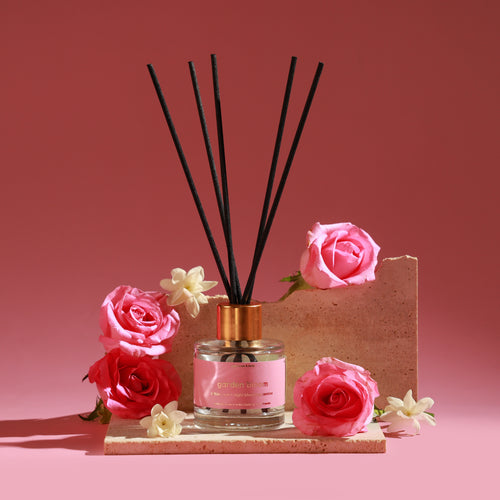
Then deal with the share that got past, and only then add fragrance. That share is on the curtains, the sofa and the cushion covers. Wash covers monthly, curtains seasonally, vacuum upholstery with the brush head, and open the windows on both sides for ten minutes while the odour is still airborne rather than an hour later when it has already settled. Once the room is genuinely neutral, fragrance has a clean base to sit on. For a living room adjoining a working kitchen I would use a reed diffuser from ₹749 as a permanent low background — it needs no switching and it is doing its job at the times you are not thinking about it. If you would rather have control, the Sukoon at ₹1,899 with a Hotel Collection scent from ₹299 covers roughly 270–320 sq ft and can be run for an hour after dinner.
The order that works
The first three steps are habits and maintenance, and they do the bulk of the work. The fourth is the purchase — worth making, but only once the first three are in place.
| Step | What to do | When | Cost |
|---|---|---|---|
| 1. Remove the source | Chimney on three minutes early and ten minutes late; strong dishes on a back burner; lid on; filters degreased | Before anything else | ₹0 |
| 2. Move the air | Fan off and balcony door shut while the plume rises, then cross-ventilate hard for ten minutes | Daily, five to ten minutes | ₹0 |
| 3. Deal with what holds it | Wash curtains and cushion covers, vacuum upholstery, wipe the hood underside and tiles with warm detergent | Weekly to monthly | ₹0 |
| 4. Then the always-on layer ★ | A SOSA reed diffuser — a permanent low background for the living room, with nothing to switch on or remember | 50ml 6-8 weeks · 130ml 14-18 | from ₹749 |
| 5. Or the on-demand layer | Sukoon with a Hotel Collection scent — an after-dinner reset you can run for an hour; covers roughly 270–320 sq ft | Run it when you want it | ₹1,899 |
Versailles
People write to me about chimneys more than about any other appliance, and almost always to ask whether they should buy a stronger one. Usually they should not. The unit is fine; the timing is the problem. Switching it on when you see smoke means it missed the moment that mattered, and switching it off when you serve means it missed the tail. Nothing you buy compensates for that.
The other thing I would like more people to know is which kind of chimney they own. A ducted unit sends the air out of the building. A ductless one filters grease, runs the air through carbon and returns it to the kitchen. They look identical from the front. If yours is ductless and the carbon has never been changed, the machine is quietly handing the odour back to you, and no amount of scrubbing the hob will help.
When you do come to fragrance, remember it cannot do any of the above. It adds; it does not subtract. What it is genuinely good at is making a clean room feel considered — a living room that smells of something chosen rather than of nothing in particular. That is a real thing to want, and it is worth buying for. It is just not the answer to this question. A portion of every order funds a girl's classroom through Nanhi Kali.
Frequently asked questions
- Why the whole 1BHK smells of food — no buffer volume between pan and sofa.
- Why an open-kitchen 2BHK holds the smell — where the plume actually travels.
- Stopping frying smell at the pan — lid, oil temperature and batch size.
- Resetting the living room after a big cook — the recovery routine in order.
- Brand: the SOSA founder story.
SOSA products & prices (verified August 2026): Hotel Collection water-based ultrasonic diffuser fragrance 15ml ₹299 · 100ml ₹999 · 300ml ₹1,799 · Pack of 7 (15ml, all fragrances) ₹1,799; refills 100ml from ₹999. Seven scents: The Ritz-Carlton-inspired (white tea · bergamot · cedar), Westin-inspired (white tea · aloe · cedar), 1 Hotels-inspired (cedarwood · vetiver · green leaves), The St. Regis-inspired (amber · violet · woods), Shangri-La-inspired (jasmine · green tea · white tea), Four Seasons-inspired (citrus · floral · sandalwood), W Hotels-inspired (citrus · pepper · amber). Diffusers: Boond 300ml ₹899 · Sukoon 500ml ₹1,899 · Megh 6L ₹3,499. Water-based, phthalate-free, composed to IFRA standards for home diffusion; 3–6 drops per tank. Made in India, Pune. The Hotel Collection scents are SOSA's own interpretations inspired by the world's finest hotels; all hotel names are trademarks of their respective owners and are used only to describe the scent style — SOSA is an independent Indian fragrance house, not affiliated with or endorsed by any hotel brand. Prices and availability subject to change — see the live product pages.