



- The direct answer
- Why fabric behaves like a reservoir, not a surface
- The three things that actually change how much a material holds
- Materials and locations, matched to what actually helps
- What to do about it, honestly
- What this costs, by material and cadence
- A note from Sonal
- Questions about upholstery and food smell
2. What's absorbed doesn't stay put — it releases slowly, over hours or days. This is why a sofa can smell faintly of yesterday's cooking well after the kitchen itself has been cleaned and the air has apparently cleared — the fabric is still letting go of what it took in.
3. Deep, loose-weave and heavily textured fabrics hold more than tight, smooth ones. The same room, the same cooking load and the same cleaning routine will produce a stronger residual smell in a deep velvet sofa than in a tightly woven or wipeable seating material.
4. Cleaning frequency, not fragrance, is what actually empties the reservoir. Regular deep cleaning — not just surface wiping — removes a meaningful share of what's been absorbed; fragrance placed on or near the fabric does not touch what's inside it at all.
5. A fragrance added to absorbent fabric becomes part of what it holds and releases. Spraying a sofa doesn't cover the smell so much as give the fabric a second substance to absorb and slowly release, on top of the first — which compounds the problem rather than solving it.
Upholstery holding food smell is a material and cleaning question, not a fragrance one — the fabric is a reservoir, and reservoirs are emptied by cleaning, not by adding something else for them to hold.
Why fabric behaves like a reservoir, not a surface
A hard surface — tile, glass, sealed wood — mostly just sits in a room's air; whatever passes over it stays on the surface, where a routine wipe removes it. Fabric doesn't work that way. Woven fibre has structure at a scale that lets airborne particles and vapour get in past the surface, not just settle on it, and once something is inside the fibre, a wipe or a light clean only touches what's on top — the material genuinely holds the rest.
That's what makes fabric a reservoir rather than a source. A kitchen that's cooked fried food for a few hours produces cooking vapour for exactly those few hours and then stops; a sofa near that kitchen keeps releasing a trace of what it absorbed for considerably longer, because release from inside a material is a slower process than the original absorption was. This is why a dining room can smell noticeably better in the morning, before service, and still carry a faint trace by mid-afternoon even with the kitchen running exactly on schedule — the sofa is still letting go of yesterday's cooking on its own timetable.
Not every fabric holds the same amount. Deep pile, loose weaves and heavily textured upholstery have more internal surface area for vapour to get into, and they hold noticeably more than a tight, smooth weave or a wipeable performance fabric exposed to the identical cooking load. This is a genuine, checkable difference in material behaviour, and it's the reason two cafés with similar kitchens and similar cleaning routines can end up with quite different upholstery smell over time, based purely on what they furnished the room with.
The three things that actually change how much a material holds
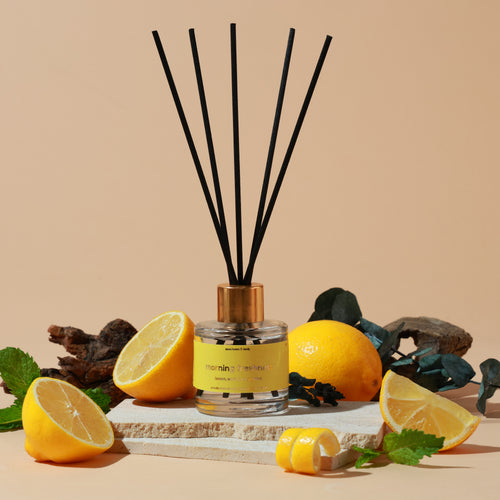
 Morning Freshness₹749Upholstery near a kitchen with a heavy cooking load benefits from a deep-clean cadence noticeably more frequent than furniture in a quieter part of the café, matched to the actual cooking volume, not a generic schedule.
Materials and locations, matched to what actually helps
Which fix matters most depends on the material and where it sits relative to the cooking source — not on how the room smells at any single moment.
| Material or location | How much it typically absorbs | What actually helps | Where fragrance fits |
| Deep-pile or heavily textured sofas near the kitchen or pass | High — the most internal surface area, the closest exposure | A more frequent deep-clean cadence, and a material swap where practical | Not the dining room |
| Curtains or soft window treatments near a kitchen exhaust vent | Moderate to high, depending on vent placement | Regular laundering or professional cleaning on a fixed schedule | Not the dining room |
| Tight-weave or wipeable seating, similar cooking exposure | Lower — less internal structure for vapour to get into | Ordinary cleaning is usually sufficient; no special cadence needed | Not the dining room |
| Fabric seating far from the kitchen, in a low-traffic corner | Low, by distance and exposure alone | Standard cleaning rota, unchanged | Not the dining room |
| A washroom or entrance with its own soft furnishings, unrelated to the kitchen | Its own, separate question | Its own cleaning routine, assessed independently | A fragrance decision, made on its own terms |
| Any of the above, if fragrance has been added to mask a smell the fabric is still releasing | The combination is the problem — the fabric keeps releasing regardless of what's added on top | Remove the fragrance layer and address the cleaning cadence or material instead |
Morning Freshness · a washroom, unrelated to this problem₹749Shop →  Sukoon · a larger washroom suite₹1,899Shop →
  Vaayu · washrooms across a chain₹11,999Shop →
What to do about it, honestly
Never spray or diffuse fragrance onto or near upholstery to deal with an absorbed food smell — the fabric goes on releasing what it already holds regardless, and the fragrance simply becomes a second substance for it to hold and release alongside the first.
Sometimes the fix is a single piece of furniture — a heavily used sofa nearest the pass that's overdue a proper deep clean, or a curtain that's never actually been laundered since installation — and addressing that one item resolves most of what's being noticed.
Usually, across a whole dining room, the honest routine is a cleaning cadence set by the café's actual cooking load rather than a generic interval, paired with a genuine look at whether any fabric closest to the kitchen could reasonably be swapped for a tighter-weave or wipeable alternative at the next refresh.
What this costs, by material and cadence
Almost entirely a cleaning-schedule and material decision — the honest shape of this specific problem.
| Route | Premises | Why | What it costs |
| Set a deep-clean cadence for upholstery matched to actual cooking load | Any café with soft seating near a kitchen or pass | Reaches what's actually absorbed into the fabric, not just what's sitting on the surface | A cleaning-contractor cost, not a fragrance purchase |
| Launder or professionally clean curtains near a kitchen exhaust vent on a fixed schedule | Soft window treatments close to cooking or extraction | Directly reduces what's stored in the material closest to the source | A cleaning cost, unrelated to fragrance |
| Choose tighter-weave or wipeable materials for seating nearest the kitchen at the next refresh | A café being fitted out, or refreshing furniture near the kitchen | Reduces how much a material absorbs in the first place, for the life of that furniture | A furnishing decision, not a fragrance one |
| Confirm the washroom or entrance is a genuinely separate decision before considering fragrance | Any zone being considered for scent at all | Establishes the zone is unrelated to the dining room's fabric question | No purchase — an assessment |
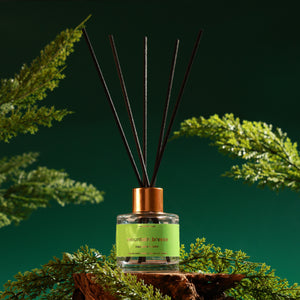
| Reed diffuser, Morning Freshness or Mountain Breeze, for the washroom or entrance only | A genuinely separate washroom or vestibule | The one point in this problem where a modest fragrance is honestly appropriate | ₹749–₹849 |
I get asked, fairly often, whether spraying the sofas would help a dining room that smells faintly of yesterday's cooking. It wouldn't — the fabric would simply hold the new fragrance alongside whatever it already had, and release both together, which tends to smell worse than the original trace on its own.
The distinction I try to explain is that fabric behaves completely differently from a hard surface — it's not something you wipe clean the way you would a counter or a table. What's absorbed into it has to actually be cleaned out, properly and on a schedule that matches how much cooking is happening nearby, not guessed at.
Where I do think it's worth a serious look is material choice, especially for anything new going in near a kitchen. A tighter weave or a wipeable performance fabric holds meaningfully less than a deep, textured one for the same cooking exposure — it's a genuinely useful lever, and it's one no fragrance can substitute for.
Questions about upholstery and food smell
- Why Does My Café Smell Like Yesterday's Food in the Morning? — the overnight version of fabric releasing what it absorbed.
- Why Does My Café Smell Musty During Monsoon? — the same materials, absorbing moisture instead of cooking smell.
- How Do I Remove Fried-Food Smell From a Café Without Covering It With Perfume? — the extraction side of the same cooking-load problem.
- Exhaust, Grease, Drains, Upholstery, HVAC, Humidity or Fragrance: What Should I Fix First if My Café Smells Bad? — the full order-of-operations this diagnosis sits inside.
- Brand: the SOSA founder story.
SOSA products & prices (verified September 2026): Reed diffusers 50ml ₹749–₹849 (to 150 sq ft, 6–8 weeks at six reeds) · 130ml ₹1,249–₹1,349 (above 150 sq ft, 14–18 weeks) · reed refill 300ml ₹2,399. Ultrasonic: Boond ₹899 (~150 sq ft) · Sukoon ₹1,899 (270–320 sq ft, ships with three 15ml Hotel Collection fragrances) · Megh ₹3,499 (6L tank, ~100 hrs runtime, ~215 sq ft — a runtime machine, not a coverage upgrade). Waterless cold-air: Safar ₹3,999 (no published coverage figure) · Vaayu ₹11,999 (up to 1000 m³, roughly 2,000–3,000 sq ft; 400ml tank lasting about 90+ days; app and onboard control, 1h/4h/8h/24h run windows, adjustable intensity, key-lock, under 38 dB, freestanding or wall/HVAC mount, 5W, CE/RoHS/SGS) · Aangan ₹25,999 (8,000–10,000 sq ft). Hotel Collection water-based fragrance 15ml ₹299 · 100ml ₹999 · 300ml ₹1,799 is for ultrasonic machines; reed oil and Hotel Collection are not interchangeable. Reed diffusers are alcohol-free, phthalate-free, paraben-free, IFRA-compliant and low VOC, handmade in small batches in Pune. Every purchase funds a girl's education through Nanhi Kali. Prices and availability subject to change — see the live product pages.