

Then go diagonal: the best spot in almost every air-conditioned room is diagonally opposite the unit, on the side where the air is returning rather than arriving.
Height and surface: waist to chest, on a tray, with a few feet of clear space. Not a high shelf, not the floor, not inside a cabinet.
The tie-breaker: among the spots that pass the tissue test, choose the one people walk past most often. Human traffic distributes; mechanical air strips.
2. Place diagonally opposite the unit. Air leaves a split along the upper part of the room, travels to the far wall, drops and returns low. The far corner, on the return side, is slow-moving, well-mixed air — the best conditions a passive diffuser gets indoors.
3. Waist to chest height, on a tray. A console, sideboard, chest of drawers or dressing table. Not a high shelf, which is usually where the fast leg travels; not the floor, where nobody meets it; never inside a cabinet.
4. Among the spots that pass, pick the one people walk past. A doorway console beats a decorative corner, because footfall is intermittent air movement and intermittent is exactly what this format wants.
5. Leave the bottle clear. A few feet of open air, no curtain against it, no cushions or upholstery pressed up beside it — soft furnishings absorb fragrance and give nothing back.
6. Redo the map when the season changes. The louvre position you use in May is not the one you use in October, and a placement that was fine all winter can end up in the stream the day summer settings return.
Composed and handmade in small batches in Pune, and a portion of every order supports girl-child education through Nanhi Kali.
Part one — making the map
Every recommendation that follows depends on one piece of information you almost certainly do not have: where the air in your particular room actually goes. Unit placement, louvre angle, ceiling height, the position of a wardrobe and whether the door is left open all change it, which is why no general rule about feet and metres survives contact with a real flat. Four minutes of survey beats any rule of thumb, and it costs a strip of tissue.
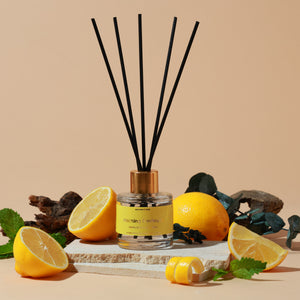
 Garden Bloom₹799 · 8.9/10A room with an air conditioner running is a loop. Cold air leaves the unit fast along the upper part of the space, loses speed as it crosses, sinks as it cools the room, drifts back low and is drawn up again at the unit. The fast, damaging leg is the first part of that journey. The far diagonal is where the loop has slowed to something a reed diffuser can live in, but is still moving enough to carry fragrance around the room. That combination — moving, but not fast — is the whole target. It is also, conveniently, where most Indian bedrooms already have a console or chest of drawers, and where most living rooms already have a sideboard. You are usually not being asked to redesign a room, only to prefer one existing surface over another.
Part two — room by room in an air-conditioned home
The map tells you the exclusion zone; experience tells you which of the remaining surfaces tends to work. Here is where units usually sit in Indian homes, where the bottle should go instead, and the surface people most often choose by mistake.
| Room | Where the unit usually sits | Put the bottle | The classic mistake | Scent that suits |
|---|---|---|---|---|
| AC bedroom ★ | High on the wall above or beside the bed | Console or chest of drawers by the door | Dressing table directly in the throw | Evening Calm ₹799 |
| Home office or cabin | Behind or above the desk | Shelf on the opposite wall, chest height | On the desk, directly downwind | Morning Freshness ₹749 |
| Living room, wall split | One long wall, aimed across the seating | Sideboard on the far diagonal, near the hall | Coffee table in the middle of the throw | Garden Bloom ₹799 |
| Living-dining, ceiling cassette | Centre of the ceiling, throwing four ways | Against a wall, outside the four arms | Dining table centrepiece, straight underneath | Two bottles, one per end |
| Rented room, window unit | Low in the window, blowing along one wall | Opposite corner console, away from the glass | Windowsill beside the unit — draught and sun | Morning Freshness ₹749 |
| The honest caveat: these are patterns, not measurements, and they come from SOSA's own customer correspondence and in-house testing rather than from laboratory work — your unit, ceiling height and furniture will move them, which is exactly why the tissue survey exists. And placement cannot beat volume: past roughly 250–300 sq ft of connected open space, no single passive bottle will fill the room wherever you stand it. That is the format's ceiling, not a placement failure. | ||||
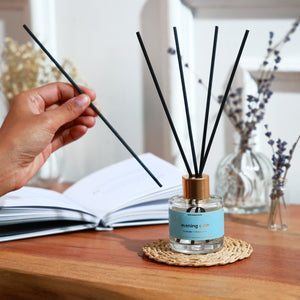
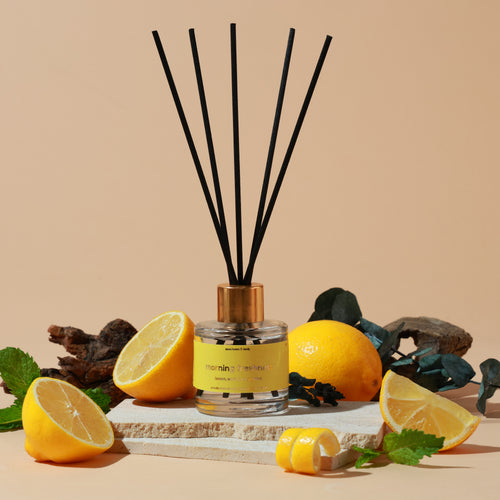
Morning Freshness · 9.0/10from ₹749Shop → 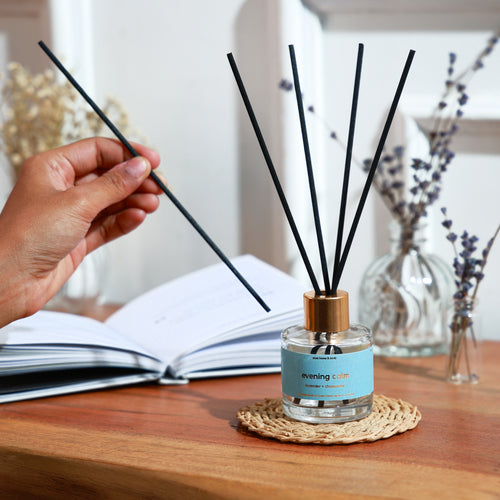 Evening Calm · 8.9/10from ₹799Shop →
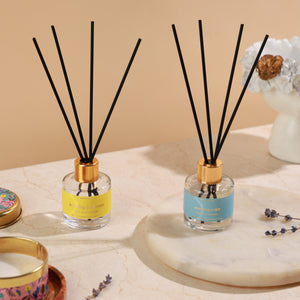
 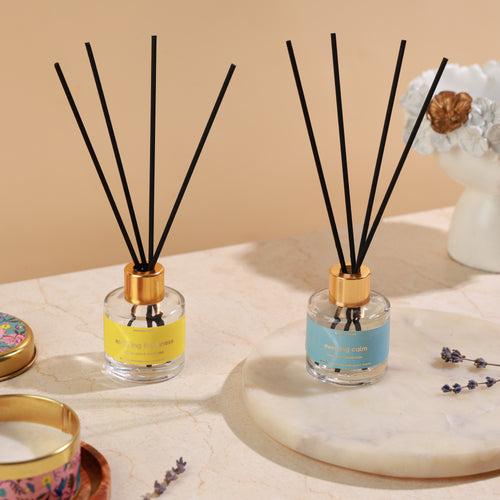 Day & Night duo · two rooms₹1,498Shop →
Part three — what the tissue usually reveals
People who run the survey tend to be surprised by the same three things. The first is how high the fast leg runs. A wall split mounted near the ceiling throws along the top of the room, and the strip barely twitches at chest height directly beneath it while streaming sideways two metres away. This is why "keep it far from the AC" produces so many bad placements — the shelf on the opposite wall, at head height, is often the single worst surface in the room, and the console under the unit is often perfectly usable. The second surprise is the return leg. Air coming back low along the floor is slow, well mixed and carries fragrance beautifully; a bottle standing on a low-to-mid console on the return side gets circulation without scouring, which is the ideal a passive format is built around.
The third surprise is the doorway. In most homes the door of an air-conditioned room is opened and closed dozens of times a day, and each opening pushes a slug of air through the gap in a way no vent ever will. That is intermittent movement — a burst, then stillness, then another burst — and it is exactly the pattern that distributes fragrance without stripping the reeds. It is also where the person arriving first meets the room, which matters more than it sounds: a house is judged at its thresholds. If a surface passes the tissue test and sits within a metre or so of the doorway, stop looking; that is your spot.
One caution about repeating the exercise. The map is not permanent. Louvre angles change with the season, furniture moves, and a fan switched on alongside the air conditioner rewrites the loop entirely. If a bottle that behaved well for two months suddenly starts emptying faster or reading quieter, run the tissue again before concluding anything about the fragrance — in my experience something in the room has changed far more often than something in the bottle has. And if the survey shows almost the entire room in the path, the honest answer may be that this space is not suited to a passive format at all; a Sukoon at ₹1,899, covering 270–320 sq ft with a remote and timers, is not a defeat but a different tool.
Part four — every position in the room, ranked
The survey results, arranged from best to worst. Nothing here costs money; it is a decision about which surface a bottle you already own stands on.
| Position | Air over the reeds | What the room receives | Verdict |
|---|---|---|---|
| 1. Console on the far diagonal, near the door ★ | Slow return-leg circulation plus doorway bursts | Even distribution the moment anyone walks in | The best spot in an AC room |
| 2. Sideboard or chest on the return side | Gentle, well-mixed, never fast | Steady presence across the space | Excellent — the usual winner |
| 3. Low console directly beneath a wall split | Often calm; the throw passes overhead | Good, if the tissue confirms it | Counter-intuitive but frequently fine |
| 4. Mid-room table away from the throw | Calm but enclosed by seating | Adequate; soft furnishings absorb some | Acceptable, rarely the best |
| 5. High shelf on the opposite wall | Usually squarely in the fast leg | Thin plume, little accumulation | Avoid — the commonest bad choice |
| 6. Windowsill in an air-conditioned room | Draught when open, heat through the glass when shut | Very little, and the oil degrades | Avoid entirely |
| 7. On top of the unit, or inside a closed cabinet | Either scoured or completely still | Nothing usable in both cases | Never |
Versailles
The tissue trick is not something I learned at ISIPCA. I learned it in our own studio, from an argument about why two identical bottles in one room were behaving completely differently. We had assumed the air moved the way the room looked as though it should. It did not. The strip of tissue settled it in under a minute and made both of us look rather foolish.
Since then I have asked every customer who writes in about an air-conditioned room to do the same thing before we talk about anything else, and it resolves the conversation more often than any product recommendation I could make. It costs nothing. It cannot be sold. It is, by some distance, the most useful thing on this page.
If the map shows that most of your room is in the path, please do not buy a second bottle in the hope of overwhelming it — that is spending against physics. Move what you have, and if there is nowhere to move it to, a machine is the honest answer. Everything we make is composed and handmade in small batches in Pune, and a part of every order funds a girl's classroom through Nanhi Kali.
Frequently asked questions
- Does air conditioning affect reed diffusers? — the three effects, and which one to act on.
- Should you put one near an AC vent? — what the stream costs, stated in weeks.
- Best airflow placement, room by room — the same survey applied to a whole home.
- The complete airflow and placement guide, and why can't I smell my reed diffuser?
- Brand: the SOSA founder story.
SOSA reed diffuser range & prices (verified August 2026): alcohol-free, phthalate-free, paraben-free and IFRA-compliant compositions on a heat-stable coconut-derived (CCT) carrier, low-VOC, supplied in a refillable glass bottle with six fibre reeds; 50ml lasts 6–8 weeks and 130ml lasts 14–18 weeks. Morning Freshness (Malabar lemon · peppermint · Nilgiri eucalyptus) 50ml ₹749 · 130ml ₹1,249 · 9.0/10; Garden Bloom (British rose · night-blooming jasmine) 50ml ₹799 · 130ml ₹1,299 · 8.9/10; Evening Calm (Kashmir lavender · chamomile) 50ml ₹799 · 130ml ₹1,299 · 8.9/10; Fresh Brew (Coorg coffee · Kerala vanilla) 50ml ₹849 · 130ml ₹1,349 · 9.5/10; Mountain Breeze (Himalayan pine · sage · Indian cedar) 50ml ₹849 · 130ml ₹1,349 · 9.4/10. Reed diffuser refills are oil only — you reuse your own vessel and reeds: 300ml ₹2,399 (roughly 8–11 months) · 500ml ₹3,499 (roughly 14–18 months), about ₹7–8 per ml against ₹15–17 per ml for a 50ml bottle. Duo sets ₹1,498–₹1,598 for 2 × 50ml and ₹2,498–₹2,598 for 2 × 130ml. Strength figures are positions on SOSA’s own internal strength scale, not an industry standard. Replacement reeds are not sold as a separate SKU; SOSA guidance is to refresh reeds every few months. The reed line is separate from the water-based Hotel Collection for ultrasonic machines (15ml ₹299 · 100ml ₹999 · 300ml ₹1,799) and the two are not interchangeable. Diffusers: Boond 300ml ₹899 · Sukoon 500ml ₹1,899 · Megh 6L ₹3,499 · waterless Vaayu ₹11,999. Composed and handmade in small batches in Pune, India; tested through 45°C summer heat and 85% monsoon humidity. Free shipping above ₹499. A portion of every order supports girl-child education through Nanhi Kali. Prices subject to change — see the live product pages.