



2. Test two: check whether the smell survives with the AC switched off. Turn the air conditioning off for a few minutes and notice whether the smell changes. If it gets stronger or clearer, the AC has been masking or redistributing a source rather than removing it.
3. Test three: find out where it is worse. Walk the premises and notice whether the smell intensifies near a particular wall, a cupboard, the bathroom or a bin. A smell that is even throughout the building behaves differently from one with a clear point of origin.
4. Test four: check whether it changes across the day. Note the smell at opening, mid-morning and evening. A pattern tied to housekeeping timing, footfall or a bin collection schedule points to a process cause rather than a fixed structural one.
5. The rule: a pointable source means fix it; a clean result means a register belongs. If any test points to a source, fragrance is the wrong purchase this month. If the building is sound, the housekeeping tail is gone and the air genuinely exchanges, that is when a register — and Vaayu specifically — is the right buy.
Run the four tests before spending anything. Vaayu is the right purchase only once every one of them comes back clean.
Why a checklist beats guessing about clinic smell
Every post in this cluster's odour-and-housekeeping block makes the same point from a different angle: disinfectant, damp, cleaning residue and layered fragrance all fail for the same underlying reason — something with an actual source is being treated as if fragrance could substitute for fixing it. A checklist turns that judgement call into four concrete, repeatable observations, so the decision does not depend on how used to the smell the staff have already become.
Staff and the clinic owner stop smelling a room they are in all day — this is a real property of how smell perception works, not a lapse in attention. A visitor or a first patient of the morning notices things nobody working there can any longer detect. The four tests are designed to recreate that outside perspective deliberately, rather than waiting for a patient to mention it.
The checklist also protects against the single most expensive mistake in this cluster: buying fragrance equipment to solve a problem it cannot solve, then buying it again later once the actual source is finally fixed. Running the tests first means any purchase made is made once, for the right reason.
The four tests, run in order
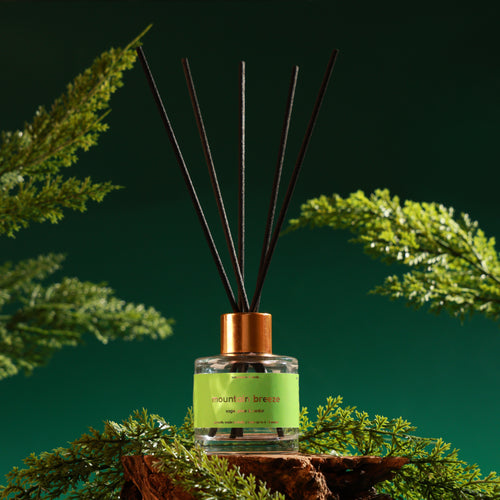
 Mountain Breeze₹849Enter from outside before anyone else has been in the building and name what you smell immediately, before your own nose adjusts. Then switch the AC off for a few minutes and notice whether the smell changes — a shift here usually means the AC has been redistributing or masking something rather than clearing it.
What each test result actually means
Every row below maps a checklist outcome to the guide in this cluster that answers it, and to whether fragrance belongs in the conversation at all.
| Test result | What it usually means | What to do about it | Does fragrance belong yet |
| Smell noticeable on walking in cold, unnamed cause | A source is present that staff have stopped noticing | Investigate before anything else | No |
| Smell changes with the AC off | Airflow is masking or redistributing a source | Review AC setting and ducting, not the diffuser | No |
| Smell worse near a wall, cupboard, bathroom or bin | A location-specific source, often damp, disinfectant residue or waste | Fix that specific location | No |
| Smell changes across the day, tied to housekeeping or footfall | A process cause, usually timing or dilution | Adjust the housekeeping process | No |
| All four tests clean: no smell on entry, no AC effect, no worse spot, no time pattern | The building, housekeeping and airflow are already sound | Choose a register proportionate to the premises | Yes |
| A clinic that only fixes the first half of this table — the source, not the register — has still genuinely improved, and may not need to buy anything at all. | |||
 Vaayu · 750 sq ft to roughly 3,000, whole floor plate₹11,999Shop → Aangan · above roughly 3,000 sq ft, HVAC-integrated₹25,999Shop → Mountain Breeze · a single cabin, dry register₹849Shop →
Running the checklist in under ten minutes
Do this before opening, on an ordinary day, not immediately after a deep clean or a repair. Walk in from outside and say out loud, or write down, exactly what you smell in the first few seconds — before your own nose has had time to adjust to the room. This is worth two minutes and it is the single most informative step in the whole exercise.
Then spend two minutes with the AC off, noticing whether the smell shifts, and three minutes walking the premises specifically checking near walls, cupboards, the bathroom and any bin. Note anywhere the smell is clearly stronger than the average of the room.
Finally, repeat a shorter version of the first test at mid-morning and again in the evening, noting whether the smell has changed. Taken together, these four observations — cold entry, AC-off, location, and time-of-day — normally make the source, or the absence of one, obvious within the same day, without needing a second visit.
What to buy, by checklist outcome
Every row below assumes the four tests have actually been run. A clinic that has not run them should not be choosing a register yet — it should be walking the premises first.
| Route | Checklist outcome | Why | What it costs |
| Fix the identified source, buy nothing | Any test points to a location, an AC effect or a time pattern | The correct response to a pointable source, every time | ₹0 |
| Fix housekeeping timing or dilution, buy nothing yet | Clean on location, but a process cause still present | The tail needs to clear before any register would read as considered | ₹0 |
| Reed diffuser, Mountain Breeze or Morning Freshness | All four tests clean, under 300 sq ft, single cabin | A proportionate register for a small premises with nothing to cover | ₹749–₹849 |
| Sukoon ultrasonic, reception only | All four tests clean, 300–750 sq ft | Real coverage at a lower outlay, with daily refilling as the honest trade-off | ₹1,899 |
| Vaayu, low intensity from reception or transit zones | All four tests clean, 750 sq ft and above | Control, no-water operation and distribution across a multi-room premises with nothing left to compete against | ₹11,999 |
Every clinic I have worked with eventually asks some version of the same question: how do I know if this is a fragrance problem or something else. The honest answer is that they can find out themselves, in ten minutes, before they ever need to ask me.
The four tests in this guide are exactly what I would do if I walked into a clinic for the first time — smell it cold, check it against the AC, find where it is worst, and watch how it changes across the day. None of it requires special equipment or an outside consultant. It requires walking the space with attention, which any owner or manager can do themselves.
What I want a clinic to take from this whole cluster is not 'buy Vaayu.' It is 'run the checklist, fix what it finds, and only then decide whether a register belongs.' Some clinics finish that process and genuinely do not need to spend anything further — and that is exactly the outcome I would rather see than a sale that was never the right fix.
Questions clinic owners ask about this checklist
- How do I deal with a musty clinic smell during monsoon? — the seasonal case of test three and four, run every wet spell.
- My clinic has a persistent damp smell — will a scent machine help? — what it means when test three finds a source that will not clear.
- Why does my clinic smell like cleaning chemicals even hours after housekeeping? — what test four usually finds when the pattern is tied to timing.
- Disinfectant, dampness and ambient fragrance — why can a clinic end up smelling worse? — why skipping this checklist and adding fragrance anyway backfires.
- Brand: the SOSA founder story.
SOSA products & prices (verified September 2026): Reed diffusers 50ml ₹749–₹849 (to 150 sq ft, 6–8 weeks at six reeds) · 130ml ₹1,249–₹1,349 (above 150 sq ft, 14–18 weeks) · reed refill 300ml ₹2,399. Ultrasonic: Boond ₹899 (~150 sq ft) · Sukoon ₹1,899 (270–320 sq ft, ships with three 15ml Hotel Collection fragrances) · Megh ₹3,499 (6L tank, ~100 hrs runtime, ~215 sq ft — a runtime machine, not a coverage upgrade). Waterless cold-air: Safar ₹3,999 (no published coverage figure) · Vaayu ₹11,999 (up to 1000 m³, roughly 2,000–3,000 sq ft; 400ml tank lasting about 90+ days; app and onboard control, 1h/4h/8h/24h run windows, adjustable intensity, key-lock, under 38 dB, freestanding or wall/HVAC mount, 5W, CE/RoHS/SGS) · Aangan ₹25,999 (8,000–10,000 sq ft). Hotel Collection water-based fragrance 15ml ₹299 · 100ml ₹999 · 300ml ₹1,799 is for ultrasonic machines; reed oil and Hotel Collection are not interchangeable. Reed diffusers are alcohol-free, phthalate-free, paraben-free, IFRA-compliant and low VOC, handmade in small batches in Pune. Every purchase funds a girl's education through Nanhi Kali. Prices and availability subject to change — see the live product pages.