



The arithmetic: 52 weeks ÷ 7 weeks per 50ml = 7.4 a year per bottle. Five bottles is about 37 replacements. In 130ml it is 52 ÷ 16 = 3.25 each, or about 16.
The fixes, in order of value: delete the positions nobody uses; buy 130ml not 50ml; run four reeds not six; order two bottles at a time. Together that turns 37 events into five orders.
2. The cost curve is flat, which is exactly the problem. A 130ml at ₹1,249 running 14–18 weeks is about ₹78 a week of use. Buy four and it is still about ₹78 a week per room; the total is ₹4,996 for four bottles and four rooms, which is the same value per room as buying one. Price scales cleanly and honestly. Attention does not scale at all — you have the same amount of it at six bottles as at one, spread six ways.
3. Do the arithmetic on events, not rupees. A 50ml runs 6–8 weeks; call it seven. 52 ÷ 7 = 7.4 replacements a year per bottle. Five bottles is about 37 — one every ten days. Switch the same five positions to 130ml at 14–18 weeks, call it sixteen: 52 ÷ 16 = 3.25 each, about 16 a year, one every three weeks. Same rooms, same scent, less than half the events, and a lower cost per week into the bargain.
4. Then use reeds as a second lever, because it is free. Reed count sets both strength and speed. Six reeds is a hall setting; four is a bedroom setting and stretches a 130ml to something nearer 24 weeks. Five positions at four reeds is 52 ÷ 24 = 2.17 each, about 11 replacements a year. You have now gone from 37 to 11 without spending anything extra — in fact you are spending less, because the same liquid is covering more weeks.
5. And delete the positions that were never earning. Before optimising the rota, shorten it. In most five-bottle homes two of the five are a passage and a room nobody sits in. A corridor is measured in seconds of occupancy and a spare bedroom in visits per month. Take those two out and you are at three positions, eleven replacements becomes seven, and the whole problem you came here with has gone away for ₹0.
Made in India, composed by an ISIPCA Versailles-trained perfumer — and a portion of every order supports girl-child education through Nanhi Kali.
Why the money never warns you, and the calendar always does
Almost every buying guide in this category is written about cost, and cost is the one variable that behaves itself here. A 130ml reed diffuser at ₹1,249 runs 14–18 weeks; take the middle and that is about ₹78 a week of scented room. Buy a second for another room and the second one also costs about ₹78 a week. A sixth costs about ₹78 a week. There is no cliff, no penalty band, no point at which the arithmetic turns against you. Four bottles is ₹4,996 and four rooms; that is exactly four times one bottle and one room, which is a perfectly fair deal and tells you nothing at all about whether you should have done it.
The variable that does have a cliff is the number of separate moments a year in which you must notice something, decide something and buy something. Each bottle contributes its own stream of those moments, and the streams do not merge. A 50ml on six reeds gives you a replacement roughly every seven weeks — 52 ÷ 7 = 7.4 a year. One bottle is fine. Three bottles is 22 a year and still manageable, because you can hold three timelines in your head. Five bottles is 37, which is one every ten days, and at that frequency the events stop being distinguishable from each other. You are no longer running a home that smells nice; you are running a small inventory. The tell is always the same: two of the bottles are empty and have been for a while, and the person who owns them concludes that reed diffusers are more trouble than they are worth. They are not. There were simply too many of them, in the wrong size, on the wrong reed count, bought on the same day.
The three decisions when you own more than three
 Three positionsFrom ₹3,897Before improving the rota, shorten it. Three 130ml bottles — a living room, a bedroom, a bathroom — is ₹3,897 at ₹1,249, ₹1,299 and ₹1,349, and it is the last count most people manage without a list. The fourth and fifth positions in a typical home are a passage and a guest room, and both fail the same test: a corridor is measured in seconds of occupancy and a spare room in visits per month. Neither earns a bottle, and neither earns a place on your reordering calendar either. Deleting them is the only fix on this page that costs nothing and gives back time.
Sizing by space — where the rota starts to fail
Read down to the number of bottles you actually have standing in the house. The right-hand column is the purchase; the middle column is what it costs you in attention. One row here is a room you should take off the list entirely.
| Space | What it needs | How many | Cost |
|---|---|---|---|
| Three rooms, three 130ml bottles ★ | The last comfortable count — about 10 replacements a year on six reeds, seven on four | Three | ₹3,897 |
| Four rooms, four 130ml bottles | The edge. About 13 replacements a year — buy in pairs from here on, and stagger them | Four | from ₹4,996 |
| Five rooms in 50ml bottles | About 37 replacements a year, one every ten days — the size, not the count, is the problem | Five, but in 130ml | from ₹3,745 |
| Five rooms in 130ml on four reeds | About 11 replacements a year, ordered two at a time — five or six orders in total | Five | from ₹6,245 |
| One room among them over about 200 sq ft | Past what reeds hold — a Sukoon with a 15ml Hotel Collection takes that room off the reordering rota almost entirely | One machine | ₹2,198 |
| The passage between bedrooms, and the guest room used twice a month | Nothing. These are the two positions that turn a manageable three into an unmanageable five — delete them and the problem solves itself | None | ₹0 |
| A note on all of the above: every replacement figure here is derived from the stated bottle life on six reeds — 6–8 weeks for a 50ml and 14–18 for a 130ml, in a closed room of standard height. Heat and airflow shorten those, so a bottle in a hot hallway generates more events a year than the same bottle in an air-conditioned bedroom. Placement changes the calendar as well as the cost. | |||
One room · the unitFrom ₹749Shop → 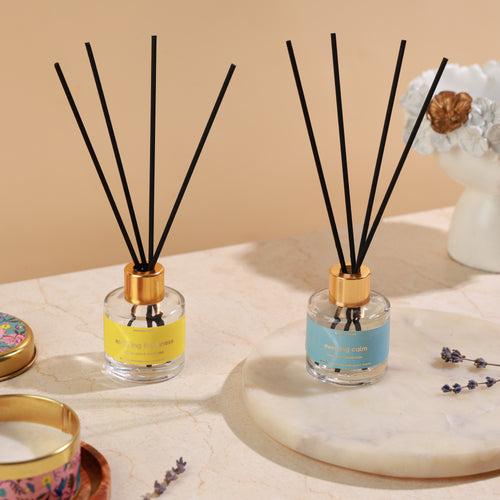 Two rooms · better value₹1,498Shop →
  Large room · a switch₹1,899Shop →
Cutting the admin without cutting the rooms
Start by removing positions, because it is the only free move that also gives back time. Walk the house and give every bottle a number: hours a day that somebody is genuinely in that room with a nose that has not already adapted. A living room used four hours a night scores well. A bathroom scores well despite being tiny, because everybody who uses it arrives with a fresh nose. A passage between two bedrooms scores close to nothing — it is measured in seconds of occupancy, and nothing you can buy improves those seconds. A guest room used twice a month scores close to nothing for twenty-eight days out of thirty. In a five-bottle home, two positions almost always fail this test, and taking them out drops you from 37 replacements a year to 22 in the small bottle, or from 16 to 10 in the large one, without removing a single scented room that anybody was actually smelling.
Then consolidate onto the 130ml and turn the reeds down. These two moves compound. Going from 50ml to 130ml takes each position from 52 ÷ 7 = 7.4 replacements a year to 52 ÷ 16 = 3.25, and lowers the cost from about ₹105 a week to about ₹78 at the same time. Going from six reeds to four takes a 130ml from around sixteen weeks to nearer 24, so each position drops again to about 2.17 a year. Three positions run that way is roughly six or seven replacements across a whole year — which is a thing you can hold in your head. Four reeds is also the correct setting for most bedrooms on its own merits, so you are not trading strength for convenience; you are correcting two mistakes with one adjustment. Six reeds belongs in a hall or a large living room, where people arrive with a fresh nose rather than sitting in it all evening.
Then change how you buy rather than what you buy. Order two bottles at a time and put the second in a cupboard. Six or seven replacements a year becomes three or four orders. Stagger the start dates so the bottles do not all finish in the same fortnight — buying the second one a few weeks after the first is free and permanently offsets them. And when a bottle is empty, refill rather than rebuy: a 300ml refill at ₹2,399 is ₹8.00 a millilitre against ₹9.60 for a new 130ml, and a 500ml at ₹3,499 is ₹7.00. Refilling is also the moment to fit fresh reeds, since clogged fibre is the commonest reason a bottle seems to fade before it is empty. If one of your rooms is genuinely over about 200 sq ft, a Sukoon at ₹1,899 with a 15ml Hotel Collection at ₹299 is ₹2,198 and takes that room off the rota almost entirely — three to six drops a tank makes a 15ml go a very long way. The two liquids are not interchangeable in either direction.
What to buy
If you already own four or five bottles, the useful lines here are the 130ml and the refill. If you are still building up, stop at three and see whether you miss the fourth.
| Buy | What it covers | Lasts | Price |
|---|---|---|---|
| One 50ml | A single reed diffuser — a bathroom, or trying a blend — not a room on a five-bottle rota | 6–8 weeks | from ₹749 |
| One 130ml ★ | The value size — every position on a multi-bottle rota — 3.25 replacements a year each instead of 7.4 | 14–18 weeks | from ₹1,249 |
| The duo | Day & Night duo — two rooms started at once, which you then stagger four weeks apart so they never finish together | 6–8 weeks each | ₹1,498 |
| Sukoon | 500ml ultrasonic — the one room over about 200 sq ft, which it removes from the reordering calendar almost entirely | Runs when you switch it on | ₹1,899 |
| 300ml refill | The running cost — ₹8.00 a millilitre against ₹9.60 for a new bottle — and the moment to fit fresh reeds | Roughly 2 × 130ml fills | ₹2,399 |
Versailles
People write to me about the money and it is almost never the money. Four 130ml bottles is ₹4,996 and four scented rooms, which is exactly four times one bottle and one room. The arithmetic is fair the whole way up. What actually breaks is that you have five bottles finishing on five different clocks and one head to keep track of them in.
I have watched this go wrong the same way many times. Somebody buys five 50ml bottles because five small ones felt more sensible than three large ones. That is 37 replacements a year. By month four, two of them are dry, and the conclusion is that the product is high-maintenance. It was not. It was five of the wrong size, all six reeds in, all bought on the same afternoon.
So my advice is dull and it works. Three positions unless you have a specific reason for a fourth. The 130ml every time. Four reeds, not six, in anything you sit in for hours. Buy two bottles at once and start the second a few weeks after the first. And take the passage and the spare room off the list entirely — I would genuinely rather sell you three bottles you keep filled than five you stop noticing. A portion of every order funds a girl's classroom through Nanhi Kali.
Frequently asked questions
- Reordering with five bottles — the calendar, in days.
- Staggering your purchases — the offset that costs nothing.
- Does a corridor count as a room? — seconds of occupancy.
- The complete sizing and quantity guide — every home type, three builds.
- Brand: the SOSA founder story.
SOSA products & prices (verified August 2026): Hotel Collection water-based ultrasonic diffuser fragrance 15ml ₹299 · 100ml ₹999 · 300ml ₹1,799 · Pack of 7 (15ml, all fragrances) ₹1,799; refills 100ml from ₹999. Seven scents: The Ritz-Carlton-inspired (white tea · bergamot · cedar), Westin-inspired (white tea · aloe · cedar), 1 Hotels-inspired (cedarwood · vetiver · green leaves), The St. Regis-inspired (amber · violet · woods), Shangri-La-inspired (jasmine · green tea · white tea), Four Seasons-inspired (citrus · floral · sandalwood), W Hotels-inspired (citrus · pepper · amber). Diffusers: Boond 300ml ₹899 · Sukoon 500ml ₹1,899 · Megh 6L ₹3,499. Water-based, phthalate-free, composed to IFRA standards for home diffusion; 3–6 drops per tank. Made in India, Pune. The Hotel Collection scents are SOSA's own interpretations inspired by the world's finest hotels; all hotel names are trademarks of their respective owners and are used only to describe the scent style — SOSA is an independent Indian fragrance house, not affiliated with or endorsed by any hotel brand. Prices and availability subject to change — see the live product pages.