


The four that cost nothing. Turning a bench so people are not facing each other across four feet. Clearing the desk. Moving the printer. Checking whether the waiting area actually runs at the same temperature as reception.
Light temperature is the one most often wrong. A waiting area lit at the same colour and brightness as a workup room reads as an extension of the clinical space, and no amount of fragrance corrects that.
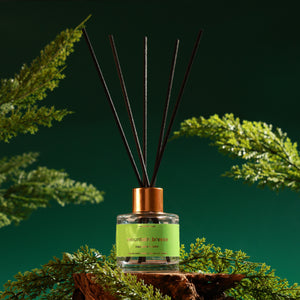
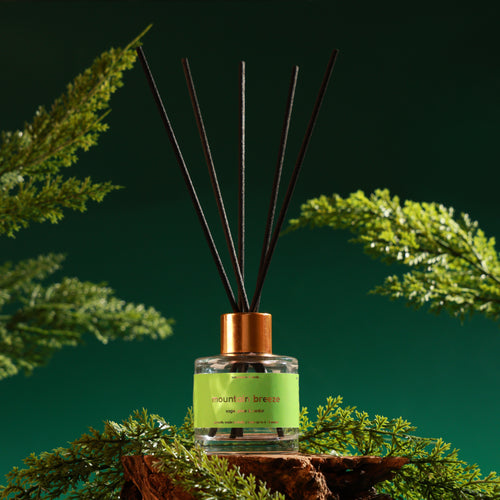
If you reach item six, keep it small. Mountain Breeze ₹849 at three of six reeds, or Sukoon ₹1,899 for a 150–320 sq ft arrival zone. In a clinic the correct intensity is lower than in any showroom or hotel lobby.
2. Seating geometry, which costs an afternoon and nothing else. Benches or chairs arranged so that strangers face each other across four or five feet produce a room where nobody relaxes their posture. Turning a bench, breaking a row into two shorter runs at an angle, or simply pulling seating six inches further from a wall changes the character of a waiting area more than any purchase on this page.
3. Light temperature, the detail most often got wrong in a clinic. Waiting areas are frequently lit with the same fittings, at the same colour temperature and the same brightness, as the rooms behind them — which makes the waiting area read as an extension of the clinical space rather than as somewhere to sit. Warmer, lower and more indirect at the seating, with task light kept at the desk where it is needed, is the correction. This is a lamp and dimming question before it is a rewiring question.
4. Clutter, and the honest audit of the counter. A reception desk accumulates: files, a card machine, a sanitiser bottle, spectacle cases, three pens, a register, a box of trial lenses that has been there since March. Nothing in a fit-out survives that, and no environmental detail is undone faster. This is free, it is operational, and it needs a person and a rule rather than a product.
5. Air temperature, measured rather than assumed. Waiting areas are commonly a degree or two off the rest of the floor because they sit under a diffuser, beside a door, or at the end of a duct run. Patients sit still in that air for a long time while staff move about in it, so the two groups experience it differently. Put a thermometer on the bench for a week and look at it at four in the afternoon rather than at nine in the morning. What your air handling ought to be doing is a matter for your own contractor and clinicians, not for a fragrance company.
6. Scent, sixth and smallest. One low source in the arrival zone only. Mountain Breeze ₹849 at three of six reeds is the specification I would give most premium eye clinics; a Sukoon at ₹1,899 if the arrival zone runs 150–320 sq ft and you want run windows. Size to the arrival zone, never to the clinic. In a medical building the correct intensity is lower than in a salon, a showroom or a hotel lobby — the target is considered, never scented, and if a patient can name the fragrance it is too strong.
7. And the boundary that governs all six. Only reception and waiting are in scope. Examination rooms, diagnostics, consultation cabins, the procedure suite, any post-operative area, sterilisation and stores take nothing, in any format, at any level, at any hour. A fragrance-free seat must genuinely exist somewhere a person would ordinarily sit. Reception staff are in that air for a full shift while patients are in it for forty minutes, so they set the level and may switch it off without asking. Nothing here is medical, clinical, ventilation, infection-control, accreditation or regulatory advice. Composed and made in small batches in Pune, and a portion of every order supports girl-child education through Nanhi Kali.
Part one — the three details that change the most
Of the six, three account for most of the difference between a waiting room that reads as considered and one that reads as merely clean. None of the three is a purchase, and all three are things a practice can test in a fortnight without spending anything.
 Sukoon 500ml₹1,899 · steady / 2H / 4HThis is the detail I would put second, and it is where premium clinics most often fall between two intentions. The building has been specified as a medical facility, so the lighting package is uniform, bright and cool throughout — and then the waiting area, which is the one room in the building meant to read as hospitality space, gets the same fittings as the rooms it is meant to be distinct from. The result is a waiting area that behaves visually like an anteroom to a diagnostic suite, which is precisely the impression a considered practice is trying to avoid. The correction is rarely structural. Lower, warmer, more indirect light at the seating; task light kept where the work is, at the counter; a lamp or two at low level; dimming on the ambient circuit if it exists. Where an electrician has to be involved at all, it is usually to change fittings or add a dimmer rather than to move circuits. Two clinic-specific cautions. Anything you do at the seating must leave the desk properly lit for the work that happens there, since staff are reading and writing. And whatever is done in the arrival zone stops at the corridor: how the clinical rooms are lit is a matter for your clinicians and for the work being done in them, and I have no view on it.
Part two — all six, with what each costs and who owns it
The full list, with the honest cost of each, the person in the practice who should own it, and how long it takes to know whether it worked. Read the cost column before the product column.
| Detail, in order | What a person sitting in the waiting area actually encounters | Honest cost to improve | Who in the practice owns it | How long before you know it worked |
|---|---|---|---|---|
| 1 · Sound ★ | The desk telephone, the printer, and other people's appointment conversations | Nothing to move a printer; a few thousand for soft material near the bench | The person who runs the desk, not the owner | Same day — sit in the furthest chair and listen |
| 2 · Seating geometry | Whether they are facing a stranger across four feet, and where they can put a bag | An afternoon of moving furniture; zero rupees | Whoever opens in the morning | A week of watching where people actually choose to sit |
| 3 · Light temperature | Whether the waiting area looks like the rooms behind it or like somewhere to sit | Lamps and dimming, low thousands; new fittings, more | The owner, with an electrician for anything wired | Immediately, and it is the most visible change on this list |
| 4 · Clutter at the counter | The card machine, the register, the files, and the box that has been there since March | Zero, plus storage under the desk | A named person, with an end-of-session rule | One day, and it must be re-won every day |
| 5 · Air temperature | Sitting still for forty minutes in air set for people who are moving about | Zero to measure; the fix belongs to your contractor | Facilities, with a thermometer on the bench for a week | A fortnight, read at four in the afternoon |
| 6 · Ambient scent | A low, dry, consistent character they would struggle to name | ₹849 for a bottle; ₹1,899 for a machine with a schedule | Reception staff — they are in the air all day and set the level | A fortnight, judged by a colleague coming in from outside |
| The honest caveat: the scope of this table is the arrival zone — reception and waiting — and nothing else. Examination rooms, diagnostic areas, consultation cabins, the procedure suite, any post-operative area, sterilisation and stores take no fragrance in any format, at any level, at any hour, and how those rooms are lit, cooled, cleaned and ventilated is entirely a matter for the practice's own clinicians and licensed contractors. Nothing on this page is medical, clinical, ventilation, air-handling, infection-control, accreditation or regulatory advice. No SOSA product or setting is described as safe or unsafe for any patient or staff group, and no claim is made about how anybody perceives or responds to fragrance beyond the plain fact that some people are sensitive to airborne fragrance — which is exactly why the clinical pathway stays fragrance-free and why a fragrance-free seat must genuinely exist somewhere a person would ordinarily sit. No effect on comfort, anxiety, perceived waiting time, recovery, ratings, reviews, footfall, patient numbers or revenue is claimed for any detail in this table. Fragrance adds a scent alongside what is already in the air; it removes, masks, neutralises or purifies nothing. | ||||
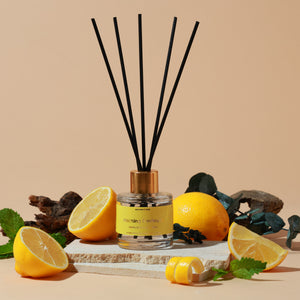
Mountain Breeze · dry, low, unnameable₹849Shop → 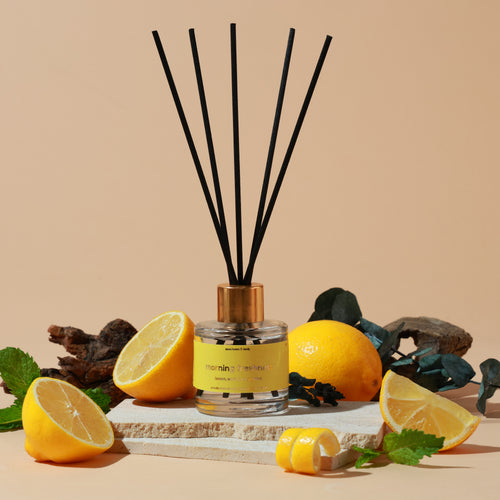 Morning Freshness · brightest, driest opening₹749Shop →
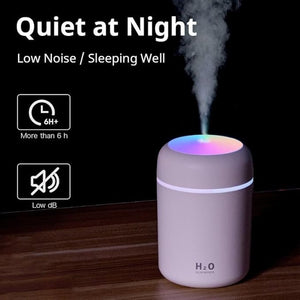
  Sukoon · 150–320 sq ft, with run windows₹1,899Shop →
Part three — the practice that should stop at five
There is a straightforward version of this that ends without a purchase, and it is common enough to deserve its own section rather than a footnote. If you work through sound, seating, light temperature, clutter and air temperature honestly, a substantial number of practices will find that the question they arrived with has dissolved. The reason is that "the waiting room feels ordinary" is a summary judgement, and summary judgements have several causes at once. When an owner names the feeling, the instinct is to reach for the one intervention that is a product — because products are purchasable, arrive in a box and can be actioned by a decision rather than by a habit. But the printer on the counter, the two rows of chairs facing each other, the cool uniform light and the stack of files are the actual authors of the impression, and each of them can be dealt with this month at no cost. Do all five and then sit in the furthest chair again. If the room now reads as considered, you have your answer and it did not involve me. A practice that reaches that point and buys nothing has not failed to complete a project; it has completed it correctly, and I have had that conversation often enough to know it is the honest outcome rather than a rhetorical device.
The second reason to stop at five is that the sixth detail requires conditions the first five do not. A continuous scent source needs a room that clears, a fragrance-free seat that genuinely exists, and staff who want it. If your arrival zone has no openable window, opens onto an internal corridor rather than the street, is served by one recirculating system and does not deliberately exchange air with outside between opening and closing, then anything added accumulates and settles higher than you intended — felt as weight rather than as fragrance, heavier rather than fresher. In that room, item six makes the environment less considered rather than more. Similarly, if there is no second seating area anywhere in the building, a fragrance-free seat is difficult to produce honestly: a chair four feet from a source in a single small air volume is not meaningfully different from one eight feet away, and offering it as an accommodation is a gesture rather than a design. And the staff question is decisive on its own. Your reception team is in that air for eight or nine hours a day against a patient's forty minutes, with the least ability to leave it. Ask them with an open question — if you could change one thing about this room, what would it be — and ask again a fortnight later, because the first answer is about novelty and the second is about living with it. If they would rather have nothing, that is a complete answer.
The third case is the one where a smell already exists and is being mistaken for an absence of one. If your reception smells of disinfectant in the morning, of damp in August, or simply of a room that has been closed, none of those is a fragrance problem and adding the sixth detail will make each of them worse. A disinfectant character is a cleaning-protocol and ventilation question; layering scent over it produces a third smell worse than either. A musty or damp character is a moisture problem, and SOSA sells no dehumidifier and no air purifier, so there is nothing in my range that addresses it. A room that smells closed is under-ventilated, and more fragrance in an under-ventilated room reads heavier, not fresher. In all three cases the sequence is fixed and it is the same sequence used throughout this cluster: find the source, deal with ventilation or cleaning, and only then consider fragrance. There are pages in this cluster devoted to each of those problems and they all end in the same place — spend nothing here yet. What your building ought to be doing about air handling and moisture is a question for your contractor and your clinicians, and I will not offer a view on it.
Part four — if you reach the sixth detail, how to specify it
Assume the first five are done. Here is how to specify the sixth for a premium eye clinic, decision by decision, with the reasoning and the honest limits. Every row here is deliberately smaller than a hospitality supplier would propose.
| Decision | What I would specify for a premium eye clinic | Why, in one line | The honest limit |
|---|---|---|---|
| Where it goes ★ | Far end of the waiting area, away from the corridor to consultation and clear of any return grille | The doorway should smell of nothing, and the clinical corridor of nothing at all | If the corridor has no door and stays open, that placement may still not be enough |
| Which format | A reed bottle under ~150 sq ft; a Sukoon ₹1,899 from 150–320 sq ft | Size to the arrival zone, never to the clinic's total area | Above ~320 sq ft on one connected path is a separate decision entirely |
| Which direction of scent | Dry and woody, or dry and citrus-green. No sugar, no heavy floral | A dry character is registered without being identified | The range has no oud, no musk-forward composition and no aquatic |
| What level | Three of six reeds, or an ultrasonic on its lowest mode with a light dose | Lower than a salon, a showroom or a hotel lobby, deliberately | No bottle-life figure is published below six reeds — an honest gap |
| What hours | Clinic hours only, never overnight, never during the cleaning shift | Fragrance over cleaning chemistry makes a third smell worse than either | A reed bottle has no schedule; only a machine can do this |
| Who may change it | Anyone on the desk, immediately, without asking permission | They are in the air all day; a control needing permission is not a control | The Sukoon has no key-lock, so a level can drift upward over a season |
| How it is judged | By a colleague who has been outside fifteen minutes, entering through the patient door at four in the afternoon | Your own nose adapts to a constant within minutes, hardest where you work | Judging it from the doorway in the morning is how rooms end up too strong |
Versailles
I was asked to look at the waiting area of a well-known practice that had recently been refurbished to a standard I could not fault. The owner's brief was a single sentence: it looks right and it does not feel right, can scent fix it. I spent forty minutes in the furthest chair before answering, which is the only method I have.
The list I came back with had six items and the fragrance was the sixth. A laser printer eighteen inches from the counter, cycling every few minutes. Two benches facing each other across a gangway of about four feet. Ceiling light at the same colour and brightness as the corridor behind the desk, so that the room read as a lobby to the clinical area rather than as a place to sit. A counter carrying nine objects. And an air outlet directly above the left-hand bench, which meant one half of the room was noticeably cooler than the other and everybody sat on the right.
They moved the printer, turned one bench, changed the ceiling lamps for warmer ones on a dimmer, wrote an end-of-session counter rule and had the outlet vane adjusted by their own contractor. Then they waited three weeks and asked me back. The room was better in a way that had nothing to do with anything I sell, and the owner said — a little ruefully — that she had expected to be buying a fragrance system. She bought a bottle in the end, at ₹849, and it worked because by then it was the only quiet thing left in the room. That is the whole argument for the order. Composed and made in small batches in Pune, and a part of every order funds a girl's classroom through Nanhi Kali.
Frequently asked questions
- Is scent worth adding after a heavy interiors spend? — the cost framing.
- A sensory identity that does not feel commercial and matching scent to the interior.
- Premium interiors that still feel generic — what scent can and cannot contribute.
- Reeds, sprays or a machine — the pillar this family resolves into.
- Brand: the SOSA founder story.
SOSA range, specifications and prices used in this guide (verified August 2026): Vaayu ₹11,999 — waterless cold-air nebulisation of undiluted fragrance oil; no water, no heat, no added humidity, no white mineral dust. Coverage up to 1000 m³, about 2,000–3,000 sq ft. 400ml refillable tank lasting roughly 90+ days at a mid setting. Bluetooth app plus onboard controls, 1h / 4h / 8h / 24h run windows, day selection, adjustable intensity, auto-stop and key-lock. Under 38 dB. DC 12V / 1A, 5W. Freestanding or wall / HVAC mount. CE, RoHS and SGS certified. SOSA does not currently sell a separate Vaayu cold-air refill oil; the 400ml supplied in the box is the fragrance available at the time of writing, so a practice planning continuous or multi-site use should confirm current refill availability with SOSA before committing. The water-based Hotel Collection is made for ultrasonic machines and must not be used in a Vaayu. Other machines: Boond 300ml ₹899 (~150 sq ft, ultrasonic) · Sukoon 500ml ₹1,899 (270–320 sq ft, 16–18 hours on low, remote and steady/2H/4H timers, three 15ml fragrances included, ultrasonic) · Megh 6L ₹3,499 (~215 sq ft — a runtime and humidity machine that covers less than a Sukoon, never a coverage upgrade) · Safar ₹3,999 (waterless cold diffusion, cordless, 20ml, about 6.9cm, three speeds, 1/2/3-hour auto-off — sold as a car and travel diffuser, personal-scale only; SOSA publishes no coverage figure for it) · Aangan ₹25,999 (HVAC nebulising, ~8,000–10,000 sq ft) · Meenar ₹38,500 (commercial HVAC, 12,000–18,000 sq ft). Water-based Hotel Collection for ultrasonic machines: 15ml ₹299 · 100ml ₹999 · 300ml ₹1,799 · pack of seven ₹1,799; scents are inspired by the atmosphere of well-known hotels — SOSA is an independent Indian brand and is not affiliated with, endorsed by or supplying any hotel group. Reed diffusers ₹749–₹1,349 (50ml 6–8 weeks, 130ml 14–18 weeks, six fibre reeds, no 100ml size; replacement reeds are not sold separately). Reed oil cannot be used in an ultrasonic machine and Hotel Collection oil cannot be used in reeds. SOSA sells no room spray or home spray — every SOSA spray is a car perfume. Nothing in this guide is medical, clinical or safety advice. A fragrance diffuser adds a scent to the air. It does not clean, purify, filter, sanitise or disinfect air, does not remove or neutralise disinfectant, damp or occupancy smells, and has no effect on comfort, anxiety, waiting time, recovery or any clinical outcome. Some people are sensitive to airborne fragrance, which is why this guide recommends that examination rooms, diagnostic areas, consultation cabins, procedure suites and post-operative areas remain fragrance-free, that a fragrance-free seating option always exist, and that a diffuser is never mounted into shared HVAC in a clinical building. Decisions about clinical policy, ventilation standards, infection control and patient suitability rest entirely with the practice and its clinicians. A persistent stale, damp or disinfectant smell is a ventilation, moisture or cleaning problem — SOSA sells no dehumidifier and no air purifier, and fragrance should never be used to cover one. Coverage, runtime and longevity figures are manufacturer specifications and typical ranges, not guarantees, and vary with room volume, ceiling height, air exchange, occupancy and season. SOSA publishes no commercial or bulk pricing, no corporate account, no annual maintenance contract, no installation service, no stated warranty term and no multi-location programme; warranty length, spare parts, servicing and app platform availability are unconfirmed, and larger or multi-site enquiries should go through the contact page before any commitment. Composed and made in small batches in Pune, India. Free shipping above ₹499. A portion of every order supports girl-child education through Nanhi Kali. Prices subject to change — see the live product pages.