Founder Diaries · The Brokerage Office · Your Own Space
By Sonal Sahani · ISIPCA Versailles 11 min read Updated September 2026
Every other arrival you plan is an arrival at somebody else's building. This one is at yours, which changes what the client is reading: at a viewing they are assessing a property and you are the guide, and in your office they are assessing you and the property is only the reason for the appointment. That makes the sequence worth walking properly — the parking, the door, the look-up, the wait, the sightline from the chair, the state of the room, the air in it and what arrives on the table. Scent belongs in that sequence and it belongs quietly, well behind the item that costs nothing.
Quick answers — read this first
The sequence, in order: where the car goes and whether the driver is told; whether your door is findable from the lift; whether somebody looks up within five seconds and uses their name; how long they wait and what the waiting chair faces; whether the meeting room was ready before they arrived; the temperature and the noise; and what they are offered.
The thing that matters most and costs nothing: being expected. Everything else in the list is recoverable and that one is not.
Where scent sits: one composition, low, running from before the office opened, in the entrance zone. Never switched on for a visitor and never adjusted in front of one.
The honest note: a strongly scented office reads as trying, in exactly the way a strongly scented flat does. The level that works is the one a client cannot report on afterwards.
The short answer
Short answer: an HNI client entering a luxury realtor's office should experience a sequence that has clearly been thought about before they arrived — findable door, immediate acknowledgement by name, a short wait facing something worth facing, a room already prepared, a settled temperature and quiet enough to say a number out loud. Scent is one quiet consistency inside that sequence, not the headline.
The pick: one composition held at a low level across the whole office — the Ritz-Carlton-inspired
Quiet Luxury (white tea, bergamot, cedar, ₹299) is the default, the Westin-inspired
White Tea Serenity (₹299) if the reception is small — running on a schedule through a
Vaayu at ₹11,999 so it has arrived at its level long before the first client does.
Shop: the
Vaayu at ₹11,999 covers up to 1000 m³ with Bluetooth 1h/4h/8h/24h scheduling, under-38 dB running, auto-stop and a key-lock, on a 400ml tank lasting about 75 days. The
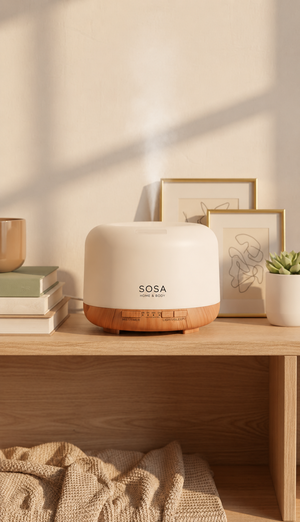
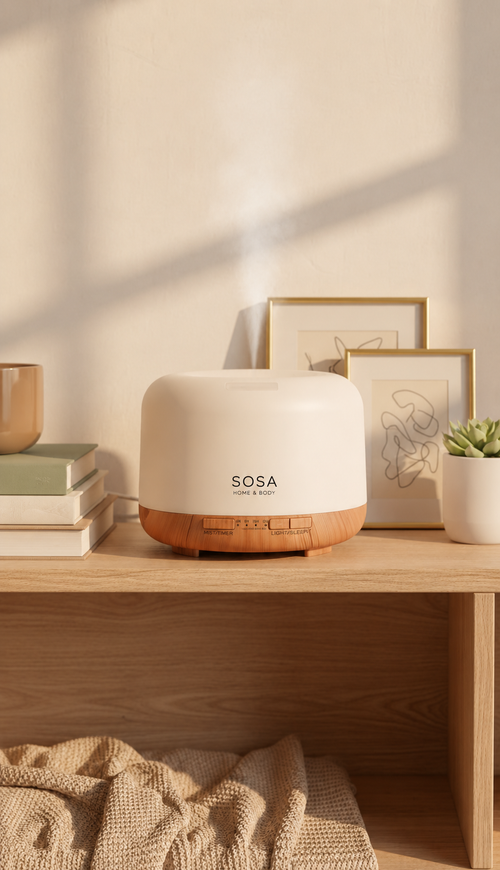
Sukoon at ₹1,899 covers a single reception of 270–320 sq ft and includes three 15ml scents.
Hotel Collection from ₹299. Free shipping above ₹499.
Straight answer
What should an HNI client experience when they walk into a luxury realtor's office?
1. Solve the car before you solve anything indoors. Somebody arriving at a commercial building for the first time is deciding where to leave a vehicle, whether the driver waits and where, and which of three towers they are looking for. A single message the day before with the tower name, the floor, the parking level and where a driver can stand removes the only part of the visit that can make a person arrive irritated, and it costs one minute.
2. Make your door findable from the lift door. Stand where the lift opens and look. If your firm's name is not legible from there, a client is opening the wrong door or reading a directory board while somebody else's staff watch them. A legible nameplate and a lit approach are a few thousand rupees and they are the last six metres of a journey the client has already spent forty minutes on.
3. Somebody looks up inside five seconds and uses their name. This is the single item on this page that costs nothing and cannot be recovered later. Being expected is the whole of it: their name, the meeting, and a direction. A reception with nobody at it, or somebody who asks who they are here to see, undoes a great deal of what you spent on the stone behind the desk.
4. Decide what the waiting chair faces, and keep the wait under four minutes. A client sitting for six minutes looking at a printer, a pantry door or a colleague's screen with another client's file open on it is being told something you did not intend to tell them. One thing worth looking at is enough, and an empty wall beats a crowded one.
5. The room is finished before they enter it, not while they enter it. Chairs square, table clear, cooling started twenty minutes ahead, the previous meeting's cups already gone. A room assembled around a standing client is the most expensive free mistake in this business.
6. Then the air, which is where scent finally arrives. One composition, low, on a schedule that had it at its level before the office opened, through a
Vaayu at ₹11,999 or a
Sukoon at ₹1,899 if you have one room. A client should register the office, not the fragrance.
A portion of every order supports girl-child education through Nanhi Kali.
TL;DR: a client at your office is reading you rather than a building, so the sequence is the answer: tell them where to park, make the door findable, look up and use their name inside five seconds, keep the wait under four minutes facing something worth facing, have the room finished before they enter it, and hold the temperature and the noise. Scent sits inside that at a low, scheduled, unchanging level — the Ritz-Carlton-inspired
Quiet Luxury at ₹299 through a
Vaayu at ₹11,999.
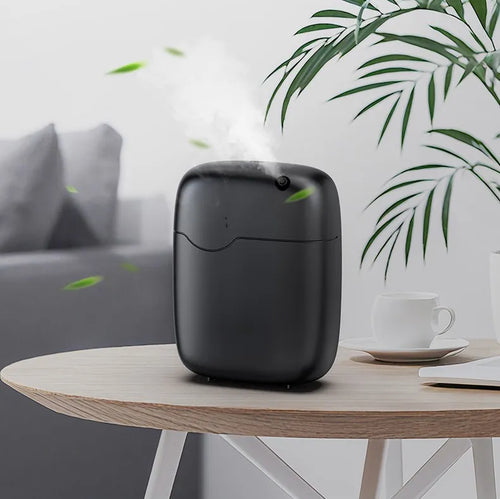
The one object in the room you must never be seen operating
SOSA Vaayu · waterless, scheduled, key-locked ₹11,999
A client who watches you switch on a diffuser has been shown the mechanism, and a mechanism on display stops being atmosphere and becomes a device. Bluetooth scheduling and 1h/4h/8h/24h timers mean the machine reached its level before the building opened and nobody in the room has touched it, which is the only condition under which scent reads as a property of the office rather than as a preparation for a visitor. The key-lock exists for the same reason: nothing to fiddle with, nothing a visitor can turn up. Waterless cold-air nebulisation, up to 1000 m³, a 400ml tank lasting about 75 days, under 38 dB, auto-stop, 0.9 kg.
Why an office arrival is not a viewing arrival
It is worth naming the difference precisely, because the whole page follows from it. At a viewing, everything the buyer meets is evidence about a building, and you are a neutral presence walking them through it. In your office, nothing is evidence about a building — every single thing they meet is evidence about how you work, because you chose all of it. The lighting, the wait, the chair, the state of the table and the air are not incidental conditions of a property you are selling. They are your operating standards, on display, in a room you control completely and have had unlimited time to prepare. That is a much less forgiving position than a viewing, and it is also a much easier one to get right, because nothing about it is a surprise.
1
THE APPROACH
The car, the lift lobby and the last six metres
Start outside the building, because the client's experience of your office starts about eleven minutes before they see it. A person driving to a commercial address in an Indian city is solving three problems on the way: which gate, where the car goes, and what the driver does for the next hour — and every one of those is solved by a message sent the previous evening rather than by anything in your reception. Tower and floor, the parking level, whether the security desk needs a name in advance, and somewhere sensible for a driver to wait. If your building's security takes a photograph of every visitor's identity card and issues a paper pass, say so in that message, because being warned about a procedure removes almost all of the irritation of it. Then the lift lobby, which belongs to the building rather than to you and is very often the shabbiest part of the whole journey. You cannot repaint it, and you can control the last six metres of it. Stand where the lift doors open and look at what a stranger sees: if your firm's name is not legible from that spot, the client's arrival ends with them reading a directory board or opening somebody else's door, and they will be slightly on the back foot when they finally reach you. A properly lit, properly sized nameplate at eye height, a doormat that is not disintegrating, and a door that opens without being shouldered. It is a spend of a few thousand rupees against a client who is arriving to discuss several crores, and it is the part of the sequence that brokerages most reliably skip because they stopped seeing it in their first month.
2
THE LOOK-UP AND THE WAIT
Five seconds, four minutes, and what the chair faces
Then the moment the door opens, which is decided faster than anybody likes to admit. Somebody should look up within about five seconds, stand, use the client's name and say what happens next. That is the entire specification, it costs nothing, and it is the one thing on this page that no amount of later polish repairs. A client who has to announce themselves twice has learned that their arrival was not on anybody's mind, and everything afterwards is read through that. If your reception is unstaffed for part of the day, then whoever is taking the meeting comes out to the door themselves — that is better than a handsome empty desk, not worse. Then the wait, and here I would give you two numbers. Four minutes is roughly where a wait stops being a pause and starts being a queue, and six minutes unexplained is where a client begins constructing a theory about how busy you are and whether they are the important meeting. If you are going to be eight minutes, somebody says so, and says why, and the water arrives during the wait rather than after it. The last piece is the sightline, which almost nobody plans. Sit in your own waiting chair and look straight ahead. If the view is a printer, a pantry door, a stack of files, a colleague's monitor with another client's file open on it, or a wall of framed certificates arranged like a clinic, that is what your client has been studying for four minutes. One good thing to look at is enough. An empty wall is better than a crowded one, and a screen showing somebody else's transaction is worse than either.
3
THE ROOM AND THE AIR
Finished before they enter it — and where scent honestly comes in
Then the meeting room, and the single distinction that matters is whether it was finished before the client arrived or is being finished while they stand in the doorway. A room being tidied around a client is a statement of fact about your buffer between appointments, and everybody in the doorway understands it. Ten minutes between meetings resolves the whole thing: cups gone, chairs square, table clear and dry, screen off or showing your own material, cooling started twenty minutes ahead rather than as the door opens. Noise is next, and it is the item premium consultancies under-spend on most: if a client suspects the desks outside can hear them, they will not tell you the real reason they are selling, which is a functional failure rather than an atmosphere problem. And then the air, which is the last thing in the sequence and belongs last. One composition across the office, held at a level that a visitor reads as the room rather than as a fragrance, running from before opening so nothing was switched on for anybody's benefit. That is scent's honest position here: not the arrival, one of several quiet consistencies inside it, alongside the temperature being the same every time and the water arriving without being asked for. And the warning that belongs on this page rather than a later one: a strongly scented office reads as trying, in precisely the way a strongly scented flat does. A client who notices the fragrance as a fragrance has been given something to have an opinion about, and you did not want an opinion, you wanted a room that felt looked after.
The test that settles all of this in one afternoon: ask somebody who has never been to your office to arrive at three o'clock without being announced, and to write down every single thing they noticed before they sat down. You will get eight items, six of them free to fix, and the fragrance will not be on the list — which is the outcome you want.
The same client, two arrivals
The identical person, arriving at a listing on Saturday and at your office on Monday, is doing two different jobs with their attention. This is the sequence set side by side, moment by moment, because the differences are the instruction. The column that matters is the last one: what each moment is actually telling them.
Moment by moment
A property viewing and an office visit, compared step by step
| The moment |
At a property viewing |
At your office |
What it tells them |
| Being expected ★ |
You are already there, so it is automatic |
Somebody looks up in five seconds and uses their name, or nobody does |
The single free item that cannot be recovered afterwards. Everything later is read through it |
| The approach |
The address is the point; a difficult building is the building's problem, not yours |
The tower, the parking, the driver and the pass are all yours to solve in advance |
Whether you anticipate the practical bits of somebody's day |
| The threshold |
A front door you are unlocking in front of them |
A door they must find from a lift lobby you do not own |
That the last six metres were thought about, or were never looked at |
| The wait |
There is none — the tour begins immediately |
Two to four minutes, in a chair, facing something you chose |
Whether their time is treated as valuable or as elastic |
| The room |
You are showing rooms, so their state is the subject |
The meeting room was ready, or is being made ready around them |
Your buffer between appointments, stated as a fact |
| The air |
Set for one occasion, two hours before, then it ends |
The same every day, all day, for your team as much as for them |
Consistency. A level chosen to impress a visitor is the wrong level here |
| Afterwards |
They remember a flat and, if it went well, not much else |
They will be back three or four times before anything is signed |
Repetition is the whole difference. An office is judged on its fourth visit |
Shop this guide
The arrival, in three products
The SOSA principle
Almost everything an HNI client registers on arrival at an office is free, and happens in the first fifteen seconds. Scent is neither of those things, which is exactly why it belongs late in the sequence rather than early.
Being expected costs nothing. A findable door costs a few thousand. A four-minute wait facing something decent costs a decision. Do those three before you spend ₹11,999 on anything.
Where scent goes in the sequence, and at what level
Start with placement, because in an office it is decided by the sequence rather than by the floor plan. The machine belongs in the entrance zone — the reception area and the first few metres of the floor beyond it — because that is where a person's impression of the whole space is formed and because it is the part of your office that every visitor meets and most of your team walks past rather than sits in. Waist height or above, at the edge of the room rather than in the doorway itself, out of the direct path of an air-conditioning vent, and not on the reception counter where a client is standing over it. A Vaayu at ₹11,999 covers up to 1000 m³, which is most brokerage offices in one machine, and it is waterless cold-air nebulisation, so nothing damp is being added to a room holding paper, files, drawings and a printer. If your office is genuinely one room of 270 to 320 square feet, the Sukoon at ₹1,899 is the honest answer and it arrives with three 15ml Hotel Collection scents of your choice — but it is an ultrasonic, so it puts 30 to 50 millilitres of water an hour into the air, which is a consideration in a sealed cabin in August and not one in a dry January.
Then the level and the schedule, which are the two settings people get wrong in opposite directions. The correct level in an office is the one at which a visitor would describe the room as pleasant and could not tell you what it smelled of, and it is lower than the level you would set to impress somebody in a flat you are trying to sell. Set it in the morning with fresh noses in the building, ask two people who have just walked in from outside, and then leave it alone. The schedule matters as much: the machine starts half an hour before the office opens and stops after the last person leaves, on the Vaayu's 1h/4h/8h/24h timers through the app, so that the level has been reached and held long before the first appointment. The rule underneath both settings is that nothing is ever switched on for a client. A room that has been at its level since eight in the morning reads as a property of the office; a machine started when a client's car reaches the gate is a preparation, and a client who watches you adjust it has been shown the mechanism. This is why the key-lock is worth more here than the coverage figure, and why I would rather you ran a lower setting continuously than a higher one on demand.
Then the constraints, which in a workplace are non-negotiable and come before anything I have written above. The people who work in this office meet the scent for something like two thousand hours a year against a client's twenty minutes, so they are the constraint and not the visitor. Ask them before you install anything, and if somebody reacts to it — a migraine, asthma, a pregnancy, or simply that they cannot work under it — the answer is to stop, not to turn it down. That is a straightforward position and it has never cost me a customer worth having. Then habituation: within a fortnight nobody in the building can smell it any more, because a nose reports change and discards constants, and the instinct that produces is to increase the output while every visitor is still receiving the level you originally set. Do not chase it. Ask somebody arriving from outside instead. And the two lines that govern this cluster apply to your own address as much as to a listing: if there is a smell in your office with a cause — damp in a wall, an untrapped pantry drain, a leak under the sink — that is a repair and not a fragrance problem, and no machine should be bought to sit on top of it. Nothing on this page claims that scenting your office affects a client's decision, a mandate or a price. It is presentation, in the same category as your lighting and your stationery, and that is enough to justify it without inventing anything.
A client at a viewing is reading a building. A client in your office is reading you, and everything in the room is something you chose.
— Sonal Sahani, SOSA
The SOSA edit
In the order of the arrival itself rather than in order of price, because that is how a client meets it. The first three rows cost nothing or nearly nothing and they outrank everything below them. The last row prints the thing this page is most often asked for and will not recommend.
The SOSA edit
An office arrival, in the order the client meets it
| In this order |
What it is |
When it happens and how |
Cost |
| 1. The message the night before ★ |
Tower, floor, parking level, security procedure, and where a driver can wait |
First, always. It removes the only part of the visit that can make somebody arrive annoyed |
₹0 |
| 2. A findable door |
A legible, lit nameplate at eye height from where the lift opens; a mat that is intact |
The last six metres of a forty-minute journey, and the part brokerages stop seeing after a month |
₹3,000+ |
| 3. Being expected |
Somebody looks up in five seconds, stands, uses the name and gives a direction |
Free, unrecoverable, and worth more than everything else on this table put together |
₹0 |
| 4. The waiting sightline |
One thing worth facing. Not a printer, a pantry door or somebody else's screen |
Decided by sitting in your own chair for four minutes, which nobody in your firm has ever done |
₹0 |
| 5. One scent, low, scheduled |
A Vaayu at ₹11,999 in the entrance zone, or a Sukoon at ₹1,899 for one room |
After the four above. Running before the office opens, never switched on or adjusted for a visitor |
₹1,899–₹11,999 |
| 6. The composition itself |
The Ritz-Carlton-inspired Quiet Luxury — white tea, bergamot, cedar — as the default |
Chosen so that a client cannot name it afterwards. Nothing sweet, nothing identifiable as a perfume |
₹299 |
| Not recommended: a stronger setting for an important client |
Turning the output up on the morning of a large meeting, or starting the machine as the car arrives |
This is the single mistake this page exists to prevent. A climbing room reads as an event being staged |
— |
Honest notes for buyers: fragrance is the last step in preparing a property, never the first, and it must never be used to cover a defect. Damp, a leak, drains, smoke or anything structural is a material fact about a property: find it, fix it or disclose it. Scent a listing that is genuinely sound. On the machines: the
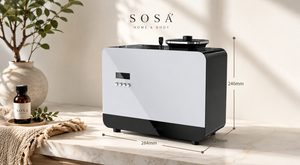
Vaayu at ₹11,999 is waterless cold-air nebulisation — no water, no heat and no dampness — covering up to 1000m³ or roughly 2,000–3,000 sq ft, with a 400ml tank lasting about 75 days, Bluetooth app control, 1h/4h/8h/24h timers, under-38dB running, auto-stop and a key-lock, at 0.9 kg and smaller than a shoebox, so one machine can serve a whole portfolio. The
Aangan at ₹25,999 covers up to 3,000m³ for sales galleries and clubhouses. The ultrasonic
Sukoon,
Boond and
Megh are water-based and add 30–50 ml of water an hour to the air, which makes them the wrong choice for a closed or humid vacant property. A
reed diffuser needs 24–72 hours to establish, so it suits a listing shown over months rather than a viewing tomorrow. A candle must be attended and put out, which rules it out of an unoccupied property. SOSA does not make a room spray for the home; the sprays in the range are car perfumes. The Hotel Collection scents are SOSA's own interpretations inspired by the world's finest hotels; SOSA is an independent Indian fragrance house, not affiliated with or endorsed by any hotel brand. A portion of every order supports girl-child education through Nanhi Kali.

The target is a scent nobody can describe afterwards
The Ritz-Carlton-inspired · Quiet Luxury ₹299 / 15ml
White tea, bergamot and cedar.
A client who can name your office fragrance in the car afterwards has spent part of the meeting describing your firm as a smell, and that is a worse outcome than a room that smelled of nothing. The brief is a composition with no signature material sticking out of it — nothing sweet, nothing that reads as a person's perfume, nothing anybody has an opinion about. Cool, dry and faintly citric is the safest register a workplace has. ₹299 for 15ml, ₹999 for 100ml and ₹1,799 for 300ml water-based for ultrasonics; the
Vaayu and
Aangan take undiluted oil and ship with four hotel-inspired scents.
A note from Sonal
I have been walked into a lot of brokerage receptions, and the thing that separates them has almost never been the money spent. It has been whether anybody knew I was coming. The best arrival I can remember was in a small office above a bank in Bengaluru with a laminate reception desk and one chair, where a man stood up before I was through the door, said my name, said the room was ready and that his colleague was two minutes away, and put a glass of water down. The worst was a marble-and-brass reception in a very good building where I stood for four minutes while two people avoided eye contact, and I have never once thought about the marble since.
So I would be careful about where scent sits in this. It is a genuine part of how an office feels and it is not the part that decides anything, and a page that told you otherwise would be selling rather than advising. What it does is something the rest of the list cannot: it is the same at nine fifteen on Monday and at six forty on Friday, without anybody having remembered it, on the day your receptionist is off and the day three meetings run over. That consistency is worth ₹11,999 to a firm that already has the free things right. To a firm that does not, it is a purchase standing in for a conversation with its own team, and I would rather you had the conversation.
Everything is made and supported from Pune, and a part of every order funds girl-child education through Nanhi Kali. You get a space that smells like somewhere considered; a girl gets a classroom. That equation has always felt right to me.
Frequently asked questions
What is the single most important thing an HNI client notices when entering a realtor's office?
Being expected. Somebody looking up within about five seconds, standing, using their name and saying what happens next. It costs nothing, it happens before anything else, and no amount of later polish repairs it if it goes wrong. Everything after it is read through it.
How long should a client wait in a luxury brokerage reception?
Under four minutes. Four minutes is roughly where a wait stops being a pause and starts being a queue, and six minutes without an explanation is where a client starts building a theory about their own importance. If it will be longer, somebody says so and says why, and the water arrives during the wait.
Should the office scent be turned up before an important client visits?
No, and this is the mistake the page exists to prevent. A room that has held one level since before opening reads as a property of the office; a room climbing while somebody is in it reads as an event being staged for them. Set one level, schedule it, and never touch the machine in front of a visitor.
Can an office be too strongly scented?
Easily, and it reads exactly as a strongly scented flat does: as trying. The level that works is the one a client would describe as a pleasant room without being able to tell you what it smelled of. Your own team will stop noticing it in a fortnight, so judge it by asking somebody who has just come in from outside.
What should I buy for the reception of a 1,500 sq ft brokerage office?
A
Vaayu at ₹11,999 in the entrance zone, on a schedule running the office hours. It is waterless, so nothing damp reaches paper or a printer, it covers up to 1000 m³ against the roughly 425 m³ that office holds, and it runs under 38 dB. A single-room office of 270–320 sq ft is a
Sukoon at ₹1,899.
The room they come back to
Everything free, first — then one scent, low, on a schedule
The Vaayu is ₹11,999: waterless cold-air nebulisation covering up to 1000 m³ or roughly 2,000–3,000 sq ft, a 400ml tank lasting about 75 days, Bluetooth app control with 1h/4h/8h/24h timers, under 38 dB, auto-stop and a key-lock, at 0.9 kg. The Sukoon is ₹1,899 for a single reception of 270–320 sq ft and includes three 15ml Hotel Collection scents. Hotel Collection from ₹299. Free shipping above ₹499. A portion of every order supports girl-child education through Nanhi Kali.
See the Vaayu · ₹11,999 See the Sukoon · ₹1,899
Continue the read
More from SOSA
Editorial standards & sources
About this guide: Written by Sonal Sahani, ISIPCA Versailles-trained founder and perfumer at SOSA Home & Body, on the arrival sequence at a brokerage office rather than at a property — the parking message, the findable door, the five-second look-up, the four-minute wait and what the waiting chair faces, the state of the meeting room at the moment the door opens — and on where scent honestly sits inside that sequence, at what level, and why a strongly scented office reads as trying.
Facts verified August 2026: Product facts used in this guide. SOSA Vaayu ₹11,999: waterless cold-air nebulising diffuser, atomises undiluted fragrance oil to a dry residue-free nano-mist, coverage up to 1000m³ (approximately 2,000–3,000 sq ft), 400ml refillable tank lasting up to about 75 days per fill, Bluetooth app plus onboard control, 1h/4h/8h/24h timer scheduling, adjustable intensity, under 38 dB, DC 12V/1A at 5W, 165 × 80.5 × 215 mm and 0.9 kg, freestanding or wall/HVAC mounted, auto-stop and key-lock, CE, RoHS and SGS certified, supplied with four hotel-inspired fragrances. SOSA Aangan ₹25,999: HVAC-connected or standalone commercial nebulising diffuser, coverage up to 3,000m³ (roughly 8,000–10,000 sq ft), 800ml reservoir, metal body, programmable schedules, under 42 dB. Ultrasonic machines are water-based and consume 30–50 ml of water an hour: Sukoon ₹1,899 (500ml, 270–320 sq ft, 16–18 hours on low, 3–6 drops per tank, steady/2H/4H timers, three 15ml Hotel Collection scents included), Boond ₹899 (300ml), Megh ₹3,499 (6 litres). Hotel Collection water-based fragrance 15ml ₹299, 100ml ₹999, 300ml ₹1,799, Pack of 7 at 15ml ₹1,799 against ₹2,093 bought singly; the Vaayu and Aangan take their own undiluted oil rather than these water-based bottles. Reed diffusers (separate alcohol-free line) from ₹749, requiring 24–72 hours to reach their working level. Scented candles from ₹379, scenting a room in roughly 15–20 minutes but requiring attendance. Free shipping above ₹499. Timings: a nebulising diffuser reaches a working level within minutes and a stated viewing level well inside two hours. This guide makes no claim that fragrance affects a property's price, offer level or time on market; it is presentation, in the same category as photography, styling and lighting. Fragrance must never be used to conceal a material defect. SOSA is not affiliated with or endorsed by any hotel brand. Prices subject to change — see the live product pages.



 Sukoon · a single reception₹1,899Shop →