
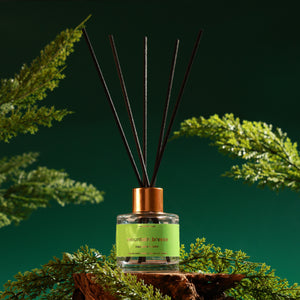

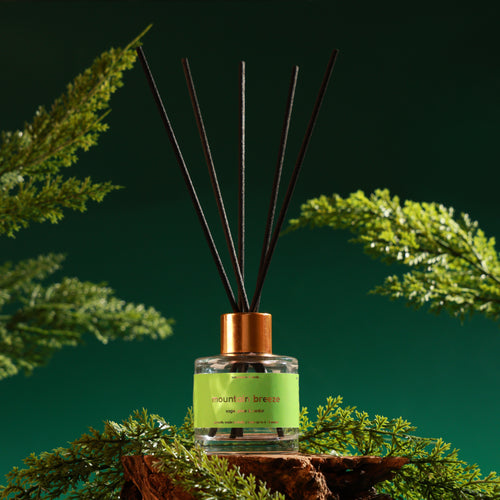
In the SOSA reed range one composition meets the definition properly. Mountain Breeze ₹849 — Himalayan pine, sage and Indian cedar — is dry, unsweetened and has no floral weight. Everything else in the range trades one of the four away.
The fifth property is specific to your building: brightness. A sharp citrus-eucalyptus profile is neutral by every classical measure and can still read as a cleaning product in a medical corridor, which is a register problem rather than a composition problem.
Three directions do not exist in the reed range at all. No aquatic, no musk-forward composition and no oud. If a neutral marine or a skin-musk is what you actually want, SOSA does not make it, and I would rather say so than sell you something adjacent.
2. Neutral is four properties, and a composition either has them or it does not. Low sweetness. Low floral weight. A dry base rather than a soft or creamy one. No gourmand signal — nothing that references food or drink. Any composition failing one of those is not made neutral by being turned down.
3. The fifth property is contextual and it only bites in buildings like yours. A bright citrus-mint-eucalyptus profile is classically neutral and can still read as a cleaning product in a clinical corridor, because that is what those materials do in institutional buildings. That is a register judgement, not a fault in the composition.
4. Neutral and low are separate controls, and you need both. Choose the composition for neutrality; set the reed count or the machine mode for level. In a multi-age arrival zone I would run two or three of the six supplied reeds — six is where SOSA calibrates and where the published strength positions are measured, on SOSA's own internal scale rather than any industry standard.
5. What the base does at forty minutes matters more than what the top does at the door. People sit in an eye clinic for a long time, so judge a composition on what is still in the air at the end of a wait. Dry woods hold their character; softer, sweeter bases tend to feel heavier the longer you sit in them.
6. Three directions do not exist in the reed range, and I will not pretend otherwise. No aquatic or marine, no musk-forward composition, no oud or incense. If your idea of neutral is a clean marine or a skin musk, SOSA does not make it.
7. Neutral fragrance is still fragrance. A neutral room is not an unscented room, and the fragrance-free seat is not optional because you chose a dry composition. Some people are sensitive to airborne fragrance, which is exactly why the clinical pathway stays fragrance-free and why that seat has to be somewhere a person would ordinarily sit.
8. Nothing here is a claim about anybody, and nothing goes past the consultation door. No product or setting is described as safe, unsafe or suitable for any patient group, and no claim is made about how anybody at any age perceives or responds to fragrance. Examination rooms, diagnostics, consultation cabins, the procedure suite and post-operative areas take nothing. Composed and made in small batches in Pune, and a portion of every order supports girl-child education through Nanhi Kali.
Part one — what neutral actually means in perfumery
The word is used loosely enough to be useless, so here is the version I would defend in front of anybody. Neutral is not "no smell", it is not "unscented", and it is not "faint". It is a composition built to sit in a room without proposing anything. Three things follow from that.
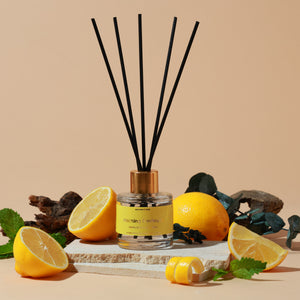
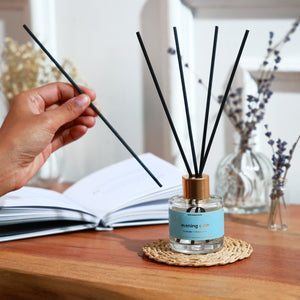
 Evening Calm₹799 · soft, not neutralThis is the one that catches practices out, and it is worth understanding because it is contextual rather than compositional. Morning Freshness at ₹749 — Malabar lemon, peppermint and Nilgiri eucalyptus — scores well on all four tests: not sweet, not floral, no gourmand reference, a clean structure. But lemon, mint and eucalyptus are also the materials that dominate institutional cleaning products, so in a building with hard floors, waiting-room chairs and a cleaning trolley somewhere down the corridor, a bright citrus-eucalyptus profile can be read as "this room has just been cleaned" rather than as ambience. That is not a flaw in the composition and it is not a claim about anyone's perception — it is a description of the associations those materials carry in this category of building. Where it works well is a compact, well-ventilated entrance that people pass through rather than sit in. Where I would avoid it is a seated waiting area in a clinical corridor, which is exactly the room this page is about.
Part two — the five properties, and how to hear each one
The definition made operational: what each property is, what raises it, what it does to a room over a long wait, and the correction that costs nothing. The last column is where each property is legitimately allowed to break.
| Property | What raises it | The symptom in a long wait | The correction that costs nothing | Where it may legitimately break |
|---|---|---|---|---|
| Sweetness ★ | Vanilla, benzoin, caramelised and candied materials; ripe fruit | The room reads as comfortable, then as slightly full, then as too much — usually without anyone naming why | None. This one cannot be corrected by setting; it is a different bottle | Nowhere in the arrival zone. It belongs in a living room, not a clinical building |
| Floral weight | Rose, jasmine, tuberose, and white florals generally | Reads as decoration, and competes with the competence signal a clinic wants read | None by setting. Fewer reeds make it quieter, not less floral | An entryway in a hospitality building, or a home. Not a seated waiting area |
| Base dryness | Lowered by creams, balsams and soft musks; raised by cedar, vetiver and dry resins | A soft base seems to grow through the wait even when emission is constant | Choose a dry-based composition. Then the level you set is the level you keep | Nowhere here. Dryness is the property that makes a long wait survivable as a design |
| Gourmand signal | Coffee, vanilla, chocolate, spice, anything referencing food or drink | The room reads as a café, which is the wrong register for a clinical building at any strength | None. This is a composition decision, full stop | A staff room behind a closed door, if you want it there. Never the patient-facing zone |
| Brightness (the contextual one) | Sharp citrus, peppermint, eucalyptus — the institutional cleaning palette | Reads as "recently cleaned" rather than as ambience, specifically in a medical building | Move the source to a passing space rather than a seated one, or lower the reed count | A compact, well-ventilated entrance people walk through. It is a genuine option there |
| The honest caveat: the symptoms above are design observations about how compositions tend to behave in a room, not claims about how any individual, age group or patient perceives, tolerates or responds to fragrance, and no patient group is characterised anywhere on this page. Nothing here is medical, clinical, ventilation, infection-control or regulatory advice; those judgements belong to the practice and its clinicians. No SOSA product or setting is described as safe, unsafe or suitable for any patient or staff group. Every row describes the arrival zone only — reception and waiting. Examination rooms, diagnostic areas, consultation cabins, the procedure suite and any post-operative area take nothing, in any format, at any level. Some people are sensitive to airborne fragrance, which is why the clinical pathway stays fragrance-free and why a fragrance-free seat must genuinely exist. A neutral composition is still a fragrance: it adds a scent to the air and removes nothing already there — it does not clean, purify, filter or freshen anything. | ||||
Mountain Breeze · four out of four₹849Shop → 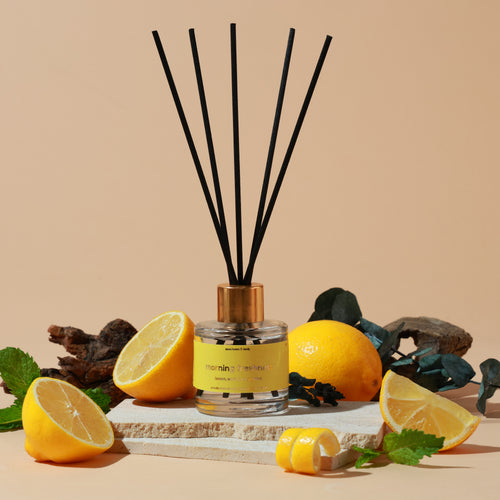 Morning Freshness · watch the context₹749Shop →
 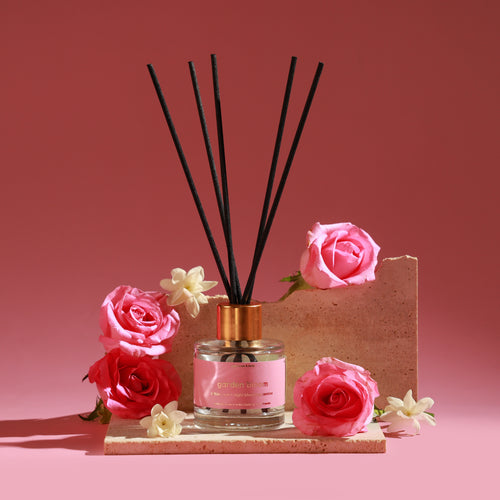 Garden Bloom · not neutral, and fine about it₹799Shop →
Part three — when the genuinely neutral answer is nothing
I should say the obvious thing before the recommendations get any more detailed, because it is true and a fragrance brand has every reason to skip it. The most neutral room is the one with nothing in it, and for a meaningful number of the practices reading this that is the correct destination rather than a failure to decide. A neutral composition is still a composition; it is still something you have added to air that people cannot leave. Choosing Mountain Breeze over Garden Bloom moves you a long way down that scale, but it does not take you to zero, and the fragrance-free seat is not made optional by a dry cedar base. So the honest sequence for any practice starting from scratch is: get the room genuinely neutral first — surfaces clean, no lingering cleaning agent, air actually exchanging, nothing damp anywhere — and then decide whether you want to add anything to a room that is already fine. A surprising number of practices discover at that point that they do not. That is a successful outcome, and it is one I would rather you reached deliberately than by accident after two hundred rupees of reeds and a year of low-grade doubt.
The second case is a room that cannot carry any composition without it becoming the room's most obvious feature. Under about 150 square feet of arrival zone, sealed, air-conditioned, with the front door as the only real opening, even a dry woody composition at two reeds is a small space with a discernible scent in it rather than a room that seems well kept. The physics does not care how tasteful the choice was. In that room I would fix the air exchange first and revisit the question in a quarter — and if you do proceed, one 50ml bottle at two of the six supplied reeds, at the far end, away from the corridor, is the entire specification. Between roughly 150 and 320 square feet a Sukoon at ₹1,899 becomes the sized instrument if you want a control rather than a bottle, and it should run on its lowest mode with the fragrance dosed light. Size to the arrival zone and never to the practice: most of the rooms in your building are clinical and take nothing at all, so a 900 square foot clinic is not a 900 square foot scenting decision.
The third case is the one I would put to a partners' meeting rather than to a supplier. Neutral is not a substitute for the fragrance-free option, and choosing a dry composition does not discharge the obligation to have somewhere the fragrance does not reach. Some people are sensitive to airborne fragrance — that is why the clinical pathway in this cluster stays unscented and why the seat has to exist. Make it a seat somebody would ordinarily choose, level and near the desk, far enough from the source that the difference is real, and make sure everyone on the front desk can switch off or remove the source themselves without asking permission or making a note for the morning. Then ask your own reception team what they think, twice, a fortnight apart, with an open question rather than a leading one. They are in that air for eight or nine hours a day against a patient's forty minutes, and if they would rather the room had nothing in it, that is a complete answer and it does not need to be justified any further.
Part four — the directions, and the three SOSA does not make
Eight fragrance directions rather than eight products, scored against the definition, with the SOSA option for each — or the plain admission that there isn't one. The last three rows are gaps, and I would rather name them than steer you to the nearest thing.
| Direction | Sweetness and floral weight | What its base does over a long wait | How neutral it reads in a clinical building | The SOSA option — or the gap |
|---|---|---|---|---|
| Dry woody-aromatic — pine, sage, cedar ★ | Both low. Nothing rounded, nothing floral | Holds. Cedar at minute ninety is the same proposition as cedar at minute five | The most neutral of the eight, and the direction I would specify | Mountain Breeze ₹849 / ₹1,349, at two or three of six reeds |
| Bright citrus-mint-eucalyptus | Both low — classically neutral | Fades faster than the woods, so the room can feel emptier late in a wait | Neutral by the definition, but can be read as cleaning product in a medical corridor | Morning Freshness ₹749 / ₹1,249 — better at an entrance than a seated area |
| Soft herbal-floral — lavender, chamomile | Sweetness low-to-moderate; floral weight present but gentle | Softens. The base is comfortable rather than dry, and can seem to grow | Quiet, but not neutral — and lavender is among the most recognisable materials in perfumery | Evening Calm ₹799 / ₹1,299, the softest at 8.9. Verify nobody is naming it |
| Floral — rose, jasmine | Floral weight high by design | Holds its character, which is precisely the problem in this room | Reads as decoration. Not neutral in any sense | Garden Bloom ₹799 / ₹1,299 — a good floral, and not for a clinic arrival zone |
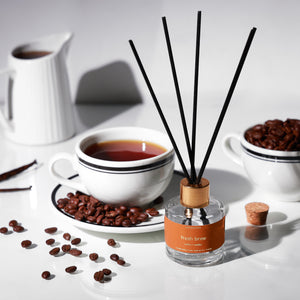
| Gourmand — coffee, vanilla | Sweetness high; the edible signal is the point | Rounds out and fills the room as the wait goes on | Reads as a café. The wrong register for a clinical building at any strength | Fresh Brew ₹849 / ₹1,349 at 9.5 — for a home or an office, not here |
| Aquatic / marine | Would be low on both — a legitimate neutral direction | Typically light and transparent throughout | Would read as neutral, and is a reasonable thing for a clinic to want | SOSA does not make one. An honest gap; the nearest in temperament is Morning Freshness, which is not the same thing |
| Musk-forward | Low floral weight; sweetness varies with the musk | Very persistent, and usually soft rather than dry | Often the quietest of all directions, which is why practices ask for it | SOSA does not make one. Named as a gap rather than substituted for |
| Oud / incense | Low sweetness, no floral weight, but very high presence | Extremely persistent and unmistakable | Not neutral. Distinctive is the opposite of what this room needs | SOSA does not make one — and I would not specify it for a clinic if we did |
Versailles
The first time a clinic asked me for "something neutral" I sent samples of the two driest things we make, and the reply was that both were lovely but neither was neutral enough. It took me a further exchange to realise we were using the word for two different quantities. She meant faint. I meant unproposing. She was asking me to solve a level problem with a bottle.
What unlocked it was writing the four properties down as a list and asking her to score her own shortlist against them. Sweetness, floral weight, base dryness, edible signal. She came back within an hour having realised that the composition she had almost bought failed two of the four, and that the reason she had liked it in the sample was precisely the reason it would have been wrong in a room people sit in for ninety minutes. She bought the dry one, ran two reeds instead of six, and stopped worrying about it.
I have used that list ever since, including for compositions of my own that I am fond of and would not put in a clinic. It is also why this page names the three directions we do not make. A neutral marine is a perfectly sensible thing for an eye clinic to want, and SOSA does not have one; saying so costs me a sale and keeps the rest of the page worth reading. Composed and made in small batches in Pune, and a part of every order funds a girl's classroom through Nanhi Kali.
Frequently asked questions
- Choosing when your patients range from children to seniors — the floor rule this page's direction serves.
- Fresh, green, woody or completely neutral? and premium without feeling like a spa.
- Is a strong hotel-style fragrance appropriate? — register, rather than direction.
- A premium cataract clinic — the most conservative page in this family.
- Brand: the SOSA founder story.
SOSA range, specifications and prices used in this guide (verified August 2026): Vaayu ₹11,999 — waterless cold-air nebulisation of undiluted fragrance oil; no water, no heat, no added humidity, no white mineral dust. Coverage up to 1000 m³, about 2,000–3,000 sq ft. 400ml refillable tank lasting roughly 90+ days at a mid setting. Bluetooth app plus onboard controls, 1h / 4h / 8h / 24h run windows, day selection, adjustable intensity, auto-stop and key-lock. Under 38 dB. DC 12V / 1A, 5W. Freestanding or wall / HVAC mount. CE, RoHS and SGS certified. SOSA does not currently sell a separate Vaayu cold-air refill oil; the 400ml supplied in the box is the fragrance available at the time of writing, so a practice planning continuous or multi-site use should confirm current refill availability with SOSA before committing. The water-based Hotel Collection is made for ultrasonic machines and must not be used in a Vaayu. Other machines: Boond 300ml ₹899 (~150 sq ft, ultrasonic) · Sukoon 500ml ₹1,899 (270–320 sq ft, 16–18 hours on low, remote and steady/2H/4H timers, three 15ml fragrances included, ultrasonic) · Megh 6L ₹3,499 (~215 sq ft — a runtime and humidity machine that covers less than a Sukoon, never a coverage upgrade) · Safar ₹3,999 (waterless cold diffusion, cordless, 20ml, about 6.9cm, three speeds, 1/2/3-hour auto-off — sold as a car and travel diffuser, personal-scale only; SOSA publishes no coverage figure for it) · Aangan ₹25,999 (HVAC nebulising, ~8,000–10,000 sq ft) · Meenar ₹38,500 (commercial HVAC, 12,000–18,000 sq ft). Water-based Hotel Collection for ultrasonic machines: 15ml ₹299 · 100ml ₹999 · 300ml ₹1,799 · pack of seven ₹1,799; scents are inspired by the atmosphere of well-known hotels — SOSA is an independent Indian brand and is not affiliated with, endorsed by or supplying any hotel group. Reed diffusers ₹749–₹1,349 (50ml 6–8 weeks, 130ml 14–18 weeks, six fibre reeds, no 100ml size; replacement reeds are not sold separately). Reed oil cannot be used in an ultrasonic machine and Hotel Collection oil cannot be used in reeds. SOSA sells no room spray or home spray — every SOSA spray is a car perfume. Nothing in this guide is medical, clinical or safety advice. A fragrance diffuser adds a scent to the air. It does not clean, purify, filter, sanitise or disinfect air, does not remove or neutralise disinfectant, damp or occupancy smells, and has no effect on comfort, anxiety, waiting time, recovery or any clinical outcome. Some people are sensitive to airborne fragrance, which is why this guide recommends that examination rooms, diagnostic areas, consultation cabins, procedure suites and post-operative areas remain fragrance-free, that a fragrance-free seating option always exist, and that a diffuser is never mounted into shared HVAC in a clinical building. Decisions about clinical policy, ventilation standards, infection control and patient suitability rest entirely with the practice and its clinicians. A persistent stale, damp or disinfectant smell is a ventilation, moisture or cleaning problem — SOSA sells no dehumidifier and no air purifier, and fragrance should never be used to cover one. Coverage, runtime and longevity figures are manufacturer specifications and typical ranges, not guarantees, and vary with room volume, ceiling height, air exchange, occupancy and season. SOSA publishes no commercial or bulk pricing, no corporate account, no annual maintenance contract, no installation service, no stated warranty term and no multi-location programme; warranty length, spare parts, servicing and app platform availability are unconfirmed, and larger or multi-site enquiries should go through the contact page before any commitment. Composed and made in small batches in Pune, India. Free shipping above ₹499. A portion of every order supports girl-child education through Nanhi Kali. Prices subject to change — see the live product pages.