


The three-part use test: how often will it be used, how much effort is required to start using it, and does anyone else in the house benefit? A gift that scores well on all three is nearly impossible to get wrong.
Activation energy is what kills gifts. A book needs three free evenings. A candle needs a match, an hour and supervision. A gadget needs a setup. Anything requiring a decision before it can begin will often never begin.
Do not buy this if: they have said they dislike scented things, there is a newborn in the home, someone there is scent-sensitive, or they already have two or three diffusers running.
2. Estimate use in days, not in sentiment. A book they will not open for a year is one day of use. A jar of something good they eat every morning is thirty. A room fragrance that runs constantly from the afternoon it arrives until it finishes is six to eight weeks in a 50ml and fourteen to eighteen in a 130ml, and every one of those days is a day it is doing its job.
3. Subtract activation energy. Anything that has to be started will sometimes not be. A candle requires a match, a free hour and somebody in the room. A subscription requires an account. A gadget requires setup. The best gift for this recipient is one where the effort required to begin using it is close to zero — you put it down, and it is already working.
4. Prefer things that serve the household. A gift to one person in a shared home is used by one person. A gift that changes a room is used by everyone who walks through it, including guests, which raises the use rate without raising the price.
5. Do not confuse "useful" with "used". Useful gifts imply a deficiency. A person who needs nothing hears a corrective in a practical present, however kindly meant. High use with no need attached is the register you want.
6. Let it end. Somebody who says they need nothing is often really saying they do not want to be given another responsibility. A consumable answers that literally: it is used, it finishes, and nothing is owed.
7. And take a no seriously. If they have said they dislike fragrance, if there is a newborn or a scent-sensitive person in the house, or if they already own several diffusers, none of the above rescues the gift. Choose something else from the table in Part two.
Everything we make is composed and handmade in small batches in Pune, and a portion of every order supports girl-child education through Nanhi Kali.
Part one — the three-part use test
Use is not one variable, it is three, and gifts fail on different ones. A beautiful hardback fails on frequency. A candle fails on activation. A single-serve gadget fails on breadth — one person in a house of four ever touches it. Score any candidate gift on all three before you buy, and the list shortens very fast. What follows is how I run the test, including the part that is inconvenient for me, which is that several of the best-scoring answers are not things I sell.
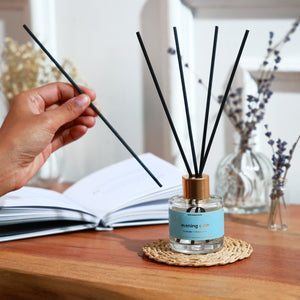
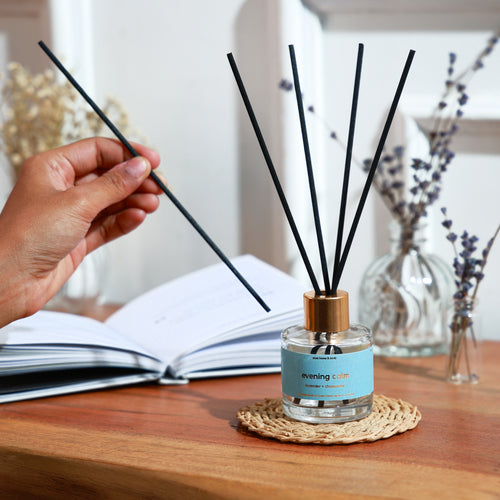
 Morning Freshness₹749 · bright, coldThis is the test almost nobody applies and the one that explains most failed gifts. Every gift has a cost of beginning. A book costs three free evenings and the mental space to start something new. A candle costs a match, an hour when somebody will be in the room, and the small anxiety of a flame in a house with a cat or a child. A gadget costs an account, a cable and a first hour of learning. For a person who has everything and needs nothing, the scarce resource is not money — it is attention, and any gift that asks for attention before it gives anything back is competing with a full life. The reason a reed diffuser scores so well on this test is structural rather than clever: there is no switch, no flame and no timer. You stand the bottle somewhere with a little passing air, put six reeds in, and the gift has started. Nobody has to remember it again, which for this recipient is the difference between a present and a project.
Part two — what actually gets used, ranked by realistic use rate
A working table rather than a wish list. The middle columns are the honest ones: several things people buy for this recipient every year score badly and are on the list anyway, out of habit.
| Gift | Days of use before it ends | Effort to begin | Who benefits | Verdict |
|---|---|---|---|---|
| Reed diffuser ★ | Every day for 6–8 weeks (50ml) or 14–18 (130ml) | None — no switch, no flame, no setup | Everyone in the room, including visitors | Highest use rate per rupee in this list |
| Good everyday soap or hand wash | Daily, several times, for weeks | None | The whole household | Excellent and badly under-given |
| Coffee or tea they already drink | Daily until finished | Low — but must match their method | One or two people | Very good if you know how they brew |
| A candle | Occasional sessions, an hour at a time | Match, free hour, supervision | Whoever is in the room | Good, but it waits to be chosen |
| A book | A few evenings, if it is the right book | High — needs unclaimed attention | One person | Only when it is specific to an obsession |
| A plant | Years, if it survives | Moderate and ongoing | The household, visually | Good — but it is a responsibility, not a consumable |
| A gadget or kitchen appliance | Twice, then a cupboard | High — setup, learning, storage | One person | Avoid unless they have asked for it by name |
| A dated restaurant booking | One evening | None — the date is fixed for them | Two people | Low frequency, very high value. Genuinely excellent |
| The honest caveat: a high use rate is worthless if the recipient does not want the category at all. Everything in the top row assumes a person who has not told you they dislike scented things, a home without a newborn or a scent-sensitive resident, and a flat that is not a single sealed room. Where any of those apply, the soap, the coffee and the booking are the rows to take. | ||||
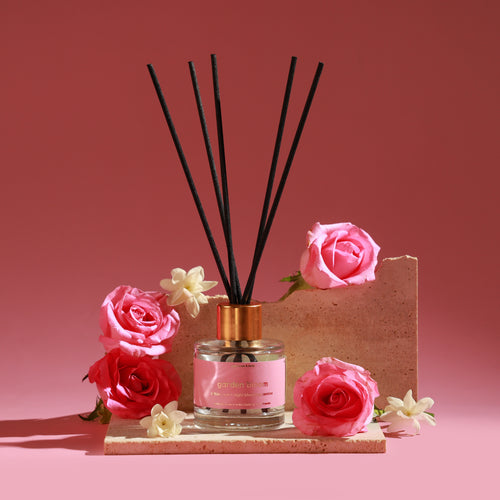 Garden Bloom · the safe defaultfrom ₹799Shop → Evening Calm · the quietestfrom ₹799Shop →
 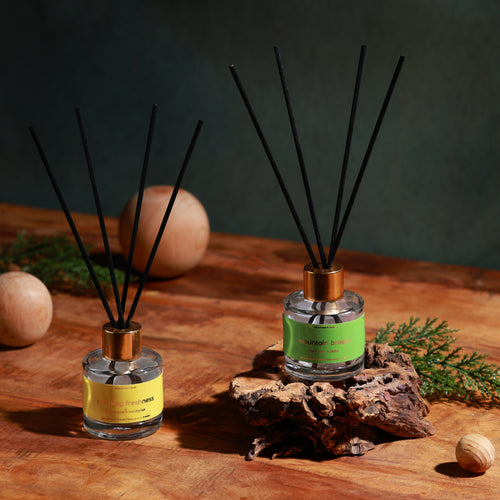 Fresh and Grounded · nothing sweet₹1,548Shop →
Part three — when this is the wrong gift
The use argument is strong enough that it can talk you past a refusal, so here is the boundary. A stated dislike outranks every use rate in the table. If somebody has said they do not like scented things — about a car, an office, a friend's house, anywhere — that is a preference and not a gap in their education. A gift that runs continuously in their home for six weeks is a particularly poor way to argue with them, because unlike a book they can leave unopened, this one keeps making its case every hour. Similarly, do not send fragrance into a home with a newborn, or one where somebody has asthma, migraine triggers or a diagnosed sensitivity. Our reed compositions are alcohol-free, phthalate-free, paraben-free, low-VOC and IFRA-compliant, and that is still not the point; the point is that it is their decision and not yours.
Two more. A very small sealed room — a studio flat, a single-room let, a home where the only clear surface is in a narrow passage — turns the format's greatest strength into its problem. Constant is lovely in a living room and relentless in eight square metres, and the recipient will experience the gift as too much rather than as misplaced. If you must, give the smallest size in the quietest composition and mention where to stand it. And a recipient who already runs two or three diffusers does not have an unclaimed category. Adding a fourth is not thoughtfulness, it is inventory, and the person who needs nothing will recognise it as such immediately.
Finally, the failure mode particular to this article's logic. High use is not the same as high meaning, and there are occasions that call for meaning — a fiftieth birthday, a retirement, the friend who has looked after you through a difficult year. For those, the right gift may well score two days of use and be worth every rupee: a framed photograph nobody else has, a first edition of the book they quote, a table booked at the place they mentioned once. Use is the right axis for the ordinary gift and the wrong axis for the significant one, and knowing which occasion you are in is most of the skill. If it is the significant one, come back to this page next year for the everyday gift instead.
Part four — the gift edit, by price and by use rate
Everything above as a shopping decision, with the situations each choice suits. The prices are the whole range; there is nothing above ₹2,598 in the reed line, and I would rather you knew that before you started.
| Price | The gift | Days of use | Give it when |
|---|---|---|---|
| ₹799 ★ | Garden Bloom 50ml — rose and night-blooming jasmine | 6–8 weeks, continuous | You know nothing about their taste and want the lowest-risk option |
| ₹749 | Morning Freshness 50ml — lemon, peppermint, eucalyptus | 6–8 weeks | The gift is really for a kitchen, a bathroom or a working room |
| ₹799 | Evening Calm 50ml — Kashmir lavender and chamomile | 6–8 weeks | Compact flat, light sleeper, or anyone nervous about strong smells |
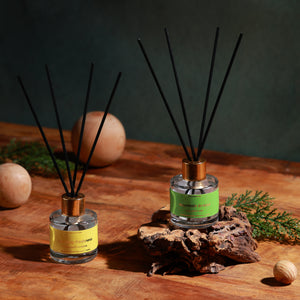
| ₹849 | Mountain Breeze 50ml — pine, sage, Indian cedar | 6–8 weeks | They reject anything sweet, floral or obviously "scented" |
| ₹1,249–₹1,349 | Any composition in 130ml | 14–18 weeks | You want the use to run through a whole season rather than a month |
| ₹1,498–₹1,598 | A duo — Day and Night, Fresh and Grounded, Warmth and Bloom | 6–8 weeks in two rooms at once | You want the gift to read as a decision about their home |
| ₹2,498–₹2,598 | The same duos in 2 × 130ml | 14–18 weeks, two rooms | A milestone, where you want scale as well as use |
| Wrong instrument | An oil refill at ₹2,399, or a Sukoon machine at ₹1,899 | Months | Only for someone you know already uses the relevant format |
Versailles
There is a shelf in my parents' flat that I think about a lot. On it are four or five genuinely lovely things that people have given them over the years and which have never been used. A cut-glass decanter. A leather writing set. A tea set that requires hand-washing. Every one of them was chosen well and every one of them asked for something the recipient was never going to supply — an occasion, a free hour, a change of habit.
Then there is a small bottle of hand wash by the kitchen sink that a friend brought once, which my mother has now bought for herself eleven times. Nobody would list it as a great gift. It scores better than anything on the shelf.
That contrast is the whole reason our reed range has no switch, no flame and no instructions beyond flipping the reeds once a week with gloves on. I would rather make something that works while people are thinking about other things than something that waits to be deserving of an occasion. It is also why I tell people plainly what it does not do: it will not fill a large open-plan floor, and past roughly two hundred and fifty to three hundred square feet of connected space the honest answer is a Sukoon at ₹1,899 rather than a third bottle. Everything is composed and handmade in small batches in Pune, and a part of every order funds a girl's classroom through Nanhi Kali.
Frequently asked questions
- What do you gift someone who has everything? — the method for finding the empty category.
- The four gift types that survive a full house — consumable, replacement, room, life stage.
- For the person who buys everything themselves — and the one blind spot they all share.
- The complete guide — this article and the eight around it, in one place.
- Brand: the SOSA founder story.
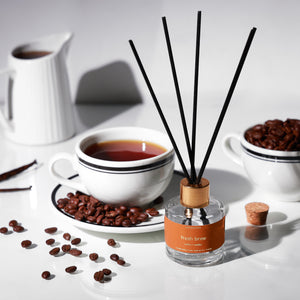
SOSA reed diffuser range & prices (verified August 2026): alcohol-free, phthalate-free, paraben-free and IFRA-compliant compositions on a heat-stable coconut-derived (CCT) carrier, low-VOC, supplied in a refillable glass bottle with six fibre reeds; 50ml lasts 6–8 weeks and 130ml lasts 14–18 weeks. Morning Freshness (Malabar lemon · peppermint · Nilgiri eucalyptus) 50ml ₹749 · 130ml ₹1,249 · 9.0/10; Garden Bloom (British rose · night-blooming jasmine) 50ml ₹799 · 130ml ₹1,299 · 8.9/10; Evening Calm (Kashmir lavender · chamomile) 50ml ₹799 · 130ml ₹1,299 · 8.9/10; Fresh Brew (Coorg coffee · Kerala vanilla) 50ml ₹849 · 130ml ₹1,349 · 9.5/10; Mountain Breeze (Himalayan pine · sage · Indian cedar) 50ml ₹849 · 130ml ₹1,349 · 9.4/10. Reed diffuser refills are oil only — you reuse your own vessel and reeds: 300ml ₹2,399 (roughly 8–11 months) · 500ml ₹3,499 (roughly 14–18 months), about ₹7–8 per ml against ₹15–17 per ml for a 50ml bottle. Duo sets ₹1,498–₹1,598 for 2 × 50ml and ₹2,498–₹2,598 for 2 × 130ml. Strength figures are positions on SOSA’s own internal strength scale, not an industry standard. Replacement reeds are not sold as a separate SKU; SOSA guidance is to refresh reeds every few months. The reed line is separate from the water-based Hotel Collection for ultrasonic machines (15ml ₹299 · 100ml ₹999 · 300ml ₹1,799) and the two are not interchangeable. Diffusers: Boond 300ml ₹899 · Sukoon 500ml ₹1,899 · Megh 6L ₹3,499 · waterless Vaayu ₹11,999. Composed and handmade in small batches in Pune, India; tested through 45°C summer heat and 85% monsoon humidity. Free shipping above ₹499. A portion of every order supports girl-child education through Nanhi Kali. Prices subject to change — see the live product pages.