Founder Diaries · Clinics & Medical Centres · Vaayu or Aangan · The Head-to-Head
By Sonal Sahani · ISIPCA Versailles 13 min read Updated November 2026
There are two machines, they are ₹14,000 apart, and the honest version of this comparison is shorter than a brochure would like.
The Vaayu at ₹11,999 covers up to 1000 m³ — roughly 2,000 to 3,000 sq ft — is waterless with no standing water tank, holds 400ml for about seventy-five days, runs on an app and 1h/4h/8h/24h timers, is under 38 dB, weighs 0.9 kg, and stands, wall-mounts or duct-mounts. The Aangan at ₹25,999 covers up to 3,000 m³ — roughly 8,000 to 10,000 sq ft — connects to an air-handling unit or runs standalone, holds 800ml, has a metal body, is programmable, and is under 42 dB. Four clinics in five are correctly served by the ₹11,999 machine, and the Aangan is the wrong machine for a 2,500 sq ft polyclinic. Recommending it there is overselling, I will say that in writing on my own website, and the only thing that decides between them is a sum you can do yourself in ten minutes.
Quick answers — read this first
The sum that decides it, and it is free: public area in square feet divided by 10.76, multiplied by ceiling height in metres, counting only the volumes a door closes. Every consultation and examination room, procedure room, dressing room, collection room, laboratory, dispensing counter, sterile store, imaging room, day-care bay and paediatric clinical area comes out entirely. In most clinics that removes forty to sixty per cent of the plan area.
Under 1000 m³ in one volume: Vaayu ₹11,999. Waterless, no standing water tank, 400ml ≈ 75 days, app and timers, under 38 dB, 0.9 kg, key-lock, four scents in the box.
Over 1000 m³ in one connected volume: Aangan ₹25,999. Up to 3,000 m³, 800ml, metal body, programmable, under 42 dB, HVAC-connected or standalone.
Several volumes, each under 1000 m³: one Vaayu per volume, same scent, same setting, same schedule. Three floors is three machines even when the floors total less than 1000 m³, because a rating is a capacity figure and not a delivery figure.
A 2,500 sq ft polyclinic: about 300 m³ of public volume. One Vaayu, and the Aangan is simply the wrong machine.
The short answer
Short answer: the Vaayu at Rs 11,999 suits almost every multi-speciality clinic - up to 1000 m3, roughly 2,000 to 3,000 sq ft, waterless with no standing water tank, 400ml lasting about 75 days, app plus 1h/4h/8h/24h timers, under 38 dB, 0.9 kg, freestanding or wall or duct mounted, auto-stop and key-lock. The Aangan at Rs 25,999 is for one connected public volume above 1000 m3, up to 3,000 m3 - a large integrated centre, a double-height atrium, a long concourse - with an 800ml reservoir, a metal body, programmable scheduling, under 42 dB, HVAC-connected or standalone. In a 2,500 sq ft polyclinic the Aangan is the wrong machine and recommending it there is overselling.
The rule that decides it: do the volume sum on public areas only and ask whether the result sits in one connected volume or several. One volume under 1000 m3 is a Vaayu. One volume over 1000 m3 is an Aangan. Several separate volumes each under 1000 m3 is one Vaayu per volume, because a coverage rating is a capacity figure, not a delivery figure, and nothing carries a controlled level through a closed fire door or up a lift shaft.
The rest of the range, honestly: ultrasonic machines are water-based and hold standing water, adding 30-50 ml of water an hour to the air - Sukoon Rs 1,899, Boond Rs 899, Megh Rs 3,499 - which suits a single administrative cabin with a named person emptying and drying the tank daily and is unsuitable for public clinical property. Alcohol-free reed diffusers from Rs 749 need 24-72 hours to establish and are barely noticed past about a metre, so they belong in a cabin rather than a waiting hall. Candles are not appropriate in a healthcare building. SOSA does not make a room spray. Free shipping above Rs 499.
Straight answer
Vaayu or Aangan — which diffuser suits a multi-speciality clinic?
1. For almost every multi-speciality clinic and polyclinic in India, the Vaayu at ₹11,999. Up to 1000 m³, which is roughly 2,000 to 3,000 sq ft of ordinary 3m-ceilinged space; waterless cold-air nebulisation with no standing water reservoir, which in a twelve-hour building is the specification that matters most and is a housekeeping argument rather than anything clinical; a 400ml fill lasting about seventy-five days, so four refill visits a year by one named person; Bluetooth app plus 1h/4h/8h/24h timers, so the facility team runs the opening hours from the office and the centre head never touches it; under 38 dB; auto-stop; a key-lock, which is the only reason a machine can stand in a public waiting hall at all; 0.9 kg at 165 × 80.5 × 215 mm, so it stands on a shelf or wall-mounts on two screws; freestanding, wall or HVAC mounting; and four hotel-inspired scents in the box, so the first month of trialling is free.
2. For one connected public volume above 1000 m³, the Aangan at ₹25,999. Up to 3,000 m³, which is roughly 8,000 to 10,000 sq ft; HVAC-connected or standalone; an 800ml reservoir; a metal body; programmable scheduling; under 42 dB. The buildings this is right for are specific rather than merely large: a genuinely integrated centre whose entrance, atrium, shared waiting hall and inter-departmental corridors form one volume; a double-height atrium reception, where seven metres over 1,400 square feet is about 911 m³ before you add anything else; a mall-format polyclinic with a long concourse; a building with a ducted air-handling unit that serves the public zones and nothing clinical, which
the HVAC question deals with properly.
3. The rule that actually decides it is not square feet, it is cubic metres and connectedness. Do the sum — public area in square feet divided by 10.76, multiplied by ceiling height in metres — and then ask a second question that most buying guides skip: is that volume one space, or several?
One volume under 1000 m³ is a Vaayu. One volume over 1000 m³ is an Aangan. Several separate volumes, each under 1000 m³, is one Vaayu per volume — because a coverage rating is a capacity figure and not a delivery figure, and nothing carries a controlled level through a closed fire door, round two corners or up a lift shaft.4. And the sum is done on public volume only, which is the step that changes the answer most often. Consultation and examination rooms, treatment and procedure rooms, day-care surgery and recovery, dressing rooms, blood- and sample-collection rooms, laboratories, pharmacy dispensing, sterile stores, imaging rooms, oncology day-care and paediatric clinical areas are not in the sum at all, because they are fragrance-free with their doors shut. In most medical centres that removes forty to sixty per cent of the plan area. A 6,000 sq ft clinic is very often 500 or 600 cubic metres of scented volume, not 1,600, and
the arithmetic page works it through line by line.
5. So, plainly: the Aangan is the wrong machine for a 2,500 sq ft polyclinic, and recommending it there is overselling. A 2,500 sq ft single-floor polyclinic at 3m has a plan volume of about 697 m³; take out six consultation cabins, a procedure room, a dressing room, a collection room and a small laboratory and the public volume is commonly 280 to 320 m³. That is less than a third of a Vaayu's rating and about a tenth of an Aangan's. The ₹25,999 machine in that building is not a safety margin — it is a machine that will be run at its lowest setting forever, which is a worse outcome than a smaller machine run properly, and ₹14,000 of equipment that is doing nothing.
6. The rest of the range, so nobody has to ask. The ultrasonic
Sukoon at ₹1,899,
Boond at ₹899 and
Megh at ₹3,499 are water-based, hold standing water and add 30 to 50 ml of water an hour to the air; they are honest for a single administrative cabin where one person owns a daily routine of emptying, rinsing and drying the tank, and they are wrong for public clinical property. An alcohol-free
reed diffuser from ₹749 needs twenty-four to seventy-two hours to establish and is barely noticed past about a metre, so it belongs in a cabin rather than a waiting hall — and a glass bottle of oil at reach height in a paediatric waiting area is a spill risk. Candles are not appropriate in a healthcare building, because an open flame is a fire-safety and insurance matter. And SOSA does not make a room spray.
A portion of every order supports girl-child education through Nanhi Kali.
TL;DR: Vaayu ₹11,999 for up to 1000 m³ in one volume, which is four clinics in five. Aangan ₹25,999 for one connected volume up to 3,000 m³ — a large integrated centre, an atrium, a concourse, or a public-only AHU to tie into. Several volumes each under 1000 m³ means one Vaayu each, because a rating is capacity and not delivery. In a 2,500 sq ft polyclinic the Aangan is wrong and saying otherwise is overselling.
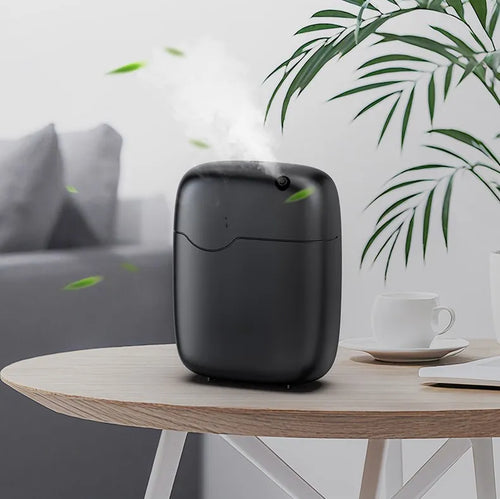
The machine four clinics in five should buy
SOSA Vaayu ₹11,999
Waterless cold-air nebulisation with no standing water tank, up to 1000 m³ or roughly 2,000 to 3,000 sq ft, 400ml lasting about seventy-five days, Bluetooth app plus 1h/4h/8h/24h timers, under 38 dB, auto-stop, key-lock, 0.9 kg at 165 × 80.5 × 215 mm, freestanding or wall or HVAC mounted, four hotel-inspired scents included. The specification that matters in a clinic is not the coverage figure, it is the absence of a water reservoir: a tank in a building that runs twelve hours a day needs a named person emptying, rinsing and drying it daily, and in most facilities that person does not exist. Public areas, one low setting, the opening hours.
The two numbers, and the ten minutes they take
You can settle this without talking to anybody, and I would rather you did, because a supplier who recommends a machine before asking for these two numbers is selling rather than advising. Number one: the public volume, in cubic metres. Take the floor plan, highlight the entrance and lobby, reception and registration, the shared or departmental waiting areas, the inter-departmental corridors, the lift and stair lobbies, administration and the café corner. Measure the ceiling height rather than assuming three metres. Then divide the highlighted square feet by 10.76 and multiply by the height. Highlight everything clinical in a second colour and do not include a single square foot of it. Number two: how many separate volumes that is. A volume ends at a closed door, a fire door, a stair, a lift lobby that latches, or a floor slab. Two waiting halls with a corridor between them are usually one volume. Two floors are always two. Write both numbers on one line — our public volume is ______ m³, in ______ separate volumes — and the machine is decided. Then, before you buy either machine, do the free list: a mug of water down every trap, gully, sluice and unused basin sixty minutes before opening, bins on a named collection time with lids that close, the soiled-linen route off the public corridor, and the air-conditioning drain pan in the maintenance scope. The twenty-six-line version is the whole of it, and thirteen of those lines cost nothing.
1
THE VAAYU, ₹11,999
What it is, what it is rated for, and where it genuinely ends
I will describe this accurately rather than generously, because the generous version comes back.
The Vaayu atomises undiluted fragrance oil to a dry, residue-free nano-mist using cold air, with no water reservoir anywhere in the machine. In a medical facility that single fact outweighs everything else on the specification sheet, and it is a housekeeping argument and never an infection-control one: a water tank in a building open twelve hours a day has to be emptied, rinsed and dried every single day by a named person, and if that person does not exist in your facility — and in most facilities they do not — you should not buy a tank at all. Coverage is up to 1000 m³, which is roughly 2,000 to 3,000 sq ft at ordinary ceiling heights, and the honest way to read that is as a capacity for one connected volume rather than as a radius. A 400ml fill lasts about seventy-five days on clinic opening hours, so four refills a year, which procurement can model in ten minutes. Bluetooth app plus 1h/4h/8h/24h timers mean the level has arrived before the first appointment rather than climbing while patients sit in it, and that nobody at the desk can change it. Under 38 dB, which is quieter than the reception's own air conditioning and quieter than a ceiling fan on medium —
the acoustics page has the comparison properly. Auto-stop. A key-lock, which is why it can stand in a public hall. 0.9 kg and 165 × 80.5 × 215 mm, so a shelf or a two-screw bracket. Freestanding, wall or HVAC mounting. CE, RoHS and SGS certified. Four hotel-inspired scents in the box.
Where it ends: one connected public volume above 1000 m³. Not a bigger building — a bigger single volume. A 10,000 sq ft centre whose public areas come to 900 m³ is a Vaayu. A 4,500 sq ft clinic with a seven-metre atrium that comes to 1,300 m³ is not.
2
THE AANGAN, ₹25,999
What it is for, and the four building shapes where it is right
The
Aangan is a commercial nebulising diffuser in a metal body: up to 3,000 m³ — roughly 8,000 to 10,000 sq ft — an 800ml reservoir, programmable scheduling, under 42 dB, and HVAC-connected or standalone operation.
It is right for four building shapes and I can name all four. One: a genuinely integrated medical centre where the entrance, the shared waiting hall and the inter-departmental corridors form one connected volume above 1000 m³ — not a building with more floor area, a building with more connected floor area. Two: a double-height atrium reception, where the height does the work; 1,400 square feet at seven metres is about 911 m³ before you add a single lobby, and the atrium page works the sum through. Three: a mall-format or hospital-adjacent polyclinic with a long public concourse that is one volume from end to end. Four: a building with a ducted air-handling unit serving the public zones and nothing clinical, where dosing the supply after the filter gives a genuinely even level across zones no standalone machine could reach — and where, crucially, the duct serves no consultation room, laboratory, collection room, dispensing counter or imaging room, because a supply grille cannot be shut like a door. That is the list. It is about one clinic in six, and when a building is on it I will recommend the Aangan without hedging and tell you to put it in the facilities budget line rather than marketing. What the Aangan is not is a safety margin, a premium option or a future-proofing purchase, and the 800ml reservoir is not a convenience in a small building — it is a larger volume of oil sitting in a machine that will never work through it at a low setting.
3
THE OVERSELLING TEST
Why the Aangan is wrong in a 2,500 sq ft polyclinic, and what ₹14,000 buys instead
Here is the arithmetic, so it is not an opinion.
A 2,500 sq ft single-floor polyclinic at 3m has a plan volume of about 697 m³. Take out six consultation cabins at around 110 sq ft each, a procedure room, a dressing room, a sample-collection room and a small laboratory — call it 1,400 sq ft of clinical space — and the public volume is about 307 m³. That is under a third of the Vaayu's rating and about a tenth of the Aangan's. An Aangan in that building will be run on its lowest setting from the day it is commissioned until the day it is replaced, which is a worse outcome than a correctly sized machine run normally, because a machine permanently at the bottom of its range is harder to hold steady, not easier. There is no scenario in which the extra 2,000 m³ of capacity is used. So recommending it there is overselling, and I would rather write that sentence on my own product page than have it said about me.
What I would do with the ₹14,000 difference, in order: a toilet extract fan repaired and interlocked to the light switch at ₹3,500 to ₹8,000; the air-conditioning maintenance scope widened to name the drain pan, the condensate trap, the blower wheel and two coil cleans a year; lidded bins where there are open ones; twenty-four flat microfibre mop heads at about ₹1,800 for the year; a hygrometer at ₹500 for whichever room is worst in monsoon; and a smoke pencil at ₹400, which ends every argument about which way air is moving through a doorway. Every one of those does more for how a clinic reads to a patient than a larger diffuser does, and
the list they come from has twenty-six lines of which thirteen are free.
The procurement version is the page to hand a purchase committee, and
whether one machine is enough is the question underneath this one.
The test I would apply to any quotation, mine included: did the supplier ask for your public volume in cubic metres and the number of separate volumes before naming a machine? If not, you have been quoted a product rather than advised on one, and the larger machine is the one that gets quoted.
Five facility shapes, and the honest answer for each
Five real shapes with the sums written out, plus the three rows that cover the rest of the range. Find the row nearest your building and redo the arithmetic with your own two numbers.
Print this
The decision table: volume, connectedness, machine
| Facility shape |
The public volume sum |
The honest answer |
Cost |
| 2,500 sq ft single-floor polyclinic, 3m ★ |
Plan 697 m³; take out six cabins, a procedure room, a dressing room, a collection room and a small lab — about 307 m³ public |
One Vaayu. The Aangan is the wrong machine here and recommending it is overselling |
₹11,999 |
| 3,000 sq ft multi-speciality clinic, 3m |
Plan 836 m³; public volume commonly 350–450 m³ once the clinical rooms come out |
One Vaayu, standing in the reception zone. The 3,000 sq ft case
|
₹11,999 |
| 6,000 sq ft polyclinic over two floors, splits |
Two volumes, roughly 330 m³ each, with a fire door and a stair between them |
Two Vaayu units, one per floor, same scent and schedule. The two-floor case
|
₹23,998 |
| 10,000 sq ft integrated centre, 3.2m, ducted AHU serving public zones only |
Public area about 4,000 sq ft; (4000 ÷ 10.76) × 3.2 = about 1,189 m³, one connected volume |
One Aangan, dosed downstream of the filter, zone list signed off |
₹25,999 |
| 4,500 sq ft clinic with a 1,500 sq ft atrium at 7m |
Atrium 976 m³ plus ground-floor lobbies and a gallery corridor, about 1,300 m³ total |
One Aangan. Arithmetic, not ambition. Measure to the roof
|
₹25,999 |
| Four-branch chain of 3,000 sq ft clinics |
Four separate buildings, about 400 m³ each |
One Vaayu per branch, one fragrance across all four. The chain question
|
₹11,999 each |
| A single administrative cabin |
Perhaps 40 m³ behind a closed door, one person owning the routine |
An alcohol-free reed diffuser from ₹749, or an ultrasonic if somebody empties and dries it daily |
from ₹749 |
| Never |
An Aangan quoted into a 2,500 sq ft polyclinic, a Vaayu asked to hold 2,000 m³, one machine quoted for three floors, or a candle anywhere in a healthcare building |
A rating is capacity, not delivery — and an open flame is a fire-safety matter |
— |
Shop this guide
The two machines, and the mount that decides where they go
The SOSA principle
Two numbers decide it: the public volume in cubic metres, and how many separate volumes that is. One volume under 1000 m³ is the ₹11,999 machine. One volume over it is the ₹25,999 machine. Several volumes under 1000 m³ each is one small machine per volume, because a rating is capacity and not delivery.
Four clinics in five are a Vaayu. The Aangan is right for about one in six, for reasons of building shape rather than quality — and it is wrong in a 2,500 sq ft polyclinic.
The ₹14,000 difference, and what else it buys
The gap between the two machines is ₹14,000, and the way to think about it is not as a premium but as an alternative purchase. If your sum comes back under 1000 m³ in one volume, the ₹14,000 is available for other things, and I would spend it in this order: a toilet extract fan repaired or replaced and interlocked to the light switch, ₹3,500 to ₹8,000 each, because a dead extract fan is the commonest building fault behind a clinic that is fine at nine and tired by six; the air-conditioning maintenance scope widened in writing to name the drain pan, the condensate line and trap, the blower wheel and two chemical coil cleans a year, which for a ten-unit clinic is roughly ₹25,000 to ₹45,000 a year and is mostly a renegotiation of money you already spend rather than a new cost; lidded bins from about ₹300 each wherever there is an open one in a public area; twenty-four flat microfibre mop heads at around ₹1,800 for a year, so a head is changed per zone rather than run for twelve hours; a hygrometer from about ₹500 in whichever room is worst in monsoon, because a reading is easier to act on than an opinion; and a smoke pencil at about ₹400, which settles every argument about which way air moves through a doorway in five seconds. That list does more for how your facility reads to a patient than a larger diffuser does, and the twenty-six-line version has thirteen lines on it that cost nothing at all.
If your sum does come back above 1000 m³ in one connected volume, then spend the ₹25,999 without hesitation and spend it properly. The Aangan is a metal-bodied commercial machine with an 800ml reservoir, programmable scheduling, under 42 dB running, coverage up to 3,000 m³, and the option of connecting to an air-handling unit rather than standing in the room. Two things to settle before the order rather than after: whether a tie-in is actually available, and who owns the refill. On the first — a tie-in requires a ducted central system that serves your public zones and nothing clinical, and the test is the zone list rather than the capacity, because a supply grille has no shut position and a damper somebody promises to keep closed is a person rather than a control. The HVAC page sets that out in full, and in a surprising number of buildings the honest answer is to run the Aangan standalone in the atrium or the concourse and leave the ducts alone. On the second — an 800ml reservoir in one large volume is still only a handful of refills a year, but it needs a named person with access to wherever the machine lives, and if that machine is in a plant room then the person is facilities rather than housekeeping. Write that into the handover sheet with the zone list and the schedule, and run it past the procurement checklist before the purchase order goes out.
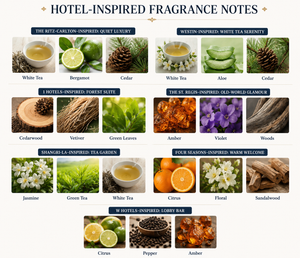
The things I would not buy for a clinic at any price, so the comparison is complete. Not a water tank for public space. The ultrasonic Sukoon at ₹1,899, Boond at ₹899 and Megh at ₹3,499 are water-based, hold standing water and add 30 to 50 ml of water an hour to the air; they need a named person emptying, rinsing and drying the tank every day in a building open twelve hours a day, and they are honest only for a single administrative cabin where one person owns that routine. Not reeds for a waiting hall: an alcohol-free reed diffuser from ₹749 takes twenty-four to seventy-two hours to establish and is barely noticed past about a metre, so it is right for a cabin or a very small lobby and wrong for forty seats — and a glass bottle of oil at reach height in a paediatric waiting area is a spill and ingestion risk before it is anything else. Not candles, in any part of a healthcare building, because an open flame is a fire-safety and insurance matter and I am not going to soften that. And not a room spray, because SOSA does not make one — the sprays in the range are car perfumes. On the fragrance itself, for either machine, take the lightest thing available rather than the most impressive: a white-tea character for reception and corridors, a clean green one where a café corner reaches the seating, and the test to hold it to is that a patient should not be able to tell you what the fragrance is, only that the place did not smell of anything unpleasant. The Hotel Collection bottles are water-based and belong in the ultrasonics; the Vaayu and the Aangan take their own undiluted oil, and the Vaayu ships with four hotel-inspired scents so the first month costs nothing. Free shipping above ₹499.
Four clinics in five should buy the ₹11,999 machine, and I would rather say so than sell the other one. An Aangan in a 2,500 sq ft polyclinic is ₹14,000 of capacity that will never be used, and a machine left on its lowest setting forever is a worse result than a smaller one run properly.
— Sonal Sahani, SOSA
The SOSA edit
The decision as six rows, keyed to the answer your own sum gives rather than to the size of your building on the brochure.
The SOSA edit
Read your two numbers, then read across
| What your sum says |
The machine |
Why |
Cost |
| Under 500 m³ in one volume ★ |
One Vaayu |
A 2,500 to 3,000 sq ft polyclinic after the clinical rooms come out. Comfortably inside the rating, run on low all day |
₹11,999 |
| 500 to 1000 m³ in one volume |
One Vaayu
|
A larger single-floor centre, or a 900 sq ft reception under a 6m ceiling at 502 m³. Still one machine |
₹11,999 |
| Several volumes, each under 1000 m³ |
One Vaayu per volume |
Two floors, or two halls with fire doors between them. A rating is capacity, not delivery. One per floor
|
₹11,999 each |
| Over 1000 m³ in one connected volume |
One Aangan
|
A large integrated centre, an atrium, a concourse. Up to 3,000 m³, 800ml, metal body, programmable, under 42 dB |
₹25,999 |
| A ducted AHU serving public zones and nothing clinical |
One Aangan, tie-in |
The building's own distribution gives an even level across zones no standalone unit reaches. Trace the duct first
|
₹25,999 |
| Not on the list at any price |
Neither |
An Aangan in a 2,500 sq ft polyclinic, a water tank in public clinical space, reeds in a forty-seat hall, or a candle anywhere in a healthcare building |
— |
Honest notes for buyers: on this page specifically, the Aangan at ₹25,999 is the wrong machine for a 2,500 sq ft polyclinic, whose public volume after the clinical rooms come out is commonly about 307 m³, and recommending it there is overselling — the deciding figures are the public volume in cubic metres and the number of separate volumes, not the floor area. In general, fragrance in a medical facility is housekeeping and presentation, never treatment. Nothing here claims that a fragrance reduces anxiety, aids recovery, improves sleep, cleans or disinfects air, or has any clinical effect whatsoever, because it does not and a diffuser is not an air purifier. Scenting belongs to the entrance, reception, shared waiting areas, inter-departmental corridors and administrative rooms. Consultation and examination rooms, treatment and procedure rooms, day-care surgery, dressing rooms, blood- and sample-collection rooms, laboratories, pharmacy dispensing, sterile stores, imaging rooms, oncology day-care and paediatric clinical areas should be left fragrance-free. A persistent smell is information about a dry drain trap, a bin, a soiled-linen route or an air-conditioning drain pan: find it and fix it rather than covering it. On the machines: the
Vaayu at ₹11,999 is waterless cold-air nebulisation with no standing water tank, covering up to 1000m³ or roughly 2,000–3,000 sq ft, with a 400ml tank lasting about 75 days, app control, 1h/4h/8h/24h timers, under-38dB running, auto-stop and a key-lock for public areas. The
Aangan at ₹25,999 covers up to 3,000m³ and connects to HVAC for a whole floor or an atrium. The ultrasonic
Sukoon,
Boond and
Megh are water-based, hold standing water and add 30–50 ml of water an hour to the air, which suits a single administrative cabin with a named person emptying and drying the tank daily and is unsuitable for public clinical property. An alcohol-free
reed diffuser needs 24–72 hours to establish and suits a small lobby rather than a large waiting hall. Candles are not appropriate in a healthcare facility because an open flame is a fire-safety matter. SOSA does not make a room spray. The Hotel Collection scents are SOSA's own interpretations inspired by the world's finest hotels; SOSA is an independent Indian fragrance house, not affiliated with or endorsed by any hotel brand. A portion of every order supports girl-child education through Nanhi Kali.
The machine the sum usually points to
SOSA Vaayu ₹11,999
Up to 1000 m³ or roughly 2,000 to 3,000 sq ft, waterless cold-air nebulisation with no standing water tank, a 400ml fill lasting about seventy-five days, Bluetooth app plus 1h/4h/8h/24h timers, under 38 dB, auto-stop, key-lock, 0.9 kg at 165 × 80.5 × 215 mm, freestanding or wall or HVAC mounted, four hotel-inspired scents included. Four clinics in five are correctly served by this machine, and the ₹14,000 difference between it and the Aangan buys a repaired extract fan, a widened air-conditioning maintenance scope and a year of flat mop heads — all of which do more for how a facility reads to a patient. Public areas only, one low setting, the opening hours.
A note from Sonal
I have had this conversation often enough that I can usually tell within two minutes which machine a clinic needs, and often enough to know that the instinct cuts the other way than people expect. Facility managers do not generally try to underbuy. They try to overbuy, because a bigger number on a specification sheet feels like insurance, and because somewhere along the way a supplier told them that a machine running below its maximum lasts longer. The second part is not how these machines behave: a nebuliser held permanently at the bottom of its range is harder to keep steady than one running comfortably in the middle, and a clinic that has bought three times the capacity it needs ends up chasing a level rather than setting one. So the sentence I say most often on the phone is that the smaller machine is the right machine, which is an odd sentence for somebody selling both of them.
The one building shape that reverses it is height, and it reverses it completely. An architect in Bengaluru pointed out to me, years ago, that a double-height atrium doubles the volume under the footprint — obvious once said, not obvious before — and since then I have been happy to recommend the ₹25,999 machine to clinics of four or five thousand square feet with seven metres over the reception, while telling 10,000 sq ft single-storey centres to buy the ₹11,999 one. Both of those recommendations surprise the person on the other end of the call, and both come from the same ten-minute sum. That is the part I would most like a reader to take away from this page: it is not a question of taste or of how serious your facility is. It is two numbers, a division by 10.76, and a multiplication, and if a supplier names a machine before asking you for those numbers, they are quoting a product rather than advising on a building.
Everything is made and supported from Pune, and a part of every order funds girl-child education through Nanhi Kali. You get a space that smells like somewhere looked after; a girl gets a classroom. That equation has always felt right to me.
Frequently asked questions
Vaayu or Aangan — which suits a multi-speciality clinic?
For almost all of them, the Vaayu at ₹11,999: up to 1000 m³ or roughly 2,000 to 3,000 sq ft, waterless with no standing water tank, 400ml lasting about seventy-five days, app plus 1h/4h/8h/24h timers, under 38 dB, auto-stop and key-lock. The Aangan at ₹25,999 is for one connected public volume above 1000 m³ — up to 3,000 m³, 800ml, metal body, programmable, under 42 dB, HVAC-connected or standalone — which in practice means a large integrated centre, a double-height atrium, a long concourse, or a public-only air-handling unit to tie into.
Is the Aangan worth it for a 2,500 sq ft polyclinic?
No, and recommending it there is overselling. A 2,500 sq ft single-floor polyclinic at 3m has a plan volume of about 697 m³, and once six consultation cabins, a procedure room, a dressing room, a collection room and a small laboratory come out, the public volume is commonly about 307 m³ — under a third of the Vaayu's rating. The Aangan would run on its lowest setting permanently, which is harder to hold steady than a correctly sized machine run normally.
My clinic is 10,000 sq ft. Does that mean I need the Aangan?
Not on floor area alone. Do the sum on public volume only: a 10,000 sq ft centre whose entrance, reception, waiting areas and corridors come to 900 m³ is a Vaayu, because forty to sixty per cent of a medical plan is clinical space that is fragrance-free with its doors shut and therefore not in the sum at all. Ask the second question too: if that volume is split across two floors by a fire door and a stair, it is two Vaayu units rather than one Aangan.
Would two Vaayu units be better than one Aangan?
It depends on whether you have one volume or two. In two separate volumes — two floors, or two halls with fire doors between them — two Vaayu units at ₹23,998 are the correct answer and an Aangan would not reach the second volume anyway. In one connected volume above 1000 m³, two machines on the same schedule give you a strong zone near each unit and a thin middle, with no way to tell which one to turn down, and the single Aangan is simpler and more controllable.
What about the ultrasonic machines, reeds or a room spray?
The ultrasonic Sukoon at ₹1,899, Boond at ₹899 and Megh at ₹3,499 are water-based, hold standing water and add 30 to 50 ml of water an hour to the air, which needs a named person emptying and drying the tank daily — honest for a single administrative cabin, unsuitable for public clinical property. An alcohol-free reed diffuser from ₹749 takes 24 to 72 hours to establish and is barely noticed past about a metre, so it suits a cabin rather than a waiting hall. Candles are not appropriate in a healthcare building, and SOSA does not make a room spray.
Two numbers, then choose
Public volume, and how many volumes — and four clinics in five are the ₹11,999 machine
The Vaayu is ₹11,999: waterless cold-air nebulisation with no standing water tank, up to 1000 m³ or roughly 2,000–3,000 sq ft, a 400ml tank lasting about seventy-five days for four refills a year, Bluetooth app control with 1h/4h/8h/24h timers, under 38 dB, auto-stop and a key-lock, 0.9 kg at 165 × 80.5 × 215 mm, freestanding or wall or HVAC mounted, supplied with four hotel-inspired fragrances. The Aangan is ₹25,999 for one connected volume up to 3,000 m³ — roughly 8,000–10,000 sq ft — HVAC-connected or standalone, 800ml, metal body, programmable, under 42 dB. Free shipping above ₹499, and a portion of every order supports girl-child education through Nanhi Kali.
See the Vaayu · ₹11,999 See the Aangan · ₹25,999
Continue the read
More from SOSA
Editorial standards & sources
Product facts used in this guide. SOSA Vaayu Rs 11,999: waterless cold-air nebulising diffuser, no water reservoir, coverage up to 1000m3 (approximately 2,000-3,000 sq ft), 400ml refillable tank lasting up to about 75 days per fill, Bluetooth app plus onboard control, 1h/4h/8h/24h timer scheduling, adjustable intensity, under 38 dB, DC 12V/1A at 5W, 165 x 80.5 x 215 mm and 0.9 kg, freestanding or wall or HVAC mounted, auto-stop and key-lock, CE, RoHS and SGS certified, supplied with four hotel-inspired fragrances. SOSA Aangan Rs 25,999: HVAC-connected or standalone commercial nebulising diffuser, coverage up to 3,000m3 (roughly 8,000-10,000 sq ft), 800ml reservoir, metal body, programmable schedules, under 42 dB. Ultrasonic machines are water-based, hold standing water and consume 30-50 ml of water an hour: Sukoon Rs 1,899 (500ml, 270-320 sq ft, 16-18 hours on low, three 15ml Hotel Collection scents included), Boond Rs 899 (300ml), Megh Rs 3,499 (6 litres). Hotel Collection water-based fragrance 15ml Rs 299, 100ml Rs 999, 300ml Rs 1,799. Alcohol-free reed diffusers from Rs 749, requiring 24-72 hours to reach their working level. Free shipping above Rs 499. Coverage arithmetic: cubic metres equal floor area in square feet divided by 10.76 and multiplied by ceiling height in metres, counting only the volumes that are actually scented. This guide makes no medical, therapeutic or clinical claim of any kind for fragrance: a diffuser does not purify, disinfect or clean air, and does not treat, calm or affect any patient or condition. Fragrance is housekeeping and presentation. Clinical areas should be left fragrance-free, and a persistent odour should be traced to its source and corrected rather than covered. SOSA is not affiliated with or endorsed by any hotel brand. Prices subject to change - see the live product pages.

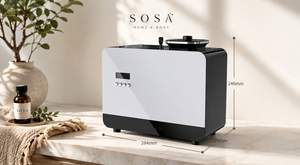
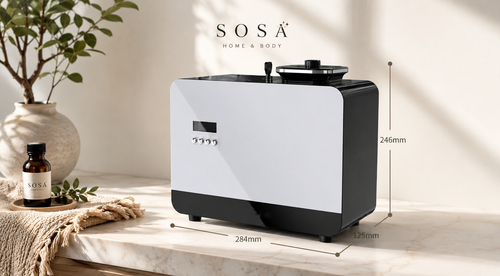 Aangan · up to 3,000 m³₹25,999Shop →
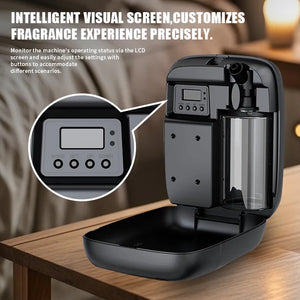
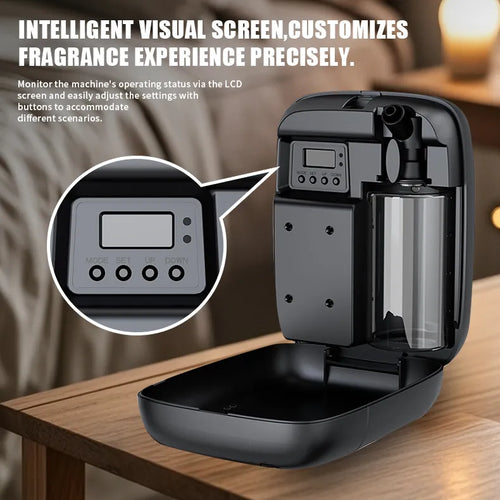 Vaayu · wall or duct₹11,999Shop →